

TL;DR:
- Effective onboarding in Portugal requires pre-arrival compliance measures, cultural integration, and personalized support to foster employee retention. It involves strict legal procedures aligned with the Labor Code, including employment contracts, tax, and social security registrations, completed before the employee’s first day. Utilizing automation tools and local expertise helps streamline this process, ensuring legal compliance and a positive onboarding experience that promotes long-term engagement.
Onboarding a new hire in Portugal is not a form-signing exercise. For international companies, it is a layered process that spans labor law compliance, tax authority registration, cultural integration, and long-term employee experience. Get it wrong, and you risk legal exposure, slow starts, and early attrition. Get it right, and you build a motivated, legally compliant team that sticks around. This article breaks down exactly what HR managers need to know to run a tight, effective onboarding process for new hires in Portugal.
Table of Contents
- What is onboarding? Definitions, misconceptions, and core goals
- Mandatory onboarding compliance steps for Portugal
- Beyond compliance: Integration and ongoing support for international hires
- Tools and workflows for efficient onboarding in Portugal
- What most HR leaders overlook: Onboarding is a strategic advantage
- Connect onboarding strategy to expert HR support in Portugal
- Frequently asked questions
Key Takeaways
| Point | Details |
|---|---|
| Onboarding is strategic | Going beyond paperwork, onboarding supports compliance and employee integration for lasting success. |
| Portugal’s compliance steps | HR must fulfill contract, tax, social security, and payroll requirements aligned with the Código do Trabalho. |
| Integration matters | International hires need cultural, language, and network support to thrive in Portuguese organizations. |
| Automation enhances efficiency | Workflow tools streamline onboarding and improve new hire experience by combining compliance and integration tasks. |
| Avoid common pitfalls | Start onboarding processes early and invest in employee experience—not just legal compliance. |
What is onboarding? Definitions, misconceptions, and core goals
Many HR teams conflate onboarding with orientation. They are not the same thing, and mixing them up creates real problems in international hiring contexts.
Orientation is the event. It is typically a one or two day session where a new employee receives paperwork, a badge, a laptop, and a tour. Onboarding is the process. It is a structured, multi-week or multi-month program designed to bring a new hire to full productivity, role readiness, and organizational fit. As Grove HR notes, orientation is a one-day information event, while onboarding is a structured process that supports role readiness, relationship building, and longer-term integration. That distinction matters enormously when you are hiring across borders.
Here is a quick comparison to make the difference concrete:
| Aspect | Orientation | Onboarding |
|---|---|---|
| Duration | 1 to 2 days | 30 to 90 days or longer |
| Focus | Information delivery | Role readiness and integration |
| Owner | HR admin | HR, manager, and team |
| Output | Completed paperwork | Productive, engaged employee |
| Timing | Day 1 | Starts before Day 1 |
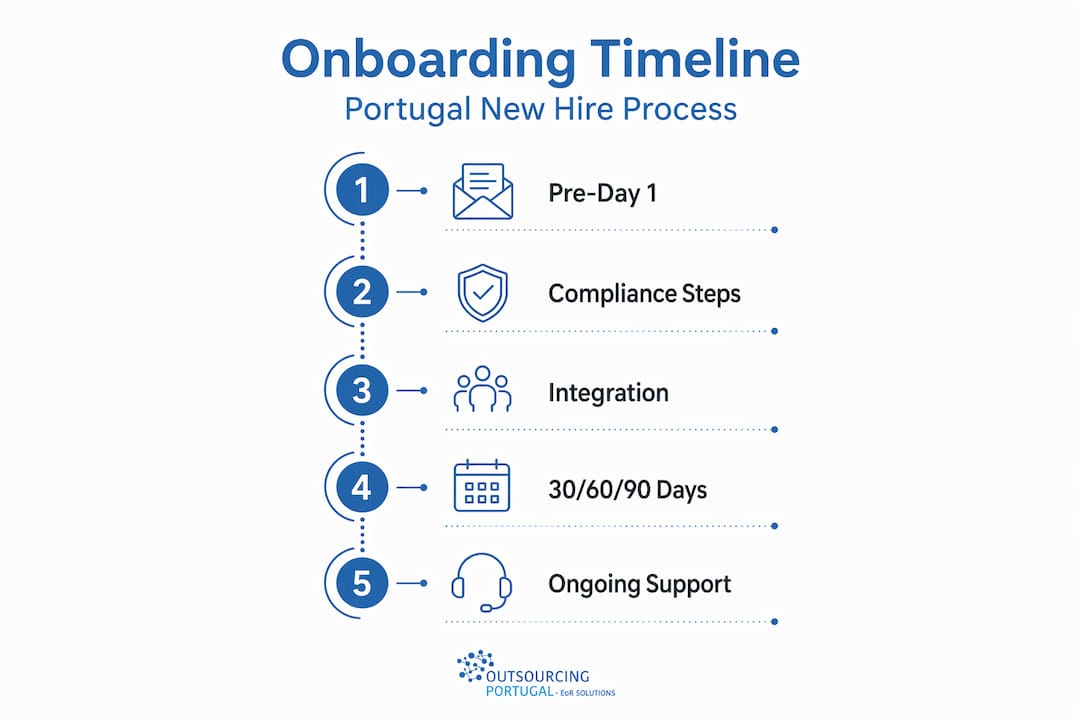
For international hires in Portugal, the table above has one critical implication: onboarding starts before Day 1. Contract drafting, tax identification number (NIF) registration, and social security enrollment all need to happen in the weeks before a hire sets foot in the office or logs into their first virtual meeting.
What HR managers commonly miss is that the pre-arrival phase carries the highest compliance risk. If those steps are incomplete, the employee cannot legally start work, payroll cannot run, and the company may face penalties.
The dual goals of effective onboarding are:
- Compliance: Ensuring all legal, tax, and administrative requirements are met under Portuguese law
- Integration: Ensuring the new hire feels connected, capable, and confident in their role and team
Both goals must be treated with equal seriousness. You can find a detailed breakdown of how these goals play out in a full Portugal onboarding guide that covers the complete process from offer acceptance to role readiness.
“Onboarding that focuses only on paperwork misses the bigger picture: a new hire who is legally set up but feels disconnected will leave within months.”
Mandatory onboarding compliance steps for Portugal
Portugal has a well-defined legal framework for employment. HR managers at international companies need to understand that framework before the first hire starts, not after.
The key piece of legislation is the Código do Trabalho (Labor Code). According to Payoneer’s Portugal hiring guide, HR onboarding must align with the Código do Trabalho and ensure ongoing obligations around employment relationships, with enforcement handled by the labor inspectorate, known as the ACT (Autoridade para as Condições do Trabalho). An audit by the ACT can expose gaps in contracts, registration status, or working-time compliance, all of which carry real financial consequences.
Here is a summary of the mandatory compliance steps:
| Step | Description | Deadline |
|---|---|---|
| Employment contract | Written contract required under Portuguese law | Before Day 1 |
| NIF registration | Tax Identification Number for the employee | Before payroll run |
| NISS registration | Social security number registration | Before Day 1 |
| Tax authority notification | Notify the AT (Tax and Customs Authority) | Within legal deadline |
| Work accident insurance | Mandatory employer-provided coverage | Before Day 1 |
| Payroll setup | Integration with Portuguese payroll obligations | Before first pay date |
As eorHQ explains, international employers must prepare all pre-Day 1 setup items including employment contract terms, tax and social security registrations, and payroll setup so that paperwork does not bottleneck the start date. A delayed registration does not just inconvenience HR. It can push back a hire’s legal start date, delay their first paycheck, and damage trust before the role has even begun.
Here is the numbered compliance sequence HR teams should follow:
- Draft and review the employment contract, ensuring it meets Portuguese Labor Code requirements for job title, salary, working hours, and probation period
- Apply for the employee’s NIF at the local tax authority or through an authorized representative
- Register the employee with the NISS (social security system) before their first working day
- Notify the Tax and Customs Authority of the new employment relationship
- Arrange mandatory work accident insurance coverage through an approved insurer
- Set up payroll to reflect Portuguese obligations including income tax withholding (IRS) and social security contributions
- File required declarations with the relevant public entities within the legally mandated timeframes
Pro Tip: Start contract drafting and registrations immediately after offer acceptance, not after the employee has signed. Any delay in this phase creates a downstream delay across every other compliance step.
For a detailed checklist of the legal requirements, the Portugal hiring compliance page lays out each obligation clearly. You can also cross-reference those steps with the payroll compliance checklist to make sure payroll setup is synchronized with your registrations.
Beyond compliance: Integration and ongoing support for international hires
Compliance keeps you legal. Integration keeps your employees. These two goals are not in competition, but far too many international HR teams treat compliance as the finish line. It is not even close to the finish line.
For international hires relocating to or working remotely from Portugal, integration means much more than a team introduction. It covers four key dimensions:
- Cultural adjustment: Understanding Portuguese workplace norms, communication styles, and professional expectations
- Language support: Providing access to Portuguese language resources even when the working language is English
- Family and relocation support: Helping partners and dependents settle in, which directly affects employee retention
- Network building: Connecting new hires with colleagues, local communities, and professional networks
According to Eres Relocation’s research on Portugal onboarding, core onboarding components for international hires must include both administrative compliance steps and integration support covering culture, language, and network building, because international onboarding gaps often appear before Day 1. That is a striking insight. The most common failure point is not the first week. It is the period between offer acceptance and start date, when an employee has said yes but has not yet received any meaningful support.
“Most international onboarding failures are not caused by bad managers or poor company culture. They are caused by administrative silence in the weeks between offer and start date.”
Practical ways HR teams can support international hires during onboarding include:
- Assigning a designated onboarding buddy or local team contact before Day 1
- Providing a welcome pack with cultural, practical, and logistical information about living and working in Portugal
- Scheduling structured 30, 60, and 90 day check-ins with both HR and the direct manager
- Sharing access to new hire support portals that centralize equipment setup, IT access, and documentation
- Offering referrals for housing, schooling, or healthcare for relocating employees
- Creating a structured peer introduction program within the first two weeks
Pro Tip: Build an onboarding handbook that covers both functional content (role expectations, team structure, tools) and cultural content (company values, communication norms, workplace customs in Portugal). New hires refer to it repeatedly, especially in the first month.
The 30/60/90 day check-in structure deserves special emphasis. The 30-day check-in focuses on early impressions and immediate needs. The 60-day check-in addresses role clarity and team relationships. The 90-day check-in evaluates performance trajectory and ongoing support needs. Each conversation should be documented and tied to a clear action plan. For broader context on creating a supportive HR environment, the Portugal HR best practices guide covers the 2026 compliance landscape in detail.

Tools and workflows for efficient onboarding in Portugal
The manual approach to onboarding breaks down quickly when you are managing multiple hires across different countries, time zones, and legal systems. The right tools do not replace human connection. They remove the friction that prevents it.
Workflow automation is now a core feature of modern HR platforms. A well-implemented onboarding workflow connects the onboarding experience to the hiring system and uses multi-step workflows that trigger automatically after offer acceptance. That means no more manual reminders, no missed registration deadlines, and no new hire waiting three days for laptop access because someone forgot to submit a ticket.
When evaluating onboarding tools for Portugal-based hiring, look for these key features:
- Automated task triggers that activate compliance steps as soon as an offer is accepted
- Document management with electronic signature capability for contracts and policy acknowledgments
- Integration with Portuguese payroll systems to synchronize registrations and payment schedules
- Multi-language support for onboarding portals used by international hires
- Compliance checklists that map to Portuguese legal requirements
- Progress tracking dashboards so HR managers can see exactly where each new hire is in the process
Pro Tip: Do not build your compliance checks separately from your welcome portal. When a new hire logs in to complete their NIF registration or upload identity documents, that same platform should also deliver their welcome video, team introduction, and first-week schedule. One seamless experience is far more effective than two disconnected systems.
Onboarding handbooks are another underused tool. According to Portuguese academic research on HR integration, onboarding handbooks are important tools that facilitate integration and socialization of recruits and can include internal norms, regulations, and cultural and functional content. A well-structured handbook covers company values, role expectations, local workplace norms, key contacts, and practical life-in-Portugal information for relocating employees.
For a complete view of how to structure the hiring and onboarding workflow end-to-end, the hiring in Portugal guide for 2026 is a strong operational reference. You can also explore automation onboarding tips for practical ideas on structuring multi-step workflows.
What most HR leaders overlook: Onboarding is a strategic advantage
Here is the uncomfortable truth that most HR teams do not want to face: compliance-only onboarding is a talent retention risk disguised as a legal victory.
When a company invests heavily in getting the contract right, the NIF registered, and the payroll running on time, and then leaves the new hire to figure out everything else on their own, that employee starts counting the days. Not because the company is bad, but because international relocation or a new remote role in a foreign market is genuinely disorienting. Silence reads as indifference.
Payoneer’s analysis of Portugal HR compliance makes clear that HR must treat onboarding as both an employee experience and a compliance workflow tied to employment contract formation, working-time and leave rules, and payroll, tax, and social security responsibilities. These are not separate tracks. They are two sides of the same onboarding investment.
The companies that use onboarding as a competitive differentiator do not just execute compliance faster. They build belonging faster. They assign mentors. They create genuine feedback loops at 30, 60, and 90 days. They treat the first 90 days as an investment period, not an administrative burden.
For international companies hiring in Portugal, the differentiator is even sharper. Portugal has a deep pool of highly educated, multilingual talent. That talent has options. The onboarding experience a company delivers in weeks one through twelve sends a clear signal about what the next two or three years will look like.
For insight into how EU compliance intersects with Portugal-specific obligations, that broader legal context matters when building a scalable onboarding program across multiple EU markets.
Pro Tip: Invest in both automation and personal connection. Use technology to eliminate friction and ensure nothing falls through the cracks. Use people, specifically managers, buddies, and HR partners, to create the moments of belonging that no software can replicate.
Connect onboarding strategy to expert HR support in Portugal
Getting onboarding right in Portugal requires local expertise, fast compliance execution, and a genuine commitment to the employee experience.
Outsourcing Portugal helps international companies build and onboard teams in Portugal without the complexity of setting up a local entity. From EoR services in Portugal that handle every compliance obligation on your behalf to smart hiring solutions that accelerate time-to-productivity, the platform is designed for HR managers who need results, not headaches. Whether you are hiring your first Portuguese employee or scaling a nearshore team, expert support makes the difference between an onboarding process that works and one that costs you talent.
Frequently asked questions
What is the onboarding process for international hires in Portugal?
Onboarding in Portugal starts with compliance steps before Day 1, including employment contract drafting, NIF and social security registration, and then moves into integration support covering culture, language, and network building, because gaps often appear before the hire even starts.
How long does onboarding usually take for new hires in Portugal?
Onboarding for international hires typically spans 30 to 90 days, with the pre-Day 1 compliance phase taking 5 to 10 business days depending on registration complexity and document availability.
What legal requirements must HR follow when onboarding in Portugal?
HR must align every onboarding step with the Código do Trabalho and complete contract drafting, payroll setup, NIF registration, social security enrollment, and tax authority notifications before the hire’s official start date.
How can HR support international hires beyond paperwork?
HR should provide cultural, language, and network support alongside structured 30/60/90 day check-ins, and use onboarding handbooks to help new hires navigate workplace norms, as integration gaps commonly emerge in the weeks before Day 1.
Can workflow automation improve the onboarding process in Portugal?
Yes. Workflow automation tools connect compliance tasks, document management, and welcome portals into a single multi-step workflow that triggers automatically after offer acceptance, reducing errors and improving the new hire experience.