
TL;DR:
- EU talent ranking refers to multiple indexes and tools that assess workforce quality and labor attractiveness across European countries. These rankings are not official or singular; they serve different purposes and should be layered for effective hiring decisions. Combining macro and occupation-level data with practical validation helps companies build sustainable and cost-effective workforce strategies.
When a hiring director asks “what is EU talent ranking,” they rarely get a straight answer. That’s because no single official EU-wide talent leaderboard exists. The term is shorthand for a collection of respected indexes, digital platforms, and occupation-level tools that measure workforce quality and labor market attractiveness across European countries. Understanding which tool serves which purpose is the difference between a smart hiring decision and a misread spreadsheet.
Key takeaways
| Point | Details |
|---|---|
| No single official ranking | “EU talent ranking” refers to multiple indexes; selecting the right one depends on your hiring intent. |
| GTCI and Where to Hire lead | The Global Talent Competitiveness Index and The Conference Board’s index are the two most widely used frameworks. |
| EU Talent Pool is a platform, not a ranking | It matches non-EU jobseekers to shortage occupations and does not score or rank countries. |
| Cost does not equal competitiveness | Top-ranked countries like Denmark and Switzerland are expensive, proving that talent quality and labor cost move independently. |
| Combine indexes for real decisions | No single ranking captures everything; stack country-level, CHRO-based, and occupation-level data for reliable workforce planning. |
What is EU talent ranking, really?
The phrase “EU talent ranking” is not an official term. It describes a category of measurement, not a specific product. HR professionals and business decision-makers use it to refer to any index or framework that scores European countries on workforce quality, skills availability, labor market conditions, or hiring attractiveness. The GTCI methodology is the most cited macro-level example, but it sits alongside CHRO-based surveys, occupation-gap trackers, and EU regulatory platforms that serve entirely different purposes.
The confusion matters because conflating these tools leads to bad decisions. A company using a macro country competitiveness index to decide which job titles are hard to fill in a specific city is using the wrong instrument. Conversely, relying on an occupation-level gap tool to choose between Ireland and Poland as a nearshore location misses the broader picture. Matching the right framework to the right question is the core skill here.
Major indexes ranking European talent
The Global Talent Competitiveness Index
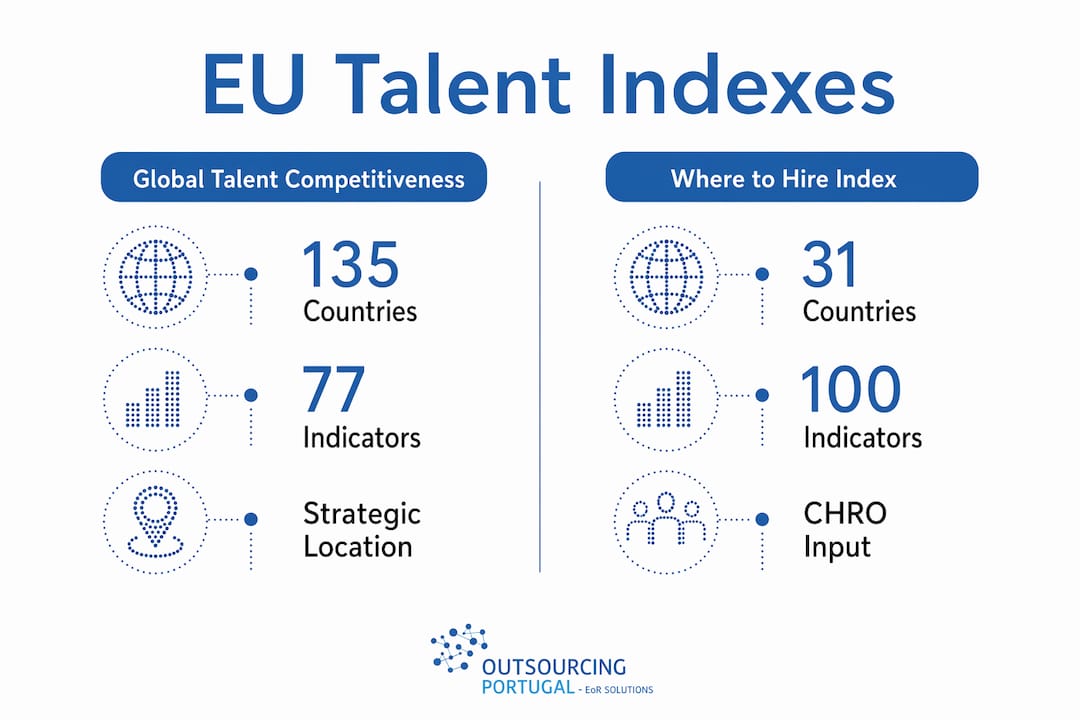
The GTCI is the broadest macro-level tool available. It ranks 135 countries across 77 indicators organized around six dimensions: attract, grow, retain, vocational and technical skills, global knowledge skills, and labor and social protection. For European hiring strategy, the headline finding is striking. Europe dominates the top tier, with 18 of the top 25 countries in the 2025 edition coming from the continent. Switzerland, Denmark, and Finland hold the highest European positions.

The GTCI is built for strategic location decisions. If you are choosing between establishing a tech team in Lisbon versus Warsaw, this index gives you a structured, multi-dimensional comparison. It does not tell you how hard it will be to find a specific software engineer role in either city.
The Conference Board’s Where to Hire Index
This index takes a different approach. Built with direct CHRO input, it ranks 31 European labor markets across 100 indicators covering skills, availability, cost, productivity, and institutional factors. The executives feeding into this index collectively oversee more than 2.15 million workers and nearly €880 billion in annual revenue. Denmark leads, followed by Switzerland and Ireland.
What distinguishes this tool is its focus on sustainable talent strategy. The Where to Hire Index shifts attention from labor cost to skills productivity and culture fit for long-term performance. It integrates business culture and institutional strength, factors that directly affect retention rates and the stability of long-term workforce investments.
| Index | Countries covered | Primary use case | Key differentiator |
|---|---|---|---|
| Global Talent Competitiveness Index | 135 globally | Strategic location selection | 77 indicators, macro workforce health |
| Where to Hire Index | 31 European markets | CHRO hiring strategy | 100 indicators, business culture and retention |
| Cedefop TalentGap Index | EU member states | Role-specific recruitment difficulty | Occupation-level gap scoring |
Pro Tip: Use the GTCI to build your initial country shortlist, then layer the Where to Hire Index to validate which markets offer sustainable hiring conditions before committing to setup costs.
The EU Talent Pool: a platform, not a ranking
A common source of confusion is the EU Talent Pool, which frequently appears in searches alongside talent ranking indexes. They are entirely different things. The EU Talent Pool is an EU-wide matching platform designed to connect third-country residents (people outside the EU) with European employers who have vacancies in shortage occupations.
Key things every employer should know about this platform:
- It does not score or rank countries in any way
- It targets non-EU nationals who want to work within the EU
- It focuses specifically on shortage occupations, not open hiring across all roles
- It excludes traineeships and apprenticeships from its scope
- It does not replace national visa requirements or immigration pathways
The EU Talent Pool is a complementary resource, but it is not a standalone immigration pathway or a general hiring tool for all roles. If you are a UK-based company looking to hire Portuguese engineers through an Employer of Record structure, the EU Talent Pool is not the tool you need. It serves employers with very specific recruitment gaps in regulated shortage categories.
Pro Tip: Before registering on the EU Talent Pool, verify that the roles you are trying to fill appear on your target country’s official shortage occupation list. The platform’s value depends entirely on that alignment.
Occupation-level tools: the Cedefop TalentGap Index
Country rankings tell you where talent is concentrated. They do not tell you how difficult it will be to recruit for a specific role in a specific market. That is where the Cedefop TalentGap Index comes in.
The TalentGap Index scores occupational recruitment difficulty on a scale from 1 to 4 across EU member states. It combines skills shortage data with recruitment difficulty factors including required competency levels, wage pressures, and workforce supply dynamics. A role scoring 4 in Germany signals a severe hiring challenge regardless of Germany’s overall talent competitiveness ranking.
Here is how occupation-level data complements country-level indexes:
- A country may rank highly in macro talent competitiveness yet show extreme shortages in specific technical roles
- TalentGap data helps HR teams set realistic timelines and budget expectations for specific hires
- It informs “build vs. buy” decisions by showing where training pipelines exist versus where external sourcing is the only option
- When combined with the GTCI, it allows teams to identify countries with both strong talent ecosystems and lower role-specific recruitment pressure
Pro Tip: Cross-reference TalentGap scores with salary benchmarks for your target role before finalizing a hiring location. A country with a score of 3 for software developers plus high wage inflation may cost more than a top-tier GTCI country where that role is readily available.
Portugal offers a useful real-world example. Its workforce ranked 23rd globally in 2026, and TalentGap data for mid-level tech and customer support roles sits notably lower than in Northern European markets, reflecting a more accessible hiring environment for those specific functions.
Applying rankings to real workforce decisions
Reading rankings is easy. Applying them is where most companies stumble. HR professionals and workforce strategy teams that use these indexes well follow a structured decision process rather than scanning headlines.
Here is a practical framework:
-
Define your hiring intent first. Are you choosing a new country to establish a team? Or are you solving a specific role shortage? These questions require different tools. Country selection needs the GTCI or Where to Hire Index. Role-specific planning needs TalentGap data.
-
Layer your data sources. No single ranking captures everything. Decision-makers who conflate macro country indexes with role-level gap indicators make poorly calibrated hiring forecasts. Use at least two complementary data sources for any significant location decision.
-
Factor in institutional and cultural fit. The Where to Hire Index explicitly includes business culture and institutional strength because these factors predict retention and long-term workforce stability. A team hired in a market with low institutional trust may be cheaper initially and far more expensive over three years.
-
Avoid the cost trap. Top-ranked European countries like Denmark and Switzerland are also among the most expensive. Cost and competitiveness do not move together. Chasing the cheapest labor market almost always trades short-term savings for long-term capability gaps.
-
Validate with operational data. Rankings are strategic directional tools. Before committing to a location, validate index signals with actual recruiter feedback, local salary surveys, and time-to-hire data for your specific roles.
Pro Tip: Build a simple scoring matrix that maps each index dimension (skills, cost, productivity, institutions) to your organization’s specific hiring priorities. Weight the dimensions by importance and score your candidate countries. This turns abstract index data into a defensible, auditable decision.
Trends reshaping European talent competitiveness
The rankings above reflect today’s snapshot. Several structural forces are already reshaping what those numbers will look like in five years.
The most significant challenge sits in Europe’s largest economies. Germany, France, Italy, and Spain all rank lower in the Where to Hire Index than their size and economic weight might suggest. Aging workforces, productivity plateaus, and institutional rigidities are eroding their talent competitiveness relative to smaller Nordic and Western European nations.
Digitalization and the AI transition are amplifying existing gaps rather than closing them. Countries with strong STEM pipelines and flexible labor markets are pulling ahead. Those with slower education system adaptation are falling behind faster than macro rankings yet show. The green transition adds another layer of occupational disruption, creating new shortage categories in energy, construction, and manufacturing across nearly every EU member state.
Two underappreciated factors deserve attention:
- English proficiency increasingly functions as a proxy for international workforce integration. Portugal’s performance here is a genuine competitive differentiator for companies building multilingual teams.
- Smaller, agile economies consistently outperform larger ones in CHRO-based indexes because institutional flexibility allows faster labor market adjustment than reform-heavy large economies can manage.
My honest take on using these rankings
I’ve spent years watching companies make expensive location decisions based on a single index score pulled from a conference slide. Rankings are genuinely useful. They are also genuinely easy to misread.
What I’ve found consistently is that the companies that use these frameworks best treat them as hypotheses, not answers. They look at a high GTCI score for a country and ask: “What specifically makes this country competitive, and does that map to what we actually need?” A country that scores well on attracting global knowledge workers may still be a poor fit for a company building a customer support function that needs native language speakers.
The cost trap is real and underappreciated. I’ve seen well-resourced hiring teams anchor on low labor cost in a market that ranked poorly on institutional factors, then spend two years rebuilding the team after retention collapsed. Balancing skills, productivity, and culture is not a soft consideration. It is the primary driver of hiring ROI over a three-year horizon.
The most honest advice I can offer: use rankings to structure your thinking and shortlist markets. Then go validate. Talk to people who have hired there. Check the EU outsourcing strategies used by companies already operating in your target market. The data tells you where to look. Real experience tells you what you will find.
— Paulo
Put these rankings to work with Outsourcing-portugal

Understanding EU talent rankings is the analytical foundation. Executing on them requires local infrastructure. Outsourcing-portugal helps international companies turn ranking insights into actual hires in Portugal, one of Europe’s most consistently well-ranked talent markets for tech, multilingual support, and professional services. Through EOR and payroll services built specifically for foreign employers, you can hire compliantly in Portugal without setting up a local entity, managing local labor law, or navigating payroll complexity from scratch. Whether you are validating a new market or scaling an existing team, the hiring guide for HR managers is a practical starting point. Contact Outsourcing-portugal to build a workforce strategy grounded in data and backed by local expertise.
FAQ
What does “EU talent ranking” actually mean?
The term refers to multiple indexes and tools that measure talent quality and labor market attractiveness across European countries, not a single official EU list. The most widely used examples are the Global Talent Competitiveness Index and The Conference Board’s Where to Hire Index.
Which European countries rank highest for talent competitiveness?
Switzerland, Denmark, Finland, and Ireland consistently lead major European talent competitiveness indexes. Denmark tops The Conference Board’s Where to Hire Index for 2026, while Switzerland and Finland rank at the top of the GTCI for European markets.
Is the EU Talent Pool the same as an EU talent ranking?
No. The EU Talent Pool is a digital matching platform connecting non-EU jobseekers with employers hiring for shortage occupations. It does not rank countries or measure talent competitiveness in any way.
How should HR teams use talent ranking data in hiring decisions?
Use country-level indexes like the GTCI to shortlist locations, then layer CHRO-based indexes for retention and culture fit, and add occupation-level TalentGap scores for role-specific hiring difficulty. Validate all index signals with local recruiter data before committing to a market.
Does a high talent ranking mean lower hiring costs?
No. The top-ranked EU countries are often among the most expensive labor markets in Europe. Denmark and Switzerland are prime examples, where high talent competitiveness coincides with high salary expectations.