

Affirmative action refers to policies and programs designed to remedy past or ongoing discrimination by actively expanding opportunities for underrepresented groups. The most recognizable examples include race as a factor in holistic college admissions, federal contractor Affirmative Action Plans (AAPs) with numerical placement goals, targeted recruitment advertising aimed at minority candidates, minority-focused scholarships, apprenticeship pipeline programs, and government procurement set-asides for minority- and women-owned businesses.
Here is a quick snapshot of what these programs look like in practice:
- College admissions factor: A university considers race as one element among many in a holistic review (lawful under Grutter v. Bollinger, 2003; significantly curtailed by Students for Fair Admissions, 2023).
- Federal contractor AAP: A defense contractor with 50 or more employees and a federal contract of a value meeting the OFCCP threshold prepares a written plan with utilization analysis and placement goals.
- Targeted recruitment: An employer posts job openings in publications and on platforms that reach underrepresented communities, or partners with HBCUs for campus recruiting.
- Minority scholarships: A university or foundation funds scholarships specifically for first-generation or minority students to close the enrollment gap.
- Apprenticeship pipelines: A construction union runs a pre-apprenticeship program in underserved neighborhoods to build a more diverse skilled-trades pipeline.
- Procurement set-asides: A city government reserves a percentage of contracts for certified minority- and women-owned business enterprises (MWBEs).
Lawful affirmative action uses time-limited, evidence-based goals rather than rigid quotas, and its purpose is always remedial: to correct a documented imbalance, not to guarantee outcomes for any group.
Key Takeaways
Affirmative action programs are lawful when they are grounded in documented underrepresentation, use time-limited goals rather than rigid quotas, and focus on expanding opportunity rather than guaranteeing outcomes.
| Point | Details |
|---|---|
| Goals, not quotas | OFCCP explicitly prohibits quotas; placement goals are aspirational targets tied to workforce availability data. |
| Mandatory vs. voluntary | Federal contractors with 50+ employees and $50,000+ contracts must maintain written AAPs; all other employers may adopt voluntary DEI programs under Title VII. |
| 2023 legal shift | Students for Fair Admissions ended race-conscious college admissions at federally funded institutions, pushing institutions toward race-neutral alternatives. |
| Core program elements | A lawful AAP includes workforce analysis, availability data, placement goals, outreach activities, and annual monitoring. |
| Enforcement bodies | OFCCP enforces contractor obligations; EEOC enforces Title VII for all covered employers. |
This article is general information, not a substitute for advice from a qualified lawyer. Consult a qualified legal professional about your own circumstances before acting on anything here.
Table of Contents
- What affirmative action means in the U.S. and why it exists
- 12 concrete examples of affirmative action programs by sector
- U.S. laws, agencies, and landmark cases that shape affirmative action
- How affirmative action plans actually work inside organizations
- Benefits and criticisms: what the evidence actually shows
- Named programs and cases worth knowing
- What to watch as affirmative action law continues to shift
- Outsourcing-portugal’s perspective on compliance-first HR design
- An editorial perspective on what affirmative action debates usually miss
- Sources
What affirmative action means in the U.S. and why it exists
Affirmative action, as defined by Cornell Law School’s Legal Information Institute, refers to procedures designed to eliminate unlawful discrimination, remedy the effects of past discrimination, and prevent future discrimination. The phrase entered federal policy vocabulary on March 6, 1961, when President John F. Kennedy signed Executive Order 10925, which required federal contractors to take “affirmative action” to ensure applicants and employees were treated without regard to race, creed, color, or national origin.
President Lyndon B. Johnson expanded that mandate with Executive Order 11246 in 1965, which required federal contractors to take affirmative action in hiring and promotion. The same year, Title VII of the Civil Rights Act of 1964 had already prohibited employment discrimination by private employers, establishing the Equal Employment Opportunity Commission (EEOC) as the enforcement body. The Office of Federal Contract Compliance Programs (OFCCP), housed within the Department of Labor, was later designated to enforce contractor obligations specifically.
The EEOC’s guidance states that a valid affirmative action program must be a “concerted, reasoned program” — not a series of isolated preferences — and should remain in effect only as long as necessary to achieve its defined objectives.
Two additional statutes extended affirmative action obligations to specific populations: Section 503 of the Rehabilitation Act (1973) requires federal contractors to take affirmative action for qualified individuals with disabilities, and the Vietnam Era Veterans’ Readjustment Assistance Act (VEVRAA) requires affirmative action for covered veterans.
Key timeline at a glance:
| Year | Milestone |
|---|---|
| 1961 | Executive Order 10925 — Kennedy introduces the phrase “affirmative action” |
| 1964 | Title VII and Executive Order 11246 establish the modern legal framework |
| 1978 | Regents of UC v. Bakke — rigid racial quotas in admissions struck down |
| 2003 | Grutter/Gratz v. Bollinger — holistic race-conscious admissions permitted; point systems struck down |
| — | Fisher v. University of Texas — race-conscious admissions must survive strict scrutiny |
| 2023 | Students for Fair Admissions v. Harvard — race-conscious college admissions effectively ended |
12 concrete examples of affirmative action programs by sector
Education
1. Race as a holistic admissions factor
Before the Supreme Court’s 2023 ruling in Students for Fair Admissions v. Harvard, hundreds of selective universities considered an applicant’s race as one factor in a holistic review. The legal basis was Grutter v. Bollinger (2003), which held that the educational benefits of diversity constituted a compelling state interest. The 2023 decision ended that practice at colleges receiving federal funding, pushing institutions toward race-neutral alternatives.
2. Top-percent automatic admission rules
Texas responded to earlier legal pressure by guaranteeing admission to the University of Texas at Austin for any student graduating in the top 10 percent of their Texas high school class. Because Texas high schools remain residentially segregated, the rule produces demographic diversity without explicit race-consciousness. Several other states have adopted similar percentage plans.
3. Targeted outreach and pipeline programs
Universities partner with high schools in underserved communities, running summer bridge programs, campus visits, and college-prep workshops aimed at first-generation and minority students. These programs do not alter admissions standards; they expand the pool of qualified applicants who apply.
Employment
4. Federal contractor Affirmative Action Plans (AAPs)
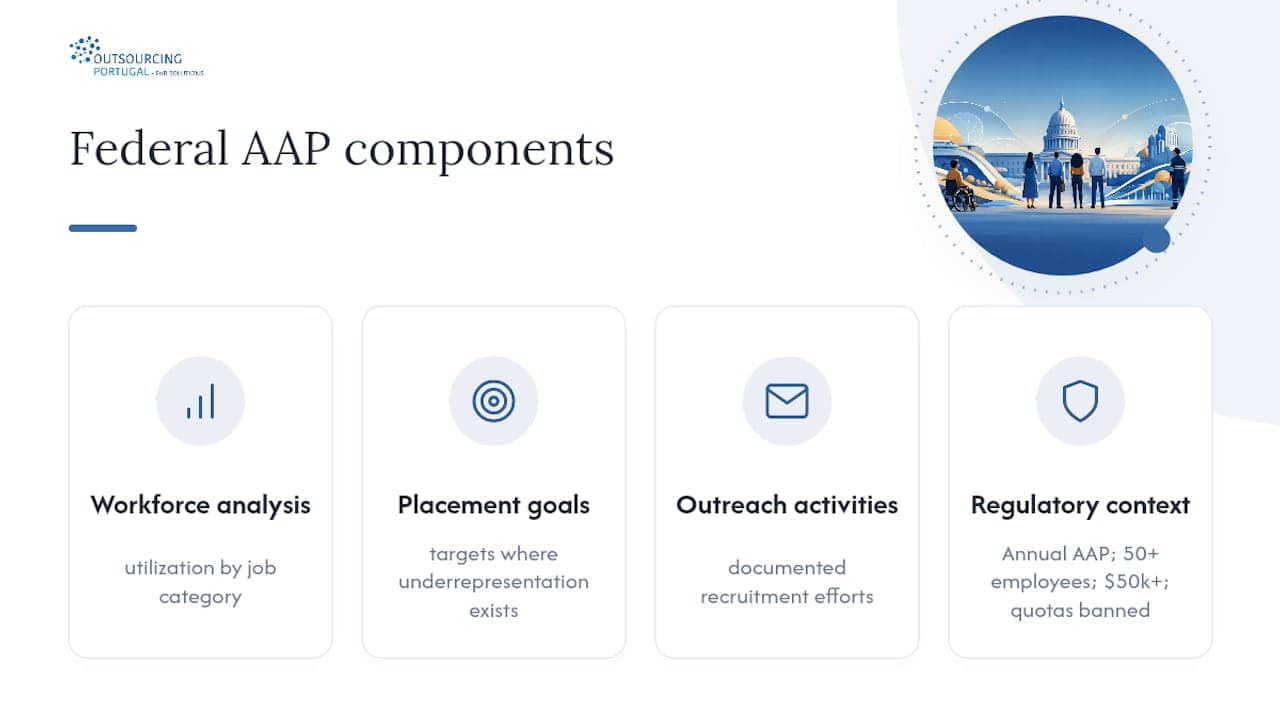
This is the most formalized example of affirmative action in employment. Under OFCCP regulations, covered federal contractors with 50 or more employees and a contract of $50,000 or more must prepare a written AAP annually. The plan includes a workforce utilization analysis, placement goals where underrepresentation is identified, and documented outreach activities. OFCCP explicitly prohibits quotas; the goals are targets, not guarantees.
5. Targeted recruitment advertising
An employer identifies underrepresentation in a job category and then places job postings in outlets that reach underrepresented candidates: historically Black colleges and universities (HBCUs), Hispanic-serving institutions, veteran employment networks, or disability-focused job boards. The Uniform Guidelines under 29 CFR Part 1608 list targeted recruitment as a recognized example of reasonable affirmative action.
6. Internship and apprenticeship pipeline programs
A manufacturing company or construction union creates a pre-apprenticeship program in neighborhoods with high concentrations of underrepresented workers, providing skills training, mentorship, and a direct path to union membership or full-time employment. The program does not reserve seats exclusively; it removes barriers to entry for candidates who might otherwise never apply.

7. Diverse candidate slates (the “Rooney Rule” model)
Some employers require that at least one underrepresented candidate be interviewed for every senior role before a hire is made. Originally adopted by the NFL in 2003 for head-coaching positions, the practice has spread to corporate hiring. It does not mandate a particular outcome; it mandates that the pipeline is genuinely open.
Government contracting and procurement
8. Minority- and women-owned business set-asides
Federal, state, and local governments reserve a portion of contracts for certified minority-owned, women-owned, or disadvantaged business enterprises (DBEs). The federal Small Business Administration’s 8(a) Business Development Program is the most prominent example: eligible small businesses owned by socially and economically disadvantaged individuals can receive sole-source contracts and competitive set-asides. Goals, not quotas, govern these programs.
9. Supplier diversity programs
Large corporations and government agencies set aspirational spending targets with diverse suppliers. A company might aim to direct a defined share of its annual procurement budget to certified minority- and women-owned vendors, tracking progress annually and publishing results. These are voluntary corporate commitments, not legally mandated quotas.
Corporate programs
10. Leadership development for underrepresented groups
Companies run targeted mentorship, sponsorship, and leadership-development programs for employees from underrepresented groups. These programs do not guarantee promotion; they address the structural barriers (lack of sponsors, limited visibility) that often explain why underrepresented employees plateau below senior levels. A multilingual and diverse workforce also tends to improve business outcomes in global markets.
Scholarships and pipeline programs
11. Minority-focused and first-generation scholarships
Foundations, universities, and corporations fund scholarships restricted to students from specific racial, ethnic, or socioeconomic backgrounds. The United Negro College Fund (UNCF) is one of the most recognized examples in the U.S., providing financial support to students attending historically Black colleges and universities. These programs are generally lawful because they do not exclude anyone from a public institution; they direct private or institutional funds toward a targeted population.
Court-ordered remedies
12. Consent decrees and court-ordered AAPs
When a court finds that an employer has engaged in systemic discrimination, it may order a consent decree requiring the employer to adopt an affirmative action plan with specific numerical goals, timetables, and monitoring requirements. The CRS legal overview notes that cases like Weber (1979) and Wygant (1986) drew important lines between permissible remedial programs and impermissible preferences that harm non-minority workers. Court-ordered plans are the most prescriptive form of affirmative action and typically include a defined end date tied to achieving the remedial goal.
Sector summary:
| Sector | Example | Legal anchor |
|---|---|---|
| Higher education | Holistic race factor (pre-2023) | Grutter v. Bollinger (2003) |
| Higher education | Top-percent automatic admission | State law |
| Federal employment | Written AAP with placement goals | EO 11246, OFCCP regulations |
| Employment (all) | Targeted recruitment advertising | 29 CFR Part 1608 |
| Employment | Apprenticeship pipeline programs | Title VII, OFCCP guidance |
| Employment | Diverse candidate slate requirements | Voluntary / corporate policy |
| Government contracting | SBA 8(a) set-asides | Small Business Act |
| Corporate | Supplier diversity spending goals | Voluntary |
| Scholarships | UNCF and minority scholarships | Private/institutional |
| Court-ordered | Consent decree with timetables | Federal court order |
U.S. laws, agencies, and landmark cases that shape affirmative action
The statutory and regulatory framework
Title VII of the Civil Rights Act of 1964 prohibits employment discrimination based on race, color, religion, sex, or national origin. It applies to employers with 15 or more employees and is enforced by the EEOC. Title VII does not require affirmative action, but it permits voluntary programs designed to correct manifest imbalances in traditionally segregated job categories.
Executive Order 11246 (1965) goes further for federal contractors: it requires them to take affirmative action, not merely refrain from discrimination. The OFCCP enforces this order and conducts compliance reviews of contractor AAPs.
Section 503 of the Rehabilitation Act (1973) and VEVRAA extend affirmative action obligations to individuals with disabilities and covered veterans, respectively. Both statutes are also enforced by the OFCCP.
The EEOC’s guidance on affirmative action clarifies that a valid program must be a concerted, reasoned effort — not a series of ad hoc preferences — and should remain in effect only as long as necessary to meet its defined objectives.
Landmark Supreme Court cases
Goals vs. quotas: the critical legal line
The OFCCP’s regulations and the Uniform Guidelines under 29 CFR Part 1608 draw a hard line between placement goals and quotas. A goal is an aspirational target derived from a workforce availability analysis; missing a goal does not automatically trigger liability as long as the employer made good-faith efforts. A quota is a rigid numerical requirement that must be met regardless of the qualified applicant pool — and quotas are prohibited.
Pro Tip: Federal contractors should document every good-faith effort made toward placement goals — outreach contacts, partnership agreements with HBCUs or veteran organizations, and recruitment advertising records — because OFCCP compliance reviews examine the effort, not just the outcome.
How affirmative action plans actually work inside organizations
An Affirmative Action Plan is not a diversity wish list. It is a structured diagnostic and action document. For federal contractors, the OFCCP requires the following components:
- Organizational profile: A workforce display showing the demographic composition of each job group.
- Job group analysis: Grouping of job titles with similar content, wage rates, and opportunities.
- Availability analysis: An estimate of the percentage of qualified minorities and women available for each job group, drawn from census data and the relevant labor market.
- Utilization analysis: A comparison of current workforce composition against availability figures to identify underrepresentation.
- Placement goals: Where underrepresentation is found, the contractor sets a numerical goal equal to the availability figure. The goal is a target, not a floor or ceiling.
- Action-oriented programs: Specific steps the contractor will take to reach its goals — targeted recruitment, training, mentorship, or revised selection criteria.
- Internal audit and reporting: A monitoring system to measure progress and adjust programs annually.
Federal contractors meeting the 50-employee and $50,000-contract thresholds are legally required to maintain written AAPs. All other employers remain subject to Title VII and may adopt voluntary DEI programs, but those programs carry different legal obligations and no mandatory documentation requirements. The Department of Labor notes that voluntary programs should be carefully designed to avoid creating new discriminatory outcomes.
After Students for Fair Admissions (2023), many organizations have pivoted toward race-neutral strategies: socioeconomic-based outreach, first-generation student programs, and neighborhood-based recruitment that achieve demographic diversity without explicit race-consciousness.
Pro Tip: When designing a voluntary DEI initiative, document the specific imbalance you are addressing, set a time-limited objective, and avoid automatic or mechanical selection rules. A reasoned, evidence-based program is far more defensible than a standing preference with no defined endpoint.
Benefits and criticisms: what the evidence actually shows
What proponents cite
Affirmative action programs have produced measurable gains in representation at selective universities and in professional occupations where underrepresentation was historically severe. Policy analysts and researchers note a worldwide shift toward “soft” measures — outreach, pipeline-building, and ensuring diverse applicant pools — rather than rigid quotas, and this approach tends to improve representation while reducing legal exposure. Proponents also point to the pipeline effect: when underrepresented students gain access to elite institutions, they are more likely to enter high-status professions, creating role models and networks that compound over time.
Workforce diversity also carries business benefits. Research on multilingual and diverse teams consistently finds broader problem-solving capacity and stronger performance in international markets.
Common criticisms
Critics raise several objections, and some carry genuine empirical weight:
- Reverse discrimination claims: Opponents argue that race-conscious programs disadvantage non-minority applicants who bear no personal responsibility for historical discrimination. Wygant (1986) and Gratz (2003) both reflect judicial concern about this.
- Mismatch theory: Some researchers argue that placing students in institutions where their academic preparation is significantly below the median harms rather than helps them, though this theory remains contested in the literature.
- Political and legal backlash: California’s Proposition 209 (1996) banned affirmative action in state government, public employment, and public education. Several other states followed. After Students for Fair Admissions (2023), race-conscious admissions are effectively prohibited at federally funded institutions nationwide.
- Stigma concerns: Some critics argue that affirmative action programs can attach a stigma to beneficiaries, undermining the very confidence and credibility they are meant to build.
The honest summary: affirmative action has demonstrably increased representation in targeted sectors, but the legal and political environment has narrowed the permissible tools significantly, especially after 2023.
Named programs and cases worth knowing
These are the real-world examples most likely to appear in news coverage or policy debates:
-
Philadelphia Plan (1969): One of the earliest federal contractor affirmative action programs, requiring construction contractors on federally funded projects in Philadelphia to set goals for hiring minority workers in skilled trades. It became the model for later OFCCP regulations.
-
United Steelworkers v. Weber (1979): Kaiser Aluminum and the United Steelworkers union voluntarily created a training program reserving half its slots for Black workers to address severe underrepresentation in skilled craft jobs. The Supreme Court upheld it as a lawful voluntary affirmative action program under Title VII.
-
Regents of UC v. Bakke (1978): UC Davis Medical School reserved 16 of 100 seats for minority applicants. Allan Bakke, a white applicant who was rejected, sued. The Court struck down the rigid quota but allowed race to be considered as one factor in a holistic review.
-
University of Michigan cases — Gratz and Grutter (2003): The undergraduate admissions system automatically awarded 20 points to minority applicants on a 150-point scale (struck down in Gratz). The law school used a holistic, individualized review that considered race as one factor (upheld in Grutter). The contrast between these two decisions is the clearest illustration of the goals-not-quotas principle.
-
Students for Fair Admissions v. Harvard (2023): The Supreme Court held that Harvard’s and UNC’s race-conscious admissions programs violated the Equal Protection Clause. The ruling effectively ended race-conscious admissions at all colleges and universities receiving federal funding.
-
California’s Proposition 209 (1996): Amended the California Constitution to prohibit public institutions from discriminating against or granting preferential treatment to individuals based on race, sex, color, ethnicity, or national origin. Studies following its passage found declines in minority enrollment at UC Berkeley and UCLA, though overall UC system enrollment of underrepresented minorities eventually recovered through race-neutral outreach.
After Proposition 209 passed in California, UC Berkeley saw a significant drop in Black and Hispanic enrollment in the years immediately following — a pattern that illustrated both the impact of race-conscious admissions and the difficulty of replacing them with race-neutral alternatives quickly.
International comparisons (for context): Several countries use affirmative action frameworks with different designs. South Africa’s Employment Equity Act requires designated employers to develop equity plans with numerical targets for previously disadvantaged groups. India’s reservation system sets aside a fixed percentage of government jobs and university seats for Scheduled Castes, Scheduled Tribes, and Other Backward Classes — a constitutionally embedded quota system that goes further than U.S. law permits. Malaysia’s New Economic Policy (NEP) established preferential policies for the Bumiputera majority as a poverty-reduction and wealth-redistribution measure. These are comparative examples; U.S. law prohibits the rigid quota structures that some of these systems use.
What to watch as affirmative action law continues to shift
Affirmative action in the U.S. is not a static policy. It is a legal framework that has been continuously reshaped by courts, executive orders, and state referendums. The core principle has remained consistent since Bakke (1978): remedial, time-limited, goal-oriented programs that treat individuals as individuals are generally permissible; rigid quotas and automatic preferences are not.
The post-2023 environment demands attention to three developments. First, Students for Fair Admissions has pushed higher education toward race-neutral alternatives, and the long-term diversity outcomes of those alternatives are still being measured. Second, state-level bans now cover a significant share of public university enrollment, and their effects on professional-pipeline diversity are an active area of policy research. Third, the OFCCP continues to enforce contractor AAP obligations, but the political environment around those requirements has fluctuated with each administration.
The safest affirmative action programs share three features: they are grounded in documented evidence of underrepresentation, they set time-limited goals rather than permanent preferences, and they rely on outreach and opportunity-expansion rather than automatic selection rules.
For primary-source language on any of these programs, consult the OFCCP’s published guidance, the EEOC’s enforcement manual, and the text of the relevant court opinions directly. Policy summaries are useful starting points, but the authoritative language is always in the original documents.
Outsourcing-portugal’s perspective on compliance-first HR design
HR teams navigating affirmative action obligations — or designing voluntary diversity initiatives — face a common trap: confusing aspiration with documentation. A program that exists only in a slide deck is not a program; it is a liability. The practical steps that actually hold up are straightforward. Conduct a genuine workforce analysis before setting any goal. Tie every initiative to a specific, measurable imbalance. Set a defined review date. And build your outreach activities around expanding the qualified applicant pool rather than adjusting selection outcomes.
For organizations hiring across borders, the compliance picture gets more complex. Different jurisdictions impose different obligations, and what is required of a federal contractor in the U.S. is not the same as what is expected of an employer in Portugal or elsewhere in the EU. Outsourcing-portugal’s Employer of Record services are built around exactly this kind of jurisdictional compliance: ensuring that hiring, onboarding, and HR practices meet local legal requirements without exposing the client to regulatory risk. If you are building international teams and want the compliance architecture handled correctly from day one, that is the right starting point.
For a practical framework on equal-opportunity employer obligations, the equal opportunity employer guide from Workit is worth reviewing alongside OFCCP and EEOC primary sources.
Pro Tip: Document not just what your program does, but why it exists: cite the specific workforce data that identified the imbalance, the outreach steps taken, and the review schedule. That paper trail is what distinguishes a defensible affirmative action program from an ad hoc preference.
An editorial perspective on what affirmative action debates usually miss
The public debate about affirmative action tends to collapse into two positions: it is either a necessary remedy for structural inequality or an unfair preference that undermines merit. Both framings miss something important.
The most durable affirmative action programs — the ones that have survived legal challenge and produced lasting change — were never really about preferences. They were about diagnostics. A well-designed AAP forces an organization to ask a genuinely uncomfortable question: if qualified candidates from underrepresented groups exist in the labor market, why are they not showing up in our applicant pool? The answer is almost never “they don’t want to work here.” It is usually a combination of where the organization recruits, who does the recruiting, and what the informal networks look like.
The shift toward race-neutral alternatives after Students for Fair Admissions is not the end of affirmative action thinking. It is a forced upgrade. Organizations that relied on race as a shortcut to diversity now have to do the harder work: fixing the pipeline, broadening outreach, and removing the structural friction that kept underrepresented candidates from ever applying. That is more work. It is also more durable.
The critics who argue that any consideration of group identity is inherently unfair are making a philosophical point that the law has never fully accepted, and probably never will. Remedying documented, systemic exclusion requires some awareness of the groups that were excluded. The legal question has always been about method, not motive.
Sources
Primary documents and authoritative references for affirmative action law and practice in the U.S.:
- affirmative action | Wex | US Law | LII / Legal Information Institute
- 29 CFR part 1608 — Context material on affirmative action (Uniform Guidelines excerpt) — govinfo
- Affirmative Action in Employment: A Legal Overview — Congressional Research Service