

If you employ people in Portugal, you cannot treat expenses as a favour. The Labour Code requires you to cover the extra costs of telework and the costs of travelling on the company’s business, and the Tax Authority sets limits above which a reimbursement stops being tax-free and becomes taxable salary. Getting the paperwork and the payroll coding right is what keeps a reimbursement non-taxable.
This guide is written for HR managers, founders and CFOs in the UK, the EU and the US who are hiring in Portugal, often without a local company. It covers what you must reimburse, the 2025 and 2026 limits we can source, how to document claims, and how to run it through payroll.
TL;DR
- Employers must compensate all additional expenses that result directly from telework, and must cover verified business-travel costs. The Labour Code does not allow the employee to bear them.
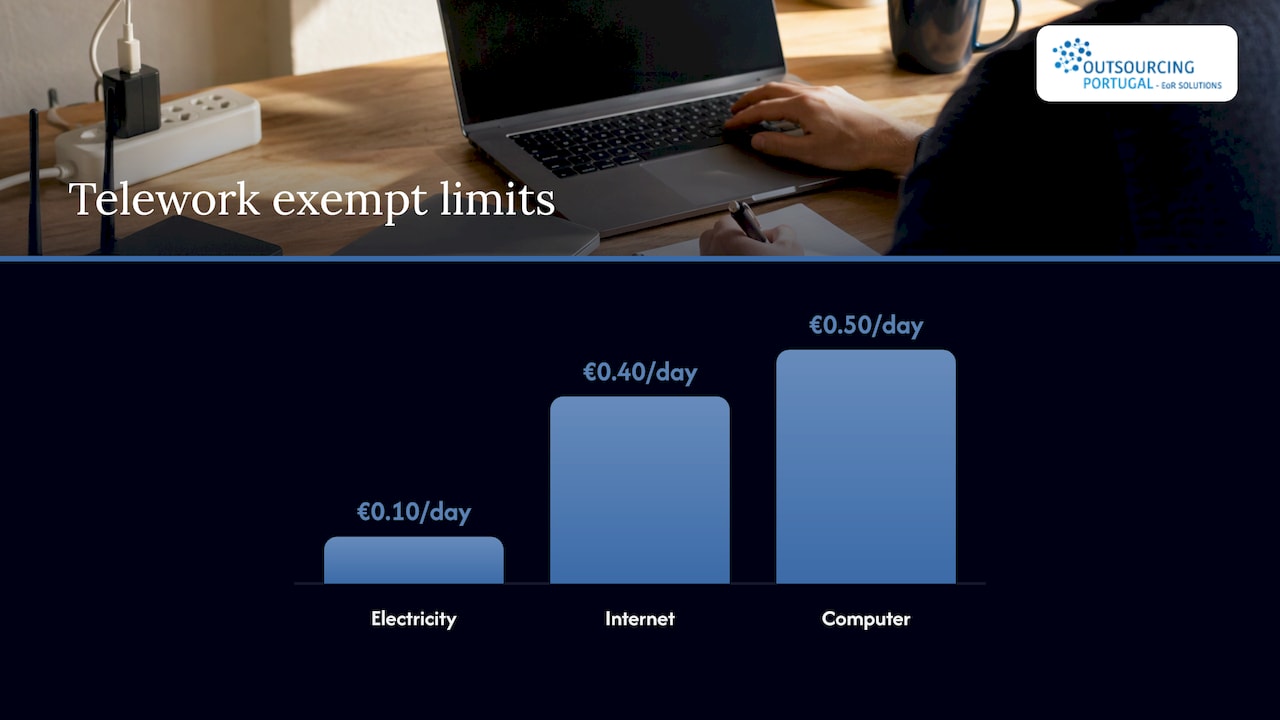
- Tax- and social-security-exempt telework limits under Portaria 292-A/2023 are €0.10 a day for electricity, €0.40 for internet and €0.50 for equipment, on full remote days under a written agreement.
- The OCC guide lists fiscal daily allowance limits of €65.89 in Portugal and €148.91 abroad, and €0.40 per km for a personal car.
- Amounts above the limits, or without the supporting documents, are taxed as employment income (Category A).
- As a Lisbon-based Employer of Record, we run this through payroll for foreign companies that have no Portuguese entity.
Table of Contents
- What Portuguese law requires you to reimburse
- Telework expenses: the rules in practice
- Business travel: per diems and mileage
- Are reimbursements taxable?
- What records to keep
- A policy that works for a foreign company
- Running expenses through an Employer of Record
- Our perspective
- FAQ
- Sources
What Portuguese law requires you to reimburse
Two situations create a clear legal duty to reimburse in Portugal:
- Telework. Under Article 168 of the Portuguese Labour Code, the employer must compensate all additional expenses the employee demonstrably incurs as a direct consequence of remote work. This includes energy, internet and computer or equipment costs.
- Business travel. Travel costs incurred in the service of the company are for the company’s account. The same Code and employment agreements govern the detail.
So the short answer to “can my company refuse?” is no, not for legitimate work expenses established by the Labour Code or the employment contract. What you can control is the method: a fixed daily amount, actual costs against receipts, or a per diem within the tax limits.
Note what the duty does not cover. Ordinary commuting, personal costs and anything the contract does not tie to the employer’s service are not automatic reimbursements. If you want to offer them, they are part of the pay package and are taxed as such.
Telework expenses: the rules in practice
Portugal is a market where many foreign companies hire people who work from home. That makes telework reimbursement the expense you are most likely to deal with first. We have a separate guide to the telework law and written agreement checklist, so here is the summary.
The written agreement
The exempt limits apply to full remote-work days under a written agreement. The agreement should state how the additional expenses are compensated: a fixed amount or the actual costs. Without that agreement, you lose the clean tax treatment and invite disputes.
How to calculate the amount
The Labour Code allows you and the employee to agree a fixed value. If you do not, the additional expenses are calculated by comparing current costs with the homologous expenses of the last month the employee worked in the office (Article 168). A fixed daily amount is simpler to administer and easier to audit.
The exempt daily limits
Portaria 292-A/2023 sets the following limits, free of tax and social security, for each full day of remote work:
| Item | Exempt limit per day |
|---|---|
| Residential electricity | €0.10 |
| Personal internet | €0.40 |
| Personal computer or equivalent equipment | €0.50 |
| Total | €1.00 |
The same Portaria raises these limits by 50% where the reimbursement is governed by a collective bargaining agreement.
Worked example. A developer works from home for 20 full days in a month under a written agreement. The exempt amount is 20 × €1.00 = €20 for the month. If you pay €50 a month as a flat amount, the first €20 can be exempt and the remaining €30 is taxable as salary, unless a collective agreement lifts the limit or you reimburse documented actual costs within the legal framework. Our guide on the €1 a day telework allowance walks through the payroll steps and codes.
Coding it in payroll
For the exemption to hold, the employer must report the payments as non-taxable income, code A23, in the Monthly Remuneration Statement (DMR). That is set out in the Tax Authority’s Circular 20249/2023. A correct payment with the wrong code can still create a problem at the next inspection.
The 2026 corporate tax incentive
There is a benefit on the employer side too. According to the 2026 State Budget summary, telework expense compensation can be counted at 110% of its amount when calculating taxable profit, up to a limit of 15% of personnel expenses. An APECA tax note adds that this depends on written remote-work agreements, proper documentation and meeting the legal requirements. It applies to companies that pay Portuguese corporate tax, so check how it fits your structure.
Business travel: per diems and mileage
Travel is the second large category. Portuguese practice distinguishes between a daily allowance (ajuda de custo), which compensates meals and lodging on a trip, and mileage compensation for using a personal car for work.
Daily allowances
The OCC guide lists the fiscal daily allowance limits for private-sector employees, still in force in 2026 (higher limits of €72.65 in Portugal and €167.07 abroad apply to managers and directors):
- €65.89 for travel in Portugal
- €148.91 for travel abroad
The guide stresses that these payments compensate expenses incurred on the employer’s service and should not replace remuneration. If you pay a “per diem” every month regardless of travel, it is salary under another name.
The Tax Authority’s binding information states that daily allowances and personal-car amounts are Category A income, meaning taxable employment income, to the extent they exceed the legal limits or the conditions for granting them are not met. It also says that advances for travel, trips or representation become Category A income if the accounts are not submitted by the end of the tax year.
The practical lesson on advances: if you give an employee cash before a trip, make sure the expense report comes back before 31 December. Otherwise the advance is treated as pay.
Mileage
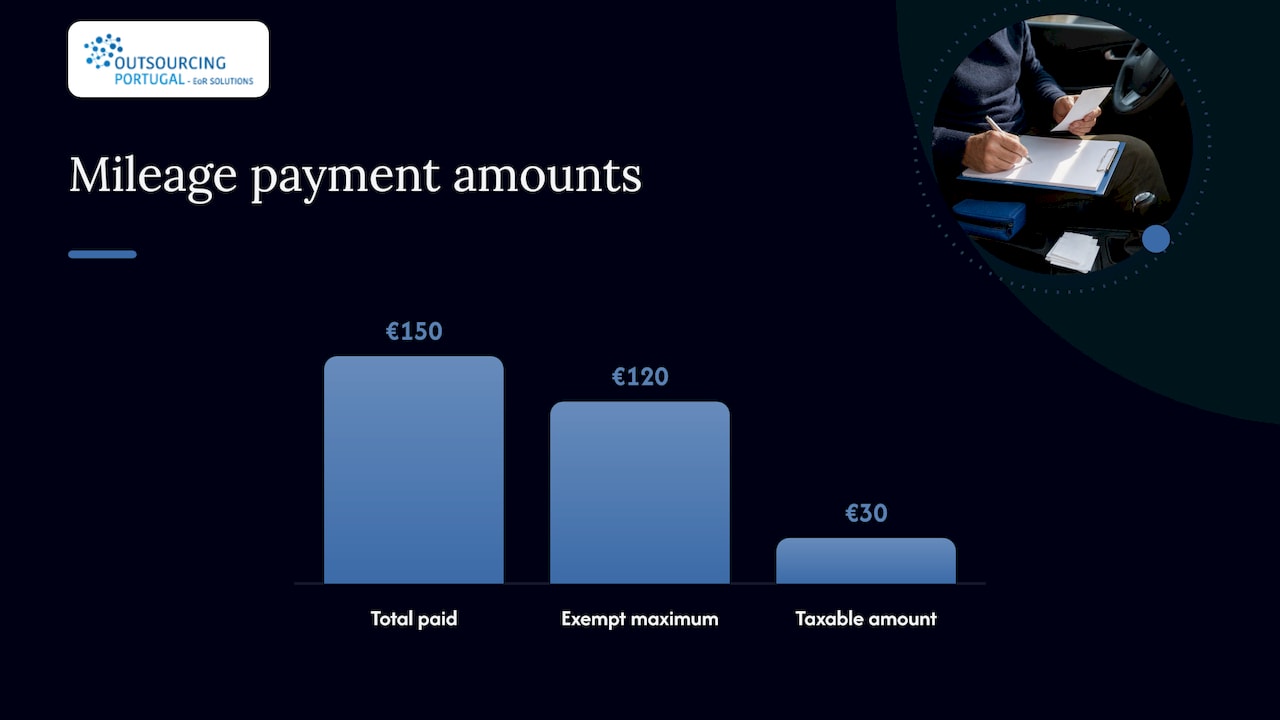
The maximum tax-exempt compensation for business use of a personal vehicle is €0.40 per kilometre, according to the OCC guide.
Worked example. An employee drives 300 km on a client visit in their own car. The exempt maximum is 300 × €0.40 = €120. Pay €150 and €30 is taxable.
The Tax Authority sets a documentation requirement. According to its binding information on mileage, for each payment the employer must keep a map showing:
- the reason for the trip and the locations
- the time spent and the objectives
- the vehicle and its owner
- the kilometres travelled
- the rate per kilometre and the total amount
The same ruling says that mileage compensation may be deductible for the company when incurred in its service and supported by that map and documentation. It also notes that mileage compensation not invoiced to clients is subject to 5% autonomous taxation, except to the extent it is taxed as income in the employee’s hands. That is a company-side cost, so build it into your budget when you set a mileage policy.
If the company provides the car instead, a different set of taxes applies. We cover it in the taxes company cars trigger in Portugal.
Are reimbursements taxable?
The rule of thumb is simple. A reimbursement is tax-free when it stays within the legal limits, is tied to a real expense or trip, and is supported by the right documents and coded correctly. It becomes taxable income when any of those fail.
The table sets out the main cases.
| Payment | Tax-free when | Taxable (Category A) when |
|---|---|---|
| Telework allowance | Within €0.10, €0.40 and €0.50 per full remote day, written agreement, coded A23 | Above the limits, or no agreement |
| Daily allowance in Portugal | Up to €65.89, genuine business trip | Above the limit, or conditions not met |
| Daily allowance abroad | Up to €148.91, genuine business trip | Above the limit, or conditions not met |
| Personal car | Up to €0.40 per km, with the trip map | Above the rate, or no supporting records |
| Advance for travel | Accounts submitted by the end of the tax year | Accounts not submitted by year end |
The tax treatment of the employee’s income is one question. Social security is another. Portaria 292-A/2023 makes the telework limits exempt from both tax and social security. Anything that is reclassified as salary also enters the social security base. In Portugal the employer rate is 23.75% and the employee rate is 11%, so a payment that loses its exemption costs both sides more than its face value.
What records to keep
Auditors look at the paper trail first. A workable set of records:
- Telework agreement. Written, signed, stating the method of compensation.
- Remote-day log. Which days were full remote days, since the exempt amounts are per full day.
- Expense reports with receipts. For anything reimbursed at actual cost.
- Trip maps for mileage. All the fields listed above, for every payment.
- Payroll coding. Telework amounts under code A23 in the DMR.
- Year-end reconciliation of advances. Submit or tax.
A small error in the paperwork does not always mean the whole payment is taxed. The law firm Fieldfisher notes in its October 2026 commentary that the tax arbitration centre, CAAD, has held that irregularities in travel logs do not automatically turn payments into taxable salary and call for an individual assessment. Still, you should not plan around that. Keep the records complete.
A policy that works for a foreign company
Most of our readers are not Portuguese companies. They are UK, EU or US businesses with one or five people in Portugal and no local entity. A few points matter for you.
- Write the policy for Portugal, not for head office. A group expense policy based on receipts in pounds or dollars will not meet the Portuguese limits or the DMR reporting.
- Separate allowances from salary. Do not top up pay through per diems. The OCC guide is clear that these payments are not remuneration.
- Decide the telework method once. A fixed daily amount in the written agreement is the easiest to run and to defend.
- Check the travel type. Domestic and foreign trips have different allowance limits.
- Plan for the employer’s cost. Mileage not charged to clients attracts 5% autonomous taxation, and excess amounts pull in social security.
If the employee works from Portugal for a company with no entity here, the employment relationship itself has to be set up correctly first. Our explanation of remote work in Portugal for a foreign company covers that.
Running expenses through an Employer of Record
When we act as the Employer of Record, we are the legal employer in Portugal on your behalf, so the Labour Code duties and the payroll coding sit within our service. Our offer includes payroll and benefits management, legal and tax compliance and HR support, and you pay one competitive monthly fee. You keep day-to-day direction of the person’s work. You approve the business trips and the claims, and the legal and payroll side is handled on the Portuguese terms.
That matters most in the first months. A new hire starts, works from home and travels to a client. Within a few weeks you have a telework agreement to sign, a mileage claim and a per diem to code. Having a Lisbon team that knows the Portuguese rules avoids guesses.
Once a candidate is selected and the offer is agreed, we can hire within 2 days. We also design tailored salary packages with tax optimisation, so that benefits and allowances are structured within the Portuguese limits from the start rather than corrected later.
See our Employer of Record service and our payroll services in Portugal for details, or contact us to talk through your own case.
Our perspective
Expense rules look minor next to salary and contracts. In practice they are where a foreign employer’s first Portuguese payroll problems appear: a flat allowance above the exempt limit, a mileage payment without a trip map, an advance nobody reconciled by year end.
We are a Portugal-only specialist, based in Lisbon, and part of HRB Solutions Group, which has been in the market for 20 years. We have hired 500+ people. What that experience tells us is that the cleanest approach is to settle the policy before the first claim: a written telework agreement, a fixed daily amount, a mileage procedure with the required map, and one person who owns the coding.
This is also why we offer personal and human support rather than a ticket queue. A founder in London or a CFO in New York should be able to ask a plain question about a Portuguese rule and get a plain answer from someone who works with the rules every day.
Our approach is to put the whole employment cost in one competitive monthly fee, to design the package so that allowances sit inside the limits, and to keep your team compliant without you building a Portuguese HR function.
Outsourcing Portugal Team
FAQ
Can my company in Portugal refuse to reimburse expenses?
Not for legitimate work expenses. The Labour Code requires the employer to compensate additional expenses that result directly from telework, and travel in the company’s service is for the company’s account. The employer decides the method and the documentation, not whether to pay.
Are expense reimbursements taxable in Portugal?
Only the part outside the rules. Amounts within the legal limits and properly documented are not taxable income for the employee. Daily allowances and car amounts above the limits, or paid without meeting the conditions, are Category A employment income, and so are advances whose accounts are not submitted by the end of the tax year.
How much can I pay tax-free for working from home?
Under Portaria 292-A/2023 the exempt limits are €0.10 a day for electricity, €0.40 for internet and €0.50 for equipment on full remote days, so €1.00 a day in total. A written agreement is required, and the limits rise by 50% where a collective bargaining agreement governs the reimbursement.
What mileage rate applies for a personal car?
The OCC’s 2025 guide gives €0.40 per kilometre as the maximum tax-exempt rate for business use of a personal vehicle. The employer must keep a map for each payment with the reason, locations, time, vehicle, kilometres and total amount.
Do I need a Portuguese company to reimburse expenses to a Portuguese employee?
You need a lawful way to employ the person in Portugal. With an Employer of Record, the legal employment, payroll and tax reporting run through us, so you do not need to set up your own entity to apply the Portuguese rules.
Sources
- Código do Trabalho, Diário da República
- Portaria n.º 292-A/2023, Diário da República
- Ofício Circulado n.º 20249/2023, Autoridade Tributária
- Ficha Doutrinária on mileage compensation, Autoridade Tributária
- Ficha Doutrinária on daily allowances, Autoridade Tributária
- Guia Prático: Enquadramento fiscal das ajudas de custo, OCC
- Orçamento do Estado 2026, summary, AICCOPN
- Informativo fiscal IRC e teletrabalho, APECA
- Fieldfisher on taxation of ajudas de custo
Recommended
- €1 a Day Telework Allowance in Portugal: Payroll Steps and DMR Codes
- Portugal Telework Law: €20–€50 Allowance, Written Agreement Checklist
- Employment Cost Calculator Portugal 2026
Disclaimer: This article is for general information only and does not constitute legal, tax, or employment advice. Laws and regulations change often. Please consult a qualified professional before making decisions. For Employer of Record services in Portugal, contact Outsourcing Portugal.