
TL;DR:
- Strategic outsourcing accelerates expansion, enhances agility, and provides significant cost and productivity benefits.
- Portugal offers EU-compliant, multilingual talent at 30-40% lower costs than Western Europe, ideal for nearshore outsourcing.
- Successful outsourcing requires strong governance, clear contracts, and strategic partnerships rather than just cost-cutting.
Outsourcing cuts costs by 40-70% for businesses worldwide, but that headline figure barely scratches the surface of what strategic outsourcing actually delivers. Most business leaders still think of it as a cost-trimming exercise. The reality is sharper: outsourcing is one of the most powerful levers for international expansion, talent access, and operational agility available to SMEs and multinationals today. Portugal has quietly become a standout destination in this story, offering a rare combination of EU compliance, multilingual talent, and competitive pricing that few nearshore markets can match. This guide breaks down the mechanics, the strategy, and the on-the-ground realities.
Table of Contents
- Why outsourcing is a catalyst for business expansion
- Portugal’s unique advantages in the outsourcing landscape
- Levers for driving expansion with outsourcing: Models, strategy, and frameworks
- Risks and realities: What business leaders must know before outsourcing
- Our perspective: What most business leaders miss about outsourcing for expansion
- Accelerate your business expansion in Portugal with trusted outsourcing partners
- Frequently asked questions
Key Takeaways
| Point | Details |
|---|---|
| Outsourcing fuels growth | Delegating operations to specialized partners enables rapid scaling and agility for businesses expanding internationally. |
| Portugal delivers unique value | Portugal stands out for cost-effective, multilingual, EU-compliant talent in a business-friendly environment. |
| Strategy and governance matter | The most successful outsourcing outcomes come from active oversight, clear goals, and the use of proven internationalization frameworks. |
| Risk management is essential | Managing contracts, performance, and partner relationships minimizes common pitfalls such as cost overruns and quality issues. |
Why outsourcing is a catalyst for business expansion
Outsourcing’s reputation as a cost-cutting tool undersells it dramatically. When deployed strategically, it functions as an expansion engine, allowing companies to enter new markets, scale headcount rapidly, and redirect internal resources toward core growth activities. The global outsourcing services market is projected to reach $525 billion by 2030, and that growth is not driven by companies trying to save a few dollars on payroll. It is driven by businesses using outsourcing to move faster, compete harder, and build capabilities they could not afford to develop in-house.
Businesses consistently report 40-70% cost savings alongside measurable productivity gains when outsourcing is structured well. But the productivity story is often more valuable than the savings story. When your internal team stops managing routine HR administration, IT helpdesk tickets, or customer service queues, they redirect energy toward product development, sales, and strategy.
Key business functions commonly outsourced by fast-growing SMEs and multinationals:
- IT development and software engineering
- Customer support and multilingual call center operations
- Payroll processing and HR administration
- Finance, accounting, and compliance functions
- Sales development and lead generation
- R&D and data analytics
The nearshore outsourcing advantages of working with teams in similar time zones and cultural contexts add another layer of value that pure offshore models often sacrifice. Real-time collaboration, shared working hours, and cultural alignment reduce friction and speed up delivery cycles.
“Outsourcing is no longer a tactical cost play. For companies scaling internationally, it is a strategic capability that determines how fast they can grow and how well they can compete.”
For companies exploring sales outsourcing in Portugal, the combination of language skills and European market familiarity creates immediate commercial value. Speed to market matters, and outsourcing compresses the timeline significantly.
Portugal’s unique advantages in the outsourcing landscape
Once you understand outsourcing’s broad power, it is vital to zoom in on destinations that outperform. Portugal is one such standout, and the reasons go well beyond low labor costs.

Portugal delivers 30-40% cost savings versus Western Europe while offering multilingual, EU-compliant talent that Asian offshore markets simply cannot replicate for European-facing operations. That combination of price and compliance is rare. Most cost-competitive markets require you to trade off regulatory certainty or talent quality. Portugal does not force that compromise.
Portugal vs. other outsourcing regions at a glance:
| Factor | Portugal | Western Europe | Asia (Offshore) |
|---|---|---|---|
| Cost savings vs. UK/Germany | 30-40% | Baseline | 50-70% |
| EU regulatory compliance | Full | Full | None |
| Time zone alignment (CET) | Yes | Yes | No |
| English proficiency | High | Varies | Moderate |
| Multilingual workforce | Yes | Partial | Limited |
| Data privacy (GDPR) | Fully covered | Fully covered | Complex |
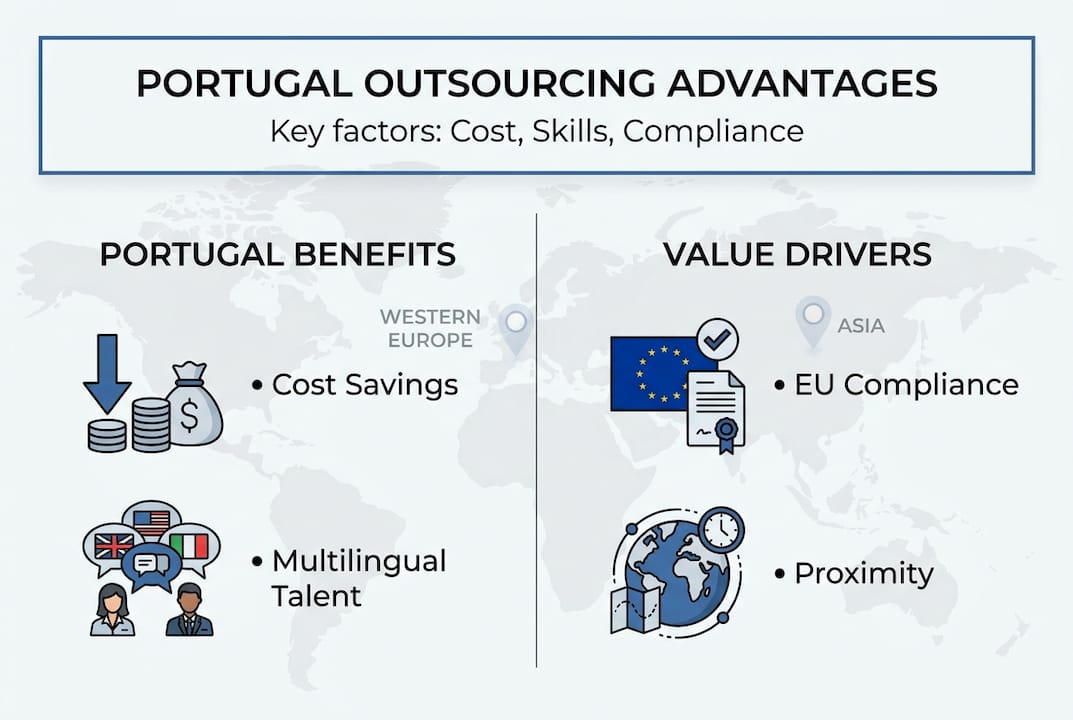
Portugal produces over 9,000 IT graduates annually, and its ranking in the Savills EMEA Nearshoring Index consistently places it among the top three European nearshore destinations. Major corporations including Accenture and Volkswagen have established significant operations in Portugal, citing both talent quality and operational cost performance as key drivers.
The Portugal nearshore cost benefits extend beyond salary differentials. Office space, employer contributions, and operational overhead are all materially lower than in London, Amsterdam, or Munich. When you calculate total cost of ownership rather than just headline salaries, the gap widens further.
Portugal’s technology sector has matured rapidly, with Lisbon and Porto now hosting thriving startup ecosystems and established tech hubs that attract talent from across Europe and beyond.
Pro Tip: When evaluating outsourcing partners in Portugal, prioritize those offering pilot programs with defined outcome metrics before committing to long-term contracts. This protects your investment and gives you real performance data before scaling.
Levers for driving expansion with outsourcing: Models, strategy, and frameworks
Selecting Portugal as a destination is only the first move. Understanding and deploying the right model and strategy is what ensures sustainable growth.
Core outsourcing models available to international businesses:
- Nearshore outsourcing: Teams in geographically close, culturally aligned countries (Portugal for European and US companies)
- Offshore outsourcing: Lower-cost distant markets, typically Asia or Latin America
- Employer of Record (EoR): A local legal entity employs your workers on your behalf, handling compliance, payroll, and HR
- Project-based outsourcing: Defined scope, timeline, and deliverables with a specialist vendor
- Managed services: Ongoing operational functions handled end-to-end by a partner
For companies entering Portugal without a local entity, the EoR model is particularly powerful. It removes the need to incorporate locally while ensuring full legal compliance from day one.
Strategic frameworks like the AAA Global Strategy (Adaptation, Aggregation, Arbitrage) and the Uppsala Model for internationalization provide structured approaches to deciding what to outsource, where, and when. The AAA framework is especially useful: Adaptation helps you customize for local markets, Aggregation captures economies of scale, and Arbitrage exploits cost and talent differences across geographies.
Steps to integrate outsourcing into your international expansion strategy:
- Audit your internal functions and identify non-core activities suitable for outsourcing
- Define clear outcome metrics and KPIs before engaging any vendor
- Select the right model based on your control, compliance, and scalability needs
- Run a structured pilot with defined success criteria before full deployment
- Build governance mechanisms including regular reviews and escalation paths
- Scale incrementally, using performance data to guide expansion decisions
Understanding how infrastructure impacts outsourcing decisions in Portugal is also critical. Connectivity, office availability, and logistics infrastructure all affect operational performance.
Pro Tip: Never outsource knowledge-intensive, judgment-heavy functions that sit at the core of your competitive advantage. Outsource what scales. Protect what differentiates.
Risks and realities: What business leaders must know before outsourcing
To maximize outsourcing’s rewards, it is crucial to recognize the realities and proactively manage potential downsides.
The numbers are sobering. 70% of IT projects run over budget, and 50% of outsourcing deals fail within five years due to governance and quality issues. Those are not fringe cases. They represent the default outcome when outsourcing is treated as a procurement exercise rather than a strategic partnership.
“Half of all outsourcing deals fail within five years. The cause is almost never the vendor’s technical capability. It is almost always governance, communication, and misaligned expectations.”
The operational outsourcing realities in markets like Portugal are nuanced. Quality and innovation can genuinely improve when you engage the right partner. But outsourcing can also amplify internal inefficiencies if your processes are unclear before you hand them off. A chaotic internal workflow becomes an expensive, chaotic outsourced workflow.
Actionable steps to reduce outsourcing risk:
- Draft contracts with explicit deliverables, SLAs, and penalty clauses for underperformance
- Establish transparent KPI dashboards accessible to both parties in real time
- Schedule quarterly business reviews with senior stakeholders on both sides
- Include IP ownership clauses and data security protocols from day one
- Build exit provisions into every contract to avoid vendor lock-in
- Conduct independent audits of quality and compliance at least annually
AI-related outsourcing introduces additional edge cases worth flagging. Prompt drift and model drift can erode output quality over time without obvious warning signs. Time-to-value compression is real, but so is the risk of deploying AI-assisted outsourcing without adequate oversight from project failure data showing how quickly misaligned AI tools degrade results.
Hidden costs are another consistent trap. Transition costs, training time, management overhead, and rework cycles can quietly consume a significant portion of projected savings if not budgeted for upfront.
Our perspective: What most business leaders miss about outsourcing for expansion
After working with international businesses entering Portugal across multiple industries, one pattern stands out consistently: companies that struggle with outsourcing almost always over-indexed on labor cost and under-invested in vendor relationship quality.
The businesses that succeed treat their outsourcing partners as strategic collaborators, not interchangeable suppliers. They share context, align on vision, and build governance structures that create accountability on both sides. The hidden nearshoring advantages of markets like Portugal are not just about price. They are about cultural proximity, shared business norms, and the kind of working relationship that actually produces innovation rather than just execution.
Scalability and real competitive advantage come from collaboration and strategic fit, not from squeezing the lowest possible rate from a vendor. Decision-makers who prioritize adaptability, shared vision, and measurable value delivery over simple cost comparisons are the ones who build outsourcing relationships that last and grow. Portugal rewards that approach more than most markets.
Accelerate your business expansion in Portugal with trusted outsourcing partners
Now that you are equipped with strategic understanding, here is how you can put it into practice. Building a compliant, cost-effective operation in Portugal does not require setting up a local entity, navigating unfamiliar employment law alone, or spending months on administrative groundwork.
Portugal employment and EoR solutions handle the full employment lifecycle, from hiring and onboarding to payroll, compliance, and HR support, so your team can focus on growth. Whether you need to source multilingual talent for a customer-facing operation or build a nearshore tech team, the infrastructure is already in place. Ready to move from strategy to execution? Contact local outsourcing experts to explore your options with no obligation.
Frequently asked questions
What is the most significant benefit of outsourcing for business expansion?
The single largest benefit is rapid scalability combined with 40-70% cost savings, while simultaneously accessing specialized talent that would be costly or slow to hire domestically. Speed and capability together are the real advantage.
Why is Portugal considered a leading nearshore outsourcing destination?
Portugal offers 30-40% cost savings versus Western Europe, a multilingual workforce, CET time zone alignment with European markets, and full GDPR and EU regulatory compliance, making it a uniquely low-risk, high-value nearshore option.
What are the main risks when outsourcing for business growth?
70% of IT projects overrun budget, and vendor lock-in, IP exposure, and quality drift are persistent risks that require robust contracts, transparent KPIs, and active governance from the start.
Which business functions are most suitable for outsourcing during expansion?
IT development, customer service, payroll, and R&D are the top outsourced functions because they offer clear scalability, measurable outcomes, and strong efficiency gains without compromising core competitive advantage.