

TL;DR:
- Hiring in Portugal can significantly lower fully-burdened labor costs for U.S. companies after accounting for taxes, benefits, and administration fees. Employing an EOR streamlines compliance and reduces expenses, especially when considering wages, employer social contributions, and hidden costs like onboarding and turnover. Using local tools and benchmarks reveals potential savings of 22 to 46 percent, but retention factors and role mis-specification must also be carefully evaluated.
Hiring in Portugal typically lowers fully-burdened labor cost for U.S. employers once you account for employer taxes, statutory benefits, payroll administration, and EOR fees. The BLS data indicates that average private-industry total compensation includes a significant portion attributable to benefits beyond wages. Portugal’s base salaries and statutory social charges run materially lower for comparable roles, and an EOR like Outsourcing-portugal handles compliance without requiring a local entity. Tools from Paycor and Gusto confirm the benchmarks; the sections below show you how to calculate, compare, and budget every line.
The two cost clusters that move the needle most:
- Wages and mandatory employer charges: base salary plus employer-side social security contributions, unemployment insurance, and any sector-specific levies. These vary significantly between the U.S. and Portugal.
- Hidden and administrative costs: onboarding, recruiting, turnover replacement, payroll processing, legal counsel, and EOR service fees. These are often underestimated and can close the gap between headline salary savings and actual net savings.
Table of Contents
- What components make up labor cost?
- How to calculate a fully-burdened labor cost
- Benchmarks and rules of thumb
- How labor-cost components typically differ between the U.S. and Portugal
- How an Employer of Record changes your cost structure
- A simple worksheet: how to estimate potential savings from hiring in Portugal
- Key legal and compliance items U.S. companies must budget for
- Typical timeline and upfront costs to onboard a Portuguese hire via an EOR
- Key Takeaways
- Why the savings math is only half the story
- Outsourcing-portugal: from cost estimate to compliant hire
- Authoritative sources and tools for your own calculations
What components make up labor cost?
Every CFO and HR leader needs a consistent checklist to avoid comparing apples to oranges when evaluating U.S. versus Portugal hiring.
Base wages and salaries are the starting point. For hourly workers, multiply the rate by annual net hours worked. For salaried employees, the annual figure feeds directly into the burden calculation.

Mandatory employer payroll taxes and social contributions sit on top. In the U.S., this means employer-side Social Security (6.2%), Medicare (1.45%), federal unemployment (FUTA), and state unemployment (SUTA). In Portugal, the employer social security contribution rate is 23.75% of gross salary, which is the dominant statutory charge to model.
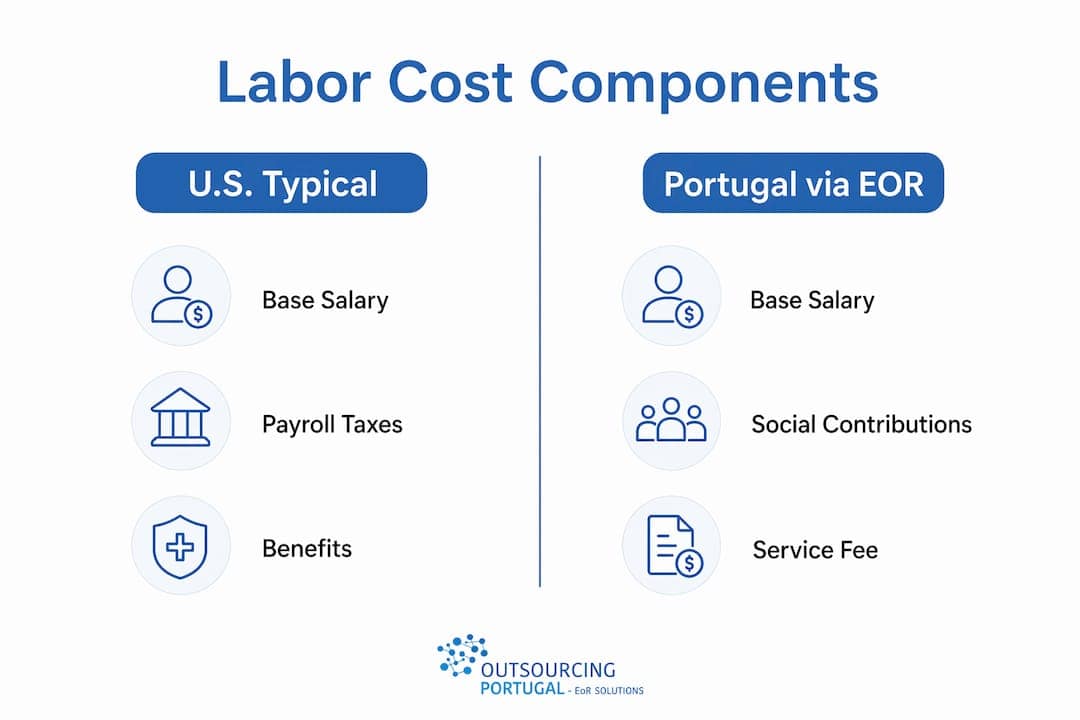
Statutory benefits include paid leave (vacation, sick, public holidays), mandatory severance accruals, and pension contributions where required. Private benefits layer on top: voluntary health plans, meal allowances, transport subsidies, and performance bonuses. These vary by role and sector.
Indirect and administrative costs round out the picture. Gusto’s labor cost guidance flags that companies frequently misallocate recruiting software, HR tools, and compliance costs to production cost centers rather than overhead, which distorts margin analysis. Treat them as overhead from day one.
EOR-specific line items apply when you hire through an Employer of Record: the service fee (flat monthly or percentage of payroll), plus pass-through costs like local legal filings and benefits administration.
How to calculate a fully-burdened labor cost
The formula is straightforward once every line has a home:
Worked U.S. example using BLS March 2026 figures
The BLS data shows private-industry workers receive wages with substantial benefit components, resulting in a noticeably higher total compensation. Annualized at 2,080 hours, that’s roughly $96,928 in total employer cost for a median private-sector worker earning about $67,608 in base wages.
| Cost component | Annual amount |
|---|---|
| Base salary (wages) | $67,608 |
| Fully-burdened total | roughly $96,928 |
That’s a burden multiplier of roughly 1.43× base salary, consistent with the 1.25–1.4× rule of thumb from QuickBooks. The recruiting and onboarding line alone can push a mid-market hire past 1.4× in year one.
BLS March 2026: Private-industry employer compensation averaged $46.60/hr. Benefits accounted for $14.01/hr, or 30.1% of total compensation — nearly one dollar in three goes to non-wage costs before a single discretionary benefit is added.
Pro Tip: Build a conservative FX buffer of 3–5% into any Portugal salary budget and a turnover reserve equal to one month’s fully-burdened cost per role. Exchange rate swings and unexpected departures are the two items most likely to blow a nearshore budget in year one.
Benchmarks and rules of thumb
Paycor’s analysis sets the target range at 20–35% of gross revenue for most businesses, with high-skill sectors like professional services and healthcare running above that band. Paycor also notes that labor can represent up to 70% of operating costs, yet HR teams typically spend only about 15% of their time actively managing it.
Quick benchmarks to pressure-test your assumptions:
- Burden multiplier: 1.25–1.4× base salary for standard roles; 1.5× or higher for senior technical hires with rich benefits.
- Labor as % of revenue: 20–35% is the healthy range; above 35% warrants a cost review.
- Benefits as % of total comp: BLS data puts this at 30.1% for private industry; budget at least 28–32% for any U.S.-based role.
- Role-level vs. company-wide: company-wide averages mask wide variance. A software engineer and a customer support rep carry very different burden profiles. Run role-level calculations for nearshoring decisions.
Industry variance matters. Hospitals and commercial banking consistently run above 35%. Tipped hospitality businesses often land below 25% because some labor cost transfers to consumers. When benchmarking a nearshore role, match the role type, not the company average.
How labor-cost components typically differ between the U.S. and Portugal
| Component | U.S. (typical) | Portugal via EOR (typical) |
|---|---|---|
| Base salary | Higher for most tech and professional roles | Materially lower for comparable roles |
| Employer social contributions | ~10% (FICA + FUTA/SUTA) | ~23.75% of gross salary |
| Statutory paid leave | 10 days PTO common; no federal mandate | 22 days annual leave + 13 public holidays |
| Statutory severance | At-will; minimal statutory cost | Accrues at 12 days’ pay per year of service |
| Private benefits (health, pension) | Employer-sponsored health often $500–$700/mo per employee | Supplemental health less common; meal allowance standard |
| Payroll admin and compliance | Moderate; in-house or via payroll vendor | Higher complexity without local entity; EOR eliminates this |
| EOR fee | N/A (direct hire) | Flat monthly fee or % of payroll (new line item) |
| Time-to-hire / onboarding | 3–6 weeks typical | 4–8 weeks via EOR (faster than entity setup) |
| Turnover and hidden costs | High; SHRM estimates replacement at significant multiples of salary | Lower attrition in many Portuguese tech roles, but cultural onboarding adds time |
The most consequential difference for U.S. employers is the employer social contribution rate. Portugal’s 23.75% looks high compared to the U.S. combined rate of roughly 10%, but base salaries for equivalent roles are often low enough that the net employer cost still comes out favorably. Severance accruals are the other item finance teams miss: they are a real cash liability, not a theoretical one, and must appear in your budget from day one.
How an Employer of Record changes your cost structure
An EOR takes on the legal employer role in Portugal, which shifts several cost lines from variable and uncertain to fixed and predictable. Specifically, an EOR handles payroll tax withholding and remittance, statutory filings, local employment contracts, termination administration, benefits enrollment, and ongoing HR support.
The fee model matters for budgeting. Flat monthly per-employee fees are easiest to model as a fixed operating expense. Percentage-of-payroll models scale with salary, which can be favorable for junior roles and less so for senior ones. Mixed models often include a base fee plus pass-throughs for specific services. Treat EOR fees as a transparent service line, not overhead to be buried, so your margin analysis stays clean.
Eight questions to ask any EOR before signing:
- What is explicitly included in the monthly fee versus billed separately?
- How often is payroll run, and what is the cut-off for changes?
- Do you handle local tax registration and ongoing filings?
- How is workers’ compensation or equivalent coverage handled?
- What is your process for termination and severance calculation?
- Do you administer statutory benefits or only pass through costs?
- What data privacy and GDPR compliance controls are in place?
- What is the notice period to exit the EOR agreement?
Outsourcing-portugal’s Employment Cost Calculator lets you run Portugal-specific, EOR-inclusive estimates before committing to any of those conversations.
A simple worksheet: how to estimate potential savings from hiring in Portugal
Minimum inputs you need: role base salary in euros, employer social charge rate (23.75%), statutory benefits estimate, private benefits, EOR fee, one-time recruiting and onboarding cost, EUR/USD rate assumption, and a productivity multiplier for the role.
| Scenario | Base salary (EUR) | Employer charges | EOR fee | Total annual cost (USD equiv.) | vs. U.S. baseline |
|---|---|---|---|---|---|
| Best case | — | — | — | — | ~46% lower |
| Base case | — | — | — | — | ~35% lower |
| Worst case | — | — | — | — | ~22% lower |
USD equivalents use an illustrative EUR/USD rate of 1.08; adjust for your actual rate and hedge assumption.
The three assumptions that drive outcomes most are the exchange rate, the EOR fee structure, and whether the role truly maps to a lower Portuguese salary band. A senior architect hired at a Lisbon market rate may save 22%; a mid-level support engineer can save 40% or more. Breaking TCOW analysis into one role at a time prevents analysis paralysis and surfaces the roles where nearshoring genuinely pays.
Key legal and compliance items U.S. companies must budget for
- Social security and payroll reporting: Portugal’s Social Security (Segurança Social) requires monthly employer declarations. Late filings carry fines.
- Mandatory paid leave: 22 days annual leave plus 13 public holidays are statutory minimums. Underpaying leave creates back-pay liability.
- Severance accruals: 12 days’ base pay per year of service, accruing from day one. Budget this as a contingent liability on your balance sheet.
- Collective bargaining agreements (CCTs): many sectors have industry-level agreements that set floors above the statutory minimum wage. Check the applicable CCT before finalizing an offer.
- Work permits and visas: EU/EEA nationals can start immediately. Non-EU hires require a work authorization process that adds 6–12 weeks and associated legal fees.
- GDPR and data privacy: payroll data for EU employees falls under GDPR. Payroll systems must meet data residency and processing requirements, which carry compliance costs.
- Misclassification risk: using contractor agreements for roles that function as employment relationships exposes you to back social charges, fines, and potential criminal liability under Portuguese labor law.
An EOR mitigates most of these risks by design. For a detailed compliance workflow, Outsourcing-portugal’s workforce compliance guide covers the operational steps and timing.
Typical timeline and upfront costs to onboard a Portuguese hire via an EOR
The process from signed offer to first payroll run typically takes 4–8 weeks via an EOR. The first two weeks cover contract drafting, social security registration, and tax identification setup. Weeks three and four handle benefits enrollment and payroll system configuration. If a work permit is required for a non-EU national, add 6–12 weeks to that timeline and budget legal fees accordingly.
| Upfront cash item | Timing | Notes |
|---|---|---|
| EOR onboarding fee | Week 1 | One-time; varies by provider |
| Recruiting fee (if agency) | Pre-offer | Typically 15–20% of first-year salary |
| First-month salary + employer charges | End of month 1 | Includes 23.75% social contribution |
| Pro-rated statutory benefits | Month 1 | Meal allowance, holiday accrual |
| Relocation or visa costs (if applicable) | Weeks 2–8 | Non-EU hires only |
Two timing traps catch companies off guard. First, delayed social security registration can create back-pay obligations that hit in month two. Second, payroll cut-off dates in Portugal are typically mid-month, so a hire that starts on the 20th may not appear in payroll until the following cycle, creating a cash-flow gap. Plan for both.
Key Takeaways
Hiring in Portugal via an EOR consistently reduces fully-burdened employment costs for U.S. companies, with savings of 22–46% versus U.S. baselines depending on role, exchange rate, and EOR fee structure.
| Point | Details |
|---|---|
| BLS baseline for U.S. cost | Private-industry total compensation averaged $46.60/hr in March 2026; wages and salaries averaged $32.60/hr (69.9%) and benefits $14.01/hr (30.1%). |
| Burden multiplier to use | Budget 1.25–1.4× base salary as a minimum; senior or benefits-rich roles often reach 1.5×. |
| Portugal’s key cost difference | Employer social contributions run 23.75% of gross salary, but base salaries for comparable roles are materially lower. |
| Legal items to reserve for | Severance accrues at 12 days per year of service from day one; GDPR compliance and CCT floors add further obligations. |
| Outsourcing-portugal’s role | Outsourcing-portugal’s EOR and Employment Cost Calculator convert U.S. assumptions into Portugal-specific, fully-burdened estimates. |
Immediate next steps:
- Run the sensitivity worksheet above for at least two roles using your actual salary offers and the current EUR/USD rate.
- Ask any shortlisted EOR provider the eight budget questions listed in the EOR section before requesting a quote.
- Schedule a scoping call with Outsourcing-portugal to validate your estimates against real Portugal market data.
Why the savings math is only half the story
The numbers in this article are real, and for most U.S. companies evaluating Portugal, they are genuinely compelling. But the CFOs who get the most out of nearshoring are the ones who treat the cost model as a starting point, not a conclusion.
What the spreadsheet misses is the retention dynamic. SHRM’s research is clear that non-financial factors, commute, work-life balance, office culture, drive turnover as much as salary does. A Portuguese hire who leaves after 14 months because the role was poorly scoped or the remote onboarding was thin costs you the severance accrual, a new recruiting cycle, and three months of lost productivity. That can erase a year’s worth of salary savings.
The other thing I see companies underestimate is the role specification problem. They take a U.S. job description, post it in Lisbon, and wonder why the hire underperforms. Portuguese labor law and market norms shape what a role looks like in practice, and a mis-specified contract creates both legal exposure and cultural friction. An EOR that knows the local market catches these issues before the contract is signed, not after.
The talent retention practices that work in Boston do not always translate directly to Porto. Build that assumption into your total cost of workforce model from the start.
Outsourcing-portugal: from cost estimate to compliant hire
If the numbers in this article look promising for your team, the practical next step is converting your U.S. salary assumptions into a Portugal-specific, EOR-inclusive cost model before you post a single job.

Outsourcing-portugal handles the full employment stack: EOR legal employer setup, payroll processing and statutory filings, benefits administration, visa and relocation support for non-EU hires, and nearshore team configuration for multi-role builds. The Employment Cost Calculator gives you a Portugal-specific fully-burdened figure in minutes, including employer social charges, EOR fees, and statutory benefits. For companies ready to move beyond the spreadsheet, the EOR services page outlines exactly what is covered and what a scoped engagement looks like. Request a tailored quote or book a scoping call to get a number you can take to your CFO.
Authoritative sources and tools for your own calculations
- U.S. Bureau of Labor Statistics (BLS): Primary source for U.S. employer compensation benchmarks. Use for wages-vs-benefits splits and percentile data by industry.
- Paycor: Best for labor-as-%-of-revenue benchmarks and industry variance guidance.
- Gusto: Practical formulas for direct vs. indirect cost separation and project-level budgeting.
- QuickBooks / Intuit: Free employee cost calculator; useful for validating burden multipliers and onboarding cost estimates.
- SHRM: Best for total cost of workforce (TCOW) methodology and hidden retention cost factors.
- EmployerCosts: Itemized employer-side tax and insurance examples; useful for pressure-testing payroll tax assumptions.
- Outsourcing-portugal Employment Cost Calculator: Portugal-specific tool that incorporates EOR fees, statutory charges, and local benefits norms. Run this alongside the BLS figures to build a side-by-side comparison.
For a deeper look at how competitive labor costs break down across roles and geographies, Outsourcing-portugal’s resource library covers role-level examples and Portugal market data that go beyond what public benchmarks provide.