

TL;DR:
- Long-term success in Portugal’s outsourcing market relies on serious governance investment rather than just cost savings.
- Governance encompasses compliance, reporting, and auditing controls that ensure legal and ethical operation within Portuguese and EU laws.
International companies entering Portugal’s outsourcing market often fixate on one thing: cost reduction. And yes, Portugal offers competitive labor costs relative to Western Europe. But the companies that actually succeed long-term, those that avoid regulatory fines, talent attrition, and reputational damage, share something more important than a favorable wage structure. They invest seriously in governance. This article walks you through the core frameworks, data protection requirements, regulatory dynamics, and practical steps that transform outsourcing in Portugal from a financial gamble into a scalable, risk-managed operation.
Table of Contents
- Understanding governance in outsourcing: Core frameworks
- Data protection and compliance: Navigating Portuguese and EU law
- Regulatory uncertainty: Adapting governance to Portugal’s evolving landscape
- Practical governance steps for HR and business leaders outsourcing in Portugal
- Why governance, not cost, drives outsourcing success in Portugal
- Need a trusted partner for compliant outsourcing in Portugal?
- Frequently asked questions
Key Takeaways
| Point | Details |
|---|---|
| Governance is vital | Effective governance protects against compliance failures and enables sustainable outsourcing in Portugal. |
| Data protection matters | Portugal’s Law No. 58/2019 and GDPR require robust frameworks for handling employee data during outsourcing. |
| Adapt to regulatory change | Flexible governance is essential to keep pace with evolving labor laws and policy debates in Portugal. |
| Use audit-ready processes | Documenting all outsourced employee data handling ensures both legal and operational accountability. |
| Leverage expert support | Partnering with local experts helps navigate governance, compliance, and hiring effectively. |
Understanding governance in outsourcing: Core frameworks
Governance in the context of outsourcing employment means something specific. It is not a vague commitment to “best practices.” It refers to the structured system of policies, controls, documentation, and accountability mechanisms that ensure every outsourced employment function operates within legal and ethical boundaries.
For HR managers and business leaders working with Portuguese talent, governance covers three interconnected pillars:
- Compliance: Ensuring all employment contracts, benefits, termination procedures, and payroll processes align with Portuguese labor law and EU regulations.
- Reporting: Maintaining clear, traceable records of workforce activity, data handling, and policy changes that regulators can inspect at any time.
- Auditing: Periodically testing whether your governance controls actually work, not just whether they exist on paper.
These pillars are reinforced by external governance models for outsourcing that treat compliance as an ongoing operational function rather than a one-time legal review. The difference matters enormously in Portugal’s context, where both EU-level and national-level regulations apply simultaneously.
“Governance is not a cost center. It is the infrastructure that protects your investment in a market you do not fully control.”
Portuguese employment law draws from multiple sources: the Labor Code (Código do Trabalho), EU directives, and national implementing acts. Staying compliant with outsourcing legal compliance in Portugal requires knowing which layer applies to which situation. A governance framework connects those layers into a coherent operating model.
According to a detailed review of Portuguese frameworks, governance should include compliance-by-design and audit-ready records for Portugal’s data protection obligations, including both GDPR and the Portuguese implementing measures under Law No. 58/2019.
Pro Tip: Assign a named governance lead internally before you onboard your first Portuguese employee. Without clear ownership, compliance gaps emerge silently and surface only during audits or disputes.
Business leaders often underestimate how much the governance structure they set up on day one shapes everything that follows. A clear escalation path, documented decision logs, and regular cross-functional reviews between legal, HR, and finance are not bureaucratic overhead. They are the mechanisms that keep compliance in international hiring from quietly unraveling as your team scales.
Data protection and compliance: Navigating Portuguese and EU law
Portugal’s data protection landscape adds a critical layer to outsourcing governance. When you outsource employment functions, you inevitably handle personal data: payroll records, performance files, health information for sick leave, and more. This data handling is governed by two interlocking legal frameworks.

The first is the EU General Data Protection Regulation (GDPR), which sets baseline rights and obligations across all member states. The second is Portugal’s Law No. 58/2019, which implements GDPR at the national level and introduces additional provisions specific to Portuguese employment and administrative contexts.
Here is a practical comparison of what each framework requires:
| Requirement | GDPR (EU-wide) | Law No. 58/2019 (Portugal) |
|---|---|---|
| Legal basis for processing | Explicit consent or legitimate interest | Same, plus specific national conditions for employment data |
| Data subject rights | Access, erasure, portability | Same, with specific timeframes under Portuguese rules |
| Data Protection Officer | Required for large-scale processing | Required for public entities and specific private processors |
| Breach notification | 72 hours to supervisory authority | 72 hours to CNPD (Portugal’s national authority) |
| Employee monitoring | Permitted with proportionality | Additional restrictions under Portuguese labor law |
| Documentation | Records of processing activities | Same, plus Portuguese-language recordkeeping in some cases |
The key practical takeaway is that governance must cover the Portuguese implementation layer whenever outsourcing processes involve personal data. This means your vendor contracts, data processing agreements, and internal policies cannot simply reference GDPR in generic terms. They must specifically address Law No. 58/2019 provisions.
To build GDPR compliance for outsourcing that holds up under Portuguese scrutiny, follow this sequence:
- Map your data flows. Identify every category of personal data processed during employment outsourcing, from candidate CVs to payroll files to termination records.
- Assign legal bases. Document the legal justification for each data processing activity under both GDPR and Law No. 58/2019.
- Draft Portuguese-compliant DPAs. Data Processing Agreements with your outsourcing partner must reference the national implementing act, not just the EU regulation.
- Establish a breach response procedure. Breaches must be reported to Portugal’s CNPD within 72 hours. Your governance framework must include a pre-tested response protocol.
- Review employee monitoring policies. Portuguese labor law restricts electronic surveillance of employees more strictly than GDPR alone. Governance must reflect these limits explicitly.
Audit-ready documentation is not optional in this context. Audit-ready documentation practices require organizations to maintain accessible records of all processing activities, decisions, and corrective actions taken. In a regulatory inspection, these records are what stand between your business and significant financial penalties.
A useful benchmark: Portuguese companies and their outsourcing partners that invest in compliance-by-design from the start spend roughly 40% less on remediation during audits compared to those that retrofit compliance after the fact. Governance built into your processes at the outset is simply far cheaper than governance bolted on under pressure.
Regulatory uncertainty: Adapting governance to Portugal’s evolving landscape
Portugal’s outsourcing regulatory environment is not static. That is one of the most important things business leaders need to internalize before designing long-term governance strategies. Policy debates actively shape what is permissible, what triggers liability, and what protections workers can claim.
Recent and proposed labor reforms and outsourcing dynamics in Portugal have introduced real tension between employer flexibility and worker protections. Government, employer associations, and union bodies (including the UGT) have openly disagreed about whether current outsourcing allowances should be tightened or expanded. This is not background noise. It directly affects how you structure employment arrangements today.
Here is a timeline of significant regulatory developments affecting outsourcing governance in Portugal:
| Year | Development | Governance impact |
|---|---|---|
| 2019 | Law No. 58/2019 enacted | GDPR national implementation; new data obligations for employers |
| 2021 | Remote work amendments (Labor Code) | New rules on remote worker rights and employer obligations |
| 2023 | Digital nomad visa and hiring frameworks | Expanded talent pool; new residency and tax compliance considerations |
| 2025 | Labor reform debate intensified | Proposals to restrict outsourcing following collective redundancies |
| 2026 | Ongoing policy negotiation | Uncertainty over outsourcing allowances post-redundancy scenarios |
The 2025 and 2026 policy debates are particularly significant. There is active policy debate in Portugal about tightening outsourcing allowances, especially in situations where companies have conducted collective redundancies and then sought to outsource the same functions. This creates a specific governance risk: if your organization restructures and then engages an outsourcing partner for equivalent roles, you may face legal challenges and reputational scrutiny.
Adaptable governance strategies for HR managers responding to this uncertainty include:
- Building regulatory monitoring into your governance calendar. Assign someone the specific responsibility of tracking Portuguese labor law updates and flagging proposed legislation.
- Scenario planning for restriction scenarios. Model what a tightened outsourcing framework would mean for your operational setup and build contingency protocols.
- Maintaining transparent documentation of outsourcing rationale. If a restructuring precedes outsourcing activity, documented business justification that clearly distinguishes the two decisions is essential.
- Engaging local legal counsel proactively. Understanding infrastructure and policy impact on outsourcing decisions requires advisors who follow Portuguese regulatory developments in real time.
Pro Tip: Do not treat Portuguese labor law as a fixed input to your governance model. Build in a quarterly review cycle specifically for regulatory updates, and test your policies against any proposed changes before they are enacted.
Practical governance steps for HR and business leaders outsourcing in Portugal
Understanding the landscape is one thing. Acting on it is another. Here are the governance steps that business leaders and HR managers can implement immediately to reduce risk and build a durable outsourcing operation in Portugal.
- Establish a governance charter. Before signing any outsourcing contract, document the governance structure: who owns compliance, who approves policy changes, and how escalations reach senior leadership.
- Conduct a pre-engagement legal review. Map your planned outsourcing arrangement against Portugal’s Labor Code, GDPR, and Law No. 58/2019. Identify gaps before they become liabilities.
- Build a contract review cadence. Outsourcing contracts should include governance clauses: audit rights, data processing terms, change notification obligations, and compliance warranties from your provider.
- Implement audit trails at every touchpoint. From onboarding through payroll to termination, every employment action should generate a traceable record. This is not about distrust. It is about defensibility.
- Train your HR team on Portuguese-specific compliance. Generic HR training is not enough. Your team needs to understand how Portuguese notice periods, severance calculations, and collective agreement obligations differ from other markets.
- Create a cross-functional governance committee. The most resilient governance structures in outsourcing involve legal, HR, finance, and operations in joint review sessions at least quarterly.
“Governance must balance local compliance, adaptable policies, and audit trails to address shifting regulatory risks in Portugal’s outsourcing landscape.”
One of the most commonly overlooked governance gaps involves handoff points. When responsibility for a compliance task moves from your outsourcing partner to your internal team, or vice versa, documentation of that handoff often disappears. Build explicit transfer records into your governance workflow for every employment function that crosses organizational boundaries.
Pro Tip: Before going live with any outsourced function, run a tabletop exercise simulating a regulatory audit. Walk through what documents you would produce, who would present them, and what gaps you discover. The gaps you find in the exercise are far less painful than the gaps regulators find in an actual inspection.
For organizations scaling their Portuguese operations, partnering with providers that embed compliance into their service delivery is essential. Understanding outsourcing hiring costs and talent in the Portuguese market is part of this equation, but so is understanding the governance capabilities your provider brings to the table.
Why governance, not cost, drives outsourcing success in Portugal
Here is the uncomfortable truth that most outsourcing conversations avoid: cost savings in Portugal are real, but they are the smallest part of the value equation. Labor arbitrage advantages are real and measurable in year one. But the companies that build durable Portugal operations do not cite cost as the reason they stayed. They cite governance.
The conventional wisdom holds that you outsource to Portugal for the economics, then build compliance structures once things grow. We have seen this approach fail repeatedly. Compliance failures in Portuguese employment are not minor administrative corrections. They trigger back-pay claims, public enforcement actions by the Authority for Working Conditions (ACT), and CNPD investigations that create headlines no European expansion strategy can afford.
What expert compliance insights consistently show is that companies treating governance as a box-ticking exercise underestimate the second-order effects. A single misclassification dispute in Portugal can take 18 to 24 months to resolve through the labor courts. During that period, your management team is distracted, your talent pipeline is damaged, and your expansion timeline is frozen.
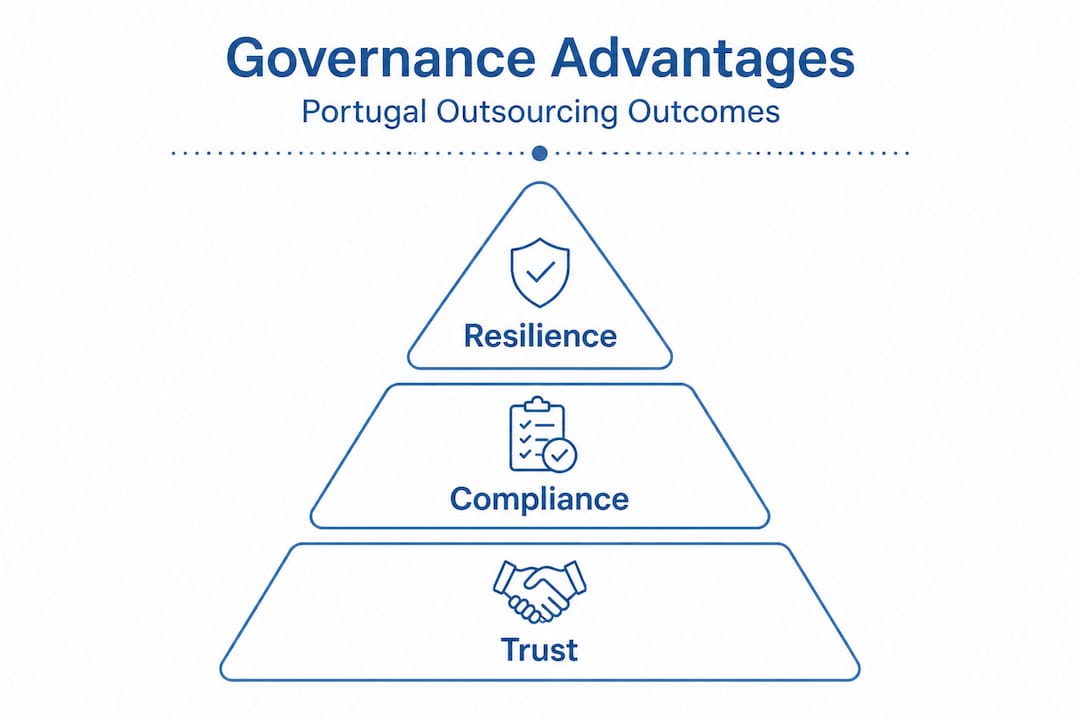
Proactive governance, on the other hand, creates three undervalued advantages. First, it builds organizational resilience. When regulations shift, as they clearly are in 2026, governance-mature organizations adapt without crisis. Second, it strengthens your employer brand in Portugal. High-quality Portuguese talent has options. Companies known for operating with integrity and legal rigor consistently attract better candidates. Third, it protects your access to Portugal’s EU-compliant talent pool, which is increasingly valuable for companies operating in regulated sectors like financial services, healthcare technology, and data-intensive industries.
The real return on governance investment is not calculated in euros saved on legal fees. It is calculated in years of uninterrupted, scalable operations built on a foundation that does not crack under regulatory pressure.
Need a trusted partner for compliant outsourcing in Portugal?
If you have reached this point, you already understand that governance is not a checkbox. It is the strategic layer that protects everything you build in Portugal. The question is how to implement it with confidence, especially when you are operating from outside the country without a local entity.
That is exactly where working with a specialized provider makes the difference. Outsourcing Portugal offers best EoR services designed specifically for international businesses that need to hire compliantly in Portugal without setting up a legal entity. From day-one compliance with the Labor Code and Law No. 58/2019 through to payroll, HR support, and regulatory monitoring, the platform handles the governance infrastructure so you can focus on building your team. Explore global employment solutions tailored to Portugal’s legal landscape, or start with the practical HR manager’s hiring guide to map your next steps with clarity.
Frequently asked questions
What is the main role of governance in outsourcing employment in Portugal?
Governance ensures legal compliance, risk management, and proper documentation when outsourcing employment functions in Portugal. Specifically, governance should include compliance-by-design structures and audit-ready records that satisfy both GDPR and Portugal’s national data protection obligations.
How does Portugal’s Law No. 58/2019 affect outsourcing governance?
It mandates compliance with local provisions supplementing the EU GDPR, requiring robust data governance in all outsourcing that handles employee information. As the framework confirms, governance must cover the Portuguese implementation layer whenever outsourcing processes involve personal data.
What are the current debates about outsourcing in Portugal?
There is ongoing policy debate over whether to tighten or expand outsourcing allowances in Portugal, particularly following labor reforms and proposals affecting companies that outsource roles after collective redundancies.
How can companies maintain audit-ready records when outsourcing?
By implementing compliance-by-design processes and adopting governance frameworks that track all employee data handling for both Portuguese and EU law compliance. Governance should include audit-ready records specifically designed to satisfy Portugal’s data protection obligations under GDPR and Law No. 58/2019.