

Both the subsídio de férias and the subsídio de Natal are statutory annual payments owed to nearly every worker in Portugal, each normally worth one month’s remuneration. The subsídio de Natal must reach private-sector workers by December 15, and the holiday subsidy must be paid before the worker actually takes their leave, unless the parties agreed in writing to split payments into monthly instalments. Both amounts carry autonomous IRS withholding and standard social security deductions, and special compensation exists for workers on long sick leave or parental leave whose employer didn’t pay on time.
TL;DR:
- Workers on extended sick or parental leave may still be entitled to subsidies if they file claims within six months of the due date, but often miss out due to lack of awareness.
- Employers must pay the Christmas subsidy by December 15 and the holiday subsidy before the employee begins their leave, with penalties for late or missing payments.
- Subsid Obi currencies are calculated proportionally based on months worked, excluding variable pay components like bonuses or meal allowances from the base salary.
- Automatic IRS withholding tables and proper documentation, including signed agreements for installment payments, are crucial to maintain legal compliance and avoid penalties.
- Payroll outsourcing simplifies compliance by managing subsidy calculations, withholding, and claims, reducing the risk of errors or documentation gaps.
Table of Contents
- What Is the Subsídio de Férias e Natal Under Portuguese Law
- Who Actually Qualifies for These Subsidies
- When Employers Must Pay and What Counts as Lawful
- How to Calculate Subsídio de Férias and Subsídio de Natal
- How Subsídios Are Taxed and What Social Security Takes
- Long Sick Leave, Parental Leave, and Prestações Compensatórias
- What to Do When an Employer Doesn’t Pay
- Payroll Controls That Keep Employers Compliant
- Why the Real Risk Isn’t the Payment, It’s the Paper Trail
- Get Compliant Payroll Support for Subsídios in Portugal
- Where to Verify the Rules Yourself
- Sources
What Is the Subsídio de Férias e Natal Under Portuguese Law
The Christmas subsidy is governed by article 263.º of the Código do Trabalho, which entitles every worker to an amount equal to one month’s remuneration, payable by December 15. Article 264.º establishes the corresponding rule for the holiday subsidy, tying it to the worker’s leave period instead of a fixed calendar date.
Both subsidies are calculated on base salary plus regular add-ons like diuturnidades (seniority payments), but they generally exclude variable items such as meal allowances, expense reimbursements, or one-off bonuses that aren’t part of guaranteed pay. Public-sector employees and pensioners follow adapted versions of the same principle, with the paying body (the state or Social Security) substituting for a private employer.
Who Actually Qualifies for These Subsidies
Coverage is broad by design. Anyone working under an employment contract, whether full-time, part-time, or fixed-term, accrues the right proportionally to time worked. A worker hired in April doesn’t wait until next Christmas for a full payment; they’re owed a slice of both subsidies based on months of active service that year.
- Permanent, fixed-term, and part-time employees all qualify, with amounts scaled to hours or months worked.
- Public-sector workers receive equivalent payments under civil service rules, and pensioners get a version through Social Security or their pension fund.
- Genuine independent contractors and freelancers working outside an employment relationship are excluded, since the subsidies attach to a labor contract, not a service agreement.
- Some workers under voluntary social insurance schemes fall outside the standard entitlement and should check their specific regime.
Before assuming a right applies, check the contract type and any applicable IRCT (collective bargaining instrument), since some sector agreements set more generous terms than the legal minimum.
When Employers Must Pay and What Counts as Lawful
Timing is where most disputes start. Private-sector Christmas subsidies are due by December 15, full stop, with no room for informal delay. The holiday subsidy follows a different clock entirely: it must be paid before the worker begins their annual leave, which in practice means most companies process it in June or July when summer holidays cluster, though it applies just as strictly to leave taken at any other time of year.
- Private sector: subsídio de Natal by December 15; subsídio de férias before the employee’s leave starts.
- Public sector: Christmas payments typically ride along with the November salary run, a month earlier than private employers.
- Duodécimos (splitting subsidies into 12 monthly instalments): allowed only with a documented written agreement between employer and worker, and the final instalment tied to the Christmas subsidy must still land by December 15.
ACT enforcement is not symbolic. Late or missing subsidy payments are treated as a contraordenação muito grave, a very serious administrative offense under Portuguese labor law, and ACT has publicly confirmed the payment-before-leave rule along with the requirement that duodécimos rest on a written agreement rather than a verbal understanding.
How to Calculate Subsídio de Férias and Subsídio de Natal
The baseline formula is simple: if you worked the full calendar year, each subsidy equals one month’s gross salary. Complications arise the moment someone starts, leaves, or takes unpaid leave partway through the year.
- Full-year employment: Subsidy = one month’s gross remuneration. A worker earning €1,400/month gets €1,400 for the Christmas subsidy and €1,400 for the holiday subsidy.
- Partial-year (admission or cessation): Subsidy = (monthly retribuição ÷ 12) × months worked, or equivalently (retribuição ÷ 365) × days worked for more granular cases. Calculator logic confirms this method: a worker on €1,200/month who worked 6 months earns €600.
- Part-time contracts: Apply the same proportional logic to the part-time monthly wage, since the law scales to actual contracted hours, not a full-time reference salary.
Include only guaranteed pay components in the base figure. Leave the meal allowance and any irregular bonuses out of the calculation, since they don’t count as consolidated remuneration under the same rules that govern the base salary itself.
How Subsídios Are Taxed and What Social Security Takes
Subsídios don’t get lumped into your regular monthly paycheck for tax purposes. They’re taxed under a separate, autonomous IRS withholding table specifically built for holiday and Christmas payments, which stops a lump-sum subsidy from artificially pushing the whole month’s income into a higher bracket.
- Employees pay the standard 11% social security contribution on subsidy amounts, same as ordinary salary.
- Employers pay their own separate social security rate on top, calculated using standard employer contribution rules.
- Payroll software must apply the autonomous withholding table specifically for subsidies, not the regular monthly IRS table.
Montepio’s payroll guidance flags a common error: some payroll systems mistakenly aggregate the subsidy with that month’s salary before applying withholding, which triggers over-withholding and forces a correction later.
Pro Tip: Cross-check your payslip’s subsidy line against the autonomous withholding table for that specific income bracket, not the regular monthly table. If the two numbers don’t match a proportional split, ask payroll to verify which table they applied.
Long Sick Leave, Parental Leave, and Prestações Compensatórias
Workers on prolonged sick leave or parental leave sometimes end up with an employer who never issues the subsidy at all, since the employee wasn’t actively working and drawing full pay. Social Security fills that gap through prestações compensatórias, but only under specific conditions.
- Check eligibility: The absence must exceed 30 consecutive days, and the employer must not have already paid the subsidy for that period.
- Confirm the compensation rate: Illness-related absences are typically compensated at around 60% of the reference pay, while parental leave situations can reach roughly 80%, depending on the specific benefit and duration involved.
- File within the deadline: Social Security’s guidance sets a six-month window from January 1 of the year following the year the subsidy was due, or from the end of the employment contract if that comes first.
- Submit documentation: Gather payslips, the employment contract, medical or parental leave certificates, and proof the employer didn’t pay, then present them to your local Social Security office.
Plenty of eligible workers never file, simply because they don’t know the benefit exists.
What to Do When an Employer Doesn’t Pay
Start in writing. Send a formal request for payment (email or registered letter) and keep a copy, along with your payslips and employment contract, since these become your evidence trail if the dispute escalates.
- Request payment in writing and retain proof of every communication with the employer.
- File a complaint with ACT (Autoridade para as Condições do Trabalho) if the deadline passes without payment; ACT can investigate and apply penalties for the contraordenação muito grave violation described earlier.
- Consider a labor court claim or a labor arbitration center if ACT intervention doesn’t resolve the issue, particularly for larger unpaid amounts.
- Preserve payslips, the contract, and any written agreement on duodécimos, since ACT has noted that a signed instalment agreement is often the deciding factor in whether an employer avoids penalties.
Act promptly. Labor claims carry their own limitation periods, and evidence is easier to gather while the employment relationship is still active or recently ended.
Payroll Controls That Keep Employers Compliant
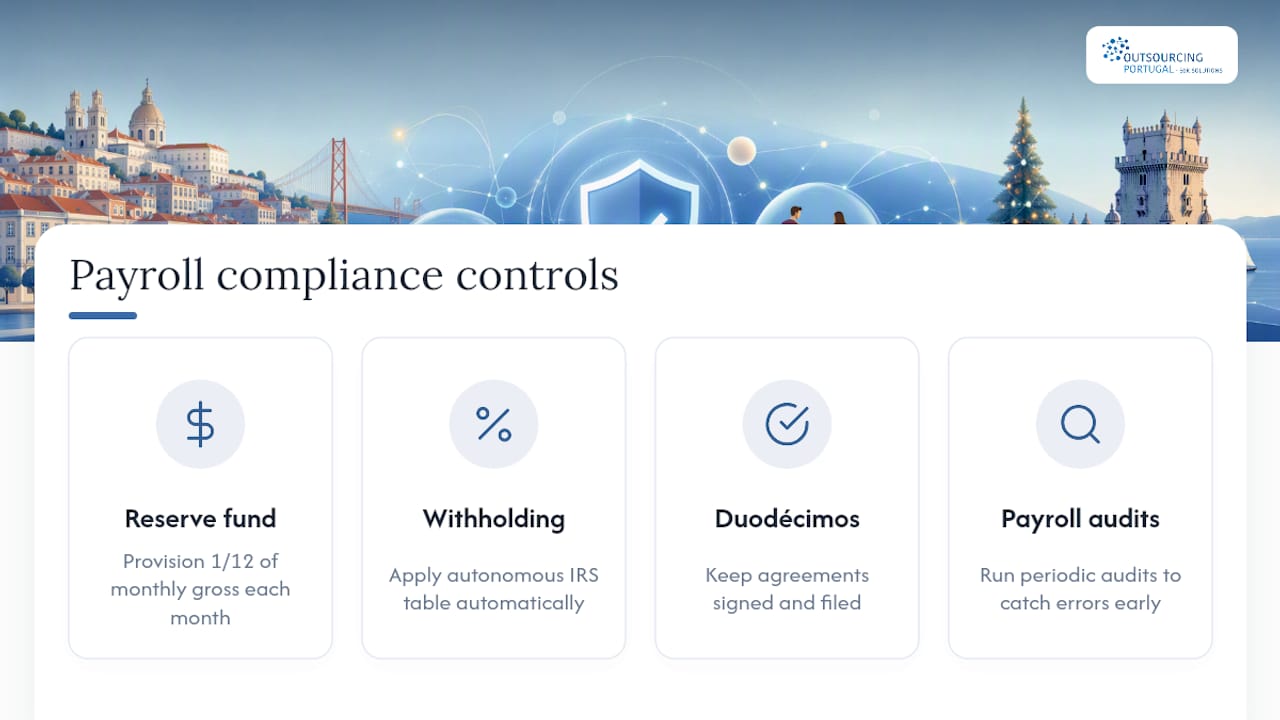
Most subsidy disputes trace back to weak internal controls, not bad intentions. Provisioning one twelfth of each employee’s monthly gross pay into a reserve fund every month, rather than scrambling for cash in June and December, is standard practice for preventing the liquidity crunch that catches smaller companies off guard.
Beyond provisioning, solid payroll operations rest on a few concrete habits: applying the autonomous IRS withholding table automatically rather than manually, keeping every duodécimos agreement signed and filed, and running a periodic payroll audit to catch miscalculated proportional amounts before they become ACT complaints.
International employers hiring in Portugal without a local entity face an added layer of risk, since they’re often unfamiliar with deadlines like December 15 or the documentation Social Security expects for prestações compensatórias claims. A local payroll partner or Employer of Record absorbs that compliance burden directly, applying Portuguese payroll rules without the employer needing to build that expertise in-house.
Why the Real Risk Isn’t the Payment, It’s the Paper Trail

Most guidance on Portuguese subsidies treats them like a math problem: get the formula right and you’re done. That’s not where employers actually get burned. The formula is genuinely simple, one month’s pay, prorated by time worked, and any competent payroll system handles it without drama. The exposure comes from documentation gaps: an oral duodécimos arrangement nobody wrote down, a payslip that lumps the subsidy into regular withholding, an employee on extended sick leave who nobody flagged for a prestações compensatórias claim.
Conventional advice stops at “pay by December 15.” It rarely mentions that ACT treats a missing written agreement as grounds to reject a duodécimos defense entirely, or that Social Security’s six-month claim window quietly expires on plenty of eligible workers who simply didn’t know the benefit existed. If you’re an employer, the priority isn’t memorizing the formula, it’s building the audit trail: signed agreements, correct withholding tables, and a habit of checking in on employees returning from long leave. If you’re a worker, the priority is knowing your deadlines exist at all, because Social Security won’t chase you down to remind you.
— Paulo
Get Compliant Payroll Support for Subsídios in Portugal
Calculating proportional subsidies correctly, applying the right autonomous withholding table, and keeping duodécimos agreements on file takes ongoing attention, not a one-time setup. Payroll outsourcing services handle this directly for international companies hiring in Portugal, so you’re not the one tracking December 15 deadlines or Social Security claim windows from another country.
Our payroll services cover the full cycle: subsidy calculations, IRS and social security withholding, monthly provisioning advice, and support if an employee needs to file a prestações compensatórias claim after extended leave. For companies without a Portuguese entity, our Employer of Record model takes on the legal employer role entirely, so subsidy compliance sits with a team that processes it every month rather than once a year. If you want a second set of eyes on your current setup, request a payroll compliance review and we’ll flag any gaps before ACT does.
Where to Verify the Rules Yourself
Cross-check anything here against the primary sources. Social Security’s own prestações compensatórias page covers eligibility and claims directly, while article 263.º of the Código do Trabalho sets the legal text itself. For a quick proportional-amount check, DadosFiscais’ calculator gives a reasonable estimate before you confirm the final figure with payroll.
Sources
- Prestação compensatória dos subsídios de férias e Natal (Segurança Social guidance)
- Artigo 263.º – Subsídio de Natal – o informador fiscal
- Calculadora de Subsídio de Férias e Natal (DadosFiscais)
- Subsídio de Natal: o que diz a lei e como calcular (Montepio)