

To hire compliantly in Portugal, you must register as an employer with Segurança Social, declare each new hire before their start date, and make sure payroll, work-accident insurance, and social-security enrollment are all active from day one. Skip any of those steps and you’re not just risking a fine. You’re operating with an employee who technically isn’t covered.
Three names matter here: Segurança Social (Social Security), the Código do Trabalho (Portuguese Labour Code), and the Autoridade Tributária (the tax authority). Employer social-security contributions run at roughly 23.75% of gross pay, a figure that needs to sit in your cost model before you make an offer, not after.
Late admission reporting and uninsured employment both carry real financial exposure, and enforcement has tightened rather than loosened.
What to do in the next 24 to 72 hours:
- Register your company as an employer with Segurança Social if you haven’t already.
- Collect the new hire’s NIF (tax number) and NISS (social security number).
- Confirm work-accident insurance coverage is bound before the person’s first working day.
Pro Tip: Don’t wait for the signed contract to start the insurance and registration process. Run them in parallel. A contract sitting in someone’s inbox for three days is a contract with an uninsured worker behind it.
Key Takeaways
Compliant hiring in Portugal depends on registering with Segurança Social, filing the admission report before the start date, and activating work-accident insurance and payroll from day one.
| Point | Details |
|---|---|
| Report hires before start date | Late Social Security admission triggers penalties and contribution liability. |
| Budget for 14 payments | Holiday and Christmas subsidies add roughly two months of cost beyond base salary. |
| Get contract clauses right | Include identification, duties, pay, hours, probation, and insurance policy details in writing. |
| Match insurance to start date | Work-accident insurance must be active before the employee’s first working day. |
| Consider an Employer of Record | Outsourcing-portugal’s EOR service centralizes registration, payroll, and insurance to close these gaps fast. |
Table of Contents
- Texas Labor Laws Comparison: A Chronological Hiring Checklist For Portugal
- What Information Must Be In A Portuguese Employment Contract?
- How Much Do Employers Pay In Payroll Taxes And Social Security?
- What Are The Working Hours And Leave Rules In Portugal?
- What Are Employer Health, Safety, And Telework Obligations?
- When Can An Employer Terminate An Employee In Portugal?
- Should You Use An Employer Of Record Instead Of A Local Entity?
- What Workplace Notices And Postings Must Employers Display?
- Does Portugal Have Family And Medical Leave Requirements?
- Are Employees Classified As Exempt Or Nonexempt In Portugal?
- Is Paid Sick Leave Required For Employees In Portugal?
- What Employee Privacy Rights Exist In The Workplace?
- How Employment Outsourcing Prevents Onboarding Mistakes
- How Outsourcing-portugal Handles Compliance For You
- Sources
Texas Labor Laws Comparison: A Chronological Hiring Checklist For Portugal
International HR teams often ask how “Texas labor laws” style checklists translate to Portugal. The honest answer: they don’t translate directly, because Portugal runs on its own statutory timeline, and that timeline is unforgiving about sequence. Here’s the order that actually works.
- Lock the offer and draft the contract. Have identification details, job title, salary, and start date finalized before you send anything for signature.
- Register as an employer with Segurança Social, if this is your first Portuguese hire, and confirm your employer number is active.
- Report the admission via Segurança Social Direta before the contract start date. This is the single most time-sensitive step in the entire process.
- Bind work-accident insurance and schedule the occupational health admission exam so both are effective on day one.
- Collect NIF and NISS, set up tax withholding with the Autoridade Tributária, and confirm the payroll calendar accounts for 14 annual payments, not 12.
Recurring monthly tasks once someone is onboarded:
- Remit Social Security contributions (typically due by the 20th of the following month).
- Process IRS (income tax) withholding alongside net pay.
- Reconcile payslips against the 13th and 14th payment schedule ahead of June and December.
A compliant hiring process requires legal, payroll, tax, and occupational safety functions to move together, not in sequence after the fact. Missing the pre-start-date admission report is the most common and most expensive slip HR teams make, and it’s largely avoidable with a shared calendar. Our own hiring compliance checklist breaks this sequence down further if you’re building it internally.
What Information Must Be In A Portuguese Employment Contract?
Not every hire needs a written contract, but several common categories do, and getting the form wrong has consequences beyond an administrative headache.
Contract types that show up most often in international hiring: permanent (open-ended), fixed-term, contracts of unspecified term, part-time, telework, and temporary agency work. Fixed-term and telework contracts must be in writing. Skip that requirement and you risk the contract being reclassified as permanent, along with an administrative offence on top of it.
Whatever the contract type, Portuguese law requires certain information to appear in writing:
- Full identification of both employer and employee.
- Place of work and job duties.
- Remuneration, including any variable components.
- Working hours and schedule pattern.
- Probation period length.
- Work-accident insurance policy details.
- Applicable collective bargaining instrument, if one applies.
Probation typically runs from 90 days for most permanent roles up to longer periods for senior or highly technical positions, and notice requirements scale with contract type and tenure. Our guide to employment contract types in Portugal walks through which category fits which hiring scenario.
Pro Tip: If you’re using a fixed-term contract, write down the specific, temporary business reason for it (a project, a leave cover, a demand spike) at signing, not later. Courts and inspectors look for that justification, and its absence is one of the fastest routes to automatic conversion to a permanent contract.
How Much Do Employers Pay In Payroll Taxes And Social Security?
Payroll in Portugal runs on numbers most international finance teams don’t expect until they see them. Employer social-security contributions sit at roughly 23.75% of gross salary, while employees contribute around 11%, both calculated against gross pay each pay cycle.

Then there’s the 14-payment structure. Employees receive salary 12 times a year plus a holiday subsidy and a Christmas subsidy, each typically equal to one month’s pay. Budget for 12 months and you’ll be short by roughly two months’ worth of salary cost when the subsidies land, usually around June and December.
Employers withhold IRS income tax and Social Security contributions from each payslip, remit them to the Autoridade Tributária and Segurança Social respectively, and report new hires through Segurança Social Direta before the employee’s first day. Miss that admission window and you’re exposed to penalties layered on top of the contribution liability itself.
| Task | Deadline / Frequency |
|---|---|
| Employer registration with Segurança Social | Before first hire, one-time |
| New hire admission report | Before contract start date |
| Monthly Social Security payment | Typically by the 20th of the following month |
| Holiday and Christmas subsidy payments | Around June and December each year |
One change worth tracking: the planned Simplificação do Ciclo Contributivo will shift how contributions are calculated, using worker records directly rather than employer-submitted declarations, starting in 2027. Data accuracy now sets you up for that transition rather than against it.
Common configuration mistakes worth flagging early:
- Treating the 14-payment structure as optional or negotiable. It isn’t.
- Setting up payroll on a 12-month annual cost basis and getting blindsided by subsidy months.
- Delaying the admission report until after the contract is signed rather than filing it in parallel.
Our payroll services page covers the practical mechanics of payslip structure, tax withholding, and remittance timing in more depth.
What Are The Working Hours And Leave Rules In Portugal?
The standard working week caps at 40 hours, typically structured as 8 hours a day across five days, with mandatory daily and weekly rest periods built into the schedule. Overtime is permitted but capped, and it triggers premium pay rather than straight-time compensation once the standard hours are exceeded.
Minimum wage was set at €870 per month from January 2025, and that figure combines with the 14-payment structure to shape real annual cost, not just the headline monthly number.
Annual leave sits at a minimum of 22 working days, and first-year hires typically accrue leave proportionally rather than receiving the full entitlement immediately.
Points worth building into your onboarding math:
- Overtime pay requires a documented business justification, not just manager approval.
- Rest periods between shifts are a compliance item, not a scheduling suggestion.
- New hires in their first calendar year should have accrual mechanics explained clearly, since it affects when they can actually take time off.
What Are Employer Health, Safety, And Telework Obligations?
Employers carry a legal duty to run risk assessments, maintain a safe working environment, and keep training and safety records current. This applies whether the role is office-based, remote, or hybrid.
Work-accident insurance isn’t optional; it must be active from the employee’s first working day, and the policy number typically belongs in the written contract information itself.
Telework arrangements need their own written agreement, separate from the general employment contract, covering the work location, working hours, equipment provided, and reimbursement for costs like energy and connectivity. Permanent telework agreements commonly carry a 60-day notice period for termination, longer than the notice on many standard contract changes.
Pro Tip: Schedule the occupational health admission exam for the same week as the insurance activation and the Social Security report. Three separate teams handle these three items, and if they run on different clocks, you end up with an employee working before one of them is actually in place.
When Can An Employer Terminate An Employee In Portugal?
Termination grounds are a closed list, not a flexible menu. Lawful reasons typically include just cause dismissal (serious misconduct), collective dismissal, position elimination, and mutual agreement, each carrying its own procedural steps, including documented disciplinary processes and required consultation periods.
Severance calculations generally follow statutory baselines tied to tenure and salary, though the exact figure depends on contract type and the grounds for termination, so treat any single number as a starting point for legal review rather than a formula to apply blindly.
Transfer of undertakings (what most international teams know as TUPE) works on an automatic-transfer principle: employee contracts, seniority, and accrued rights move to the new employer without needing fresh consent. An employee can object in specific circumstances, and how that objection is handled needs its own procedural care.
The mistakes that turn a termination into a lawsuit almost always come down to procedure, not substance:
- Skipping the required consultation or written notice steps.
- Failing to document the specific grounds relied on.
- Treating a business reorganization as a shortcut around individual dismissal procedure.
Should You Use An Employer Of Record Instead Of A Local Entity?
Setting up a Portuguese entity gives you full control but takes weeks of registration, banking, and administrative setup before you can pay anyone. An Employer of Record lets you have someone working legally within days, with the EOR provider holding the registration, insurance, and payroll compliance on your behalf.
The trade-off is straightforward: speed and compliance coverage against direct operational control. For a first hire, a market test, or a small nearshore team, an EOR usually wins on time and risk. For a larger, long-term operation planning dozens of hires, a local entity can make more financial sense eventually.
Before choosing a provider, check:
- Registration and licensing status with Portuguese authorities.
- Track record on payroll accuracy and timely Social Security reporting.
- Confirmed work-accident insurance coverage for every employee, not just a subset.
- Data handling practices and clear service-level agreements on response times.
A coordinated outsourcing approach reduces the friction between legal, payroll, and HR teams that usually causes the timeline slips discussed above.
Pro Tip: Ask any prospective EOR provider how they handle the pre-start-date admission report specifically. If they can’t describe that step in detail, they haven’t done it enough times to be trusted with it.
What Workplace Notices And Postings Must Employers Display?
Employers in Portugal must display specific information where employees can readily access it, typically covering working hours, rest day schedules, and the applicable collective bargaining instrument if one governs the role. Internal regulations on safety procedures and emergency contacts also need to be posted or otherwise made available, particularly in any workplace with physical health and safety risks.
For remote and hybrid teams, “posting” shifts from a physical notice board to a digital equivalent. HR teams should keep an accessible, dated record of working-hours policies, safety guidance, and any internal regulations, since employees working from home still need the same access to this information as someone walking past a break-room board. Keep these documents version-controlled. An outdated posting is functionally the same compliance gap as no posting at all.
Does Portugal Have Family And Medical Leave Requirements?
Portugal’s parental leave system is one of the more generous frameworks in Europe, and it applies regardless of where the employer’s headquarters sits. Maternity and paternity leave (parental leave, in Portuguese terms) typically runs for a defined number of weeks shared between both parents, with specific portions reserved exclusively for the father and paid through Social Security rather than directly by the employer.
Employees also have statutory rights to leave for serious illness of a child or family member, documented through medical certification submitted to the employer and, where relevant, to Social Security. Eligibility generally depends on the employee’s registered Social Security contribution history, which is one more reason the admission report and ongoing contribution accuracy discussed earlier in this guide matter well beyond the hiring moment itself.
HR teams managing international staff should build a simple internal process: a documented request form, a clear escalation path to confirm eligibility with Segurança Social, and a payroll flag so leave periods don’t get miscoded as unpaid absence.
Are Employees Classified As Exempt Or Nonexempt In Portugal?
The exempt versus nonexempt distinction familiar from US-style employment law doesn’t map cleanly onto Portugal’s framework. Portuguese law instead distinguishes primarily by working-time regime: standard schedule employees, employees under isenção de horário de trabalho (exemption from fixed schedule, often for management or highly autonomous roles), and part-time employees.
Employees classified under a schedule exemption typically don’t earn overtime pay in the traditional sense, since their role structure assumes some flexibility in hours worked. Everyone else, effectively most of the workforce, falls under standard working-time rules, meaning hours beyond the 40-hour week trigger overtime premiums.
Misclassifying someone into a schedule exemption without genuine justification, just to avoid overtime obligations, is a common and costly HR error. Portuguese labor inspectors look closely at whether the role actually carries the autonomy and seniority the exemption assumes, not just what the contract label says.
Is Paid Sick Leave Required For Employees In Portugal?
Sick leave in Portugal runs through the Social Security system rather than as an employer-funded benefit in the way some markets structure it. Employees who fall ill submit medical certification, and Social Security pays a sickness subsidy calculated as a percentage of the employee’s registered earnings, with the percentage and waiting period varying by the length of the absence.
This is precisely why accurate, timely Social Security registration matters beyond the hiring moment. An employee whose contribution record isn’t correctly filed can face delays or reductions in their sickness subsidy eligibility, a problem that traces directly back to payroll and admission accuracy rather than anything the employee did wrong. Employers don’t typically continue paying full salary during an extended illness. They coordinate the paperwork that lets Social Security take over that responsibility.
What Employee Privacy Rights Exist In The Workplace?
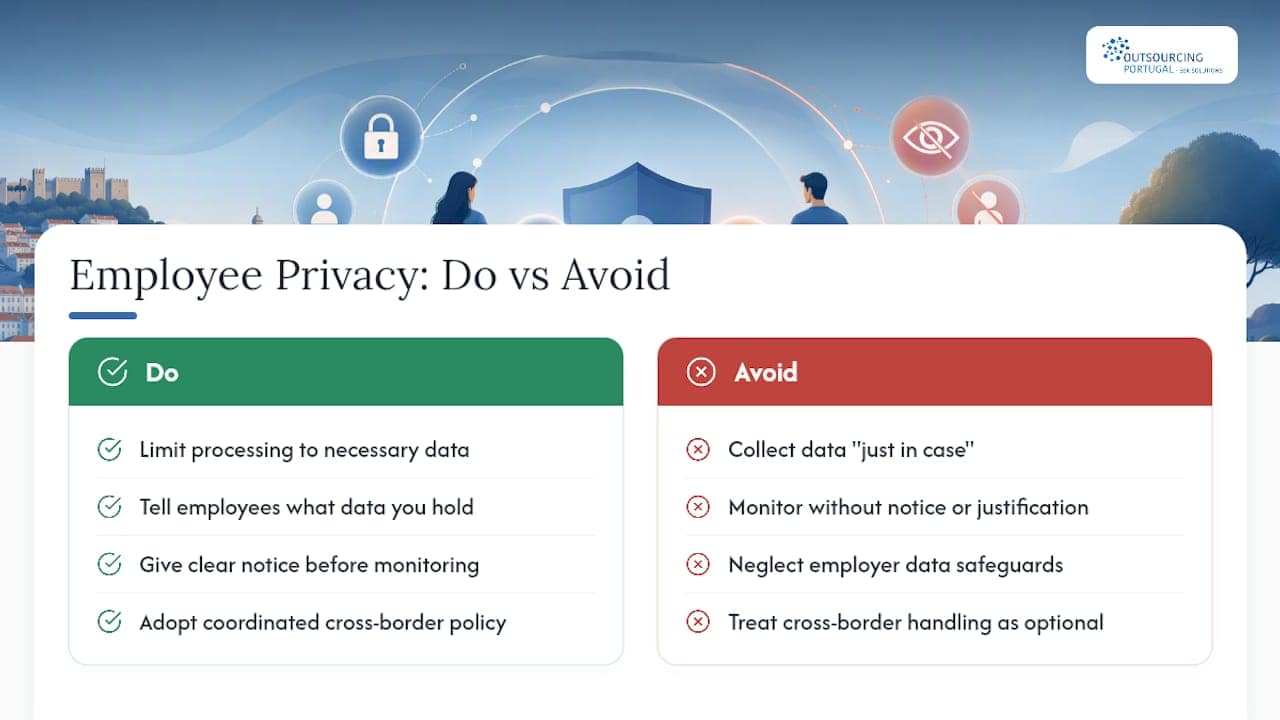
Employee privacy in Portugal sits under both the Código do Trabalho and the EU’s General Data Protection Regulation (GDPR), and the two frameworks reinforce each other rather than conflict. Employers may only collect and process personal data that’s genuinely necessary for the employment relationship, and employees have a right to know what data is held and why.
Monitoring of employee communications, email, or workplace activity is heavily restricted and generally requires clear, advance notice along with a legitimate, proportionate business justification. Employers can’t simply monitor everything “just in case.” Confidentiality obligations typically run both directions: employers must safeguard employee personal data, and employees are frequently bound by confidentiality clauses regarding company information, particularly in roles with access to client data or proprietary systems.
For international HR teams managing personal data across borders (payroll files, immigration documents, medical certifications), this is an area where a coordinated data-handling policy between HR, payroll, and any outsourcing partner isn’t a nice-to-have. It’s a legal requirement with GDPR-level penalties attached to it.
How Employment Outsourcing Prevents Onboarding Mistakes
The mistake we see most often isn’t a bad contract. It’s a signed contract sitting for a week while the Social Security admission report gets filed late, because payroll, legal, and occupational health were working from three different timelines.
Fixing it usually means one shared start-date calendar across legal, payroll, and occupational health, with immigration checks folded in for any foreign hire and every registration document kept audit-ready from day one, not assembled retroactively when an inspector asks.
How Outsourcing-portugal Handles Compliance For You
Every step in this guide, the Social Security admission, the payroll configuration, the insurance activation, the contract clauses, is exactly what Outsourcing-portugal manages daily for international companies hiring in Portugal without a local entity. Its Employer of Record service registers your hire, remits contributions, and keeps the admission report on schedule, closing the exact compliance gaps this article just walked through.
The practical advantage over building this in-house: you skip the weeks of entity setup and the risk of missing a pre-start-date filing deadline, because the registration and reporting infrastructure already exists and is already compliant. Outsourcing-portugal’s team coordinates legal, payroll, and occupational health as one workflow instead of three separate handoffs. If you’re planning a hire in the next few weeks, check out the Employer of Record services page or reach out directly through the main services overview to get a compliance timeline specific to your hire.
Sources
- Segurança Social — Rights and obligations of employers in Portugal
- Working in Portugal — Portuguese government guidance (English)
- Hiring in Portugal: Labour & immigration compliance guide for employers — LVP Advogados
- Hiring your first employee in Portugal in 2026 — The Portugal Brief
This article is general information, not a substitute for advice from a qualified lawyer. Consult a qualified legal professional about your own circumstances before acting on anything here.