
TL;DR:
- Settlement support in Portugal involves a layered ecosystem of agencies and NGOs that aid expatriates in legal, social, and employment integration. Businesses partnering with local providers can enhance retention by focusing on social bonds and ongoing support rather than just administrative compliance. Structured, multi-month programs emphasizing social inclusion significantly improve expat long-term retention and workplace productivity.
Settlement support is defined as the structured set of services that help expatriates establish legal status, access employment, learn the local language, and build social connections in a new country. For international businesses relocating staff to Portugal, understanding how this system works is not optional. It directly affects how fast your employees become productive, how long they stay, and whether your company stays compliant with Portuguese labor and immigration law. Portugal’s integration framework, anchored by AIMA, CLAIM centres, and organizations like Caritas, offers one of the most distributed settlement ecosystems in the European Union.
What is the role of settlement support in Portugal’s integration system?
Settlement support in Portugal operates through a layered ecosystem of public agencies, local centers, and civil society organizations. Each plays a distinct role, and together they cover the full spectrum of what an expatriate needs to function and thrive.

AIMA (the Agency for Integration, Migration and Asylum) sits at the top of this structure. It handles immigration administration, residency permits, language courses, and employment orientation. AIMA runs rotating weekly services in locations like Espinho and Cascais, bringing tailored assistance directly to expat communities rather than forcing everyone to travel to Lisbon.
CLAIM centres form the operational backbone of local settlement support. The network includes 179 centres that have collectively assisted 763,509 immigrants since 2023. These centres act as mediators between migrants and public bodies, handling everything from legal status questions to housing and education referrals. The CLAIM Portimão centre alone assisted 25,360 migrants from 60 nationalities over 10 years, with direct relevance to sectors like hospitality and construction that dominate the Algarve economy.
Caritas and other NGOs fill the gaps that public agencies cannot. Caritas supported 41,692 people in 2024 alone, providing community-based support that includes food assistance, psychological counseling, and social inclusion programs. The Gulbenkian Foundation also funds projects that promote language learning and civic participation as part of a broader social cohesion strategy.
Here is a breakdown of the core services available across these providers:
| Service type | Primary provider | What it covers |
|---|---|---|
| Residency and legal status | AIMA | Permit applications, document regularization |
| Language learning | AIMA, Gulbenkian Foundation | Portuguese language courses, civic orientation |
| Employment orientation | AIMA, CLAIM | Job market access, credential recognition |
| Community and social support | Caritas, NGOs | Housing, family reunification, psychological support |
| Local mediation | CLAIM centres | Liaison with municipalities, schools, public services |
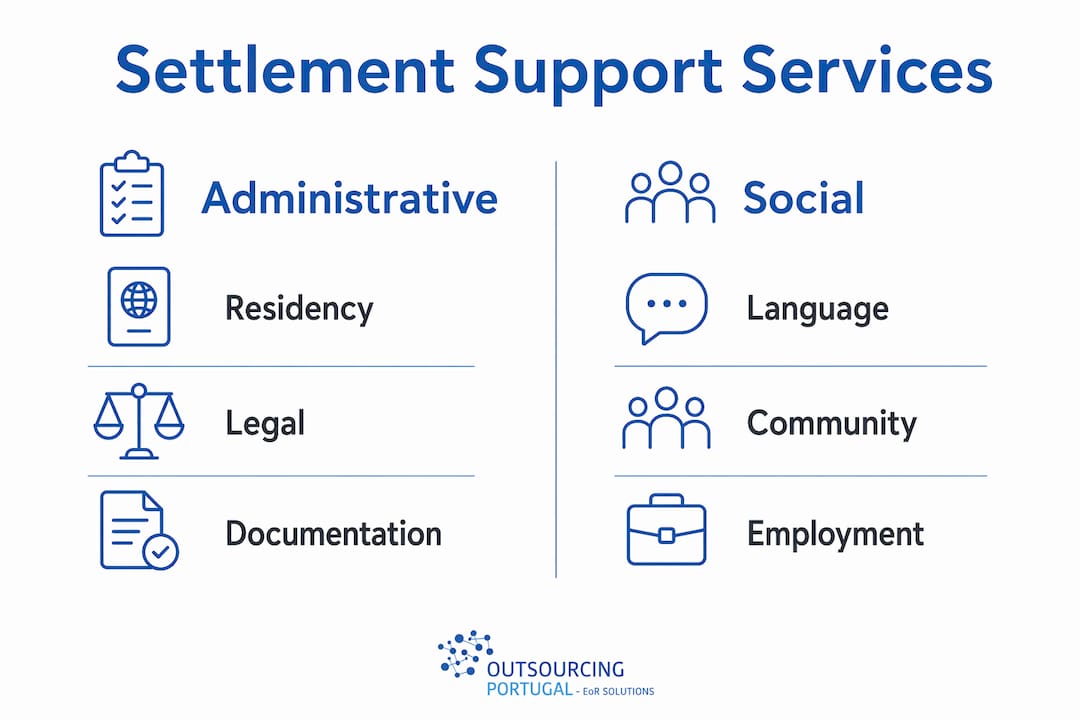
The importance of settlement support becomes clear when you map these services against what your expat employees actually need in their first six months in Portugal.
How does settlement support build social capital for long-term integration?
Settlement support does far more than process paperwork. Research from Western Sydney University identifies three forms of social capital that settlement services actively build: bonding (connections within the expat’s own community), bridging (relationships with the wider Portuguese society), and linking (access to institutions and power structures like employers, government agencies, and civic bodies).
These three dimensions matter because social bonds and orientation beyond paperwork assistance directly shape an expat’s long-term settlement trajectory. An employee who only completes administrative milestones but has no social network in Portugal is a flight risk within 18 months. One who has built genuine community ties, speaks enough Portuguese to navigate daily life, and understands the local labor market is far more likely to stay and perform.
“Settlement services impact broader settlement trajectories by fostering social bonds and providing orientation beyond paperwork assistance.” — Western Sydney University humanitarian migrant study
For businesses, this research has a direct operational implication. Measuring your expat program’s success only by permit approvals and onboarding completion misses the most predictive indicators of retention. Belonging, inclusion, and orientation to the new environment are the outcomes that determine whether your investment in relocation pays off.
Pro Tip: Align language course enrollment and community networking activities with legal administrative milestones. When an expat submits their residency application, that same week is the right time to connect them with a local language program or a CLAIM centre social event. The two tracks reinforce each other and reduce the isolation that often follows the initial bureaucratic rush.
How can international businesses integrate settlement support into expat programs?
The most effective approach for international businesses is to partner with Portugal’s existing settlement infrastructure rather than build internal programs from scratch. The EU 2026 integration update confirms that Portugal’s distributed ecosystem, built on partnerships across municipalities, NGOs, and migrant associations, consistently outperforms centralized approaches.
Here is a practical framework for building this into your expat relocation program:
-
Map local providers before your employee arrives. Identify the nearest CLAIM centre, AIMA rotating service schedule, and any Caritas offices in the destination city. This takes one hour and saves weeks of confusion for your employee on arrival.
-
Design a 6 to 12 month support timeline. Settlement support requires a planned integration period with ongoing check-ins rather than a one-time administrative push. Build monthly touchpoints into your HR calendar for the first year.
-
Assign a local contact, not just a relocation checklist. Whether that is an HR partner, a CLAIM centre counselor, or a Caritas caseworker, your expat needs a named person they can call. Checklists do not answer questions at 9 PM when a housing contract falls through.
-
Measure social connectedness alongside administrative outcomes. Track whether your employee has joined a local community group, enrolled in a language course, or made connections outside the workplace. These indicators predict retention better than permit status alone.
-
Tailor support by sector. A hospitality worker in the Algarve needs different support than a tech professional in Lisbon. CLAIM Portimão’s data on professional activity support for hospitality and construction workers shows that sector-specific guidance on credential recognition and labor rights is one of the highest-value services you can provide.
Pro Tip: The biggest bottleneck in expat settlement is not the residency permit. It is the gap between legal status and social inclusion. Address both simultaneously by pairing every administrative milestone with a social integration activity. Businesses that do this report faster productivity ramp-up and significantly lower early attrition.
What settlement support services do expats use most, and why does it matter?
The benefits of settlement support show up most clearly when you look at which services expats actually use and what happens when those services are absent.
Language and cultural learning programs are the most widely used. Portuguese language courses offered through AIMA and supported by the Gulbenkian Foundation give expats the ability to handle daily transactions, communicate with landlords, and engage with local colleagues. An employee who cannot communicate outside the office is dependent on their employer for everything, which creates both a welfare risk and a productivity drag.
Legal status regularization is the second most critical service. Delays in residency permits create anxiety, restrict travel, and in some cases prevent expats from opening bank accounts or signing rental contracts. AIMA’s rotating services in cities like Cascais and Espinho reduce these delays by bringing processing closer to where expats actually live.
The table below compares the direct impact of key settlement services on your business operations:
| Settlement service | Impact on employee | Impact on business |
|---|---|---|
| Language courses | Faster social integration, reduced isolation | Higher productivity, better team communication |
| Residency permit support | Legal security, freedom to travel | Compliance protection, reduced HR burden |
| Employment orientation | Credential recognition, labor rights awareness | Lower turnover, fewer disputes |
| Family reunification support | Emotional stability, commitment to location | Higher retention, reduced relocation costs |
| Housing and education access | Practical stability | Faster onboarding, fewer emergency absences |
The importance of settlement support for business operations is most visible in retention data. Expats who receive structured settlement support, covering both administrative and social dimensions, are more likely to complete their assignment and consider staying in Portugal long-term. For businesses investing in relocation costs that can run into tens of thousands of euros per employee, that outcome is not a soft benefit. It is a direct return on investment.
You can find a detailed breakdown of how these services fit into a structured relocation timeline in the settlement assistance guide published by Outsourcing-portugal.
Key takeaways
Effective settlement support combines legal administration with social integration to produce expats who stay, perform, and contribute to your business in Portugal.
| Point | Details |
|---|---|
| Portugal’s settlement ecosystem | AIMA, CLAIM’s 179 centres, and Caritas together cover legal, social, and employment needs. |
| Social capital drives retention | Bonding, bridging, and linking social capital predict long-term integration success better than permit status. |
| 6 to 12 month support timeline | Settlement support requires ongoing check-ins over months, not a single onboarding event. |
| Partner with local providers | Partnering with CLAIM and Caritas outperforms building internal centralized programs. |
| Measure social outcomes | Track community connectedness and language progress alongside administrative case completion. |
What I’ve learned about settlement support that most businesses miss
After working with international companies relocating staff to Portugal, the pattern I see most often is this: businesses invest heavily in the legal and administrative side of relocation and almost nothing in what comes after the permit is approved. They treat settlement support as a compliance task rather than a workforce strategy.
The research backs up what I observe on the ground. Social inclusion and community networking are not soft add-ons to a relocation program. They are the variables that determine whether your expat stays past the 18-month mark. Portugal’s integration infrastructure is genuinely strong. AIMA, CLAIM, and Caritas give you a ready-made support network that most countries cannot match. The mistake is assuming your employees will find it on their own.
The businesses that get this right treat settlement support as a multi-month program with named contacts, scheduled check-ins, and measurable social outcomes. They use the workforce settlement guide frameworks as a starting point and then customize based on sector and location. The ones that get it wrong send a relocation checklist and wonder why their expat quit after 14 months.
Portugal’s integration model is distributed by design. That is a strength, not a complexity to work around. Lean into it.
— Paulo
How Outsourcing-portugal supports your expat settlement program
Outsourcing-portugal combines Employer of Record services, payroll management, and settlement support coordination into a single solution for international businesses entering Portugal.
When you hire through Outsourcing-portugal’s EoR and payroll services, settlement support is built into the employment framework from day one. That means residency permit coordination, AIMA registration, and connections to local CLAIM centres are handled as part of your employee’s onboarding, not as an afterthought. For businesses that want to hire in Portugal without setting up a local entity, this removes the single biggest operational risk: an expat who is legally employed but practically unsupported. Explore the full range of employment solutions in Portugal to see how this works in practice.
FAQ
What is settlement support for expatriates?
Settlement support is the set of services that help expatriates establish legal status, access housing and employment, learn the local language, and build social connections in a new country. In Portugal, it is delivered through AIMA, CLAIM centres, and NGOs like Caritas.
How does settlement support help businesses in Portugal?
Settlement support reduces employee attrition, speeds up productivity ramp-up, and protects businesses from compliance gaps related to residency and labor law. Expats with structured support are more likely to complete their assignments and remain in Portugal long-term.
What is CLAIM and how does it support expats?
CLAIM is Portugal’s network of local migrant integration centres, with 179 locations that have assisted over 763,000 immigrants since 2023. CLAIM centres act as mediators between expats and public bodies, covering legal, employment, housing, and education needs.
How long should settlement support last for an expat in Portugal?
Settlement support should cover a minimum of 6 to 12 months post-arrival, with scheduled check-ins throughout. Administrative milestones like permit approval are early steps, not endpoints, and social integration continues well beyond the first few months.
What is the difference between administrative and social settlement support?
Administrative settlement support covers legal status, permits, and document processing. Social settlement support covers language learning, community networking, and civic participation. Both are necessary. Research shows that social integration outcomes predict long-term retention more reliably than administrative case completion alone.