
TL;DR:
- A market entry strategy is a structured plan that guides companies in establishing products or services in new markets. It involves analysis, selecting an entry mode, and careful planning to avoid costly mistakes. Starting with low-control methods and conducting thorough pilots reduces risks and improves chances of long-term success.
A market entry strategy is a structured roadmap comprising research, regulatory analysis, and a go-to-market plan that defines exactly how a company will introduce and establish its products or services in a new market. Getting this plan right separates companies that build lasting positions from those that burn capital and retreat. The core components are market potential, competitive landscape, customer requirements, and legal alignment. Business leaders who treat market entry as a one-time decision rather than a structured process consistently underestimate costs and overestimate speed.
What is market entry strategy and why does it matter?
A market entry strategy is the deliberate framework a company uses to move from “we want to be in that market” to “we are operating profitably in that market.” Without it, expansion becomes guesswork. A systematic entry approach is essential to realistically assess risks and opportunities, facilitating accelerated and more predictable market access.
The strategy forces leaders to answer four questions before spending a dollar. How large is the opportunity? Who already owns the customer relationship? What regulations govern operations? What entry mode fits the company’s risk tolerance? Answering these questions in sequence prevents the most common failure mode: entering a market with a product built for a different customer in a different context.
Market entry planning is also a resource allocation tool. It tells you where to concentrate sales, marketing, and operational investment during the critical first 12–18 months. Companies that skip this step frequently spread resources too thin and fail to achieve the customer density needed to generate word-of-mouth or distribution leverage.
What are the main types of market entry strategies?
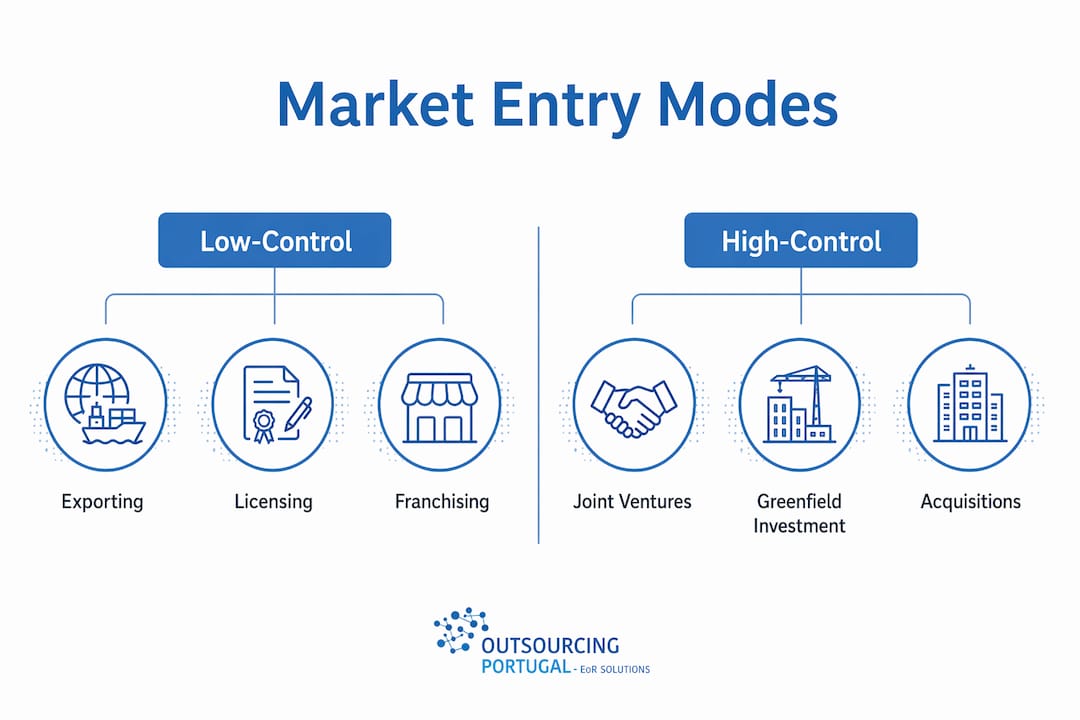
Companies select entry methods by balancing speed, cost, control, and risk. The spectrum runs from low-investment, low-control models to high-investment, high-control models. Each point on that spectrum carries distinct trade-offs.

Low-control entry modes
Exporting is the simplest starting point. A company ships products to a new market without establishing a local presence. Licensing lets a local partner manufacture or sell under the company’s brand in exchange for royalties. Both methods minimize upfront investment but surrender direct control over customer experience and brand positioning.
Intermediate entry modes
Joint ventures and franchising sit in the middle. A joint venture pairs a foreign company with a local partner, sharing both risk and reward. This model works particularly well where regulations limit foreign ownership. Franchising transfers the operating model to a local operator while the franchisor retains brand standards. Both modes provide local knowledge and networks without requiring full ownership.
High-control entry modes
Greenfield investments, acquisitions, and wholly-owned subsidiaries give companies full operational control. A greenfield investment builds operations from scratch. An acquisition buys an existing local business and its customer base. A wholly-owned subsidiary establishes a legal entity in the target country. These modes cost more and take longer, but they protect margins and brand integrity.
| Entry mode | Investment level | Control | Speed to market | Best for |
|---|---|---|---|---|
| Exporting | Low | Low | Fast | Testing demand |
| Licensing | Low | Low | Fast | IP-rich businesses |
| Joint venture | Medium | Shared | Medium | Regulated markets |
| Franchising | Medium | Shared | Medium | Scalable models |
| Greenfield | High | Full | Slow | Long-term commitment |
| Acquisition | High | Full | Medium | Speed plus local base |
| Wholly-owned subsidiary | High | Full | Slow | Full brand control |
Pro Tip: Start with a low-control mode to validate demand before committing to a high-control structure. The data you collect in year one is worth more than the control you sacrifice.
How to systematically develop an effective market entry strategy
Effective market entry requires a nine-step process: objective definition, market analysis, target selection, competition review, distribution validation, value proposition design, go-to-market planning, pilot testing, and scaling. Each step builds on the previous one. Skipping steps does not save time. It creates expensive corrections later.
-
Define objectives. Set specific, measurable goals. “Enter Portugal” is not an objective. “Acquire 200 paying customers in Lisbon within six months at a customer acquisition cost below €150” is an objective.
-
Conduct market analysis. Quantify market size, growth rate, and addressable segments. Identify regulatory requirements, tax obligations, and employment laws specific to the target country.
-
Select target segments. Not every customer in a new market is worth pursuing. Identify the segment with the highest willingness to pay and the lowest switching cost from existing solutions.
-
Evaluate the competitive landscape. Map direct competitors and indirect alternatives. Understand their pricing, distribution, and customer loyalty levels.
-
Validate distribution channels. Confirm that your preferred channel actually reaches your target customer. A channel that works in your home market may be irrelevant in the target market.
-
Design a value proposition for the local context. Translate your core benefit into language and framing that resonates with local buyers. This is not a copy-and-paste exercise.
-
Build a go-to-market plan. Define pricing, launch timing, sales motion, and marketing channels. Assign budget and ownership for each element.
-
Run a pilot. A 90-day pilot creates crucial feedback loops to validate assumptions before large resource commitment. Set clear go/no-go milestones before the pilot starts.
-
Scale or iterate. If the pilot hits its milestones, scale. If it misses, diagnose the specific failure point and adjust before committing further resources.
Pro Tip: Treat your pilot as a scientific experiment, not a soft launch. Define success criteria in writing before day one. Leaders who define success after the fact almost always declare victory prematurely.
Why does localization determine whether your entry succeeds?
Localization requires auditing and adapting pricing, marketing channels, customer support workflows, and product features to meet local cultural codes and buying behaviors. Simple language translation is inadequate for successful market acceptance. This distinction matters because most companies stop at translation and then wonder why conversion rates disappoint.
True localization covers several dimensions that translation never touches:
- Pricing structure. A price point that signals premium quality in one market signals unaffordability in another. Local purchasing power and competitive benchmarks must drive pricing decisions.
- Payment preferences. Customers in some markets expect invoice payment terms. Others expect mobile payment options. Offering only your home-market payment method creates unnecessary friction.
- Marketing channels. A LinkedIn-first strategy works in some B2B markets and fails in others where industry relationships are built through trade associations or in-person events.
- Customer support protocols. Response time expectations, preferred communication channels, and escalation norms vary significantly across cultures.
- Product features. Features that drive adoption in one market may be irrelevant or confusing in another.
The hardest localization challenge is behavioral. The biggest competitor in new markets is often entrenched customer habits and existing solutions rather than direct industry rivals. Customers do not switch because a new option exists. They switch when the new option is demonstrably better in ways they already care about. Effective entry strategies focus on displacing these existing behaviors, not just outcompeting other vendors.
Pro Tip: Commission a local market audit before finalizing your go-to-market plan. A local consultant will surface payment preferences, channel norms, and cultural sensitivities that no amount of desk research will reveal.
What risks should leaders weigh when choosing an entry method?
Entry mode selection carries financial, operational, and strategic risks that compound over time if chosen poorly. The most common mistake is selecting a high-control mode too early because it feels more “serious,” then discovering the market is smaller or more complex than projected.
High-control entry modes like wholly-owned subsidiaries restrict future business agility. Unwinding a subsidiary is expensive and time-consuming. Leaders must weigh lock-in risk against control benefits before committing.
Local distributors provide swift market access but reduce direct customer control and margins, typically by 15–30%. This trade-off is often worth it in the early stages. The risk is becoming dependent on a distributor whose incentives diverge from yours as the market matures.
Key risks to evaluate before selecting an entry mode:
- Regulatory constraints. Some markets restrict foreign ownership percentages, require local board members, or mandate specific licensing before operations begin. Ignoring these requirements creates legal exposure that can shut down operations entirely.
- Capital lock-in. Greenfield investments and acquisitions require significant upfront capital. If market assumptions prove wrong, that capital is difficult to recover.
- Brand control loss. Licensing and franchising models transfer brand execution to third parties. A single bad local operator can damage brand reputation in ways that take years to repair.
- Margin erosion. Distributor fees, local compliance costs, and currency risk all compress margins in new markets. Model these costs explicitly before setting revenue targets.
The most effective sequencing approach starts with a low-risk entry mode to validate demand, then transitions to higher-control structures as market credibility grows. Outsourcing-portugal’s legal compliance guidance illustrates how companies entering Portugal navigate employment law and regulatory requirements during this transition.
Key Takeaways
A market entry strategy succeeds when it combines rigorous market analysis, a matched entry mode, genuine localization, and a disciplined pilot process before full resource commitment.
| Point | Details |
|---|---|
| Define entry mode by risk tolerance | Match your entry mode to your investment capacity and how much control you need over the customer relationship. |
| Pilot before scaling | Run a 90-day pilot with fixed milestones to validate unit economics before committing significant capital. |
| Localize beyond translation | Adapt pricing, payment methods, marketing channels, and product features to local norms, not just language. |
| Behavioral inertia is the real competitor | Displacing entrenched customer habits requires a demonstrably better offer, not just a new one. |
| High-control modes create lock-in risk | Wholly-owned subsidiaries limit agility; plan a transition path from flexible to full-control structures as the market matures. |
What I’ve learned about market entry that most frameworks miss
Most market entry frameworks are structurally sound but emotionally optimistic. They assume leaders will run the pilot objectively and make rational go/no-go decisions. In practice, the sunk cost of planning creates pressure to proceed even when early signals are negative.
The most valuable discipline I’ve seen in real market entries is writing the failure conditions before the pilot starts. Not just the success metrics, but the specific results that would trigger a full stop. Teams that define failure criteria in advance make cleaner decisions and waste far less capital on markets that were never going to work.
The second lesson is that market entry is an ongoing process, not a one-time event. The companies that build durable positions treat their first 18 months as a continuous learning loop. They adjust pricing, channels, and messaging based on actual customer behavior, not the assumptions in the original plan.
The third lesson is about localization depth. I’ve watched well-funded companies translate their website, hire a local sales rep, and call it localized. Then they wonder why conversion rates are a fraction of their home market. Real localization means rebuilding the customer journey from the local buyer’s perspective, not adapting the existing journey at the margins.
Finally, the choice of entry mode shapes long-term strategic flexibility in ways that are easy to underestimate at the start. A joint venture that makes sense in year one can become a constraint in year three when you want to acquire a local competitor or change your pricing model. Think two moves ahead before signing any partnership agreement.
— Paulo
How Outsourcing-portugal supports your market entry into Portugal
Entering a new market means hiring local talent, managing payroll, and staying compliant with employment law from day one. These operational demands arrive before revenue does, and getting them wrong creates legal exposure that derails the entire entry plan.
Outsourcing-portugal provides Employer of Record and payroll services that let international companies hire in Portugal without setting up a local legal entity. This removes the most common operational barrier to market entry: the time and cost of establishing a subsidiary before you have validated local demand. Outsourcing-portugal handles employment contracts, payroll processing, tax compliance, and HR support so your team can focus on building the market. For companies ready to move from planning to execution, Portugal EOR services are the fastest compliant path to a local workforce.
FAQ
What is a market entry strategy in simple terms?
A market entry strategy is a structured plan that defines how a company will introduce its products or services in a new market, covering research, entry mode selection, and go-to-market execution.
What are the main types of market entry strategies?
The main types range from low-control modes like exporting and licensing to intermediate modes like joint ventures and franchising, and high-control modes like greenfield investments, acquisitions, and wholly-owned subsidiaries.
How long does a market entry strategy take to develop?
Development time varies by market complexity, but a thorough process covering objective setting, market analysis, pilot design, and go-to-market planning typically requires 2–4 months before the first pilot launch.
Why do market entry strategies fail?
The most common causes are inadequate localization, underestimating the difficulty of displacing entrenched customer habits, and committing full resources before validating assumptions through a structured pilot.
What is the best market entry strategy for a new geographic market?
The best approach starts with a low-risk entry mode to validate demand, runs a time-bound pilot with clear success criteria, and transitions to a higher-control structure only after unit economics are confirmed.