
TL;DR:
- Managing workforce compliance requires embedding verification, monitoring, and audits into every stage of employment. Proper governance, automation, and continuous review help organizations stay audit-ready and reduce legal risks. International companies must carefully navigate jurisdictional regulations and leverage specialized services to maintain compliance effectively.
When a Notice of Inspection arrives, you have exactly three business days to produce every workforce compliance record on demand. Miss that window, and fines can reach $28,619 per violation. That is not a hypothetical scenario for international HR teams managing distributed workforces. It is the operating reality in 2026, where federal enforcement has accelerated and regulators are no longer waiting for complaints. A tightly designed workforce compliance workflow is the difference between passing an audit in 72 hours and spending six months in a legal scramble.
Table of Contents
- Key Takeaways
- What your workforce compliance workflow needs first
- Executing the employee compliance process step by step
- Common pitfalls in workforce regulation management
- Verification, audits, and continuous improvement
- My take on compliance as a strategic advantage
- How Outsourcing-portugal supports your compliance workflow
- FAQ
Key Takeaways
| Point | Details |
|---|---|
| Build compliance into onboarding | Embed I-9 verification and document checks into every hire’s first day rather than treating them as afterthoughts. |
| Automate expiration tracking | Use automated alerts for work authorization renewals, certifications, and re-verifications to prevent lapses. |
| Conduct quarterly self-audits | Schedule internal audits at least every three months to catch errors before regulators do. |
| Govern your technology | Apply role-based access controls and audit logs to every HR and compliance platform you use. |
| Prepare a digital war room | Organize records so you can respond to a government audit notice within the three-business-day deadline. |
What your workforce compliance workflow needs first
Before you can design or fix a compliance workflow, you need to understand exactly what regulatory territory you are operating in. For international companies hiring workers in the United States, that means mapping obligations under federal employment eligibility law, wage and hour rules under the Fair Labor Standards Act, state-specific leave and pay requirements, and applicable anti-discrimination statutes.
The foundational documents
Form I-9 sits at the center of employment eligibility compliance. Every U.S.-based employee must have a completed, accurate I-9 on file, regardless of citizenship status. Payroll records, timekeeping data, written offer letters, and signed policy acknowledgments round out the core documentation set. These are not optional records you can reconstruct later. They need to exist, be accurate, and be retrievable within days.
A compliance calendar is one of the most underused tools in HR. It maps every recurring obligation by deadline: I-9 re-verifications, state-mandated harassment training completions, benefits enrollment windows, and payroll tax filings. Without it, your employee compliance process is entirely reactive.

Technology and governance
Modern HR teams rely on a digital HRIS to manage employee records, and a compliance tracking system to monitor status and flag upcoming deadlines. E-Verify, the government’s electronic employment eligibility verification system, is mandatory for federal contractors and strongly recommended for all other employers. Critically, the technology you use must be governed properly.
Automation without governance does not scale. It creates new failure modes. You need role-based access controls so only authorized staff can view or edit sensitive records, and you need immutable audit logs that show who changed what and when.
| Governance Element | Why It Matters |
|---|---|
| Role-based access controls | Prevents unauthorized edits to compliance records |
| Immutable audit logs | Provides a verifiable change history for government review |
| Document version control | Protects against policy drift and outdated procedure use |
| Compliance calendar integration | Surfaces deadlines before they become violations |
Pro Tip: Before purchasing or upgrading any HR compliance workflow software, audit your current data governance setup first. The best software fails when access controls are inconsistent or audit logs are disabled.
Executing the employee compliance process step by step
A well-run workforce compliance workflow is not a checklist you pull out once a year. It runs every time you hire someone, extend a work authorization, process payroll, or face a government inquiry.
-
Verify identity and work authorization on day one. The employee completes Section 1 of Form I-9 on or before their first day of work. The employer completes Section 2 within three business days of the start date. For remote hires, the Alternative Procedure for remote verification requires a live video call during which original documents are examined and a specific checkbox is marked. Over 1.1 million E-Verify-enrolled employers have adopted this procedure since August 2023.
-
Retain document copies from remote verifications. A live video call alone is not enough. Retaining clear copies of identity documents shown during the session is required to maintain an audit-ready trail. Failing to keep copies results in an incomplete record, which auditors treat as a violation.
-
Track authorization expirations proactively. Set automated alerts for temporary work authorization end dates at least 90 days in advance. The same logic applies to professional certifications, training completions, and any time-limited employee credentials your workforce policy adherence program requires.
-
Run quarterly internal audits. The DOL recovered $255.9 million in back wages in FY 2023 alone, with a three-year statute of limitations for willful violations. Quarterly self-audits catch overtime miscalculations, misclassification errors, and I-9 discrepancies before they compound.
-
Correct errors without backdating. If Form I-9 corrections are needed, employees correct Section 1 themselves and employers correct Section 2. Neither party can backdate entries. Corrections must be initialed and dated at the time they are made.
-
Integrate payroll and timekeeping data into your compliance review. Wage and hour compliance is inseparable from accurate timekeeping. Your HR compliance workflow should pull payroll data into audit reviews so you catch off-clock work, missed meal breaks, or minimum wage gaps alongside eligibility issues.
-
Build a digital war room for audit responses. When a Notice of Inspection arrives, you have three business days to produce records. A litigation hold policy and pre-organized digital file structure reduce that response from a crisis to a routine task.
Pro Tip: Download your E-Verify records annually. USCIS stopped hosting data older than 10 years as of January 2026, so historical compliance proof can disappear if you wait too long.
Common pitfalls in workforce regulation management
Even experienced HR teams make the same compliance mistakes. Knowing where failures typically occur lets you design workflows that catch problems early.
-
Misunderstanding remote I-9 rules. Many HR teams think a video call completes the alternative verification procedure. It does not. The authorized representative must physically examine original documents, retain copies, and mark the correct checkbox. An authorized representative performing remote inspection bears personal liability for errors, even if they work off-site.
-
Inconsistent recordkeeping across locations. International companies managing multiple office sites often end up with different procedures in each location. One office uses paper I-9s. Another uses a digital system. Neither has a unified audit log. The result is a compliance gap that appears small until a regulator examines all locations simultaneously.
-
Ignoring document retention schedules. I-9 forms must be retained for three years from the hire date or one year after employment ends, whichever is later. Many employers either destroy records too early or keep them indefinitely without a formal schedule, both of which create problems during audits.
-
Reactive compliance culture. Treating compliance as something you handle when a problem surfaces is one of the costliest mistakes a workforce compliance team can make. Embedding preventive controls rather than relying on reactive correction is the defining trait of audit-resistant organizations.
-
Treating automation as a set-and-forget solution. Automated compliance solutions reduce manual errors, but they require governance oversight. Workflows that send alerts or populate records without human review can propagate errors at scale if the underlying data is wrong.
“Compliance should be treated as an ‘always-on’ discipline. Organizations that embed preventive controls into their hiring and HR workflows spend far less time responding to government investigations because they have far fewer violations to explain.”
For international teams, reviewing a payroll compliance checklist specific to your country of operations adds another layer of protection against the wage and hour issues that auditors target most frequently.
Verification, audits, and continuous improvement
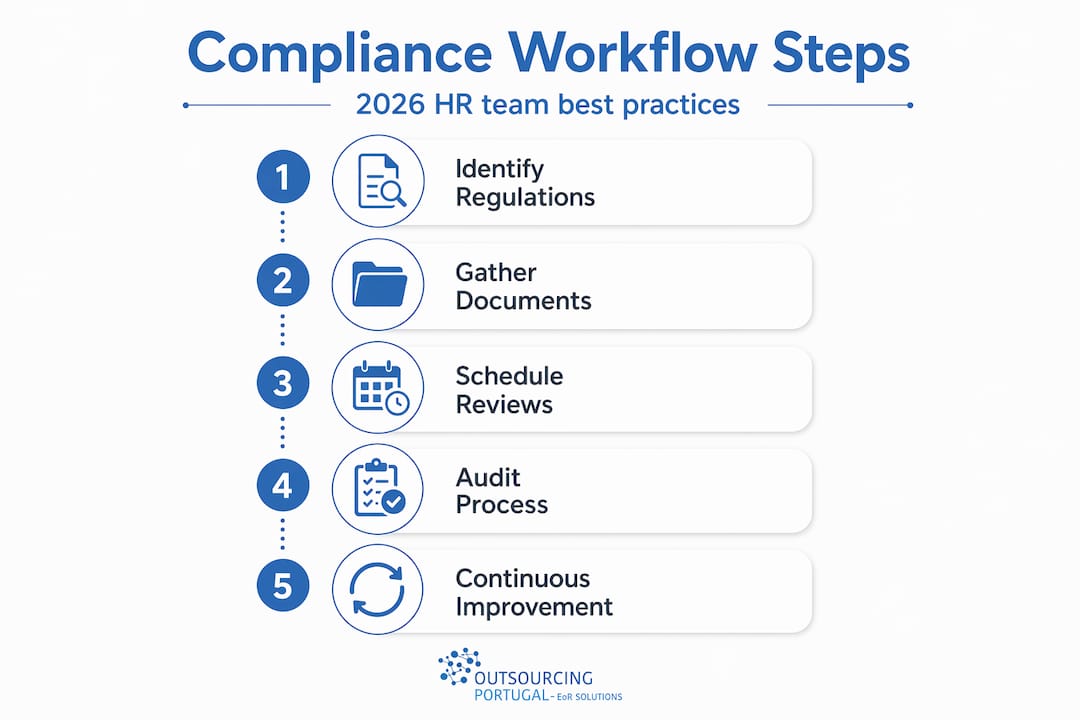
Getting a workforce compliance workflow to a functioning state is step one. Keeping it audit-ready over time requires a structured approach to continuous improvement.
Building a review schedule
| Review Frequency | Activity |
|---|---|
| Monthly | Check for upcoming authorization expirations and certification deadlines |
| Quarterly | Full self-audit of I-9 files, payroll records, and policy acknowledgments |
| Annually | Download E-Verify records, update compliance calendars, and review policy changes |
| After any regulatory change | Update workflows, retrain staff, and update HRIS configurations |
Using data to find risk before it finds you
Compliance analytics tools built into modern HRIS platforms can flag patterns that manual reviews miss: employees whose authorization expires within 60 days clustered in a single department, or a spike in overtime hours that signals a potential wage violation. These tools work best when the HR compliance workflow is already structured with clean, consistent data entry standards.
Training matters more than most compliance officers acknowledge. When managers understand the “why” behind I-9 procedures, they make fewer errors during onboarding. When payroll staff understand wage and hour rules, they catch miscalculations before they appear in a DOL audit. A culture of workforce policy adherence does not emerge from written policies alone. It comes from regular, practical training tied to real scenarios.
Pro Tip: Treat your compliance training program like a product with version numbers. Every time a regulation changes, release a new training version and track completion rates by department. This gives you documented proof of your good-faith compliance efforts if a violation is ever disputed.
On the technology side, staying current matters. Automated compliance solutions evolve quickly, and a tool that was best-in-class two years ago may lack support for the remote I-9 alternative procedure or current E-Verify APIs. Annual technology reviews should be part of your compliance calendar, not an afterthought triggered by a failed audit.
My take on compliance as a strategic advantage
I’ve worked with international HR teams long enough to notice a consistent pattern. The organizations that struggle most with compliance are not the ones that ignore it. They are the ones that treat it as a once-a-year project. They build an I-9 binder, send out a policy email, and consider the box checked. Then an audit notice arrives in February, and suddenly they are hunting for records from 2022.
The teams that get it right do something fundamentally different. They embed compliance into the employee lifecycle so thoroughly that it stops feeling like a separate function. Onboarding has compliance built in. Payroll reviews include compliance checks. When a work authorization is 90 days from expiring, an alert fires automatically. Nobody has to remember because the system does not rely on memory.
What I’ve found surprising is how much this approach reduces HR team stress, not just legal risk. When you know your records are current, your logs are clean, and your workflows are documented, a government audit becomes a process you manage rather than a crisis you survive.
The automation piece is real, but it is not magic. I’ve seen companies implement automated compliance solutions and immediately relax their oversight. That’s when errors scale. Governance has to travel alongside automation. Every automated alert, every digital record, every access control needs a human owner who reviews it periodically. That is not extra work. That is how you streamline compliance workflow for the long term.
— Paulo
How Outsourcing-portugal supports your compliance workflow
Managing a workforce compliance workflow across borders multiplies every risk described in this article. Different jurisdictions, languages, and regulatory frameworks make it easy for critical steps to fall through the gaps. Outsourcing-portugal specializes in removing that risk for international companies hiring in Portugal. Their Employer of Record services handle employment eligibility, payroll compliance, contract management, and ongoing HR regulation management, so your team operates within a fully compliant structure from day one.
Whether you are building a nearshore team in Lisbon or hiring a single specialist, Outsourcing-portugal’s employment and payroll solutions keep your workforce regulation management on track. Speak with their team to find a compliance structure that fits your operations.
FAQ
What is a workforce compliance workflow?
A workforce compliance workflow is the structured set of processes HR teams use to meet employment eligibility, wage, and regulatory requirements across the employee lifecycle. It includes onboarding checks, ongoing monitoring, internal audits, and audit response procedures.
How long do employers have to respond to a government audit notice?
Employers typically have three business days to produce requested records after receiving a Notice of Inspection from ICE or a DOL audit notice. Having pre-organized digital records significantly reduces response time.
What does remote I-9 verification require?
Remote I-9 verification under the Alternative Procedure requires a live video call where original documents are physically presented, copies are retained, and the specific remote verification checkbox on the form is marked. A video call without document copies is not sufficient for audit compliance.
How often should companies run internal compliance audits?
Quarterly internal audits are recommended, particularly for I-9 files and payroll records. The DOL’s three-year statute of limitations for willful wage violations means errors can compound over time if they go undetected.
Can automation replace manual compliance oversight?
Automated compliance solutions reduce errors and flag deadlines efficiently, but they require governance structures including role-based access controls and audit log reviews. Automation without oversight can scale errors rather than prevent them.