
TL;DR:
- Portugal has a strong, diverse workforce with a rapidly developing tech ecosystem.
- High demand and talent shortages for senior IT roles require strategic hiring and pipeline development.
- Proactive local partnerships, community engagement, and compliance support are key to long-term success.
Portugal is one of Europe’s most misunderstood outsourcing destinations. Many international business leaders assume it offers only low-cost, entry-level labor, while others believe the talent pool is too thin for serious tech operations. Both assumptions are wrong. Portugal’s workforce is genuinely strong across many disciplines, its tech ecosystem is maturing fast, and its time-zone alignment with Western Europe makes it a natural nearshore fit. But there is a real tension here: the same digital transformation driving demand for Portuguese talent is also creating fierce competition for senior IT professionals. Understanding that duality is the key to building a successful nearshore operation in 2026.
Table of Contents
- Portugal’s labor landscape: Opportunities and realities
- Key factors driving Portugal’s nearshore outsourcing growth
- Navigating talent challenges: IT gaps and strategic hiring
- Turning Portugal’s advantages into sustainable business growth
- What most companies overlook about hiring in Portugal
- How to get expert support for hiring in Portugal
- Frequently asked questions
Key Takeaways
| Point | Details |
|---|---|
| Labor market advantage | Portugal’s workforce is stable and increasingly attractive for international companies. |
| IT skills gap | Filling advanced tech roles can be challenging due to high competition and industry shortages. |
| Nearshore strengths | Portugal offers a strong tech ecosystem, strategic location, and robust infrastructure for outsourcing. |
| Success strategies | Winning in Portugal means adapting hiring plans, building partnerships, and leveraging expert support. |
Portugal’s labor landscape: Opportunities and realities
Portugal’s overall employment picture is healthier than most people expect. The country’s unemployment rate sits between 5.6% and 6.3%, which is below the EU average, signaling a stable and active workforce. That stability matters for HR leaders planning long-term headcount growth, because it suggests lower workforce volatility compared to markets with boom-and-bust hiring cycles.
However, stability at the macro level does not mean easy hiring across every discipline. Portugal’s competitive workforce is genuinely strong in areas like customer support, finance, legal services, and general software development. The challenge appears when you need senior AI, machine learning, or cloud architecture specialists. Demand for these profiles is outpacing supply, and companies that ignore this reality end up with delayed launches and frustrated hiring managers.
Time-to-fill is a concrete metric worth tracking. IT roles in Portugal can take anywhere from 98 to 127 days to fill, which is significantly longer than general professional roles. If your expansion plan assumes a 30-day ramp, you will miss your targets. Build buffer time into your hiring roadmap from day one.
| Role category | Avg. time-to-fill | Competition level |
|---|---|---|
| Customer support | 20 to 35 days | Moderate |
| General software dev | 45 to 70 days | High |
| Senior IT / AI / ML | 98 to 127 days | Very high |
| Finance and admin | 25 to 40 days | Low to moderate |
“Portugal’s labor market is strong for most roles, but IT talent is a different game entirely. Plan your pipeline accordingly or expect delays that compound over time.”
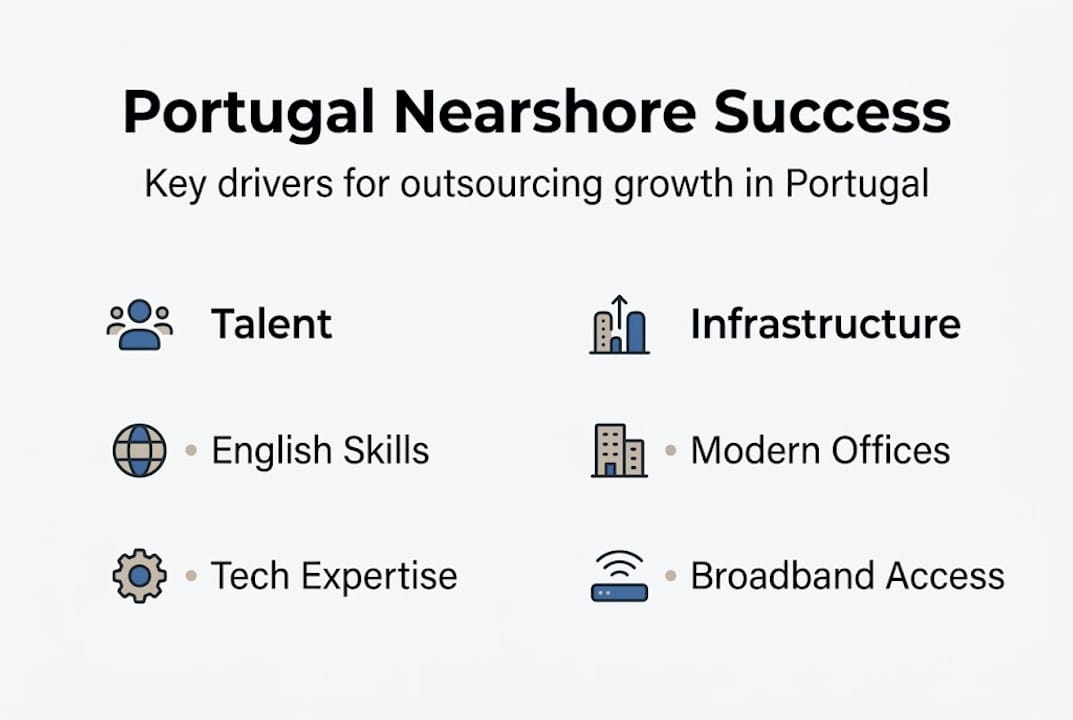
The key reasons companies choose Portugal go beyond cost. Cultural alignment with Western Europe, a high rate of English fluency, and a growing startup scene all contribute. But the smart move is to look beyond Lisbon. Porto has a deep and often underutilized talent pool, and cities like Braga and Coimbra are producing strong graduates in engineering and computer science every year.
Key workforce strengths at a glance:
- Multilingual professionals with strong English proficiency
- EU-compliant employment framework with predictable legal standards
- Growing STEM graduate pipeline from top Portuguese universities
- Active tech communities in Lisbon, Porto, Braga, and Coimbra
Pro Tip: Do not limit your search to Lisbon. Porto and smaller university cities offer comparable talent with less competition and, in some cases, lower salary expectations.
Key factors driving Portugal’s nearshore outsourcing growth
Portugal’s rise as a nearshore destination is not accidental. Several structural factors have converged to make it one of the most attractive options for international companies looking to build European operations without the overhead of Western European pricing.
First, time-zone alignment is underrated. Portugal operates on Western European Time, which means near-perfect overlap with the UK, France, Germany, and the Netherlands. For companies managing distributed teams, that synchronous working window is enormously valuable. No one is waiting until 2 p.m. for a morning standup.
Second, English fluency is genuinely high. Portugal consistently ranks among the top non-native English-speaking countries in Europe, which removes a major friction point for international teams. Your onboarding materials, Slack channels, and client calls can all run in English without translation overhead.
Third, Portugal’s tech development strengths are growing. The country has attracted major tech investments from companies like Google, Mercedes-Benz, and Volkswagen, which signals ecosystem maturity, not just cost arbitrage. That investment is building local expertise and raising the overall skill ceiling.
Despite these advantages, one common mistake is overlooking Portugal’s depth in advanced digital skills. While 85% of companies report IT talent shortages, which is higher than the global average of 73%, this reflects demand outpacing supply rather than an absence of skilled professionals. The talent exists. You need a smarter strategy to find it.
Top reasons companies choose Portugal for nearshoring:
- Skilled, multilingual labor with strong technical foundations
- Strategic location with EU membership and Western European time-zone alignment
- Competitive labor costs compared to Germany, France, or the UK
- Government-backed incentives and a stable regulatory environment
| Country | Avg. senior dev salary (annual) | Time-zone overlap with UK | English proficiency |
|---|---|---|---|
| Portugal | €35,000 to €55,000 | Full overlap | Very high |
| Poland | €40,000 to €65,000 | 1 hour difference | High |
| Romania | €30,000 to €50,000 | 2 hours difference | Moderate to high |
| Germany | €70,000 to €95,000 | 1 hour difference | High |
Portugal’s infrastructure advantages also play a real role. Reliable broadband, modern office spaces, and strong transport links between major cities make operational setup straightforward. This is not a market where you are fighting unreliable connectivity or fragmented logistics.

Navigating talent challenges: IT gaps and strategic hiring
Knowing the IT talent gap exists is one thing. Building a strategy around it is another. The 85% IT shortage rate in Portugal, compared to 73% globally, is not a reason to avoid the market. It is a reason to approach it with more precision than your competitors do.
Porto alone reported over 12,400 ICT vacancies in Q3 2024, which illustrates both the scale of demand and the opportunity for companies willing to invest in pipeline development rather than reactive hiring. If you wait until you have an open role to start building relationships, you are already behind.
Strategies to close the IT talent gap in Portugal:
- Partner with Portuguese universities like Instituto Superior Técnico and Universidade do Porto to access emerging talent early
- Build upskilling programs that convert strong junior candidates into the senior profiles you need
- Engage with local tech communities, meetups, and hackathons to identify high-potential professionals before they are actively job-hunting
- Work with a nearshore partner who already has an established talent network in Portugal
- Consider hybrid models that blend Portuguese senior leads with junior talent for cost-effective team scaling
Statistic callout: 85% of companies operating in Portugal report IT talent shortages, making proactive pipeline management essential, not optional.
Portugal’s tech industry is not a niche. It is a growing ecosystem with real depth, but that depth requires active cultivation. Companies that treat Portugal as a passive talent market where candidates come to them will struggle. Companies that invest in community presence and employer branding will consistently outperform.
Pro Tip: Join local LinkedIn groups, sponsor tech events in Porto and Lisbon, and engage with Portuguese developer communities on GitHub. Visibility in these spaces dramatically reduces your time-to-fill for specialist roles.
Turning Portugal’s advantages into sustainable business growth
The companies that win in Portugal are not the ones with the biggest budgets. They are the ones with the clearest strategy. Portugal’s outsourcing environment rewards patience, local investment, and flexibility. Companies that parachute in expecting instant results consistently underperform against those that build genuine roots.
The IT talent shortages are real, but Portugal’s labor market remains strong for most roles. The practical implication is that you need a tiered hiring strategy: move fast on general roles, build pipelines for specialist ones, and never stop investing in the talent you already have.
Sustainable actions for long-term outsourcing success in Portugal:
- Cultivate local partnerships with universities, staffing agencies, and industry associations to maintain a warm candidate pipeline
- Invest in continuous training and certification programs that develop your existing Portuguese team members into senior roles
- Adopt flexible outsourcing models that allow you to scale up or down based on project demand without violating Portuguese labor law
- Leverage expert EOR solutions to handle employment compliance while you focus on team performance
- Track Portuguese employment trends quarterly and adjust your hiring strategy based on real market data, not assumptions
Pro Tip: Build a quarterly review cadence with your HR team specifically for Portugal. Review salary benchmarks, time-to-fill data, and retention rates. Small adjustments made consistently outperform large reactive changes made in a crisis.
The companies that treat Portugal as a long-term strategic asset rather than a short-term cost play consistently report better retention, stronger team cohesion, and faster growth. That is not a coincidence.
What most companies overlook about hiring in Portugal
Here is the uncomfortable truth: most international HR leaders treat Portugal’s IT talent gap as a dealbreaker when it is actually a filter. It filters out companies that are not serious about building real operations and rewards those that are.
The businesses building the strongest teams in Portugal right now are not the ones with the most attractive job postings. They are the ones showing up consistently in local communities, investing in junior talent, and treating Portuguese professionals as long-term partners rather than interchangeable resources. International firms that succeed in Portugal share one trait: they adapted faster than their competitors to local realities.
Ignoring the talent gap does not make it disappear. It just means someone else’s team is hiring the people you needed. The companies that acknowledge the constraint and build around it are the ones that will own Portugal’s tech talent market in the next five years.
How to get expert support for hiring in Portugal
Understanding Portugal’s talent landscape is the first step. Executing a compliant, efficient hiring strategy is where most companies need support.
At Outsourcing Portugal, we provide end-to-end hiring, payroll, and EoR solutions for Portugal that remove the legal and administrative complexity from your expansion. Whether you are building a tech team in Porto, scaling a customer support operation in Lisbon, or testing the market before committing to a local entity, our global employment solutions give you the infrastructure to move fast and stay compliant. Start with our step-by-step Portugal hiring guide or contact our team directly to discuss your specific hiring goals.
Frequently asked questions
How long does it take to hire IT talent in Portugal in 2026?
On average, IT roles take 98 to 127 days to fill in Portugal due to high demand and specialist skill shortages. Build this timeline into your hiring roadmap from the start.
Is Portugal a good choice for scaling an international tech team?
Yes, Portugal offers a strong general workforce and a growing tech ecosystem, but expect real competition for senior specialist roles. The 85% IT talent shortage reflects demand, not absence of skill, so proactive pipeline strategies are essential.
What cities in Portugal have the largest IT job opportunities?
Porto and Lisbon have the largest concentration of IT vacancies and the most mature tech talent pools. Porto alone recorded 12,400 ICT vacancies in Q3 2024, making it a primary target for tech hiring.
Are labor costs in Portugal competitive with other EU countries for outsourcing?
Portugal consistently offers a better balance of cost and talent quality than Western European markets like Germany or France, making it one of the most competitive nearshore destinations inside the EU.