
TL;DR:
- Proper onboarding in Portugal requires compliance with strict legal documentation and notification deadlines.
- Using local expertise or an Employer of Record can streamline processes, reduce risks, and ensure regulatory adherence.
- Structured integration and early legal support improve employee retention and prevent costly compliance mistakes.
Hiring your first employee in Portugal without a clear onboarding plan is one of the fastest ways to trigger regulatory fines, delay a start date, or lose a great candidate before they even log in on day one. Portugal’s labor framework is detailed and unforgiving for companies that treat it like a formality. This guide walks HR managers and decision-makers through every stage of the process, from mandatory documentation and Social Security registration to cultural integration and compliance verification. Whether you’re building a nearshore team or hiring a single specialist, the steps here will help you move fast without cutting corners.
Table of Contents
- Key requirements for onboarding in Portugal
- Step-by-step onboarding process in Portugal
- Ensuring compliance and avoiding common onboarding mistakes
- Integrating new employees into the Portuguese workplace
- Why traditional onboarding fails in Portugal—and what actually works
- Streamline onboarding with expert support
- Frequently asked questions
Key Takeaways
| Point | Details |
|---|---|
| Start with compliance | Meeting Portuguese legal and administrative requirements is essential before onboarding any employee. |
| Follow detailed steps | A step-by-step approach prevents errors and ensures smooth onboarding every time. |
| Avoid common errors | Missing documents or failed registration can cause fines or project delays. |
| Integrate for success | Engaging new hires with structured integration programs increases retention and productivity. |
| Seek expert support | Most international companies benefit from specialized EOR and payroll solutions for efficient onboarding. |
Key requirements for onboarding in Portugal
Before you schedule anyone’s first day, you need to confirm that the legal and administrative groundwork is in place. Legal hiring and onboarding in Portugal require specific documentation and compliance steps that differ meaningfully from other EU countries. Missing even one item can stall the entire process.
Every new hire in Portugal must have three core identifiers in place: a valid employment contract (contrato de trabalho), a Portuguese tax identification number (NIF, or Número de Identificação Fiscal), and active registration with the Segurança Social (Social Security system). Non-EU nationals also need a valid work permit before onboarding can begin. These aren’t optional extras; they’re the baseline.
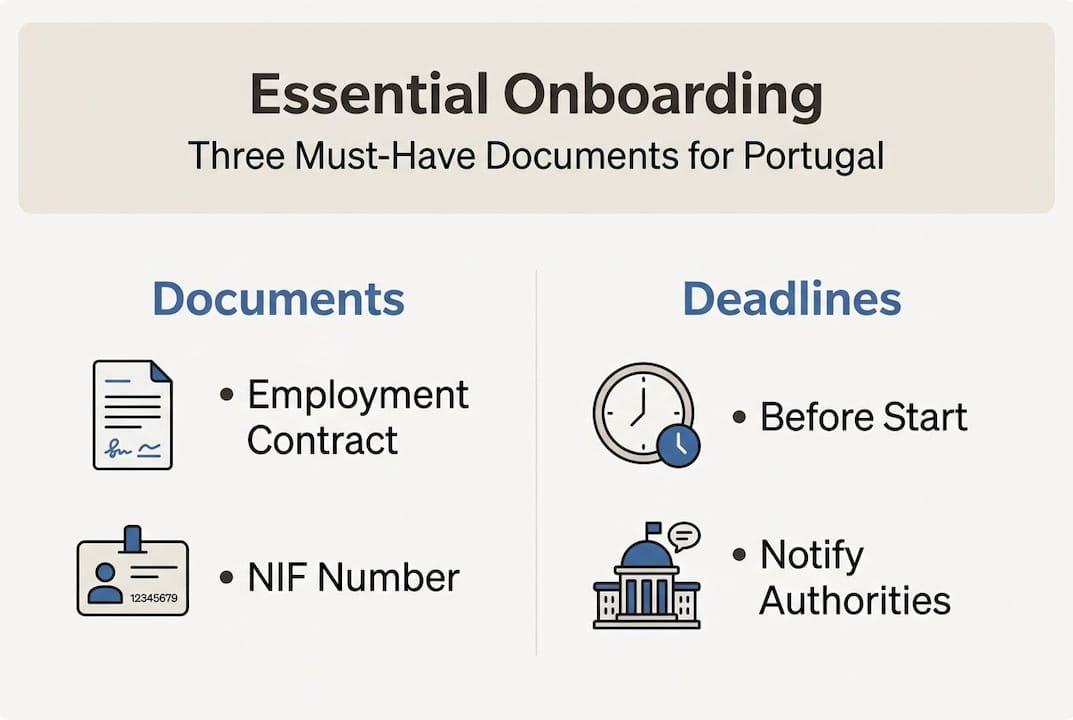
HR teams are also responsible for notifying the relevant authorities within specific deadlines. The employment contract must be communicated to the ACT (Autoridade para as Condições do Trabalho, Portugal’s labor authority) before the employee’s first working day. Payroll setup must be completed so that the first salary is paid on time and includes all mandatory contributions.
Here’s a quick breakdown of the key documents, who owns them, and when they’re due:
| Document | Responsible party | Deadline |
|---|---|---|
| Employment contract | HR/Legal | Before first working day |
| NIF registration | Employee (HR-assisted) | Before contract signing |
| Social Security registration | Employer | Before first working day |
| ACT notification | HR/Legal | Before first working day |
| Health and safety briefing | HR/Operations | Day one |
| Internal policy handout | HR | Day one |
Beyond the table above, HR should prepare a structured orientation package. This includes internal policy documents, a clear explanation of the employee’s role and reporting structure, and any tools or system access they’ll need. Orientation materials should be ready before the employee arrives, not assembled on the fly.
Key items to have ready before day one:
- Signed employment contract (in Portuguese, or bilingual)
- NIF confirmation document
- Social Security registration confirmation
- Payroll system setup with bank details
- IT access credentials and equipment
- Health and safety induction materials
- Internal HR handbook or policy guide
Getting these right from the start sets a professional tone and signals to your new hire that the company is organized and serious about compliance.
Step-by-step onboarding process in Portugal
Once you’ve collected the right documents, it’s time to walk through onboarding step by step. Each stage of onboarding has associated timelines and legal requirements, so sequencing matters.
- Offer acceptance and pre-boarding. Send the signed offer letter and begin collecting the employee’s personal data for contract preparation. Confirm their NIF status. If they don’t have one yet, guide them through obtaining it from the Portuguese Tax Authority (AT).
- Draft and sign the employment contract. The contract must comply with Portugal’s Labor Code (Código do Trabalho). Include role, salary, working hours, probation period, and termination conditions. Both parties must sign before the start date.
- Register with Social Security. The employer must register the employee with the Segurança Social portal before their first day. This activates their entitlement to healthcare, unemployment benefits, and pension contributions.
- Notify the ACT. Submit the employment contract details to the ACT online portal. This step is legally required and must happen before the employee begins work.
- Set up payroll. Configure payroll to reflect the correct gross salary, income tax (IRS) withholding rates, and Social Security contributions. In 2026, employer Social Security contributions sit at 23.75% of gross salary.
- Day one orientation. Walk the employee through health and safety procedures, data privacy policies, anti-discrimination rules, and company values. Assign a buddy or mentor for the first month.
- First month check-ins. Schedule structured touchpoints at week one, week two, and end of month one to address questions and confirm the employee is integrating well.
For international companies managing multiple hires, the comparison below shows where in-house onboarding and outsourcing diverge:
| Factor | In-house onboarding | Outsourced (EOR) |
|---|---|---|
| Legal expertise required | High | Handled by partner |
| Time to first day | 3-4 weeks | 1-2 weeks |
| Compliance risk | Higher | Lower |
| Cost for single hire | Lower | Moderate |
| Scalability | Limited | High |
Pro Tip: Build a digital onboarding checklist using tools like Notion or a dedicated HRIS platform. Assign each task to a responsible owner with a due date. This removes ambiguity and makes it easy to audit your process if a compliance question comes up later. You can also review the detailed hiring process to align your checklist with local legal expectations.
Ensuring compliance and avoiding common onboarding mistakes
With the onboarding roadmap in hand, don’t overlook common pitfalls that trip up international HR teams. Errors in onboarding can lead to regulatory fines and employee disengagement, both of which are expensive to fix after the fact.
The most frequent mistakes HR teams make when onboarding in Portugal include:
- Missing the ACT notification deadline. This is one of the most common errors and can result in immediate fines.
- Incorrect payroll setup. Using the wrong IRS withholding table or failing to account for meal allowances and other mandatory benefits creates payroll errors that are hard to reverse.
- Incomplete Social Security registration. If the employee isn’t registered before their first day, they have no legal employment status in Portugal.
- Failing to provide a written contract. Verbal agreements are not enforceable under Portuguese labor law.
- Overlooking probation period terms. The default probation period varies by contract type and must be explicitly stated.
The consequences go beyond fines. Delayed start dates damage your employer brand. Employees who experience a chaotic onboarding process are significantly more likely to disengage early or leave within the first six months. For international companies, this also creates reputational risk in a market where word travels fast.
“Compliance in Portugal is not a one-time checkbox. It’s an ongoing obligation that begins before the employee’s first day and continues through every payroll cycle.” This is why coordinated handoffs between HR, finance, and legal are non-negotiable.
For compliance steps in Portugal to work smoothly, all three teams need to be aligned on timelines and responsibilities before the hire is confirmed. Finance needs payroll data at least two weeks before the first pay date. Legal needs to review the contract before it’s sent to the candidate.
Pro Tip: Use a pre-boarding phase starting the moment an offer is accepted. Send document requests digitally, verify submissions before the start date, and flag any gaps at least five business days in advance. Pairing this with payroll outsourcing removes a significant layer of administrative risk.
Integrating new employees into the Portuguese workplace
After compliance is covered, supporting new hires’ social and professional integration is essential for retention. Getting the paperwork right is only half the job. The other half is making sure your new employee actually wants to stay.

Effective integration reduces turnover and boosts long-term productivity, and the research backs this up. Companies with structured onboarding programs see up to 82% improvement in new hire retention and a 70% increase in productivity within the first year. Those numbers matter when you’re investing in a new market.
Portugal has a relationship-driven workplace culture. New employees, especially those joining international teams remotely, benefit enormously from being introduced to their colleagues in a structured way. A buddy system, where a more experienced team member is assigned to support the new hire for the first 30 days, dramatically reduces the time it takes to feel connected and productive.
Mandatory onboarding training in Portugal must cover:
- Health and safety procedures (required by law)
- Data privacy and GDPR compliance
- Anti-discrimination and harassment policies
- Company-specific tools, systems, and workflows
- Role-specific technical training
For workplace integration tips that go beyond the legal minimum, consider building a first-month milestone tracker for HR to follow:
- Day 1: Complete legal induction, meet the team, set up systems
- Week 1: Shadow key colleagues, attend team meetings, complete mandatory training
- Week 2: Begin independent work with manager check-ins every two days
- Week 3: First performance conversation and feedback exchange
- End of month 1: Full integration review, confirm probation progress, address any concerns
This kind of structured support isn’t just good for the employee. It gives HR a clear audit trail showing that onboarding obligations were met and that the company invested in the person’s success from day one.
Why traditional onboarding fails in Portugal—and what actually works
Many multinationals arrive in Portugal with a global onboarding template they’ve used in five other countries and assume it will transfer cleanly. It rarely does. Portugal’s labor law is precise, and the ACT enforces it actively. A template built for the UK or Germany will miss local nuances around contract language, probation terms, and notification timelines.
The counterintuitive lesson we’ve seen play out repeatedly is this: simpler, checklist-driven onboarding with native legal support outperforms elaborate global frameworks every time. The companies that struggle most are the ones that treat Portuguese compliance as an afterthought, something to bolt onto their existing process rather than build around.
“The biggest onboarding failures we see aren’t from companies that don’t care. They’re from companies that assumed Portugal works like everywhere else.”
Local expertise isn’t optional here. It’s the difference between a smooth first day and a regulatory investigation. If you’re serious about cost-effective hiring in Portugal, the investment in local legal and HR support pays back quickly in avoided fines, faster start dates, and better retention.
Streamline onboarding with expert support
If you want to skip trial-and-error and avoid costly onboarding mistakes, specialized support can make the difference. Getting onboarding right in Portugal requires more than a checklist. It requires local knowledge, legal fluency, and the ability to move fast without missing steps.
At Outsourcing Portugal, we help international companies onboard employees in Portugal without setting up a local entity. Our Employer of Record Portugal service handles contracts, Social Security registration, payroll setup, and ACT notifications, so your new hire is compliant from day one. Whether you’re hiring one person or building a full team, we handle the complexity so you can focus on the work that matters.
Frequently asked questions
What documents are required to onboard employees in Portugal?
Portugal mandates an employment contract, Social Security registration, a tax number (NIF), and onboarding notifications to local authorities. Specific documentation steps must be completed before the employee’s first working day.
How long does the onboarding process take in Portugal?
Onboarding can typically be completed in one to two weeks if documents are prepared and compliance steps are followed in sequence. Associated timelines and requirements vary depending on the employee’s nationality and contract type.
What are the penalties for non-compliance during employee onboarding?
Regulatory fines, delayed start dates, and loss of work authorization are possible outcomes of compliance failures. Compliance errors can also damage employee trust and increase early turnover.
Is it better to onboard employees in Portugal in-house or use an outsourcing partner?
Large companies and those new to the Portuguese market often benefit from using an Employer of Record to manage compliance and reduce administrative risk. In-house versus outsourced onboarding depends on your team’s local expertise and the volume of hires planned.