
TL;DR:
- Portugal’s strict labor laws and contractor classification risks require specialized employer services for compliance.
- Employer of Record (EOR), local entity setup, and payroll outsourcing are the main models depending on company size and long-term plans.
- Due diligence in choosing a provider is vital to avoid hidden costs, compliance gaps, and operational risks.
Portugal looks like an easy win on paper. A stable EU member state, a talented multilingual workforce, and competitive labor costs make it one of Europe’s most attractive nearshore destinations. But strict dismissal laws and misclassification risk make Portugal’s labor environment far more complex than most international HR leaders expect. Skipping specialized employer services is one of the most common and costly mistakes companies make when entering this market. This guide breaks down exactly what employer services are available, which compliance traps to avoid, and how to match the right solution to your expansion strategy.
Table of Contents
- Why employer services matter in Portugal’s talent market
- Main types of employer services in Portugal
- Key compliance risks and how employer services address them
- How to choose the right employer services in Portugal
- A candid view: What most guides don’t tell you about hiring in Portugal
- Next steps: Expert employer services for Portugal expansion
- Frequently asked questions
Key Takeaways
| Point | Details |
|---|---|
| Strict local regulations | Portugal enforces complex dismissal and classification laws that elevate compliance risks for international employers. |
| EOR vs entity setup | Employer of Record suits rapid hiring for small teams, while entity setup becomes cost-effective for larger, long-term operations. |
| Value of specialized support | Expert employer services simplify hiring, payroll, and compliance—reducing legal and financial exposure for expanding companies. |
| Critical due diligence | Rigorous partner selection and clear compliance insights are essential for successfully hiring talent in Portugal. |
Why employer services matter in Portugal’s talent market
Portugal has earned its reputation as a top nearshore hub, but its employment framework is not forgiving of shortcuts. The country’s labor code is built around strong worker protections, and those protections carry real teeth for employers who don’t know the rules.
Here’s what catches most international companies off guard:
- No-fault dismissal is prohibited after the probation period ends. You need documented, substantiated grounds to terminate any employee.
- Notice periods can run up to 240 days depending on seniority and contract type.
- Severance obligations are legally mandated and calculated based on tenure.
- Contractor misclassification under Law 12/2013 carries fines exceeding €50,000 and can trigger retroactive employment reclassification.
“Portugal enforces strict dismissal laws and high penalties for contractor misclassification, creating significant legal exposure for foreign employers who rely on informal or freelance arrangements.”
The financial stakes are not abstract. Misclassifying a worker as an independent contractor when they function as a full-time employee can result in back-payment of social security contributions, benefits, and severance, on top of the regulatory fines. For a company running lean operations, that exposure can be catastrophic.
This is exactly why compliance in Portugal hiring has become a strategic priority rather than an afterthought. International HR teams are increasingly turning to payroll outsourcing in Portugal because the alternative, managing Portuguese payroll and employment law in-house without local expertise, is simply not sustainable at scale.
The Europe payroll outsourcing market has been growing steadily as companies recognize that regulatory complexity across EU jurisdictions demands specialized support. Portugal is no exception. For international HR managers, the question is no longer whether to use employer services, it’s which type fits your specific situation.
Main types of employer services in Portugal
Not all employer services are the same, and choosing the wrong model for your stage of expansion can cost you time, money, and legal standing. There are three primary approaches available to foreign companies hiring in Portugal.
1. Employer of Record (EOR)
An EOR becomes the legal employer of your workers in Portugal. Your team members work for you operationally, but the EOR handles contracts, payroll, benefits, and full legal compliance. This is the fastest path to hiring without setting up a local entity. The EOR hiring guide outlines exactly how this model works in practice.
2. Local entity setup
You register a Portuguese subsidiary or branch and hire employees directly. Portugal’s ‘Empresa na Hora’ program allows entity creation in as little as one business day, which is genuinely impressive. However, ongoing compliance, tax filings, and HR administration remain your responsibility.
3. Payroll outsourcing
You maintain the employment relationship but outsource payroll processing and reporting to a local specialist. This works well when you already have a local entity but want to reduce administrative burden.
Here’s how the three models compare at a glance:
| Service model | Best for | Speed | Cost | Compliance coverage |
|---|---|---|---|---|
| EOR | Under 8 employees, short-term projects | Fast (days) | Higher per-employee | Full |
| Local entity | 8+ employees, long-term scaling | Slow (weeks/months) | Lower at scale | Requires active management |
| Payroll outsourcing | Existing entity, admin reduction | Moderate | Low to moderate | Partial |
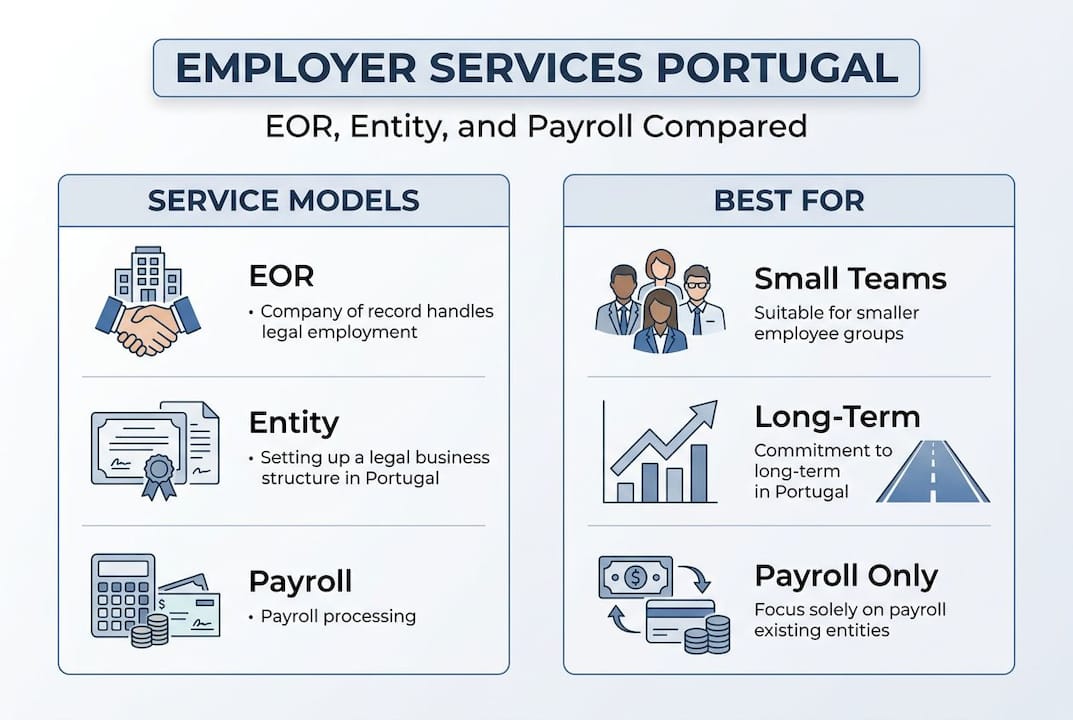
According to cost-effective hiring guidance, EOR is ideal for fewer than 8 employees and short-term projects, while entity setup becomes more cost-effective for larger, long-term teams despite the initial setup delays.
Pro Tip: Portugal’s ‘Empresa na Hora’ is a genuinely fast entity creation tool, but speed of registration does not equal compliance readiness. You still need local HR expertise and a robust payroll process from day one.
For most companies entering Portugal for the first time, employer of record services offer the lowest-risk, fastest path to compliant hiring while you assess whether the market justifies a permanent entity investment.

Key compliance risks and how employer services address them
Compliance in Portugal is not a one-time checkbox. It’s an ongoing operational requirement that evolves with legislation, tax policy, and labor court decisions. Here are the four biggest risk areas international HR teams face:
- Dismissal law exposure: Post-probation terminations require documented cause. Wrongful dismissal claims are common and expensive.
- Contractor misclassification: 70% misclassification risk reported by PwC, with fines up to €50,000 under Law 12/2013. This is not a theoretical risk.
- GDPR data handling: Employee data must be managed under strict EU data protection rules. Payroll systems, HR platforms, and onboarding tools all carry GDPR obligations.
- Tax regime changes: The removal of Portugal’s Non-Habitual Resident (NHR) tax regime post-2024 has shifted the tax landscape for internationally mobile employees, creating new planning requirements.
“The combination of contractor misclassification exposure, GDPR obligations, and post-NHR tax complexity means Portugal’s compliance environment is more demanding in 2026 than it was just two years ago.”
Reputable employer services address these risks by acting as the legal employer of record, maintaining compliant contracts, managing payroll under Portuguese law, and handling GDPR-compliant data processing. They also stay current on legislative changes so you don’t have to.
Use the payroll compliance checklist to audit your current processes, and review compliance strategies for hiring to understand where your gaps may be.
Pro Tip: Even when using an EOR, you retain responsibility for how intellectual property is managed and how employee data flows between your systems and the EOR’s platform. Demand a clear data processing agreement and IP ownership clause before signing any EOR contract.
The companies that get into trouble are rarely the ones who ignored compliance entirely. They’re the ones who assumed their employer service provider had it covered without verifying the specifics.
How to choose the right employer services in Portugal
Selecting the right employer service is not just a procurement decision. It’s a strategic one that affects your legal exposure, your team’s experience, and your ability to scale. Here’s a practical framework for making the right call.
Step 1: Define your employee count and time horizon.
For fewer than 8 employees or a project under 18 months, EOR is almost always the right answer. For larger, permanent teams, entity setup deserves serious consideration.
Step 2: Assess your risk tolerance.
If your industry involves sensitive data or regulated activities, you need a provider with demonstrable GDPR and sector-specific compliance experience, not just a generic EOR platform.
Step 3: Evaluate provider track record in Portugal specifically.
Portugal’s labor code has unique quirks. A provider with broad European coverage but shallow Portugal expertise is a liability. Ask for case studies and references from Portuguese hires.
Step 4: Map compliance coverage to your needs.
Use the table below to align your situation with the right service model.
| Scenario | Recommended model | Key consideration |
|---|---|---|
| Testing the Portuguese market | EOR | Speed and low commitment |
| Building a nearshore tech team (10+) | Local entity + payroll outsourcing | Cost efficiency at scale |
| Short-term project staffing | EOR | Flexibility and compliance coverage |
| Existing entity, growing team | Payroll outsourcing | Reduce admin, maintain control |
As the Portugal EOR decision guide makes clear, EOR versus entity decisions hinge on employee count, time horizon, risk tolerance, and your broader expansion strategy. There is no universal right answer, but there is a right answer for your specific situation.
Step 5: Check for hidden costs.
EOR pricing often looks simple but can include per-employee fees, benefits markups, and exit costs. Get a full cost breakdown before committing.
A candid view: What most guides don’t tell you about hiring in Portugal
Most articles on employer services in Portugal present EOR as the obvious, simple solution and entity setup as the slow, expensive alternative. That framing is too clean.
EOR is fast and genuinely useful, but it comes with real trade-offs that providers rarely volunteer. Co-employment dynamics can create friction around performance management, and IP ownership can become murky when the legal employer is a third party. These are not hypothetical concerns. They surface in practice.
Entity setup looks expensive and slow on a spreadsheet, but for companies building a serious nearshore presence, it creates a level of operational control and employer brand credibility that EOR simply cannot replicate. The companies scaling 20-person tech teams in Lisbon are not doing it through EOR.
The most overlooked risk of all? Assuming your provider handles compliance without verifying it. We’ve seen companies rely on real EOR experience only to discover gaps in GDPR documentation or missing social security filings months later. Due diligence on your employer service partner is not optional. It’s the foundation of everything else.
Next steps: Expert employer services for Portugal expansion
If this article has clarified the landscape, the next move is finding a partner who knows Portugal’s employment market from the inside out.
Portugal employer services from outsourcing-portugal.co.uk cover the full spectrum: EOR hiring, payroll management, legal compliance, and onboarding support for international teams. Whether you’re placing your first hire or scaling a nearshore operation, explore Portugal EOR solutions designed for companies at every stage of expansion. The compliance hiring guide is a strong starting point if you want a structured walkthrough before speaking with an advisor.
Frequently asked questions
Do I need a local entity to hire employees in Portugal?
No. EOR solutions for under 8 employees allow you to hire compliantly without entity setup, though larger or long-term teams often benefit from establishing a local entity for cost and control reasons.
What are the risks of hiring contractors in Portugal?
Contractor misclassification is heavily scrutinized in Portugal, with 70% misclassification rates reported and fines exceeding €50,000 under Law 12/2013, making it one of the highest-risk approaches for foreign employers.
How do employer services help with GDPR compliance?
Reputable employer services manage payroll and HR data under GDPR frameworks, acting as data processors and reducing your company’s direct legal exposure under EU data protection law.
Is Portugal’s fast entity setup suitable for all companies?
Portugal’s ‘Empresa na Hora’ enables rapid entity creation in as little as one day, but ongoing compliance obligations mean it’s only the right fit for companies ready to actively manage Portuguese employment law from day one.