

TL;DR:
- Cultural compatibility is a crucial factor in outsourcing success that is often overlooked during initial assessments.
- Building and maintaining cultural fit require ongoing governance, clear communication norms, and regular recalibration to prevent misalignment.
Firms entering a new outsourcing relationship almost always run the same checklist: labor costs, legal compliance, contract terms, and service-level agreements. What rarely makes that list is cultural compatibility, and that omission is exactly where many otherwise solid outsourcing arrangements begin to break down. Cultural misalignment does not announce itself with a failed project or a missed deadline. Instead, it surfaces slowly through misread emails, decisions that never get escalated, feedback that never lands, and a growing sense that the remote team is operating on entirely different assumptions. For companies outsourcing to Portugal, understanding and actively managing cultural fit is not a soft concern. It is a core success factor.
Table of Contents
- Why cultural compatibility matters in outsourcing
- How cultural fit influences remote work and innovation
- Assessing cultural compatibility: methods and real metrics
- Best practices for building and sustaining cultural compatibility
- What most leaders miss about cultural fit in Portugal outsourcing
- How Outsourcing Portugal helps you achieve culture fit
- Frequently asked questions
Key Takeaways
| Point | Details |
|---|---|
| Cultural fit drives outcomes | Cultural compatibility determines both the success of entry strategy and sustainability of outsourced operations. |
| Use evidence-backed metrics | Go beyond frameworks; track real-world KPIs like trust and communication effectiveness to measure culture fit. |
| Make fit an ongoing process | Sustain cultural compatibility with regular training, explicit norms, and feedback, not just at launch. |
| Portugal offers strategic advantages | Portugal’s workforce and business culture position it as a leading choice for culturally compatible outsourcing in Europe. |
Why cultural compatibility matters in outsourcing
Cultural compatibility in an outsourcing context means more than speaking the same language or sharing a time zone. It refers to the degree of alignment between the values, norms, communication styles, decision-making habits, and professional expectations of a client organization and its outsourced partner. When that alignment is strong, teams move faster. When it is weak, friction builds in every interaction.
“Cultural distance affects internationalization decisions and can reduce subsidiary performance even when overall firm performance effects may be weaker or absent.” This finding, drawn from a meta-analytical review of decades of internationalization research, confirms what experienced HR leaders already sense: cultural friction has measurable operational consequences.
The ways cultural misfit shows up in real outsourcing operations include:
- Communication breakdowns: Teams interpret directness, formality, or silence differently. A terse email that signals efficiency in one culture signals coldness or disrespect in another.
- Misaligned expectations: What counts as “done,” who is responsible for escalation, and how much autonomy is expected all vary across cultures.
- Workflow friction: Meeting norms, documentation habits, and approval processes that work fine domestically can create bottlenecks when applied across cultural boundaries.
- Innovation stifling: Teams that feel culturally unsafe to challenge decisions or offer alternative ideas simply stop doing it, quietly eroding the value outsourcing was supposed to generate.
Portugal has genuine strengths here. Its workforce is highly educated, widely multilingual, and deeply familiar with Western European and North American business norms. Portugal’s strategic edge lies in that combination of proximity to Western values, English proficiency, and a collaborative work culture that adapts well to international partnerships. But compatibility is never automatic. It requires deliberate effort from day one.
How cultural fit influences remote work and innovation
Once you accept that cultural distance affects performance, the next question is: exactly how does it play out in a modern remote or hybrid outsourcing arrangement? The answer is more nuanced than most leaders expect.
Empirical research shows that cultural characteristics including power distance, individualism, and indulgence moderate both how readily employees adopt remote work practices and how effectively that adoption translates into innovation outcomes. In plain terms, a culture that respects hierarchy and avoids uncertainty will experience remote work differently from one that prizes autonomy and experimentation. Neither profile is inherently better, but they do require different management approaches.
Here is a practical comparison that matters for outsourcing decisions:
| Cultural dimension | High power distance teams | Low power distance teams |
|---|---|---|
| Remote decision-making | Waits for manager sign-off | Acts autonomously, reports after |
| Feedback style | Indirect, face-saving | Direct, issue-focused |
| Meeting participation | Defers to seniority | Open debate across levels |
| Innovation contribution | Suggestions flow upward only | Lateral idea-sharing is common |
| Response to ambiguity | Seeks explicit instructions | Comfortable with general direction |
Portugal sits in a moderate position on power distance. Portuguese professionals tend to respect organizational structure but are also accustomed to international work environments that require more lateral communication and self-direction. This means they adapt well to Western remote work models, but they benefit from clear expectations around autonomy, escalation, and feedback cycles.

English proficiency also plays a larger role than most HR leaders initially factor in. When team members are highly proficient, miscommunication from language ambiguity drops sharply, and cultural nuances become far easier to navigate. Portugal consistently ranks among the highest in Europe for English proficiency, which removes one of the biggest sources of remote work friction before it even starts.
Pro Tip: Before finalizing any outsourcing vendor in Portugal, include a structured cultural assessment as part of your due diligence. Tools do not need to be elaborate. A short survey measuring communication preferences, attitudes toward hierarchy, and expectations around autonomy will reveal misalignments early, when they are cheap to address. Use the insights from your HR leaders’ guide to culture fit to frame those questions properly.
Assessing cultural compatibility: methods and real metrics
Most HR leaders reach for established frameworks when they need to assess cultural compatibility. Hofstede’s dimensions, the GLOBE study, and similar models are genuinely useful starting points. They give you a structured vocabulary for describing cultural differences and help you anticipate where friction is most likely.
The limitation, however, is significant. These frameworks are built on national averages. They describe what is statistically typical for a population, not what is true for a specific team, company, or individual. As reviewed in internationalization research, empirical effects of cultural distance are mixed across contexts and outcomes. Using a Hofstede score alone to decide whether a Portugal outsourcing arrangement will work is like using national average traffic data to predict whether you will hit congestion on a specific road at a specific time.
What works better is combining those frameworks with real operational data. Here is a step-by-step approach for assessing cultural compatibility before and after outsourcing begins:
- Map the dimensions that matter most for your workflows. Identify which cultural traits are most likely to affect your specific processes, whether that is decision speed, feedback culture, or documentation habits.
- Interview the team leads, not just the account managers. The people who will actually run the day-to-day work reveal cultural expectations that polished sales presentations never surface.
- Run a structured pilot project. Even four to six weeks of real collaboration produces far more useful data than any pre-engagement survey.
- Track communication patterns. Measure how often clarification requests appear, how long it takes for decisions to be escalated, and how frequently deliverables require rework due to misunderstood requirements.
- Survey trust and psychological safety. Ask team members directly whether they feel comfortable raising concerns or proposing alternative approaches.
- Recalibrate at 90-day intervals. Cultural adaptation is not a static state. What worked at launch may need adjustment as the team grows and projects evolve.
| Assessment type | What it captures | Limitations |
|---|---|---|
| Hofstede-based scoring | High-level cultural tendencies | National averages, not team-specific |
| Communication log analysis | Real breakdown rates and patterns | Time-intensive to analyze |
| Trust surveys | Psychological safety and escalation habits | Requires psychological safety to complete honestly |
| Pilot project review | Actual workflow friction | Needs careful design to be representative |
| Mixed metrics approach | Full operational picture | Most resource-intensive but most accurate |
Measuring culture fit through a mixed approach is not just academic rigor. It is how you avoid discovering a major misalignment six months into a contract when switching costs are high and momentum has been lost.
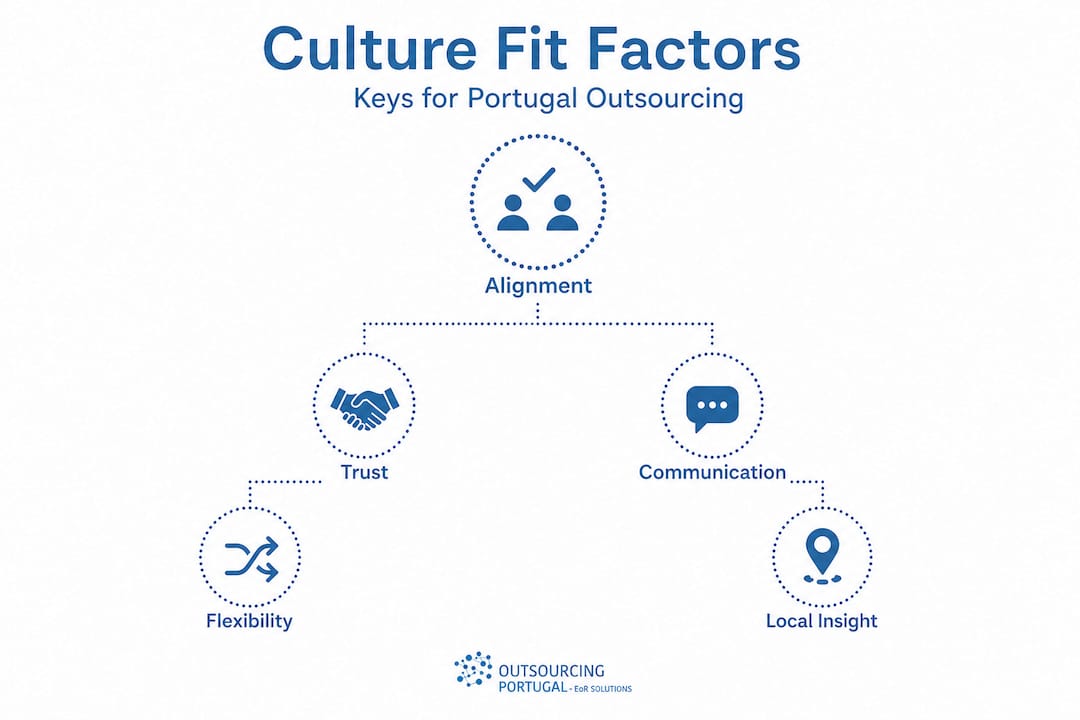
Best practices for building and sustaining cultural compatibility
Measuring cultural compatibility is only half the work. The other half is actively building and maintaining it throughout the life of the outsourcing relationship. This is where many organizations fall short. They invest in a pre-launch cultural workshop, feel confident the issue is handled, and then let the relationship drift.
Cross-cultural HR management that actually works in the field includes providing cultural intelligence training to both sides of the relationship and setting explicit global communication norms that remove ambiguity about how decisions get made, how feedback is delivered, and what response times are expected. The operative word there is explicit. Assumptions that feel obvious to a London or New York team may be invisible to a Lisbon team operating under different professional norms.
Practical mechanisms that sustain cultural compatibility over time include:
- Cultural onboarding programs that go beyond general diversity content and address the specific working styles and expectations of both the client and the Portugal-based team.
- Time-zone fairness policies that rotate meeting schedules rather than defaulting to client-side working hours. This signals genuine respect for the remote team and builds trust at a foundational level.
- Explicit escalation paths that both sides understand and agree on, so that decisions do not stall because no one is sure who has authority to act.
- Regular cross-cultural feedback loops that create structured space for either party to flag friction before it becomes embedded in the working relationship.
- Dedicated culture ambassadors on both sides who monitor relationship health and act as first responders when miscommunication occurs.
Outsourcing HR effectively in Portugal means treating these mechanisms as operational infrastructure rather than optional extras. The firms that get lasting value from their Portugal partnerships are the ones that build these structures in from day one rather than retrofitting them after problems emerge.
For distributed teams specifically, clear written communication standards make a measurable difference. When teams know whether to use synchronous or asynchronous channels for specific types of decisions, response time expectations, and documentation protocols, the cognitive load of cross-cultural navigation drops sharply. Remote team best practices consistently identify written clarity as the single highest-leverage investment for distributed team performance.
Pro Tip: Schedule quarterly culture health checks as a standing agenda item at the executive or program director level. Treat them the same way you treat financial reviews. Ask both sides to report on specific incidents where cultural friction created delays or misunderstandings, and use those examples to update your communication norms and training materials.
What most leaders miss about cultural fit in Portugal outsourcing
Here is the perspective that rarely appears in standard outsourcing guidance: cultural compatibility is not a launch condition. It is a governance discipline.
Most business leaders approach cultural fit as a setup problem. They hire a consultant, run an assessment, deliver a workshop, and mark the box as done. Then the real work starts, and culture management quietly disappears from the operational agenda. Six months later they are puzzled by why a technically capable team is producing work that consistently misses the spirit of the brief.
The research on operationalizing cultural compatibility in international business is clear: firms that treat cultural alignment as an end-to-end operating model issue, covering governance structures, communication protocols, trust-building rituals, and decision-rights between client and supplier, outperform those that treat it as a one-time onboarding event. It is not enough to document norms. Those norms need to be reinforced, tested, and updated as the relationship evolves.
Portugal offers a genuinely favorable starting position. The workforce is skilled, adaptable, and familiar with Western business culture in ways that many alternative nearshore locations are not. But that favorable starting position creates a subtle trap. It makes it easy to underestimate ongoing effort because the surface-level signals look fine. Teams communicate well in English, deliverables arrive on time, and meetings feel productive. The deeper misalignments, around autonomy expectations, feedback culture, or innovation ownership, only surface under pressure.
The firms that build the most durable Portugal outsourcing partnerships use frameworks for culture fit as living tools, not static documents. They revisit assumptions regularly, create safe channels for both sides to surface concerns, and treat cultural recalibration as a normal part of program management rather than a sign that something went wrong.
How Outsourcing Portugal helps you achieve culture fit
Building cultural compatibility into an outsourcing arrangement from day one requires local knowledge, structured processes, and the right operational infrastructure. That is exactly what we provide.
Our employment outsourcing solutions are designed specifically for international companies that need more than just cost savings. We support end-to-end cultural alignment, from hiring candidates whose professional profiles match your working style, through structured onboarding that sets shared expectations for both sides. Our Employer of Record services ensure you stay fully compliant with Portuguese labor law while maintaining the cultural and operational governance that makes partnerships work long term. And our detailed guide to onboarding in Portugal gives HR leaders a practical framework for building trust and alignment from the first day of engagement. Talk to our team to explore how we can help you build a Portugal partnership that performs.
Frequently asked questions
How can I assess cultural compatibility with a potential outsourcing provider in Portugal?
Use both standardized cultural frameworks and real-world operational metrics such as trust scores and communication breakdown rates together, since frameworks alone reflect national averages and may miss team-specific dynamics.
Does cultural misfit always lead to failure in outsourced operations?
Not always, but research confirms it increases the risk of lower subsidiary performance, particularly when misfit is allowed to persist post-launch without active management.
What should be included in cross-cultural HR management policies?
Effective policies should cover cultural intelligence training, explicit communication norms, time-zone fairness provisions, escalation path clarity, and regular structured feedback mechanisms for both sides of the relationship.
Is Portugal considered a culturally compatible location for most Western firms?
Portugal is broadly considered a strong cultural match for Western European and North American firms given its flexible workforce and shared business values, but compatibility should always be verified through direct assessment specific to your organization’s working style and team structure.