

TL;DR:
- Managing cross-border teams involves navigating complex legal systems, cultures, and payroll structures in each country. Proper international HR management requires tailoring processes to local laws and cultures, especially in Portugal, where strict labor laws and regulations apply. Success depends on implementing modular, compliant systems with local expertise and continuous monitoring to ensure legal adherence and talent retention.
Managing people across borders is nothing like managing them at home. The moment your organization hires a single employee in Portugal, you’re no longer dealing with one legal system, one cultural norm, or one payroll structure. You’re operating inside a web of obligations that multiplies with every country you add. IHRM covers the full employee lifecycle across multiple countries and demands adaptation to different laws, cultures, currencies, and systems. This guide walks HR leaders through the core concepts, the real challenges in Portugal, and the strategies that actually work.
Table of Contents
- What is international HR management?
- Key functions and frameworks of international HR management
- Core challenges of international HR management in Portugal
- Smart strategies for compliance and talent optimization
- Why most international HR strategies break down (and how to build smarter systems)
- Partner with experts for international HR success in Portugal
- Frequently asked questions
Key Takeaways
| Point | Details |
|---|---|
| IHRM complexity | Managing HR internationally is much more complex due to varying laws, cultures, and compliance needs. |
| Balancing policy | Success requires mixing global consistency with local adaptation, especially in legal and cultural areas. |
| Portugal specifics | Portuguese labor laws and workplace culture demand a specialized, informed approach. |
| Practical compliance | Active compliance strategies and real-time system updates are key to smooth global HR operations. |
| Expert partners | Using local HR experts or Employer of Record services can help de-risk and optimize international HR management. |
What is international HR management?
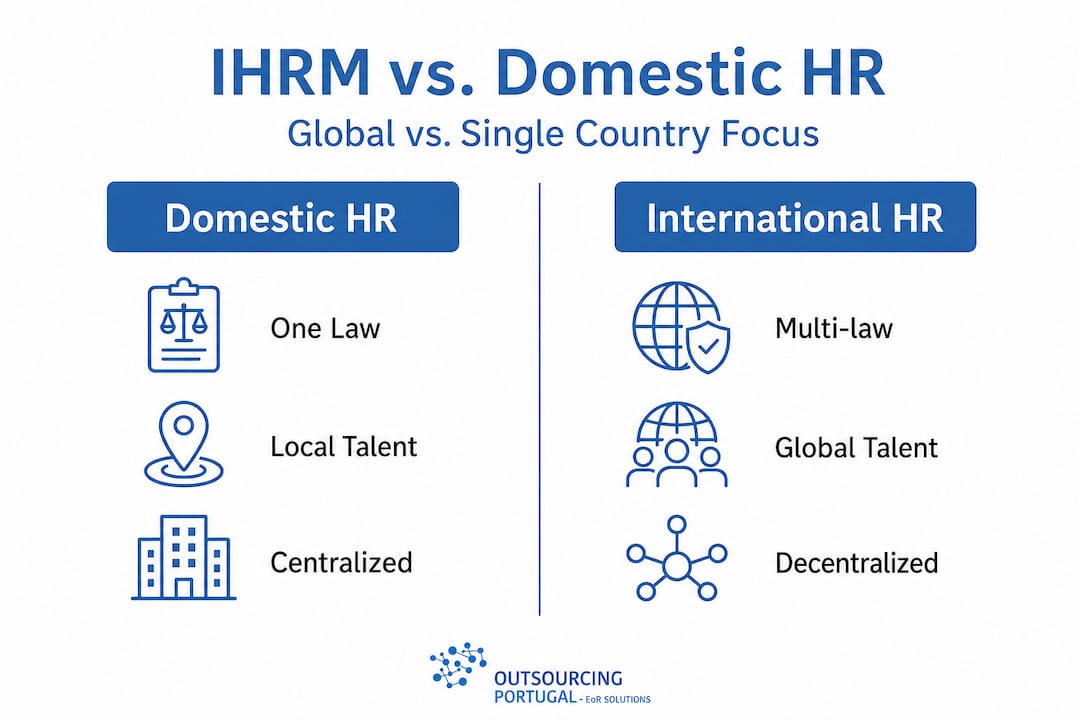
International HR management, commonly called IHRM, is not simply domestic HR practiced in more locations. The scope is fundamentally different. Where domestic HR deals with one legal framework, one labor culture, and one currency, IHRM requires simultaneous management of multiple and often contradictory systems. Every process you have at home, from recruitment to termination, must be redesigned or at minimum re-examined for each country you operate in.
IHRM is HR across multiple countries that covers the full employee life cycle and requires adapting to differences in laws, cultures, currencies, and systems. This includes everything from how you write a job posting to how you calculate severance pay.
“International HR management is not a scaled-up version of domestic HR. It is a completely different discipline that demands country-specific knowledge, systems that can flex across borders, and HR professionals who understand that the rules you know at home may be illegal elsewhere.”
Here is a quick comparison of how domestic and international HR differ across key dimensions:
| Dimension | Domestic HR | International HR (IHRM) |
|---|---|---|
| Legal framework | Single national law | Multiple, often conflicting laws |
| Payroll complexity | One currency, one tax code | Multiple currencies, tax treaties |
| Culture | Relatively uniform | Varies by country and region |
| Compliance risk | Lower, familiar rules | High, constantly shifting |
| Onboarding | Standardized process | Locally customized by law and norm |
| Data privacy | One national standard | GDPR plus local rules |
Portugal is a particularly instructive case. The country operates within the European Union framework, which means GDPR applies in full, but Portuguese labor law adds another layer on top of EU-wide rules. For companies coming from the United States, Canada, or non-EU countries, the differences can be significant and costly if ignored.
Key functions and frameworks of international HR management
With an understanding of what IHRM is, it’s essential to examine the main functional areas and strategic frameworks that guide HR teams worldwide.
The key mechanics of IHRM include balancing global consistency with local requirements across hiring, onboarding, rewards and pay, performance management, compliance, and data privacy. Each of these functions requires its own localization strategy.
Here is how global standards typically compare to Portuguese local requirements:
| IHRM Function | Global standard approach | Portugal-specific requirements |
|---|---|---|
| Hiring | Standardized job descriptions | Must comply with Portuguese anti-discrimination laws |
| Onboarding | Company-wide orientation | Mandatory documentation, social security registration |
| Compensation | Market-benchmarked global bands | Minimum wage laws, mandatory benefits, 13th month salary |
| Performance management | Annual review cycles | Must align with termination law requirements |
| Compliance | General labor law adherence | Specific Portuguese Labor Code (Código do Trabalho) obligations |
| Data privacy | GDPR-compliant globally | Portuguese Data Protection Authority (CNPD) oversight |
The strategic framework most effective for IHRM follows a three-level approach:
-
Set global non-negotiables. Identify which policies cannot vary, such as anti-harassment standards, ethical conduct codes, and data security protocols. These apply uniformly across all locations, including Portugal.
-
Define locally flexible zones. Determine which practices must adapt to local law and culture. In Portugal, this includes notice periods, probation terms, mandatory bonuses, and working hour regulations.
-
Build feedback loops. Establish regular reporting from local HR representatives or partners that flag legal changes, cultural friction points, and compliance gaps before they become problems.
Pro Tip: When entering Portugal for the first time, map every HR function against the Portuguese Labor Code before you adapt your global playbook. Many companies discover that practices legal in their home country, such as at-will employment or certain non-compete clauses, are either restricted or unenforceable in Portugal.
For companies serious about compliance in international hiring, this framework creates a system that scales. You’re not rewriting HR policy from scratch every time you hire in a new country. You’re plugging local requirements into a structure that already knows how to handle them.
Global leadership hiring strategies are also evolving rapidly, with companies prioritizing cultural intelligence alongside technical skills when building international management teams.
Core challenges of international HR management in Portugal
Understanding the general frameworks, let’s focus on the practical challenges HR leaders face when managing teams in Portugal.
The blunt reality is that IHRM is not just “more HR”. It’s HR multiplied by the number of countries, where the hardest parts are compliance execution and system design that keeps global consistency without breaking local rules. Portugal highlights this tension perfectly.
The most common challenges international companies face in Portugal include:
- Employment contract requirements. Portuguese law requires written employment contracts in most cases. Fixed-term contracts are heavily regulated, with strict rules on when they can be used and how long they can last before converting to permanent status.
- Termination law. Portugal has some of the most worker-protective termination rules in the EU. Redundancy requires objective justification, and wrongful termination penalties are significant.
- Working hours and overtime. The standard working week is 40 hours, and overtime must be compensated at premium rates defined by the Labor Code, not by the employer’s discretion.
- Mandatory benefits. Employees are entitled to a 13th month salary (holiday allowance) and a 14th month salary (Christmas allowance), a meal allowance, and paid vacation of at least 22 working days per year.
- Social security contributions. Employers contribute 23.75% of gross salary to social security, which must be calculated and remitted correctly each month.
- Data privacy. GDPR compliance is mandatory, and the Portuguese Data Protection Authority actively monitors compliance. HR data handling, storage, and transfer require careful documentation.
Portugal’s workforce also carries specific cultural expectations that affect HR management. Relationship-building is important in Portuguese professional culture. Employees tend to value job stability and expect managers to communicate with clarity and respect. Flat hierarchies common in tech companies from Northern Europe or North America may need adjustment to match local management norms.
A statistic worth noting: Portugal ranks among the top EU countries for English proficiency and workforce education, with a high percentage of university graduates in technology, engineering, and business fields. This makes it a strong talent market, but also means competition for skilled workers is real and growing.

Legal compliance in Portugal is not a one-time setup task. Portuguese labor law is updated regularly, and companies that set up compliant processes in year one often find themselves out of date by year three if they do not maintain active monitoring.
Effective onboarding in multinational companies requires integrating legal, cultural, and operational elements simultaneously, which is a genuinely difficult balance for HR teams that are not based locally.
Pro Tip: Many international companies underestimate the complexity of Portuguese social security registration. The process requires multiple government registrations, and errors in early setup often compound over time, creating significant back-payment liabilities. Getting this right from day one is far cheaper than correcting it later.
Smart strategies for compliance and talent optimization
Having identified where things often go wrong, here’s how to get IHRM right in Portugal through compliance and talent strategies.
The balance between global consistency and local compliance across hiring, onboarding, rewards, performance management, and data privacy is not just a framework challenge. It’s a daily operational reality. Here are the strategies that actually move the needle:
-
Conduct a Portugal-specific HR audit before your first hire. Map your existing HR processes against the Portuguese Labor Code point by point. Identify every gap and every conflict. This is not optional. Skipping this step is how companies end up facing labor court proceedings within 18 months of entering the market.
-
Structure contracts correctly from the start. Use fixed-term contracts only when legally justified. Make sure probation periods, notice periods, and grounds for termination are explicitly documented according to Portuguese law, not imported from your home-country template.
-
Build payroll compliance into your monthly operations. Use a payroll compliance checklist that covers social security contributions, income tax withholding, meal allowances, vacation accruals, and the 13th and 14th month salary calculations. Running this monthly prevents the accumulation of errors that become expensive to unwind.
-
Invest in local HR expertise or a local partner. The most effective international HR operations in Portugal are not run entirely from headquarters. They include someone, whether an in-house local HR manager or an external partner, who understands how the Lisbon or Porto labor markets actually function, what employees expect, and which regulations are actively enforced.
-
Create a data privacy compliance framework specific to Portugal. This means documenting your HR data processing activities, ensuring contracts include GDPR-compliant data handling clauses, and appointing a Data Protection Officer if your processing volume requires it.
-
Build retention into your compensation strategy. Portugal’s talent market is increasingly competitive, especially in technology and customer operations. Companies that only meet minimum wage requirements without offering competitive total compensation packages lose talent to companies that have done the math on what it takes to retain skilled Portuguese workers.
-
Align performance management systems with legal requirements. In Portugal, documented performance issues are legally necessary before proceeding with certain types of terminations. Your performance management process must therefore do double duty: develop your employees and protect the organization legally.
Pro Tip: Do not translate your home-country employment contract into Portuguese and assume it is legally valid. Portuguese courts will apply Portuguese law regardless of what the contract says. Always have contracts drafted or reviewed by a local labor attorney or a specialized HR services provider.
Why most international HR strategies break down (and how to build smarter systems)
Most IHRM failures we have seen are not caused by ignorance of the law. They are caused by the wrong assumption that good HR policy equals good HR execution. Companies spend significant time and money writing detailed global HR handbooks, only to discover that the handbook does not translate into practice in countries like Portugal.
IHRM is HR multiplied by the number of countries, and the hardest parts are compliance execution and the system design that keeps global consistency without breaking local rules. The emphasis on execution is important. You can know every provision of the Portuguese Labor Code and still fail if your systems, your people, and your processes are not built to act on that knowledge reliably.
The most common breakdown point is what we call “copy and paste HR.” A company succeeds in Germany or the United Kingdom, builds a strong HR system, and then attempts to replicate that exact system in Portugal. The contract templates, the onboarding flow, the performance review process, the termination checklist: all copied, slightly edited, and deployed. Within a year, the company has employees who were technically wrongly classified, contracts that did not meet local requirements, and payroll that was calculated incorrectly.
Modular HR systems are the answer. Instead of one global policy document, build a system that has a global core and local modules. The global core covers values, ethics, and non-negotiable conduct standards. Each local module covers everything that must adapt to local law and culture. Portugal’s module would include termination procedures, mandatory benefits, social security, and cultural onboarding guidance.
Real-time compliance monitoring matters more than most HR leaders realize. Portuguese employment law is not static. When regulations change, companies running on a “set and forget” HR model discover their exposure retrospectively, often after an employee complaint or a government audit. Partnering with someone who tracks Portugal talent and regulatory changes continuously is not a luxury. For international companies with significant Portuguese headcount, it is a core risk management tool.
The final lesson is that local feedback loops outperform centralized control. Your HR team in London or New York is not the best source of ground truth about what is working in Lisbon. Build formal channels for local teams to surface problems, questions, and compliance concerns. Then act on them quickly. Organizations that do this well tend to identify problems when they are small and fixable. Organizations that do not tend to discover them when they are expensive and embarrassing.
Partner with experts for international HR success in Portugal
Moving from theory to practice in Portuguese HR management requires more than good intentions. It requires infrastructure, local expertise, and compliant processes already built and tested.
At Outsourcing Portugal, we specialize in helping international companies hire, manage, and retain Portuguese talent without the burden of setting up a local legal entity. Our Employer of Record services in Portugal handle the full employment lifecycle: contracts, payroll, social security, GDPR compliance, onboarding, and ongoing HR support. If you are planning your market entry, our 2026 guide to hiring in Portugal gives you a complete roadmap. And if you are ready to start building your Portuguese team today, our employment outsourcing in Portugal platform connects your global ambitions with local compliance and talent reality.
Frequently asked questions
What makes international HR management different from domestic HR?
International HR management must account for varying laws, cultures, and compliance risks across countries, making it substantially more complex than domestic HR, which operates within a single familiar legal and cultural system.
How can companies balance global HR policy with local compliance in Portugal?
Companies should define global non-negotiables like ethics and data security, then build local modules for everything governed by Portuguese law. The balance between global and local is a design challenge, not a compromise.
What is the most common compliance risk for international HR in Portugal?
The most frequent risk is misapplying home-country employment practices in Portugal, particularly around contract types and termination. IHRM compliance execution across employment law, immigration, and data privacy is where most companies encounter penalties.
How does an Employer of Record (EoR) help with international HR in Portugal?
An EoR acts as the legal employer in Portugal on your behalf, managing payroll, benefits, contracts, and compliance locally so your company can hire and operate without setting up a Portuguese entity.
Why do some international HR strategies fail in Portugal?
Most failures come from copying home-country HR policies without adapting them to Portuguese law and culture. Strategies built on rigid global templates, without real-time compliance monitoring or local feedback, tend to fail silently until they become expensive problems.