

TL;DR:
- Portugal has become a top nearshore destination for tech teams due to significant cost savings and a positive employment outlook. Companies should choose between EOR, legal entity, or hybrid models based on growth stage, ensuring compliance and streamlined setup. Success depends on strategic talent sourcing, efficient onboarding, and understanding the evolving local market dynamics.
Portugal has quietly become one of Europe’s most attractive destinations for nearshore tech teams, offering 30-50% cost savings versus Western European markets alongside a net employment outlook of +36% for Q1 2026. For technology executives and HR leaders under pressure to scale fast without sacrificing compliance or quality, this guide cuts through the noise. What follows is a structured, practical playbook covering every stage from legal setup and talent sourcing to payroll management and long-term retention, drawn from real market intelligence on Portugal’s evolving tech landscape.
Table of Contents
- Define your tech hiring strategy: EOR vs. entity vs. hybrid
- Core requirements: Legal, financial, and compliance essentials
- Talent sourcing: Recruitment models and market realities
- Step-by-step hiring, onboarding, and payroll management
- Beyond the basics: Lessons from building and scaling successful tech teams in Portugal
- Take the next step: Build your tech team in Portugal with expert help
- Frequently asked questions
Key Takeaways
| Point | Details |
|---|---|
| Choose the right model | EORs offer speed while setting up your own entity brings long-term control for scaling tech teams. |
| Comply from day one | Get a Portuguese tax number (NIF), register locally, and understand Tech Visa and payroll rules before hiring. |
| Know your market | Expect senior tech salaries around €50-75k in Lisbon and 15-20% lower in Porto, plus a 23.75% social security surcharge. |
| Retention requires more than pay | Senior tech talent is scarce and mobile, so combine culture fit, career prospects, and compliance for long-term success. |
| Local partners accelerate success | Leverage experienced local recruiters and EORs to avoid pitfalls, speed up onboarding, and maintain compliance. |
Define your tech hiring strategy: EOR vs. entity vs. hybrid
With the case for Portugal established, the next decision is foundational: how do you legally employ people there? Get this wrong and you face compliance exposure, unexpected costs, or painful restructuring later. There are three primary models, each suited to different growth stages.
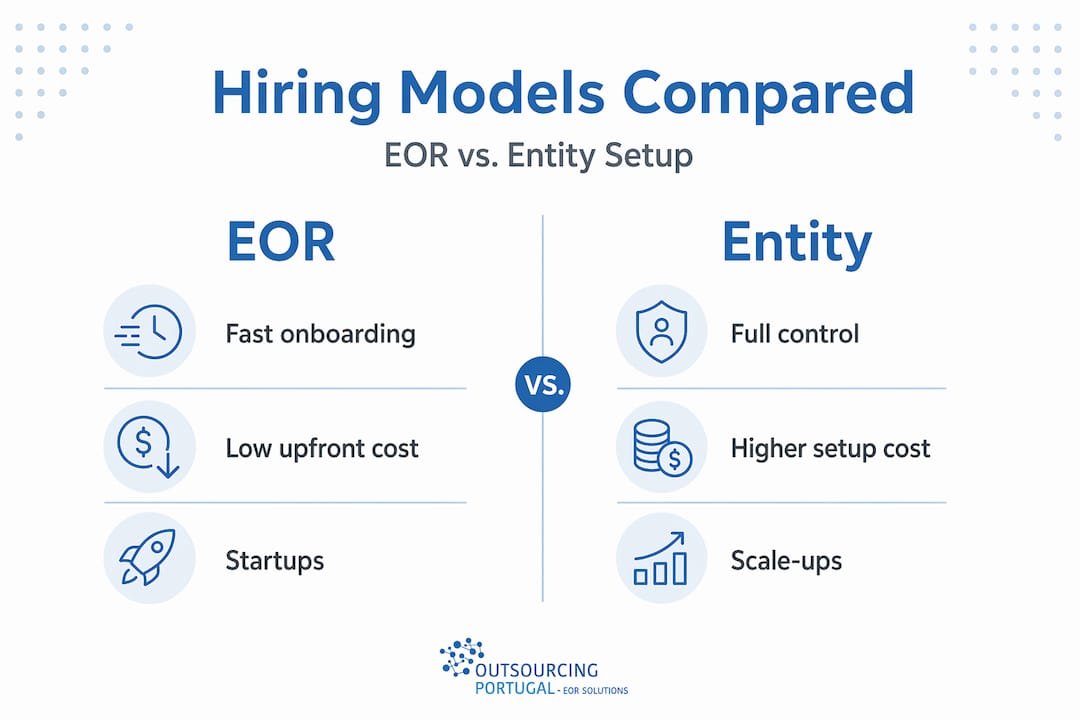
Employer of Record (EOR): An EOR is a third-party organization that legally employs your workers in Portugal on your behalf. You direct the work; the EOR handles contracts, payroll, social security contributions, and compliance. Setup takes as little as 1-2 weeks, and you avoid the cost and complexity of incorporating a Portuguese entity. This is the go-to model for companies testing the market, hiring fewer than 10 employees, or needing to move fast.
Legal entity: Setting up a Portuguese subsidiary (typically a Lda., the Portuguese equivalent of a limited liability company) gives you full operational control and can be more cost-effective at scale. Entity incorporation via Empresa na Hora (Company in an Hour) takes roughly 2-4 weeks and costs between €2,000 and €8,000 including professional fees, share capital, and registration costs. This model suits companies committed to Portugal as a permanent hub with 15 or more employees.
Hybrid (phased) approach: Many companies entering Portugal with strong growth ambitions use an EOR for the first 12 to 18 months, then transition to a legal entity once team size and market understanding justify the investment. This phased approach, sometimes called a Build-Operate-Transfer (BOT) model, lets you validate hiring before entity commitment while maintaining full compliance throughout.
| Model | Setup time | Upfront cost | Best for |
|---|---|---|---|
| EOR | 1-2 weeks | Low (service fee) | Startups, market testing, 1-10 hires |
| Legal entity | 2-4 weeks | €2,000-€8,000 | Scale teams, 15+ employees |
| Hybrid/BOT | 12-18 months phased | Variable | Growth-stage companies |
For companies expanding to Portugal from the UK or US for the first time, the EOR model typically removes the highest friction points while keeping the path to entity formation open.
Pro Tip: Don’t let “we plan to hire more later” push you into premature entity setup. Many companies that build a local entity too early end up paying maintenance costs for a structure they underutilize. Start lean with an EOR, then graduate when the team justifies it.
Core requirements: Legal, financial, and compliance essentials
After clarifying your setup strategy, ensure your administrative and compliance requirements are watertight before you make your first hire.
NIF and company registration: Every foreign company operating in Portugal needs a Número de Identificação Fiscal (NIF), which is the Portuguese tax identification number. If you are setting up an entity, you can register via Empresa na Hora in a single business day or complete the process online. If you are using an EOR, this step is handled for you. Either way, the NIF is non-negotiable since it is required for payroll, contracts, and any interaction with Portuguese tax authorities.
Tech Visa program: Portugal’s Tech Visa is a critical tool for companies hiring non-EU talent. However, it comes with meaningful restrictions. To participate, your company must be Portugal-based, certified with a clean record, and tech-focused. Certification takes up to 20 working days. Critically, the program caps non-EU hires at 50% of your total workforce, meaning you must also be actively hiring Portuguese or EU nationals. Companies that plan to staff primarily with non-EU engineers often hit this ceiling faster than expected.
Employer social security and labor law: Portuguese employers contribute 23.75% of gross salary to social security. Employees contribute an additional 11%. The Portuguese Labor Code (Código do Trabalho) governs contracts, termination rules, working hours, and mandatory benefits. Contracts must be written, specify the role and compensation clearly, and include provisions for the legally mandated 13th and 14th month salary payments (holiday and Christmas allowances). Getting these details right from day one prevents costly disputes later.
Here is a sequential compliance checklist for a new market entrant:
- Obtain your company NIF (or confirm your EOR handles this)
- Register with Portuguese Social Security (Segurança Social)
- Draft employment contracts compliant with the Portuguese Labor Code
- Confirm Tech Visa eligibility if hiring non-EU engineers
- Set up payroll software or confirm EOR payroll handling
- Register with the Authority for Working Conditions (ACT) if applicable
When it comes to tech development in Portugal, these administrative steps are not optional extras. They are the foundation everything else is built on.
Pro Tip: Portugal’s bureaucratic processes have improved dramatically in recent years, but translation requirements and notarization can still slow things down for foreign companies. Work with a local legal advisor or your EOR partner to pre-validate all documents before submission, as small errors cause disproportionate delays.
Talent sourcing: Recruitment models and market realities
With your legal and compliance requirements in place, the next challenge is finding and attracting the right engineers. Portugal’s tech talent market is genuinely competitive, and understanding its structure gives you a real advantage.
Direct hire vs. EOR talent pipelines: Direct hiring gives you more control over employer branding and candidate experience but requires you to build local recruitment infrastructure from scratch. EOR and staff augmentation partners typically maintain pre-vetted candidate pipelines, which is particularly valuable for specialized roles. Partnering with local recruiters or EORs is strongly recommended for senior engineering hires, where the market is thinner and hiring cycles run 8 to 12 weeks rather than the 4 to 6 weeks typical for mid-level roles.
Lisbon vs. Porto: Knowing the difference: These two cities are not interchangeable. Lisbon is Portugal’s primary tech hub, home to Web Summit (one of Europe’s largest tech conferences), a dense startup ecosystem, and the largest concentration of senior engineers. Porto is emerging rapidly, with a strong university talent pipeline and a cost advantage: senior developers cost 15-20% less in Porto than in Lisbon. Porto also benefits from proximity to several strong engineering faculties, making it particularly well-suited for companies willing to invest in junior-to-mid talent development.
Salary bands and AI skills premiums: Salary expectations have shifted sharply over the past two years. A senior software engineer in Lisbon carries a loaded cost of €50,000 to €75,000 annually, inclusive of social security and mandatory benefits. Engineers with demonstrated AI/ML skills command a further premium of €10,000 to €15,000 above standard senior rates. Budget for this early to avoid losing candidates mid-process.
“The companies that consistently win top Portuguese tech talent are those that move from first interview to offer within three weeks. Candidates at the senior level are interviewing with three to five employers simultaneously.”
For a broader view of Portugal’s tech industry and how its talent pool compares regionally, the depth and diversity of skills available continues to impress new market entrants. If you are focused on scaling quickly, specialized IT recruitment agencies for scaling can compress time-to-hire significantly by presenting only pre-screened, interested candidates.
Pro Tip: Don’t sleep on Braga and Aveiro for specific tech profiles. These smaller cities house excellent university programs and are producing strong backend and data engineering graduates who are eager for international employer attention and carry lower salary expectations than Lisbon or Porto equivalents.
Step-by-step hiring, onboarding, and payroll management
Once you have identified candidates, execution matters. A disorganized onboarding process signals poor employer quality and increases early churn risk, particularly with senior engineers who have multiple options.
Here is the sequential workflow for compliant, effective hiring and onboarding:
- Screen and shortlist: Define technical and cultural criteria before outreach. For senior roles, technical assessments should be efficient and respectful of candidate time (no multi-week take-home projects).
- Structured interviews: Include a hiring manager, a technical peer, and if possible, a Portuguese-based team member. Cultural fit matters as much as technical ability.
- Issue a written offer: Portuguese law requires written contracts. Specify role title, gross salary, working hours, probation period (up to 180 days for senior roles), and benefits.
- Register with Social Security: This must happen before the employee’s first day.
- Run compliant payroll: Portugal requires 14 monthly salary payments per year: 12 regular months plus a holiday allowance (typically paid in June) and a Christmas allowance (December). Missing or miscalculating these is a common and costly mistake.
- Onboard with documentation: Provide a written contract, employee handbook aligned with Portuguese law, and clear information on tax registration obligations for the employee.
The total employer cost for a senior engineer in Lisbon runs €45,000 to €60,000 per year once you factor in the 23.75% employer social security contribution. Portugal’s loaded salary burden sits at approximately 25-30% above gross pay when you include social security and mandatory holiday provisions.
“Many international companies underestimate the 14-month salary structure. Budgeting on a 12-month basis creates a surprise 16% shortfall in your annual salary cost before benefits are even factored in.”
Pro Tip: Build your salary budgets in loaded cost terms from day one. A senior engineer quoted at €55,000 gross actually costs you closer to €68,000 annually when you factor in employer social security and the two additional monthly payments. This distinction matters enormously when presenting business cases to finance teams.
For teams that are scaling rapidly, managing individual contracts, payroll runs, and compliance reporting across multiple employees becomes complex fast. Purpose-built scaling tech teams services handle this workflow end-to-end and reduce administrative burden on your internal HR team.

Beyond the basics: Lessons from building and scaling successful tech teams in Portugal
A strong process provides the foundation, but true success requires an insider’s understanding of Portugal’s shifting tech talent terrain. After working with dozens of international companies entering the Portuguese market, several patterns emerge that most generic guides never address.
The EOR vs. entity debate is more nuanced than it looks. Conventional wisdom says “use EOR for small teams, entity for large ones.” In practice, the right answer depends as much on your talent profile as your headcount. If you are hiring senior engineers who take an active interest in employer stability and benefits portability, a legal entity can be a stronger signal of long-term commitment. Conversely, companies that rush into entity setup before achieving product-market fit often find themselves managing Portuguese administrative obligations with no clear revenue to show for it.
The NHR regime change is a real retention risk. Portugal’s Non-Habitual Resident (NHR) tax regime, which offered foreign workers a flat 20% tax rate for 10 years, has ended for new applicants. The NHR regime’s end is driving churn toward competing destinations like Dubai, particularly among senior foreign engineers who relocated to Lisbon specifically for the tax advantage. If your team includes high earners who benefited from NHR, retention conversations should already be happening. The Tech Visa 50% cap compounds this challenge. Companies that built their model around a primarily non-EU workforce may now face mandatory local hiring ratios that require a recruitment pivot.
Portugal vs. Poland: It depends on what you’re optimizing for. Poland offers a deeper senior talent pool and lower costs for certain engineering specializations. However, Portugal consistently outperforms on English proficiency, cultural compatibility with UK and US companies, and time zone alignment with London. For teams where communication quality and collaboration rhythm matter more than raw cost optimization, Portugal remains the stronger choice. This is particularly true for product engineering teams that need to work closely with non-technical stakeholders.
Culture and market understanding are underrated factors. Companies that treat Portugal purely as a cost play tend to see higher churn and lower team cohesion. The engineers who thrive in Portugal’s tech market are collaborative, value work-life balance seriously, and respond well to employers who demonstrate genuine investment in the local ecosystem. Supporting employee attendance at local tech events, offering flexible working arrangements, and being visible in communities like Porto’s or Lisbon’s growing startup scenes all contribute meaningfully to retention. For a detailed view on Portugal for tech development, the long-term opportunity remains strong for companies that approach the market with the right intent.
Take the next step: Build your tech team in Portugal with expert help
Ready to put this step-by-step plan into action? Working with the right on-the-ground partner is the single fastest way to reduce risk, cut setup time, and ensure every hire is fully compliant from day one.
At Outsourcing Portugal, we provide end-to-end employment outsourcing services designed specifically for international tech companies entering the Portuguese market. Whether you need best EOR services to hire your first engineer in two weeks or a structured plan for building nearshore teams across Lisbon and Porto, our team handles the legal, payroll, HR, and compliance complexity so you can focus entirely on the work that matters. Portugal’s opportunity window is real and competitive. Let’s make sure your company captures it correctly.
Frequently asked questions
How fast can I set up a tech team in Portugal?
Using an Employer of Record, setup can take as little as 1-2 weeks; forming a legal entity typically takes 2-4 weeks once all documentation is in order.
What is the typical salary for a senior software engineer in Portugal?
A senior developer in Lisbon carries a loaded annual cost of €50,000 to €75,000, with Porto running 15-20% lower than Lisbon across equivalent roles.
How does the Tech Visa process work for hiring non-EU nationals?
Your company must be Portugal-based, certified with a clean compliance record, and focused on tech; certification takes up to 20 working days and the program limits non-EU hires to 50% of your total workforce.
Are there notable risks or challenges in Portugal’s tech hiring landscape?
Senior talent shortages and the end of the NHR tax regime are driving increased churn among experienced engineers, making retention strategy as important as recruitment strategy.
Why choose Portugal over other nearshoring destinations?
Portugal delivers nearshore savings of 30-50% versus Western Europe while outperforming Eastern European alternatives on English proficiency, cultural fit, and time zone compatibility with UK and US operations.