

TL;DR:
- Many international companies mistakenly believe that outsourcing automatically ensures legal compliance in Portugal, which can be costly.
- Legal compliance requires ongoing attention to evolving laws, regulations, and sector-specific rules to avoid penalties and reputational damage.
Many international companies assume that choosing an outsourcing partner automatically takes care of legal compliance. That assumption is expensive. Portugal has a structured, actively enforced labor law framework, and legal compliance is a continuous process that demands ongoing attention, not just a signature on a service agreement. This guide breaks down exactly what compliance means in the Portuguese context, how to structure your operational cycle, what local labor law restrictions you need to know, and how to draft contracts that protect your business from the outset.
Table of Contents
- Understanding legal compliance: Fundamentals for global employers
- Key steps to legal compliance in Portugal: The operational cycle
- Outsourcing and labor compliance: What Portugal’s law requires
- Drafting contracts and avoiding misclassification in Portugal
- Why smart compliance goes beyond regulations: Lessons from recent enforcement
- Streamline your expansion with specialized compliance support
- Frequently asked questions
Key Takeaways
| Point | Details |
|---|---|
| Compliance is ongoing | Legal compliance in Portugal requires constant monitoring, not a one-time approval. |
| Map obligations early | Identify specific laws and regulations that apply before expanding or outsourcing in Portugal. |
| Outsourcing has limits | There are strict local restrictions on outsourcing after layoffs that all companies must track. |
| Contract structure matters | How you draft contracts impacts your risk of worker misclassification under Portuguese law. |
| Expert local support helps | Partnering with compliance and HR experts reduces risk and accelerates market entry. |
Understanding legal compliance: Fundamentals for global employers
Before you can manage compliance, you need to understand what it actually means. Legal compliance is the process of ensuring an organization adheres to the laws that regulate its business activities in a given jurisdiction. That definition sounds simple. The reality is far more layered, especially for a foreign company entering Portugal with no existing legal infrastructure.
Regulatory compliance is a closely related but distinct concept. Legal compliance covers statutory law, civil and criminal codes, and employment legislation. Regulatory compliance focuses on sector-specific rules issued by government agencies or industry bodies. In practice, companies operating in Portugal need to manage both simultaneously. A tech company building a nearshore team, for example, must comply with employment law, data protection regulations under GDPR, sector-specific licensing requirements, and any applicable collective bargaining agreements.
What makes this particularly challenging for global employers is jurisdictional complexity. Rules that apply in your home country may not transfer. Employment protections in Portugal are stronger than in many non-EU markets, and what counts as a compliant contractor relationship in the United States or the United Kingdom may be classified as disguised employment under Portuguese law. Getting this wrong triggers backdated social security contributions, fines, and reputational damage.
Here is a quick summary of why compliance in international hiring is a persistent operational priority, not a one-off task:
- Employment law in Portugal updates regularly, including proposed changes under new labor legislation as recently as 2026
- Collective bargaining agreements (CBAs) apply to entire industry sectors and can override standard contract terms
- Social security registration, withholding obligations, and working time rules must be actively monitored
- Data protection obligations under GDPR apply the moment you process employee data across borders
- Inspection campaigns by the Portuguese labor authority are scheduled and well-publicized, leaving little room for “we didn’t know”
“Compliance is not a project with a finish line. It is an operating condition. Companies that treat it as a checklist will find themselves exposed the moment the rules change or an inspector arrives.”
That mindset shift, from project to operating condition, is the most important thing global employers can internalize before entering the Portuguese market.
Key steps to legal compliance in Portugal: The operational cycle
Now that the fundamentals are clear, let’s break down exactly how companies can approach compliance as an ongoing framework rather than a one-time setup exercise.
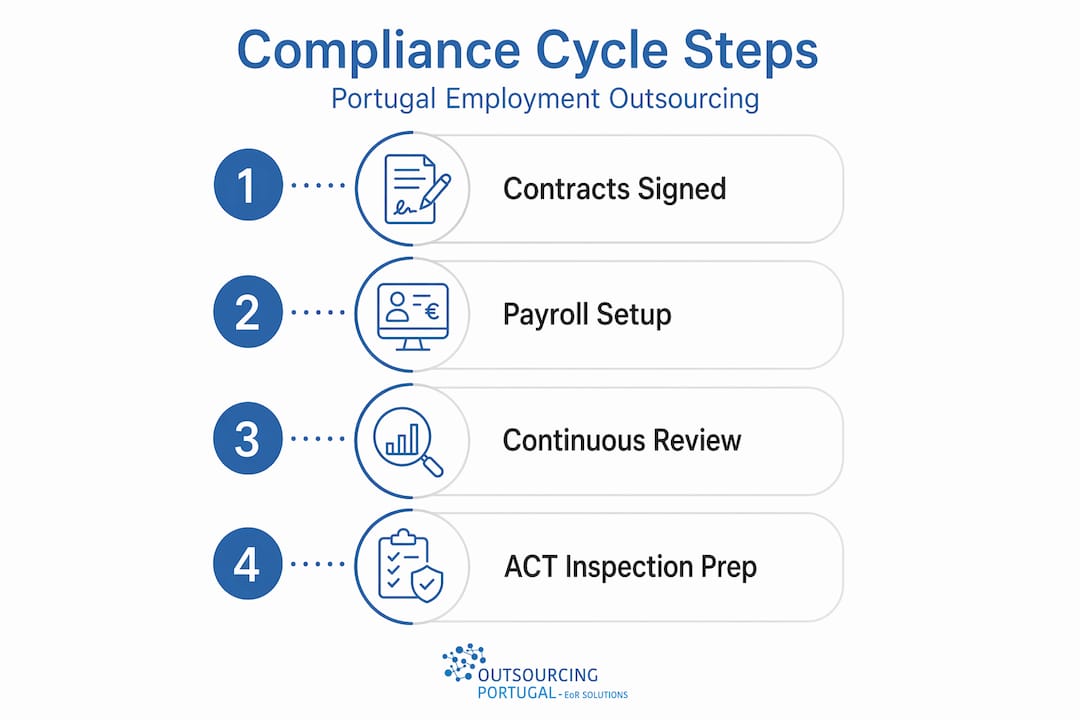
Organizations must identify enforceable obligations, map how those obligations apply to their specific situation, and run a continuous monitoring and audit cycle. The variables that shape your obligation map include your industry, the number of employees you have in Portugal, the geographic scope of your operations, and the sensitivity of the data you process. A company with three remote developers has a very different compliance profile than a contact center with 150 employees.
A practical compliance methodology follows four steps that repeat as your business evolves:
- Define scope. Identify which laws, CBAs, and regulations apply to your specific situation in Portugal. This includes labor law, tax law, data protection, sector-specific rules, and any local agreements.
- Identify obligations. For each applicable rule, document exactly what the obligation requires, who is responsible for it, and how often it needs to be reviewed or reported.
- Translate into internal procedures. Obligations on paper mean nothing without operational processes. Build HR workflows, contract templates, payroll schedules, and documentation standards that make compliance the default behavior.
- Continuously monitor and prepare for inspections. Review your compliance posture at least quarterly. Keep records of contracts, payslips, working time logs, and any correspondence with the Portuguese labor authority (ACT). Assume an inspection could happen at any time.
Here is a practical overview of how this cycle maps to common compliance areas in Portugal:
| Compliance area | Key obligation | Monitoring frequency |
|---|---|---|
| Employment contracts | Written contract required before start date | At every hire or contract change |
| Working time | Respect legal maximums; log overtime correctly | Monthly payroll review |
| Remuneration | Meet national minimum wage; apply CBA rates | Annual or when CBA updates |
| Social security | Register employees and remit contributions | Monthly |
| Data protection | GDPR-compliant data processing agreements | Annual review plus on change |
| Outsourcing restrictions | 12-month post-layoff prohibition | Before each outsourcing decision |
Pro Tip: Build a compliance calendar tied to your payroll cycle. Many violations found during ACT inspections are not deliberate breaches but administrative gaps, missing signatures, late filings, or outdated contract clauses. A calendar makes those gaps visible before an inspector does.
The compliance cycle also changes as your business scales. A company that starts with two employees in Portugal and grows to twenty will cross legal thresholds that trigger new obligations. For example, works council rights, mandatory reporting, and certain dismissal procedures only activate above specific headcount thresholds. Review your legal compliance best practices proactively at every growth milestone. For a broader view of how EU employment law shapes your obligations in Portugal, it is worth reviewing the regulatory hierarchy before finalizing your employment structure.
Outsourcing and labor compliance: What Portugal’s law requires
Understanding the general cycle sets the stage for tackling the real-world specifics of labor compliance and outsourcing in Portugal. This is where many international companies run into serious trouble, often because they apply assumptions from other markets to a legal environment that works differently.
The most important restriction to know is this: Portugal prohibits using outsourcing to fill positions that were made redundant due to layoffs for a 12-month period. This rule exists to prevent companies from cycling out employees through redundancy and immediately replacing them with cheaper outsourced labor. Violating it exposes the company to legal challenges from dismissed workers, potential reinstatement orders, and financial penalties.

This restriction is especially relevant for companies acquiring or merging with Portuguese operations, and for any business that has recently downsized before initiating an outsourcing arrangement. The 12-month clock starts from the date of the last affected redundancy. Document your timeline carefully.
Beyond this specific restriction, ACT inspection campaigns in 2026 are focused on four main areas:
- Contract compliance: Are employment contracts written, signed before the start date, and correctly classified?
- Working time: Are working hours logged accurately, and is overtime properly compensated?
- Remuneration: Are employees receiving at least the applicable minimum wage and any CBA-mandated rates?
- Collective bargaining application: Is the correct CBA being applied to the relevant workforce?
These are not random enforcement priorities. They reflect where regulators have found the highest rates of non-compliance in practice. If you are operating or planning to operate in Portugal, these four areas need to be airtight before you hire your first employee.
Here is a comparison of compliant versus non-compliant outsourcing practices to clarify where the line sits:
| Scenario | Compliant practice | Non-compliant practice |
|---|---|---|
| Post-redundancy outsourcing | Wait 12 months before outsourcing affected roles | Outsource the same roles within 12 months of layoffs |
| Worker classification | Hire via EOR or properly classify employees | Engage employees as contractors to avoid social security |
| Contract documentation | Written contracts in place before first day | Verbal agreements or backdated contracts |
| Working time | Track and compensate overtime correctly | Ignore overtime logging for salaried staff |
| CBA application | Identify and apply correct sector CBA | Apply generic terms without checking CBA requirements |
The hiring costs in Portugal are competitive compared to Western Europe, but those savings disappear quickly if non-compliance results in backdated contributions, legal fees, and fines. Treating compliance as a cost center rather than a cost-saver is one of the most common and avoidable mistakes foreign employers make. Our outsourcing compliance guide goes deeper into each of these areas with actionable checklists.
Drafting contracts and avoiding misclassification in Portugal
Getting your outsourcing structure right relies on more than following restrictions. The next step is contract design and worker classification. This is an area where small errors compound into large liabilities over time.
Portuguese regulators apply a substance-over-form test when assessing whether a working relationship is genuinely a contractor arrangement or a disguised employment contract. The label on the document matters far less than the actual conditions of the working relationship. If you control when someone works, where they work, what tools they use, and whether they can work for other clients, you are almost certainly looking at an employment relationship, regardless of what the contract says.
Drafting service contracts to reflect genuine independence, including the contractor’s autonomy over work methods and hours, a non-exclusivity clause, and payment structured around deliverables rather than time, significantly reduces the risk of reclassification as employment. These are not just legal formalities. They reflect how the relationship actually needs to function for the contractor classification to hold up under scrutiny.
Key criteria regulators use to distinguish genuine contractors from employees:
- Integration into organizational structure: Does the worker function as part of your permanent team with regular hours and a dedicated role?
- Economic dependence: Does the contractor derive most of their income from your company alone?
- Control over work methods: Do you dictate how the work is done, or just the outcome?
- Equipment and infrastructure: Does your company provide the tools, software, or workspace?
- Exclusivity: Is the contractor prohibited from working with other clients?
Each of these factors carries weight. One flag alone may not trigger reclassification, but a pattern of control indicators will. Portuguese courts and labor inspectors look at the totality of the relationship, not a single clause.
Pro Tip: Review your contractor relationships every six months. What started as a genuinely independent arrangement can drift into de facto employment as the working relationship deepens. Catch that drift before ACT does.
For international hiring compliance, the safest approach for companies that need a consistent, managed workforce in Portugal is typically an Employer of Record structure rather than a contractor model. This eliminates misclassification risk entirely while keeping your operational flexibility intact.
Why smart compliance goes beyond regulations: Lessons from recent enforcement
Here is an uncomfortable truth that most compliance guides avoid: technically following the rules is not the same as being compliant in any meaningful sense. ACT’s 2026 inspection priorities tell a story about where real-world compliance breaks down, and it is rarely in companies that are deliberately evading the law.
The pattern we see consistently is this: companies enter Portugal with good intentions, use a contract template sourced from somewhere generic, run payroll through a system not calibrated for Portuguese CBA requirements, and then discover during an inspection that their “compliant” setup has had structural errors running for months or years. The enforcement risk is not usually the rogue actor. It is the well-intentioned company that outsourced its compliance thinking along with its workforce.
What separates organizations that handle ACT inspections without incident from those that don’t is not a thicker policy document. It is whether compliance is genuinely embedded in day-to-day operations. That means the HR team knows which CBA applies and why. It means contracts are reviewed when roles evolve, not just when they are created. It means working time records are maintained as a matter of routine, not assembled reactively when an inspector calls.
The 12-month post-layoff outsourcing rule is a perfect illustration of proactive versus reactive compliance. A reactive company discovers the restriction when their legal team reviews a contract days before signing. A proactive company builds the rule into their workforce planning calendar so it never becomes an issue in the first place.
There is also a cultural dimension that pure rule-following misses. Portugal’s labor framework reflects genuine social values around worker protection, job security, and fair compensation. Companies that engage with that framework as a legitimate operating environment, rather than as a bureaucratic obstacle to manage around, build better relationships with local employees, local regulators, and local talent pools. In a competitive talent market, that matters more than you might expect. Review our practical compliance insights to see how this approach translates into operational practice.
Streamline your expansion with specialized compliance support
Navigating Portuguese employment law as a foreign company is genuinely complex. The good news is that you do not need to build that expertise from scratch internally.
Our Employer of Record services in Portugal are designed specifically for international companies that want to hire, manage, and retain Portuguese talent without setting up a local entity. We act as the legal employer on your behalf, handling contracts, payroll, social security, CBA compliance, and working time obligations in full alignment with Portuguese law. For companies that want to understand the strategic picture before committing, our resource on EOR compliance solutions walks through how the model works in practice. You can also access our HR compliance best practices guide for a structured checklist covering the 2026 regulatory landscape.
Frequently asked questions
What is the definition of legal compliance for businesses?
Legal compliance means ensuring a business continuously adheres to all applicable laws and regulations governing its operations in a specific jurisdiction. It is an active, ongoing process, not a one-time setup activity.
How often must a company assess legal compliance in Portugal?
Compliance is continuous, not periodic. Companies should monitor obligations on an ongoing basis and formally review their compliance posture at least quarterly or whenever business activities, headcount, or applicable regulations change.
Are there restrictions on outsourcing after layoffs in Portugal?
Yes. Portuguese law prohibits outsourcing work to replace employees made redundant due to layoffs for at least 12 months after the redundancy. This restriction applies regardless of the outsourcing contract structure.
Who enforces employment compliance in Portugal?
ACT inspection campaigns are conducted by Portugal’s labor authority and focus on contracts, working time, remuneration, and correct application of collective bargaining agreements. The Ministry of Labor oversees the broader regulatory environment.
What key contract clauses help prove genuine contractor relationships?
Clauses confirming that the contractor sets their own hours and methods, is not exclusive to one client, uses their own tools, and is compensated for deliverables rather than hours are the strongest indicators of genuine independence under Portuguese law.