

TL;DR:
- Using an Employer of Record with payroll and HRIS streams allows startups to hire legally in Portugal quickly without forming a local entity. Outsourcing-portugal offers comprehensive services from contracts to visa support, enabling compliance and onboarding within four to six weeks. Proper tool selection and understanding fixed employer costs ensure efficient, compliant hiring across Portugal’s dynamic labor landscape.
The fastest, most legally sound way to hire in Portugal without forming a local entity is to pair an Employer of Record (EOR) with a payroll and HRIS stack. Outsourcing-portugal is the recommended partner for startups entering this market, covering EOR, payroll, legal compliance, onboarding, benefits administration, and visa support under one engagement. You get local expertise without the six-to-twelve-month overhead of incorporating a Portuguese subsidiary.
Quick-start path:
- Select your EOR provider and confirm Portugal-specific coverage (Segurança Social registration, NHR tax handling, employment contracts under the Código do Trabalho).
- Sign the engagement and share employment terms for your first hire.
- Start onboarding — your EOR handles registration; you focus on role setup and team integration.
- Run first payroll — typically within four to six weeks of engagement start.
Table of Contents
- What do employment outsourcing tools for startups actually include?
- Why do startups choose employment outsourcing to hire in Portugal?
- How do you choose the right employment outsourcing tools for your startup?
- How do you hire an employee in Portugal without a local entity?
- What do employment outsourcing tools for Portugal hiring actually cost?
- Key Takeaways
- What founders usually get wrong about outsourcing employment in Portugal
- Outsourcing-portugal: the direct route to hiring in Portugal
- Further reading and authoritative resources
What do employment outsourcing tools for startups actually include?
“Employment outsourcing tools” is a broad phrase. The industry uses more precise categories, and knowing which one solves your problem saves weeks of vendor evaluation.
- Employer of Record (EOR): A third party becomes the legal employer in Portugal. They handle contracts, payroll taxes, social security, and statutory benefits. You direct the work. This is the core tool for hiring without a local entity.
- Global payroll platforms: Process multi-country payroll, calculate withholding, and file with local tax authorities. Often paired with an EOR or used standalone when you already have a local entity.
- HRIS (Human Resources Information System): Centralizes employee data, org charts, time-off tracking, and performance records. SAP SuccessFactors Employee Central, for example, supports compliance management across more than 100 locales.
- ATS (Applicant Tracking System): Manages job postings, candidate pipelines, and interview workflows. Tools like Gusto integrate ATS with onboarding so candidate data flows directly into employee records.
- Contractor management platforms: Handle contracts, invoicing, and payments for freelancers. Distinct from EOR — misclassifying an employee as a contractor in Portugal carries real legal risk.
- Benefits administration: Manages health insurance, meal allowances, and pension enrollment. In Portugal, meal allowances and health benefits are standard expectations, not perks.
- Compliance and legal advisory platforms: Monitor labor law changes, flag required filings, and generate compliant documentation.
At launch, a startup needs EOR plus basic payroll. HRIS and ATS become worth the investment once you’re managing five or more employees. For a deeper look at international hiring tools, Outsourcing-portugal maintains a curated breakdown by category.
Why do startups choose employment outsourcing to hire in Portugal?
Portugal punches above its weight as a hiring destination. The workforce is highly educated, multilingual, and concentrated in Lisbon and Porto, two cities with mature tech ecosystems and strong English proficiency. Time zones align with Western Europe and overlap usefully with US East Coast mornings.
Key reasons startups choose the outsourcing route for Portuguese hiring:
- Faster market entry. An EOR can have your first hire legally employed in four to six weeks. Incorporating a Portuguese sociedade por quotas (private limited company) takes months and requires ongoing administrative overhead.
- Compliance without a local legal team. Portuguese labor law, Segurança Social contributions, and tax withholding rules are specific and change. Outsourcing HR compliance in Portugal transfers that monitoring burden to specialists.
- Cost predictability. A per-employee monthly fee is easier to model than a local HR hire, a payroll accountant, and a labor lawyer.
- EU talent pool access. Hiring through Portugal gives you access to EU freedom-of-movement talent and a stable regulatory environment.
- Reduced legal exposure. Misclassification, late filings, and incorrect contract terms are the most common and costly mistakes foreign employers make. An EOR absorbs that risk by design.
Pro Tip: Before you engage any provider, confirm they have direct experience with Portuguese Segurança Social registration and the AT (Autoridade Tributária) tax portal — not just generic EU coverage. Portugal-specific knowledge is a genuine differentiator, not a marketing claim.
How do you choose the right employment outsourcing tools for your startup?
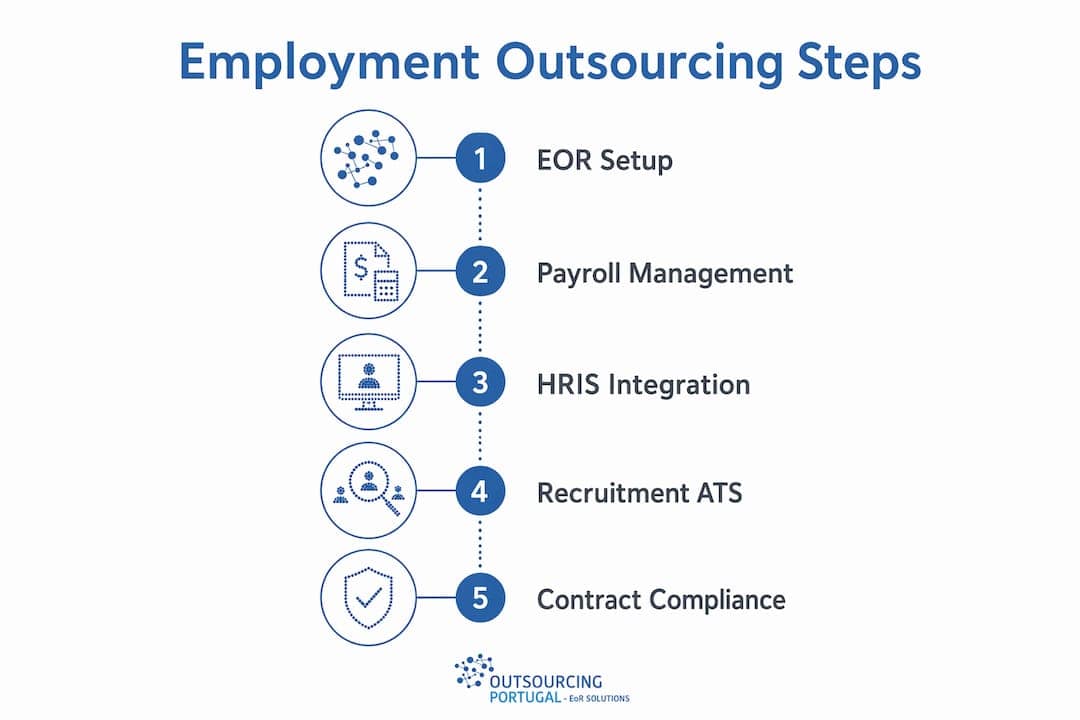
Start with the business problem, not the feature list. The single most important selection criterion is whether the provider solves the specific HR hurdle you face right now — poor compliance coverage, slow onboarding, or manual payroll processing. Buying an all-in-one platform without a clear HR strategy is one of the most common and expensive mistakes early-stage founders make.
Evaluation checklist:
- Does the provider have documented experience with Portuguese employment contracts under the Código do Trabalho?
- Can they handle Segurança Social registration and monthly contributions without requiring your team to interact with Portuguese government portals?
- How do they handle GDPR compliance for employee data? Who is the data processor of record?
- What are their SLAs for payroll accuracy and error resolution?
- Do they integrate with your existing HRIS or accounting tools (QuickBooks, Xero, NetSuite)?
- Is pricing transparent — flat per-employee, percentage of salary, or modular? Are termination fees disclosed upfront?
- What are their customer support hours, and do you get a named account manager or a ticket queue?
Selection framework:
- Map your specific hurdle (compliance complexity, onboarding speed, contractor vs. employee classification).
- Match the hurdle to the required delivery model: EOR for full employment without a local entity; global payroll if you already have a Portuguese entity; contractor platform only if your workers genuinely qualify as independent contractors under Portuguese law.
- Evaluate vendors against that specific model — not against a generic feature matrix.
Pro Tip: Insist on contract clauses that address local employment law changes and specify how notice periods and termination disputes are resolved. Portuguese labor law gives employees strong protections; your EOR agreement should spell out exactly who bears the cost and process of a contested dismissal.
How do you hire an employee in Portugal without a local entity?
The end-to-end process runs from provider selection to first payroll in roughly four to six weeks when documents are ready. Here is the ordered checklist, with who owns each step.
- Select and contract your EOR (startup, week 1–2). Confirm service scope, pricing, and contract terms. Review the EOR compliance guide for Portugal before signing.
- Define employment terms (startup, week 1–2). Salary, role, start date, working hours, and any benefits above statutory minimums.
- EOR prepares the employment contract (EOR, week 2). Drafted under Portuguese law, signed by the EOR as legal employer and the employee.
- Segurança Social and AT registration (EOR, week 2–3). The EOR registers the employee with the social security authority and the tax authority. You never log into a Portuguese government portal.
- Onboarding and benefits enrollment (EOR + startup, week 3–4). Employee completes tax forms, direct deposit, and benefits selection. Your team handles role-specific onboarding.
- First payroll run (EOR, week 4–6). Gross salary calculated, employer social security contributions applied (currently 23.75% of gross), income tax withheld at applicable IRS rates, and net salary paid.
- Ongoing compliance monitoring (EOR, ongoing). Monthly filings, annual reporting, and labor law change alerts.
Common blockers that extend timelines: work permit processing for non-EU hires (add four to twelve weeks), missing employee documents (NIF tax number, NISS social security number), and complex benefits structures requiring insurer negotiation.
What do employment outsourcing tools for Portugal hiring actually cost?

Costs fall into three layers: provider fees, statutory employer costs, and optional add-ons.
Provider fee structures:
- Entry-level: Flat monthly per-employee fee, covering EOR, payroll processing, and basic compliance. Suited to startups with one to five employees.
- Mid-tier: Modular pricing — base EOR fee plus add-ons for benefits administration, visa support, or dedicated HR advisory. Better value at five to twenty employees.
- Premium/managed: Percentage of salary or a higher flat fee with full-service HR, legal advisory, and account management. Justified when compliance complexity or employee count is high.
Statutory employer costs in Portugal (these are fixed by law, not by your provider):
- Employer Segurança Social contribution: a fixed rate of gross salary.
- Accident insurance (seguro de acidentes de trabalho): typically 1–2% of gross salary, varies by sector.
- Meal allowance: the tax-exempt daily limit is set annually by the Portuguese government; most employers pay at or above this threshold to remain competitive.
Hidden costs to ask about upfront: onboarding/setup fees, termination or offboarding fees, currency conversion margins on salary payments, and annual contract renewal fees. For exact pricing, contact Outsourcing-portugal directly — published rates vary by headcount and service scope.
Key Takeaways
An EOR paired with a payroll and HRIS stack is the fastest, lowest-risk route to legally employing workers in Portugal without forming a local entity, with first payroll achievable in a few weeks.
| Point | Details |
|---|---|
| EOR is the core tool | Without a local entity, an EOR is the only compliant way to employ workers in Portugal. |
| Match tool to problem | Select providers based on your specific HR hurdle, not a generic feature list. |
| Employer costs are fixed | Segurança Social employer contribution is 23.75% of gross salary — budget for this before negotiating salaries. |
| Timeline is a few weeks; Non-EU hires requiring work permits can add extended time; have documents ready to avoid delays. | |
| Outsourcing-portugal | Covers EOR, payroll, compliance, visa support, and onboarding for startups hiring in Portugal. |
What founders usually get wrong about outsourcing employment in Portugal
Most founders underestimate the integration effort between their EOR and their existing finance or HRIS stack. Signing an EOR agreement is the easy part. Getting payroll data into your accounting system, syncing headcount to your cap table model, and keeping benefits records current — that is where the friction actually lives.
Three pitfalls worth naming directly. First, contractor misclassification: Portuguese labor law applies a substance-over-form test. If someone works fixed hours, uses your equipment, and has no other clients, they are an employee regardless of what the contract says. The penalties are retroactive. Second, assuming one platform covers all compliance: no single SaaS tool monitors Portuguese labor law changes, files with Segurança Social, and manages individual employee disputes without human oversight. Third, underestimating benefits administration complexity: meal allowances, health insurance, and holiday pay norms in Portugal are not optional extras — candidates expect them, and getting them wrong affects retention from day one.
The corrective actions are straightforward. Before signing with any provider, ask for a documented compliance workflow specific to Portugal. Confirm they have a named contact at a Portuguese labor law firm. And run a test scenario through their onboarding process before committing to a twelve-month contract.
Outsourcing-portugal: the direct route to hiring in Portugal
Startups that need to hire in Portugal without a local entity have one practical decision to make: which EOR and employment partner to trust with local compliance. Outsourcing-portugal delivers EOR, payroll, and HR support built specifically for international companies entering the Portuguese market — not a generic global platform with Portugal as one of 150 countries on a dropdown list.
The service scope covers everything from employment contracts under Portuguese law and Segurança Social registration to visa and relocation support for non-EU hires. Fee structures are transparent, compliance workflows are documented, and the team has direct experience with the AT tax authority and Portuguese labor courts. For startups comparing providers, the top employment outsourcing agencies for Portugal page gives a direct comparison of service scope and engagement models. If you are ready to hire your first employee in Portugal, start there.
Further reading and authoritative resources
- Employer of Record Guide for Portugal — Step-by-step compliance guide for legal hiring in Portugal; supports sections 4 and 5 of this article.
- Why Use Global Employment Solutions for Portugal — Portugal-specific rationale for EOR and global payroll; supports the benefits and BLUF sections.
- Best Outsourcing Tools for International Hiring in 2026 — Curated tool categories for startups; supports the taxonomy and vendor-selection sections.
- HR Best Practices in Portugal: Compliance Guide 2026 — Detailed compliance reference for ongoing HR management in Portugal.
- Employer of Record South Africa: Complete Guide for International Businesses — Useful cross-jurisdiction comparison showing how EOR models and fee structures vary outside Europe; helpful context when evaluating global provider capabilities.