

A virtual employee is a worker who performs their job entirely off-site, typically from a home office or co-working space, under a formal employment or contractor arrangement with your company. Before you post a job listing, one decision matters more than any other: classify the role correctly. The IRS and the Department of Labor both apply behavioral control, financial control, and relationship tests to determine whether a worker is an employee or an independent contractor. Getting that wrong triggers back taxes, penalties, and potential audits. Your three options are direct hire (you run payroll), contractor engagement (the worker invoices you), or an Employer of Record arrangement where a third-party provider handles employment, payroll, and compliance on your behalf.
Table of Contents
- What roles does a virtual employee typically fill?
- Virtual employee vs. remote employee vs. contractor: what’s the actual difference?
- Why hiring virtual employees delivers real business value
- What can go wrong, and how do you prevent it?
- How to find, vet, and hire a virtual employee
- How to manage virtual employees day to day
- What does hiring a virtual employee actually cost?
- How to scale virtual staff without losing control
- Key Takeaways
- The gap between what virtual hiring promises and what actually trips employers up
- Outsourcing-portugal: compliant nearshore virtual hiring without the legal complexity
- Useful sources and further reading
What roles does a virtual employee typically fill?
The range is wider than most employers expect. A single remote worker can cover tasks that used to require two or three in-office hires, especially when the role is well-defined from day one.
Common virtual roles and their core tasks:
- Executive assistant: — board prep, stakeholder communications, expense reporting, project coordination
Each role above maps to a distinct set of recurring tasks. The cleaner your task list, the faster the hire gets productive.
Pro Tip: Before you write a job description, run a two-week time audit. Log every task you or your team handles that takes under 30 minutes and requires no specialized judgment. Total those hours. If the sum exceeds 15 hours per week, you have a full-time virtual assistant role ready to delegate.
Virtual employee vs. remote employee vs. contractor: what’s the actual difference?
These terms get used interchangeably, but they carry very different legal and financial implications for US employers.
A remote employee is a W-2 employee who works from a location other than your office. The OPM defines remote work as a flexible arrangement where the worker performs duties at an alternative worksite and is not expected to appear at the employer’s facility on a regular basis. You withhold payroll taxes, provide benefits, and carry workers’ compensation. All standard employment law applies.
A virtual employee, as the term is used in staffing contexts, is functionally the same as a remote employee. The distinction is mostly marketing language. What matters legally is whether the IRS and DOL would classify that person as an employee or a contractor under their respective tests.
An independent contractor invoices you for services. You issue a 1099-NEC, not a W-2. You do not withhold taxes or provide benefits. The tradeoff: if the IRS determines you control how the work is done (not just the outcome), you may owe back payroll taxes plus penalties. The DOL’s economic reality test and the IRS’s common-law test both look at behavioral control, financial control, and the nature of the relationship.
An EOR-managed hire is the fourth model. An Employer of Record becomes the legal employer of your worker. The EOR handles payroll, benefits, tax withholding, and local labor law compliance. You direct the work. This model is especially useful when hiring internationally, where your company has no legal entity in the worker’s country.
Practical decision checklist:
- Do you control when and how the work is done? Use employee classification (W-2 or EOR).
- Is the work project-based with a defined deliverable and no ongoing supervision? Contractor may fit.
- Are you hiring outside the US without a local entity? EOR is almost always the right call.
- Do you need benefits, continuity, and full integration into your team? Employee or EOR, not contractor.
Why hiring virtual employees delivers real business value
The cost argument is the most obvious, but it’s not the only one worth making.
- Lower overhead: No office space, equipment, or facilities costs attached to the role.
- Faster hiring: Talent pools for remote roles are national or global, not limited to your metro area.
- Specialized skills on demand: You can hire a part-time SEO specialist or a fractional CFO without a full-time salary commitment.
- Extended coverage hours: A team spread across time zones can cover customer support or monitoring around the clock without overtime pay.
- Scaling without payroll bloat: Add capacity during peak periods through contractor or managed-service arrangements, then scale back without layoffs.
- Reduced turnover costs: Remote roles consistently attract candidates who prioritize flexibility, which tends to improve retention in knowledge-work positions.
Some managed virtual assistant providers claim employers save $30,000 per year per assistant compared to an equivalent in-office hire, citing reduced overhead and lower compensation in certain markets. Treat that figure as a vendor marketing claim rather than a guaranteed outcome; your actual savings depend on the role, the market, and your existing cost structure.
For a small business owner handling 20 hours of admin weekly, a single virtual assistant hire reclaims time that goes directly back into revenue-generating work. For a startup scaling a sales team, remote SDRs in a lower-cost market can extend runway by months. For an enterprise augmenting a product team, a nearshore developer in a compatible time zone adds capacity without the six-month recruiting cycle a senior US hire typically requires.
What can go wrong, and how do you prevent it?
The risks are real, but most are manageable with the right structures in place.
Worker misclassification is the most expensive mistake. The IRS can assess back payroll taxes, interest, and penalties if a worker classified as a contractor is later found to be an employee. Write detailed Statements of Work for contractors, avoid setting their hours or providing equipment, and review classification annually as the relationship evolves.
Data security is the second major exposure. A remote worker accessing your systems from an unmanaged device is a potential breach point. Require VPN use, enforce multi-factor authentication, apply least-privilege access controls, and use a centralized password manager for shared credentials. For roles handling sensitive data, add a signed NDA and a data-handling policy to the offer package.
Performance variability is common in the first 90 days. Without clear KPIs and a structured onboarding process, virtual hires drift. Set measurable output targets from week one, not after the probation period ends.
Cultural integration takes longer remotely. A worker who never meets the team in person can feel disconnected within months, which accelerates turnover. Structured recognition practices, including public shout-outs in team channels, peer recognition programs, and small personalized gestures, measurably improve engagement for virtual team members.
Single-person continuity risk is underestimated. If one freelancer handles a critical function and they quit or go silent, you have a gap with no backup. Managed virtual assistant services address this directly: they provide backup coverage, internal supervision, and continuity guarantees that a solo freelancer arrangement cannot replicate.
Pro Tip: Add a substitution clause to every contractor SOW: the provider must supply a qualified replacement within 48 hours of any unplanned absence. Managed providers typically include this by default; freelancers will negotiate it if you ask.
US compliance checklist:
- Determine W-2 vs. 1099 classification before the first payment
- Register for payroll taxes in every state where a W-2 employee works
- Confirm benefits eligibility under ACA if the worker is full-time
- Maintain I-9 records for US-based employees (remote verification is permitted)
- Document the working relationship in a written agreement from day one
How to find, vet, and hire a virtual employee
The hiring process for a remote role is not dramatically different from an in-office hire, but a few steps matter more.
Step-by-step hiring workflow:
- Needs assessment: Define the role by listing specific recurring tasks, required output, and hours per week.
- Job brief: Write a job description that specifies deliverables, tools required, time zone overlap needed, and communication expectations.
- Sourcing: Choose your channel based on role type and risk tolerance (see below).
- Screening: Review applications for relevant experience, then send a short async screening task before any live interview.
- Interview: Conduct at least one video call. Assess communication clarity, not just technical skills.
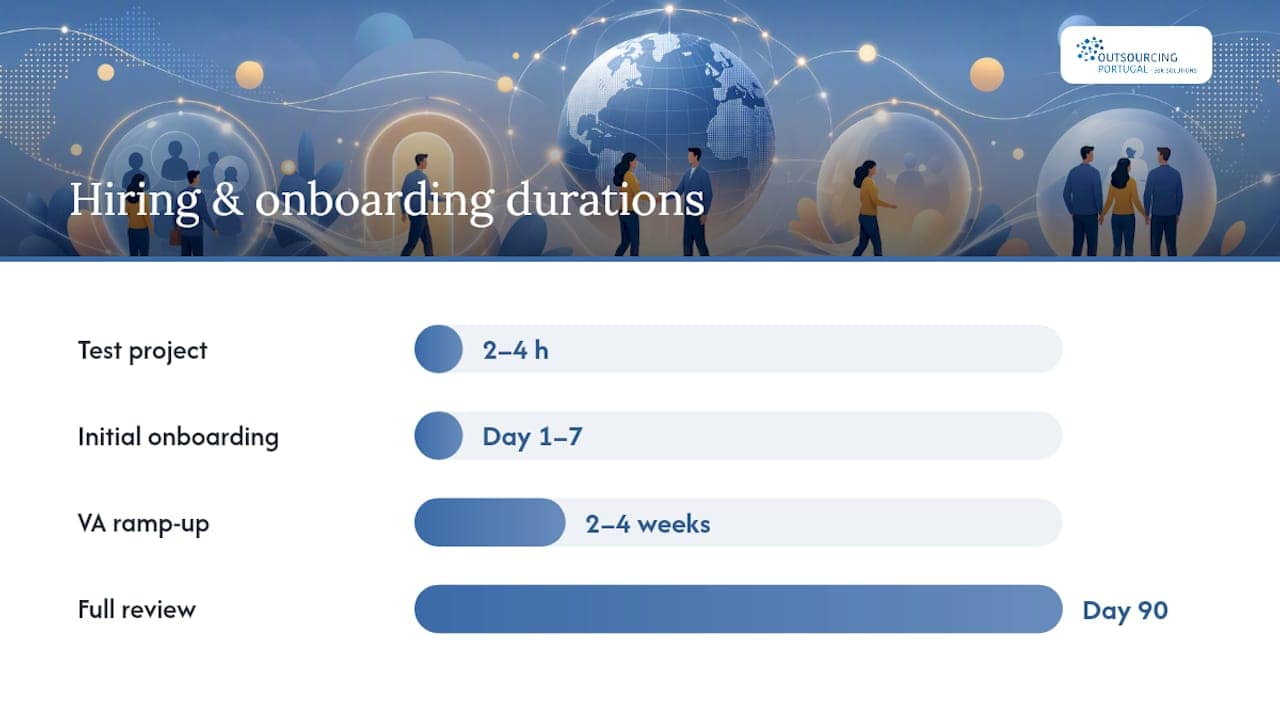
- Test project: Assign a paid, time-boxed task (2–4 hours) that mirrors real work. Evaluate output quality, deadline adherence, and how the candidate handles ambiguity.
- Offer and agreement: Issue a written offer or contractor agreement before work begins. Include scope, rate, IP ownership, confidentiality, and termination terms.
- Onboarding: Follow the 30/60/90-day structure below.
Sourcing channels and when to use each:
- Freelance marketplaces (general platforms): best for short-term, project-based work with clear deliverables and lower stakes
- Talent marketplaces (vetted remote-work platforms): better for ongoing roles where pre-screening saves time
- Managed VA agencies: best when you want backup coverage, account management, and a service-level agreement; some providers advertise onboarding as fast as one day, though realistic ramp-to-productivity for complex roles is closer to two to four weeks
- Direct recruiting: best for senior or specialized roles where culture fit and long-term retention matter
- Nearshore or EOR partners: best when hiring internationally, especially when you need local compliance, payroll, and benefits handled without setting up a legal entity; Outsourcing-portugal’s nearshore team setup workflow covers this path in detail
30/60/90-day onboarding milestones:
- Day 1–7: SSO access provisioned, tools configured, SOPs delivered, first small task assigned
- Day 30: First performance check-in, KPIs confirmed, any process gaps documented
- Day 60: Output quality review, communication rhythm assessed, role scope adjusted if needed
- Day 90: Full performance review, decision on continued engagement or contract adjustment
How to manage virtual employees day to day
Good remote management is mostly about consistency: consistent communication, consistent expectations, and consistent feedback. The tools matter less than the habits.
Tooling categories you need:
- Communication: a real-time messaging platform for daily interaction and a video tool for meetings
- Project management: a task or ticket system where every assignment has an owner, a due date, and a status
- Time tracking: optional for salaried employees, but useful for contractors and for identifying workload imbalances
- Access control: a centralized password manager and single sign-on (SSO) for SaaS tools so you can revoke access instantly when a contract ends
- Document storage: a shared, permission-controlled repository for SOPs, templates, and deliverables
Communication rhythm that actually works:
- Daily async update: each team member posts a brief written status (what was done, what’s next, any blockers) in a shared channel
- Weekly one-on-one: 30-minute video call focused on priorities, feedback, and any issues the async updates didn’t surface
- Bi-weekly team sync: the full virtual team reviews progress against goals and flags cross-functional dependencies
- Monthly performance review: structured against pre-agreed KPIs, with written notes kept on file
Performance measurement checklist:
- Set 3–5 measurable KPIs per role at the start of each quarter
- Define task SLAs (e.g., customer tickets resolved within 4 hours, reports delivered by Friday noon)
- Sample output quality weekly for the first 90 days, then monthly once performance is established
- Track completion rate and on-time delivery separately; both matter
Security and access best practices:
- Apply least-privilege access: each worker gets only the permissions their role requires
- Rotate shared credentials quarterly and immediately upon any team member’s departure
- Require device security standards (screen lock, disk encryption, updated OS) for any device accessing company systems
- Define a clear data-handling policy covering what can be stored locally, what must stay in the cloud, and how to report a suspected breach
For a deeper look at building the management layer, Outsourcing-portugal’s guide on remote team management covers the leadership and process side in detail.
What does hiring a virtual employee actually cost?
Cost depends heavily on the model you choose, the role’s seniority, and where the worker is based.
| Model | Typical cost structure | Time to hire | Notes |
|---|---|---|---|
| Direct hire (US remote, W-2) | Market salary plus additional payroll burden | Several weeks | Full employer obligations; highest long-term cost |
| Independent contractor (1099) | Hourly or project rate, no benefits | 1–3 weeks | Classification risk if role is ongoing and supervised |
| Managed VA agency | Monthly retainer; some providers charge a markup above base salary | Up to one week (vendor claim) | Includes backup, supervision, and SLA |
| Cost-plus agency | Base salary + service fee as low as 5–10% | 1–3 weeks | More transparent; better for budget predictability |
| EOR (international hire) | Local salary + EOR fee (typically 10–20% of salary) | 1–4 weeks | Full compliance, no local entity needed |
A few things to keep in mind when reading vendor claims. Some agencies advertise saving employers $30,000 per year per assistant; that figure comes from provider marketing materials and assumes a specific comparison baseline. The markup vs. cost-plus distinction matters more than the headline savings number: a provider charging a large markup may still be worth it if it delivers speed, compliance, and redundancy. If budget predictability is your priority, ask explicitly for a cost-plus pricing structure.
Sample hiring timeline:
- Post job or brief agency: Day 1
- Applications or agency match: Days 2–5
- Screening and test project: Days 5–10
- Interview and offer: Days 10–14
- Onboarding and system access: Days 14–17
- First productive week: Days 17–21
Contract model pros and cons:
- Fixed monthly retainer: predictable cost, easy to budget; less flexible if workload drops
- Hourly contractor: pay only for time used; harder to manage output quality without clear deliverables
- Project-based contractor agreement: clean scope and exit; not suitable for ongoing operational roles
- EOR full employment: highest compliance protection; best for international hires or roles requiring benefits
For outsourced finance functions specifically, TaxBowl’s outsourced operations service is worth reviewing if you’re considering delegating bookkeeping or financial operations alongside your virtual team build-out.
How to scale virtual staff without losing control
Scaling a virtual team works best when you treat it as a staged process rather than a hiring spree.
Stepwise scaling checklist:
- Stage 1 (Pilot): Hire one general virtual assistant for recurring admin tasks. Document every process they touch.
- Stage 2 (Standardize): After 60 days, convert informal workflows into written SOPs. This is the foundation for every future hire.
- Stage 3 (Specialize): Add a second role that addresses your next biggest bottleneck, typically sales support or marketing.
- Stage 4 (Expand): Bring in a specialist (developer, analyst, or finance support) once the generalist layer is stable.
- Stage 5 (Redundancy): Add backup coverage for your highest-risk roles, either through a managed provider or a second hire in the same function.
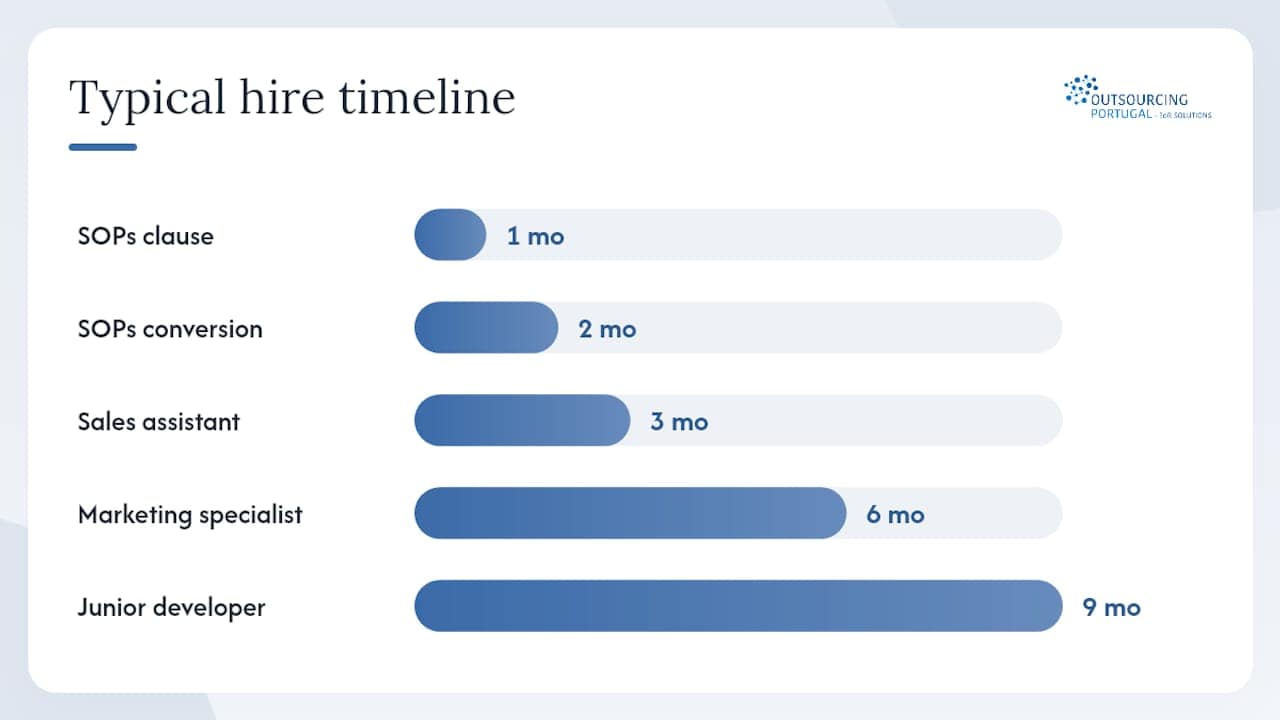
A practical example: a 10-person SaaS company starts with one VA handling scheduling and inbox management. At month three, they add a sales assistant for CRM updates and outbound sequencing. By month six, a marketing specialist takes over content scheduling. Month nine brings a junior developer for QA and bug triage. At that point, the team has four virtual roles, each with documented SOPs and clear KPIs. The next step is redundancy: either a managed provider with built-in backup, or a second hire in the VA role so no single person’s absence stalls operations.
Managed providers recommend exactly this tiered approach: start with a dedicated general assistant for recurring work, then layer in specialists as workload stabilizes. The advantage of a managed service at the redundancy stage is that backup coverage, training, and supervision are already built into the contract. A solo freelancer offers none of that by default.
Platforms built for scale, like those focused on offshore technical hiring, can match multiple roles simultaneously when you need to staff an entire team quickly. That model suits companies hiring five or more roles at once; for one or two hires, a managed VA agency or direct recruiting is usually faster and more cost-effective.
Pro Tip: When contracting with any provider, include a clause requiring written SOPs for all recurring tasks within the first 30 days. If the engagement ends, you keep the documentation. That single clause prevents the most common scaling failure: institutional knowledge that walks out the door with the worker.
Key Takeaways
Hiring a virtual employee delivers real cost and flexibility advantages, but only when you classify the role correctly, structure onboarding around measurable milestones, and build in redundancy before you need it.
| Point | Details |
|---|---|
| Classify before you hire | Determine W-2, 1099, or EOR status before the first payment to avoid IRS and DOL penalties. |
| Start small, then specialize | Begin with one general VA role, document all processes, then add specialist hires at each growth stage. |
| Managed services reduce risk | Providers with backup coverage and SLAs that protect continuity better than solo freelancer arrangements. |
| Onboarding drives productivity | SSO access, written SOPs, and 30/60/90-day milestones cut time-to-productivity for every new remote hire. |
| Outsourcing-portugal for compliant nearshore hires | For US companies hiring in Portugal without a local entity, Outsourcing-portugal handles EOR, payroll, and compliance end to end. |
The gap between what virtual hiring promises and what actually trips employers up
Most articles about virtual employees focus on the upside: lower costs, faster hiring, global talent pools. Those benefits are real. What gets less attention is the operational gap that opens up between signing a contract and having a productive team member.
The classification question is the one that bites hardest. Employers routinely engage workers as contractors because it’s simpler, then gradually add supervision, set hours, and provide tools until the arrangement looks nothing like an independent contractor relationship. The IRS doesn’t care what the contract says; it looks at the economic reality of the relationship. That gap between contract language and actual working practice is where most misclassification penalties originate.
The second gap is onboarding. A virtual hire who doesn’t receive system access, documented processes, and clear first-week tasks on day one will spend their first two weeks figuring out how your business works instead of contributing to it. That’s not a motivation problem; it’s a setup problem. The fix is mechanical: an onboarding checklist, pre-provisioned access, and a first task assigned before the start date.
The third gap is redundancy planning. Most small businesses hire one virtual assistant and treat that person as a permanent fixture. When they leave, the institutional knowledge leaves with them. Building SOPs from day one and choosing a managed provider for critical roles are the two practices that prevent this from becoming a crisis.
The nearshore EOR model addresses all three gaps simultaneously: classification is handled by the EOR, onboarding is structured by the provider, and managed teams include backup coverage. For US companies that want the benefits of virtual staffing without the compliance exposure, that combination is worth the service fee.
Outsourcing-portugal: compliant nearshore virtual hiring without the legal complexity
US companies that want the cost and talent advantages of a virtual employee in Portugal, without setting up a local legal entity, have a direct path through Outsourcing-portugal. The service covers everything that typically slows down an international hire: EOR employment, local payroll and tax compliance, onboarding, benefits administration, and HR support. You direct the work; Outsourcing-portugal handles the legal and administrative layer.

Portugal offers a highly educated, English-proficient workforce at competitive rates, with a time zone that overlaps US East Coast business hours in the morning. For tech teams, customer support, sales, and back-office functions, it’s a nearshore option that combines EU-standard employment protections with lower overhead than equivalent US hires.
This model fits best when you’re hiring one to ten roles internationally, need full compliance from day one, and don’t want to spend six months setting up a foreign subsidiary. See the top employment outsourcing options Outsourcing-portugal recommends, or go directly to the EOR and payroll services page to start a discovery conversation.
Useful sources and further reading
These are the primary sources worth bookmarking for compliance verification and deeper research:
- IRS Worker Classification guidance: The IRS common-law test and Form SS-8 process for determining employee vs. contractor status. Start here before any classification decision.
- US Department of Labor — Wage and Hour Division: The DOL’s economic reality test and enforcement guidance on misclassification. Particularly relevant for ongoing contractor relationships.
- OPM — Remote Work Definition: The federal government’s formal definition of remote work, useful for benchmarking your own remote-work policy language.
- Bureau of Labor Statistics — Telework Trends: BLS data on telework prevalence and workforce trends; useful for benchmarking remote-work adoption across industries.
- SBA — Employee Cost Guide: The SBA’s breakdown of true employment costs beyond base salary, including payroll taxes, benefits, and overhead.
- Outsourcing-portugal — EOR Service Benefits: Explains when EOR makes operational and financial sense for international hiring, with Portugal-specific context.
Note: This article provides general information for employers and HR professionals. It is not legal or tax advice. Confirm current classification rules and payroll obligations with a qualified employment attorney or CPA before making hiring decisions.