
TL;DR:
- A nearshore team setup workflow involves defining capabilities, vetting candidates, launching, and optimizing to accelerate productivity. Proper preparation, phased onboarding, and structured communication ensure successful integration and cost savings. Portugal’s time zone overlap and talent quality support effective nearshore partnerships when workflows are correctly implemented.
A nearshore team setup workflow is a structured, phased process for building a development team in a geographically close country, using time zone alignment, cultural proximity, and shared tooling to reach full productivity faster than offshore alternatives. For international companies targeting Portugal, this workflow covers everything from defining capability profiles to achieving independent sprint ownership. Done right, it delivers 30–50% cost savings compared to onshore hiring while completing projects significantly faster than offshore models. The standard industry term for this model is nearshore outsourcing, and the workflow is what separates companies that integrate teams smoothly from those that stall at month two.
What does a solid nearshore team setup workflow require upfront?
The most common reason nearshore engagements fail is not poor talent. It is poor preparation on the client side. Before you post a single job description, you need four things locked down.

Define capability profiles, not just job titles. A title like “senior backend developer” tells a recruiter nothing useful. A capability profile specifies the stack (Node.js, PostgreSQL), the ownership level (feature lead vs. contributor), and the collaboration style (async-first vs. daily pairing). This specificity cuts shortlisting time and reduces mismatches after onboarding.
Choose your engagement model. Staff augmentation embeds individuals into your existing team under your direct management. A dedicated team model gives you a self-contained unit with its own delivery rhythm. The right choice depends on how much management bandwidth you have and how mature your internal processes are.
Establish decision rights before day one. Define who approves architecture changes, who unblocks deployment issues, and who handles escalations. Without this, nearshore engineers waste hours waiting for answers that should take minutes.
Prepare your technical infrastructure. Git branching conventions, Jira board structure, Slack channel taxonomy, and access provisioning must be ready before the first engineer logs in. Pre-launch operational readiness including documentation, escalation paths, and communication rhythms is critical to avoid productivity stagnation from the start.
Pro Tip: Set written success metrics for 30, 60, and 90 days before you hire. These become your calibration benchmarks, not performance pressure tools.
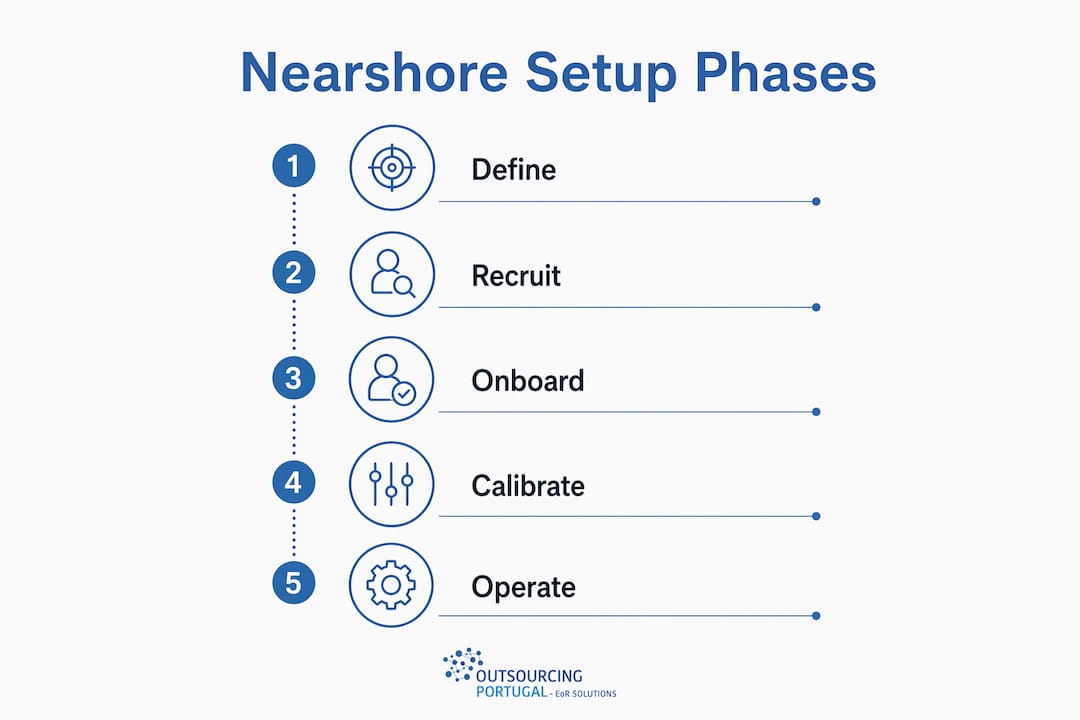
What are the four phases of an effective nearshore setup?
A proven nearshore team setup workflow runs through four phases: Define, Vet, Launch, and Optimize. Each phase has a clear owner, timeline, and exit criterion.
-
Define (Weeks 1–2). Lock in capability profiles, engagement model, tooling standards, and your 30/60/90-day success metrics. Produce a one-page onboarding brief covering technical environment, deployment process, communication norms, and decision frameworks. This document is the single most important artifact you will create.
-
Vet (Weeks 2–4). With a vetted nearshore partner, shortlisting 2–3 senior candidates can happen within 72 hours. Conduct technical screens, then run a 2–3 week pilot project before committing to full hiring. Pilot projects reveal operational and cultural fit issues that references and interviews miss entirely.
-
Launch (Weeks 4–10). Week one focuses on environment setup, access provisioning, and introductory pairing sessions. Weeks two through four introduce the nearshore engineer to sprint ceremonies, code review standards, and stakeholder communication. By weeks five through eight, the goal is independent feature ownership on non-critical paths. A structured onboarding workflow spans 6–10 weeks, with full velocity typically reached around month three.
-
Optimize (Month 3 onward). Run a formal retrospective at the 90-day mark. Review rework rates, coordination overhead, and blocker frequency. Adjust sprint cadence, communication rhythms, and ownership boundaries based on real data.
Pro Tip: Treat the first 30 days as a calibration cycle, not a performance review. The goal is to establish baseline velocity and surface workflow friction, not to hit aggressive targets.
| Phase | Timeline | Key Output |
|---|---|---|
| Define | Weeks 1–2 | Capability profiles, onboarding brief, success metrics |
| Vet | Weeks 2–4 | Pilot project completed, candidates shortlisted |
| Launch | Weeks 4–10 | Environment live, sprint ceremonies running |
| Optimize | Month 3+ | Retrospective complete, ownership model confirmed |
Portugal’s time zone sits within the Central European Time zone, giving US East Coast teams a 5-hour overlap and UK teams a near-identical working day. That overlap is not a minor convenience. Nearshoring delivers 6–8 hours of daily overlap, enabling real-time collaboration and reducing communication misunderstandings by 65% compared to offshore setups. Same-day issue resolution becomes the norm rather than the exception.
How do you build communication rhythms that actually work?
Communication structure is where most remote team workflows break down. The fix is not more meetings. It is a four-layer rhythm that separates synchronous coordination from asynchronous reference work.
- Layer 1: Daily stand-up (15 minutes, synchronous). Keep it to blockers and handoffs. Use Slack or Microsoft Teams for the call. Log outcomes in Jira or Linear so the async record is automatic.
- Layer 2: Sprint ceremonies (weekly or biweekly, synchronous). Planning, review, and retrospective. These are the only meetings where the full team must be present. Schedule them during the overlap window.
- Layer 3: Async reference channels (Notion or Confluence). Architecture decisions, process documentation, and onboarding guides live here. Engineers consult these without interrupting anyone.
- Layer 4: Escalation path (on-demand, synchronous). One named contact per side. No group pings for urgent issues. Direct message the escalation contact, who resolves or routes within two hours.
Effective teams differentiate near-sync channels like Slack and Teams from asynchronous reference tools like Notion and Confluence. Teams that blur this line experience meeting fatigue and measurable productivity declines within six weeks.
“The single biggest communication mistake is treating Slack as both a chat tool and a documentation system. It is neither. Use it for coordination, and write everything permanent in Confluence or Notion.”
Cultural alignment accelerates this rhythm. Portugal scores consistently high on English proficiency and shares Western European professional norms with most of its nearshore clients. That cultural compatibility means fewer misunderstandings in sprint planning and faster trust-building in code reviews. Outsourcing-portugal covers this in depth in their guide on cultural compatibility in outsourcing.
What are the most common nearshore setup challenges and how do you fix them?
Most nearshore project management failures trace back to three root causes: unclear escalation paths, insufficient onboarding documentation, and premature goal-setting.
Unclear escalation paths create decision bottlenecks. An engineer in Lisbon who cannot get an architecture decision approved for three days will fill that time with lower-priority work. The fix is a written escalation matrix, shared on day one, with response time commitments attached.
Insufficient onboarding documentation forces new team members to ask questions that should have been answered before they started. Every hour spent answering “where do I find X” is an hour not spent building. A complete onboarding brief covers technical environment, deployment pipeline, communication norms, and decision frameworks.
Premature OKR setting is the most underestimated risk. The first 30 days should be a calibration cycle establishing baseline velocity rather than enforcing rigid targets. Setting aggressive OKRs in week one erodes trust and inflates commitments that the team cannot yet accurately estimate.
- Monitor these three signals weekly during the first 90 days: blocker frequency (how often engineers are waiting for input), coordination overhead (time spent in meetings vs. building), and rework rate (percentage of completed work that requires revision).
- If blockers spike, revisit the escalation matrix. If coordination overhead climbs above 20% of working hours, cut a recurring meeting. If rework rises, the issue is almost always unclear acceptance criteria, not engineer quality.
Pro Tip: Run a 2–3 week pilot project before committing to full team hiring. Pilot projects uncover compatibility issues that references and technical screens consistently miss.
Successful nearshore teams evolve beyond execution. Nearshore teams act as embedded product members, owning architecture decisions and contributing to technical roadmaps. That shift from capacity to capability is the marker of a mature nearshore engagement.
Key Takeaways
A nearshore team setup workflow succeeds when preparation, phased onboarding, and structured communication rhythms are in place before the first engineer starts.
| Point | Details |
|---|---|
| Prepare before hiring | Define capability profiles, decision rights, and tooling standards before posting any role. |
| Use a four-phase workflow | Define, Vet, Launch, and Optimize gives each stage a clear owner and exit criterion. |
| Calibrate before setting goals | Treat the first 30 days as a velocity baseline, not a performance target period. |
| Separate sync and async channels | Use Slack for coordination and Notion or Confluence for permanent reference documentation. |
| Run a pilot project first | A 2–3 week pilot reveals cultural and operational fit issues that interviews cannot surface. |
Why I think most companies get nearshore workflows backwards
The companies I see struggle most with nearshore setups share one pattern. They treat the engagement as a cost reduction exercise and then wonder why the team feels disengaged by month two. Leaders who view nearshoring as a productivity multiplier rather than a cost-cutting measure get fundamentally different results. They invest in onboarding quality, not just onboarding speed. They write documentation before day one. They run pilots before scaling. They set calibration cycles instead of OKRs in week one.
Portugal specifically rewards this mindset. The talent pool is technically strong, English proficiency is high, and the time zone overlap with Western Europe and the US East Coast is genuine, not marginal. But none of that matters if you hand a Lisbon engineer a Jira board with no context and expect output in week one.
The operational lesson I keep returning to is this: the workflow you build before the first hire determines the ceiling of what the team can achieve. Rushing the Define phase to save two weeks costs you three months of ramp-up time. Skipping the pilot project to save budget costs you a full hiring cycle when the fit turns out wrong.
Portugal’s nearshore advantages are real and well-documented. Your job is to build the internal workflow that lets those advantages show up in your delivery metrics.
— Paulo
How Outsourcing-portugal supports your nearshore team setup
Building a nearshore team in Portugal requires more than a hiring plan. It requires compliant employment contracts, payroll management, and HR support from day one.

Outsourcing-portugal provides Employer of Record services in Portugal that let you hire and onboard Portuguese talent without setting up a local legal entity. Their vetted talent pools reduce time-to-hire, their compliance expertise covers Portuguese labor law, and their payroll management removes the administrative burden from your team. For companies ready to move from workflow planning to execution, Outsourcing-portugal’s employment and setup services are the direct operational next step.
FAQ
What is a nearshore team setup workflow?
A nearshore team setup workflow is a phased process covering capability definition, candidate vetting, team onboarding, and performance optimization for a development team in a nearby country. It typically spans 6–10 weeks to launch and reaches full velocity around month three.
How long does it take to set up a nearshore team in Portugal?
With a vetted nearshore partner, shortlisting senior candidates takes as little as 72 hours, with full onboarding completing within 1–2 weeks. Full team velocity typically arrives at the 90-day mark following a structured 30/60/90-day plan.
What tools are standard for nearshore team collaboration?
Slack and Microsoft Teams handle synchronous coordination, while Notion and Confluence serve as asynchronous reference tools. Jira or Linear manages sprint tracking. Using all four in defined roles prevents meeting fatigue and keeps documentation accessible.
Why is Portugal a strong nearshore location for European and US companies?
Portugal offers 6–8 hours of daily time zone overlap with US East Coast teams, high English proficiency, and a technically skilled workforce. These factors combine to reduce communication friction and accelerate team integration compared to offshore alternatives.
What is the biggest risk in a nearshore team setup?
The biggest risk is premature goal-setting before the team has established baseline velocity. Setting rigid OKRs in the first 30 days erodes trust and produces inflated commitments. A calibration cycle in month one produces more accurate planning data and stronger long-term performance.