

Employment tax returns for Portugal hires are the employer payroll and social-security filings that an Employer-of-Record (EOR) submits and pays to Portuguese authorities on your company’s behalf each month and at year-end. These are not US federal forms. This guide covers Portuguese employer obligations only.
The core filings at a glance:
- Monthly social-security contributions paid to Segurança Social with standard employer and employee rates
- Monthly payroll withholding declarations and remittances to the Autoridade Tributária (AT)
- Year-end employer declarations summarizing annual pay and withholdings
- Periodic reports on fringe benefits, termination settlements, and other pay elements
One critical point on liability: the EOR is the registered employer in Portugal and performs all filings under your service agreement. Your company remains ultimately accountable for the accuracy of the data you supply. The EOR files; you approve and fund.
Table of Contents
- Which employer filings apply when you hire in Portugal?
- Who files, who pays, and how legal responsibility is split
- What deadlines look like in practice
- What you must provide your EOR to file correctly
- Common penalties and compliance risks to know
- How an EOR handles your employment tax returns
- Pricing and cost drivers for EOR-managed filings
- How to prepare before handing filings to an EOR
- A typical payroll month: what the EOR actually does
- Key Takeaways
- Why the compliance burden is heavier than most US companies expect
- Outsourcing-portugal handles your Portugal payroll filings end to end
- Authoritative sources and further reading
Which employer filings apply when you hire in Portugal?
Portugal’s employer filing obligations fall into three recurring categories, each with its own authority and cadence.
| Filing | Authority | Frequency |
|---|---|---|
| Social-security contributions (employer + employee) | Segurança Social | Monthly |
| Payroll withholding (IRS-equivalent) declarations | Autoridade Tributária | Monthly |
| Annual employer income declaration | Autoridade Tributária | Year-end |
| Fringe benefits / company car reporting | Autoridade Tributária | Periodic |
| Termination / settlement reports | Segurança Social + AT | On event |
Employer and employee contribution rates are set at 23.75% (employer) and 11% (employee) for most for-profit entities, giving a combined rate of 34.75% of gross remuneration. The Social Support Index (IAS) for 2026 is €537.13, which anchors certain contribution bases and minimum caps.
Fringe benefits deserve attention. Meal allowances, mileage, and daily allowances each have specific incidence rules and exemption thresholds under Portuguese social-security law. Commissions and bonuses are fully subject to contributions; some allowances are exempt up to defined caps. Your EOR needs the full pay breakdown to calculate correctly.
Pro Tip: Ask your EOR to map every pay element in your offer letter to its social-security incidence status before the first payroll runs. Fixing a misclassified allowance retroactively is far more expensive than getting it right on day one.
Who files, who pays, and how legal responsibility is split
Employers must register with Segurança Social at company formation and notify the authority of each new hire within 24 hours before the contract takes effect. When you use an EOR, the EOR holds that registration and carries out those notifications as the local employer of record.
| Responsibility | EOR | Client company |
|---|---|---|
| Segurança Social registration | ✓ Performs | Receives proof |
| Worker admission notifications | ✓ Files within 24 hours | Approves hire |
| Monthly contribution payments | ✓ Remits | Funds EOR account |
| Payroll withholding submissions | ✓ Files and pays | Approves payroll |
| Year-end employer declarations | ✓ Files | Reviews and signs off |
| Accuracy of employee data supplied | — | ✓ Responsible |
Your service agreement with the EOR should include a service-level agreement specifying submission deadlines, copies of filings sent to Segurança Social and the AT, and payment receipts. Without those provisions in writing, you have no visibility into whether filings are actually happening.
Pro Tip: Require digital access to the payroll portal or a monthly reconciliation pack in your SLA. A PDF receipt of payment is the minimum; a full reconciliation showing gross pay, deductions, and remittances is what you actually need.
What deadlines look like in practice
Social-security payments relate to the previous month and fall within a mid-month payment window. Payroll withholding remittances to the AT follow a similar monthly cadence, with a year-end summary obligation.
Missing a social-security payment deadline exposes the employer to interest charges and potential administrative sanctions under Portuguese law. Late payment is not a minor administrative slip — it creates a compliance record that can affect future audits and the company’s standing with Portuguese authorities.
For a US company working across time zones, the practical implication is clear: your EOR needs your payroll approval and funded account several business days before the statutory deadline, not on the deadline itself. Build that buffer into your internal payroll calendar from month one.
What you must provide your EOR to file correctly
Getting the filings right depends entirely on the quality of data you supply. Missing or incorrect employee identifiers are the single most common cause of filing errors.
Employee identifiers (required before the first payroll):
- NIF (Portuguese tax identification number)
- NISS (social-security number, 11 digits, obtained at registration)
- Passport or national ID copy
| Data category | Specific items needed |
|---|---|
| Contract details | Signed contract, contract type, start date, work location |
| Pay elements | Gross salary, variable pay schedule, commission structure |
| Benefits | Meal vouchers, company car details, health insurance |
| Banking | Employee IBAN, expense reimbursement instructions |
| Time and attendance | Approved timesheets, absence and leave records |
| Terminations | Settlement amounts, notice period, final pay calculation |
Common penalties and compliance risks to know
Late or missing social-security payments trigger interest and can constitute an administrative offense under Portuguese law. The risks compound quickly when the underlying data is also wrong.
The most common enforcement triggers are not late payments — they are incorrect employee classification, missing NIF or NISS numbers, and failure to notify Segurança Social of a new hire within the mandatory 24-hour window. Auditors look for patterns, and a single missed notification on a new hire can open a broader review.
Misreporting fringe benefits is another frequent problem. A company car or housing allowance that is not correctly reported to the AT creates a gap between what the employer declares and what the employee’s tax return shows. That gap is an audit flag.
Pro Tip: Keep a monthly compliance checklist: payment receipt from Segurança Social, AT withholding confirmation, and a reconciliation of gross payroll to contributions remitted. If your EOR cannot produce all three within five business days of the payment window closing, that is a service gap worth escalating.
How an EOR handles your employment tax returns
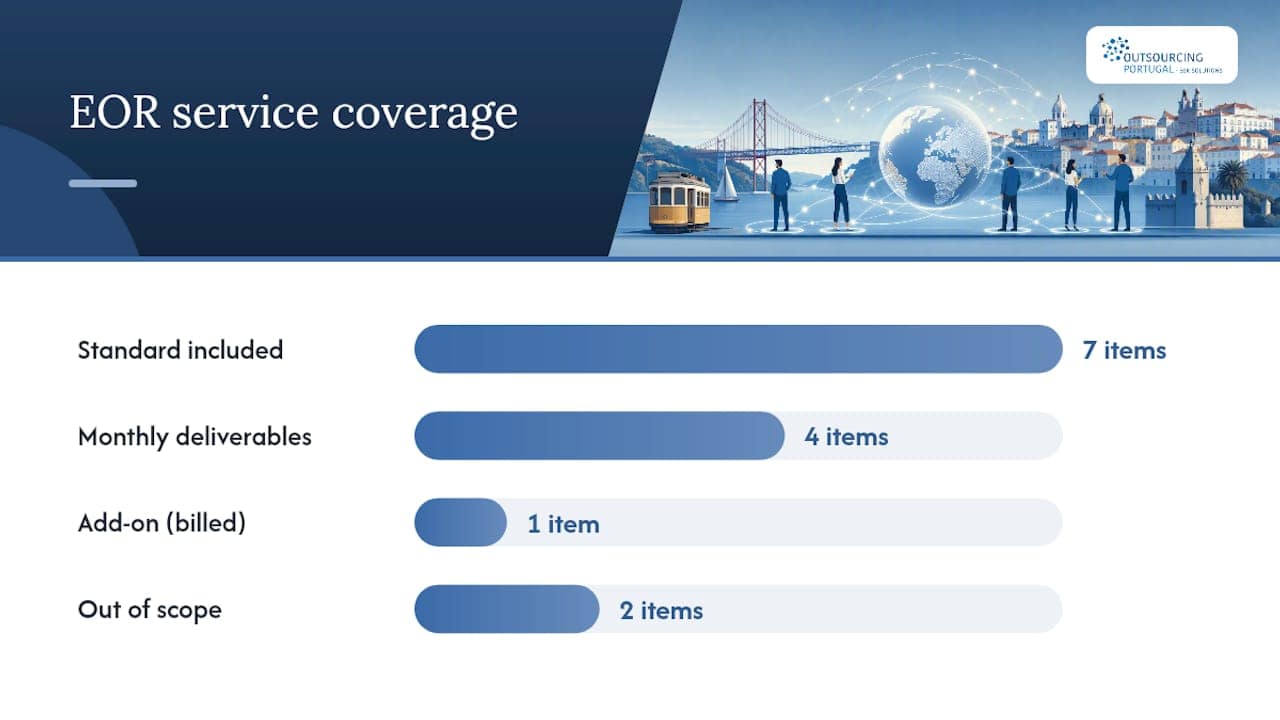
A well-structured EOR service covers the full filing cycle, from registration through year-end. Here is what the scope typically looks like and what you should receive each month.
| Service element | Standard EOR scope | Add-on / out of scope |
|---|---|---|
| Segurança Social registration | ✓ Included | — |
| Worker admission notifications | ✓ Included | — |
| Monthly contribution remittance | ✓ Included | — |
| Payroll withholding filing and payment | ✓ Included | — |
| Year-end employer declarations | ✓ Included | — |
| Monthly payroll register and payslips | ✓ Included | — |
| Payment receipts (SS + AT) | ✓ Included | — |
| Prior-period corrections | — | Typically billed separately |
| Complex tax advice / rulings | — | Out of scope |
| Multi-country payroll consolidation | — | Out of scope |
Monthly deliverables to insist on:
- Payroll register showing gross pay, deductions, and net per employee
- Individual payslips in Portuguese (legally required)
- Proof of payment to Segurança Social and the AT
- Monthly reconciliation of contributions calculated vs. remitted
Outsourcing-portugal’s EOR and payroll service covers registrations, monthly filings, and the full reporting pack described above, with SLA provisions on submission timing and audit support built into the engagement.
Pro Tip: Request a sample monthly payroll pack before signing. If the EOR cannot show you what a real deliverable looks like, that tells you something about their reporting maturity.
Pricing and cost drivers for EOR-managed filings
EOR pricing for Portugal payroll and employment tax services typically follows one of three models.
| Pricing model | How it works | Best for |
|---|---|---|
| Flat per-employee monthly fee | Fixed amount per employee regardless of salary | Predictable headcount, simple pay structures |
| Percentage of gross payroll | Fee scales with salary level | Variable or high-salary employees |
| Hybrid (flat + transaction fees) | Base fee plus charges for corrections, bonuses, or add-ons | Companies with complex or irregular pay |
Cost drivers beyond the base fee include the number of distinct pay elements (commissions, bonuses, and allowances each add processing complexity), fringe benefits requiring specific reporting, frequency of off-cycle payroll runs, and any corrective filings needed for prior periods. Setup fees for initial registration and onboarding are common and should be itemized separately.
Request a transparent fee schedule that distinguishes the EOR management fee from the pass-through costs (actual tax and contribution payments, which are always at cost).
How to prepare before handing filings to an EOR
Getting the first payroll right requires preparation on your side before the EOR can do anything.
- Collect employee NIF and NISS numbers before the contract start date. The EOR can assist with NISS registration, but the process takes time.
- Finalize the employment contract in Portuguese-compliant form, specifying contract type, salary, benefits, and work location.
- Define the payroll cycle (monthly is standard in Portugal) and set internal approval deadlines that give the EOR at least three business days before the statutory payment window.
- Sign a data processing agreement covering GDPR obligations for employee personal data shared with the EOR.
- Establish the funding mechanism for tax remittances: will you pre-fund an EOR account or wire funds on approval?
- Request proof of Segurança Social registration and AT registration from the EOR before the first payroll.
- Agree on the reporting cadence: monthly reconciliation pack, payslip delivery date, and year-end declaration timeline.
Questions to ask every EOR before signing:
- Can you show proof of your own registration with Segurança Social and the AT?
- What is your SLA for submitting monthly contributions and withholding payments?
- Do clients have direct access to the payroll portal or reports?
- How do you handle corrective filings, and what do you charge for them?
- What happens to client funds held for tax remittances if there is a service disruption?
Red flags: vague SLA language on filing deadlines, no client access to payroll reports, and unclear handling of funds between payroll approval and tax remittance.
For a deeper employer compliance checklist, Outsourcing-portugal publishes practical guides covering registration steps, sample reports, and the questions to include in an EOR RFP.
A typical payroll month: what the EOR actually does
Here is how a standard month runs for a US company with one employee in Lisbon.
Week 1: You submit approved timesheets and any variable pay to the EOR. The EOR calculates gross pay, applies the 23.75% employer contribution and 11% employee deduction, and computes IRS withholding based on the employee’s tax table.
Week 2: You approve the payroll register and transfer funds to the EOR (net salary + employer contributions + withholding). The EOR pays the employee’s net salary directly to their Portuguese bank account.
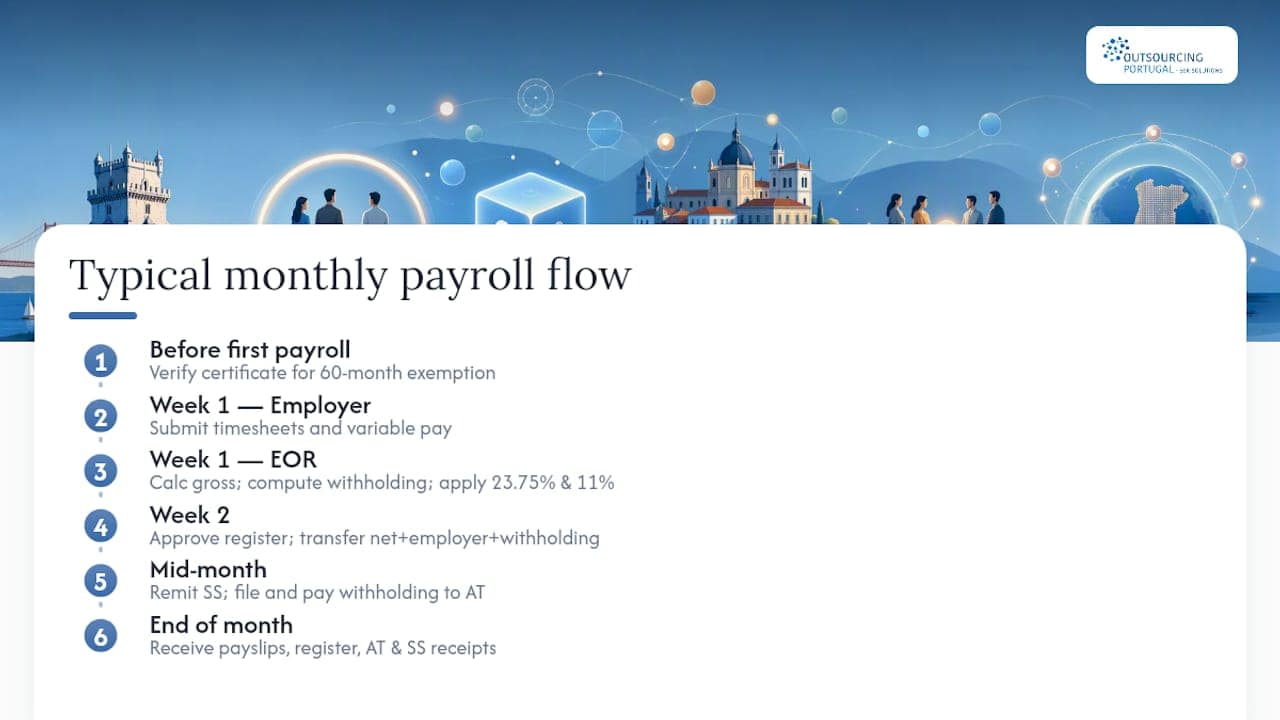
Mid-month window: The EOR remits employer and employee social-security contributions to Segurança Social and submits the payroll withholding declaration and payment to the AT, both within the statutory payment window.
End of month: You receive the full reporting pack: payslips, payroll register, and payment receipts from both authorities.
For employees on secondment from the US, the picture changes. Under the US-Portugal social-security totalization agreement, US assignees may be exempt from Portuguese social-security contributions for up to 60 months, provided they hold a valid certificate of coverage. The EOR must verify this status before the first payroll — applying full contributions to an exempt assignee creates a refund process that takes months to resolve.
Key Takeaways
An EOR handles every Portuguese employer filing, but the accuracy of those filings depends entirely on the data and approvals you provide on time each month.
| Point | Details |
|---|---|
| Combined contribution rate | Employer pays 23.75% and employee pays 11% of gross remuneration to Segurança Social monthly. |
| 24-hour registration rule | New hires must be notified to Segurança Social within 24 hours before the contract start date. |
| Payment window | Social-security and withholding payments relate to the previous month and fall within a mid-month statutory window. |
| Data you must supply | NIF, NISS, signed contract, full pay breakdown, and benefits details before the first payroll runs. |
| Outsourcing-portugal | Covers registrations, monthly filings, payslips, and full reconciliation reports under a signed SLA. |
Why the compliance burden is heavier than most US companies expect
Most US startups assume Portuguese payroll is a simpler version of running US payroll. It is not. The 24-hour pre-hire notification requirement alone catches companies off guard. In the US, you hire someone and sort out the paperwork afterward. In Portugal, the notification to Segurança Social must happen before the contract takes effect. Miss that window and you have already committed a reportable violation, regardless of whether you pay contributions correctly every month afterward.
The fringe benefits rules add another layer. Meal vouchers, company cars, and housing allowances are not just HR perks in Portugal — they each have specific social-security incidence rules and exemption thresholds. A US company that structures a compensation package the way it would for a US employee and then hands it to an EOR without a detailed pay element breakdown is setting up a correction filing within three months.
The right EOR does not just file what you send. It flags misclassified pay elements, reminds you of the funding deadline, and delivers a reconciliation that lets you verify every euro remitted. That is the standard to hold them to.
Outsourcing-portugal handles your Portugal payroll filings end to end
Foreign companies hiring in Portugal face a specific compliance burden: monthly social-security remittances, payroll withholding declarations, 24-hour hire notifications, and year-end employer reports, all in Portuguese, all with statutory deadlines. Outsourcing-portugal manages every one of those filings as your registered EOR, with proof of payment delivered each month and a signed SLA covering submission timing.
The engagement starts with registration confirmation from Segurança Social and the AT, a sample payroll pack showing exactly what you will receive each month, and a transparent fee schedule with no hidden transaction charges. Whether you are hiring your first employee in Lisbon or building a nearshore team, the process is the same: you supply the approved payroll data, Outsourcing-portugal handles the rest.
Request your sample monthly payroll pack and SLA from Outsourcing-portugal’s EOR service page or get a quote directly from the employment services homepage.
This article provides general information about Portuguese employer tax obligations and is not legal or tax advice. Confirm current rules and rates with the Autoridade Tributária, Segurança Social, or a qualified Portuguese tax professional before making compliance decisions.
Authoritative sources and further reading
| Resource | What it covers |
|---|---|
| Segurança Social — employer contribution rates and payment windows | Official contribution rates, payment deadlines, and late-payment consequences |
| Segurança Social — employer rights and obligations (English) | English-language official guidance on employer responsibilities |
| Segurança Social — employer registration obligations | Registration requirements and 24-hour hire notification rule |
| PwC Portugal — 2026 Social Security Tax Guide | Contribution regimes, IAS reference value, exemption thresholds, and international conventions |
| Outsourcing-portugal — EOR and payroll services | Service scope, registration proof, and sample deliverables |
| Outsourcing-portugal — tax compliance practical guide | Employer checklists, sample reports, and RFP questions |
| Outsourcing-portugal — payroll software tax guide | Payroll tool integration and tax handling for US companies hiring in Portugal |