

TL;DR:
- Paying employees in Portugal is just the beginning of compliance; employers must also handle withholding calculations, social security contributions, reporting, and recordkeeping to avoid penalties.
- Monthly declarations like the DMR and accurate payslips are mandatory, requiring detailed documentation and timely submissions to authorities.
Paying your employees correctly in Portugal is only the beginning. Many multinational HR managers and compliance officers assume that processing payroll equals meeting their legal obligations, but Portugal’s tax compliance framework covers a much broader set of responsibilities including withholding calculations, social security contributions, monthly declarations, payroll reporting, and strict recordkeeping standards. Miss any one component and you face audits, financial penalties, and reputational damage. This guide breaks down every major obligation clearly and gives you a practical roadmap to stay fully compliant.
Table of Contents
- Tax compliance explained: What does it mean for employers in Portugal?
- Essential components of employer tax compliance in Portugal
- How Portuguese payroll reporting works: The DMR and monthly filings
- Common challenges and smart strategies for multinational employers
- Our take: Why tax compliance in Portugal is more nuanced than most think
- Get expert support for tax compliance in Portugal
- Frequently asked questions
Key Takeaways
| Point | Details |
|---|---|
| Compliance is a process | Employer tax compliance in Portugal requires ongoing reporting, payment, and documentation—not just paying taxes. |
| Monthly payroll declarations | Submitting the DMR and related reports on time each month is mandatory for all employers. |
| Integrated obligations | Portuguese employers must handle IRS, social security, recordkeeping, and timely filings together for full compliance. |
| Global teams need local expertise | International HR operations benefit from local partners or experts to navigate Portugal’s specific compliance landscape. |
Tax compliance explained: What does it mean for employers in Portugal?
Let’s start by challenging a common assumption. Compliance is not simply the act of paying wages on time. As one widely cited payroll resource explains, tax compliance is the end-to-end process of calculating payroll-related taxes correctly, withholding the required amounts from employees where applicable, remitting payments to the right authorities, and filing required declarations within statutory deadlines.
For multinational companies operating in Portugal without a local entity, this end-to-end view changes everything. You are not just running payroll. You are managing a regulated compliance cycle that has defined steps, defined timelines, and defined penalties for any deviation.
In the Portuguese context, employer tax obligations typically cover three broad pillars:
- IRS withholding: Personal income tax withheld at source from employee wages
- Social security contributions: Employer and employee portions paid to Segurança Social
- Reporting and documentation: Monthly declarations to the AT (Autoridade Tributária e Aduaneira) and Segurança Social, plus detailed payslips and audit-ready records
The consequences of non-compliance range from minor administrative fines to full-scale tax authority audits. In more serious cases, companies face back payments with interest charges, penalties that scale with the value of the missed obligation, and potential legal liability for directors or HR officers who signed off on incorrect filings.
“Compliance is not a box you check once a year. In Portugal, it is an active monthly process with specific legal requirements at each stage.”
Pro Tip: If your internal HR team does not have dedicated Portuguese payroll expertise, consider payroll outsourcing solutions as a risk management strategy rather than just a cost decision. Many multinationals that try to manage Portuguese payroll from a central European hub underestimate local specifics until a fine arrives.
It is also worth noting that outsourcing payroll to stay compliant is increasingly common among international businesses precisely because local rules evolve frequently. Portuguese tax legislation changes regularly, and what was compliant in one fiscal year may require adjustment in the next.
Essential components of employer tax compliance in Portugal
Now that you understand compliance’s true scope, let’s walk through the individual obligations that matter most.
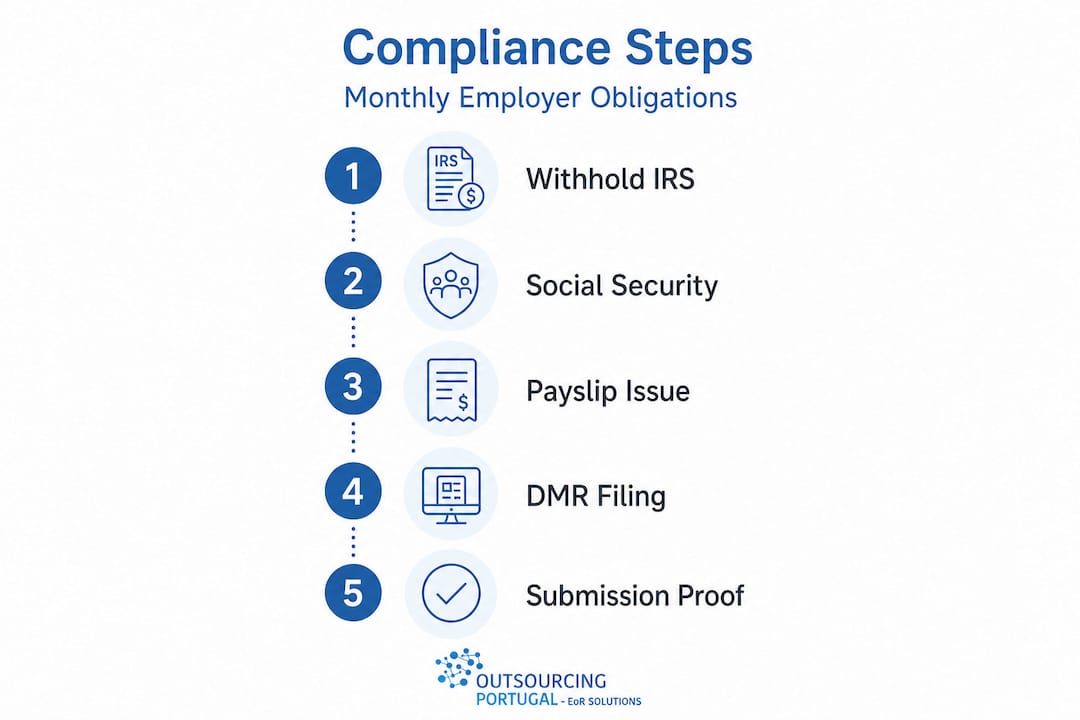
Employer compliance in Portugal typically includes IRS (personal income tax) withholding on wages, employer and employee social security contributions, recurring monthly declarations to the tax authority and Segurança Social, plus accurate payslips and recordkeeping. Here is how each component works in practice.
Step-by-step: Core employer tax obligations
- Calculate gross salary based on the employment contract and agreed terms
- Apply IRS withholding tables based on employee residency status, salary band, marital status, and number of dependents
- Calculate social security contributions at the applicable rates (employer contributes 23.75%, employee contributes 11%)
- Prepare the payslip with all required line items clearly stated
- Process the net payment to the employee by the agreed payment date
- Submit the DMR (monthly remuneration declaration) to the tax authority by the 10th of the following month
- Submit Segurança Social declarations and remit contributions by the 20th of the following month
- Archive all documentation including payslips, declarations, and remittance confirmations
Each of these steps must be completed every single month without exception. Skipping even one step for a single employee can trigger a compliance gap.
| Obligation | Rate or requirement | Deadline | Authority |
|---|---|---|---|
| IRS withholding | Variable (by salary and status) | Withheld at payment date | AT (tax authority) |
| Employer social security | 23.75% of gross salary | 20th of following month | Segurança Social |
| Employee social security | 11% of gross salary | Withheld and remitted with employer portion | Segurança Social |
| DMR filing | Monthly declaration | 10th of following month | AT |
| Payslip issuance | Required for all employees | By payment date | N/A (employee record) |
Pro Tip: Build a monthly compliance calendar that flags each deadline in advance. Use color-coded alerts for the 10th (DMR) and 20th (social security) of every month. A simple shared spreadsheet or calendar system works well until your team is ready to move to automated payroll software. You can also use a payroll compliance checklist to make sure nothing falls through the cracks month after month.
One detail that surprises many HR managers: Portugal requires payslips to show specific legally mandated information. This includes gross salary, each deduction with its name and value, the net payment amount, and the employer’s contribution to social security. Missing any of these details on a payslip can be flagged during a labor inspection.
How Portuguese payroll reporting works: The DMR and monthly filings
Once core responsibilities are understood, it’s critical to master the reporting cycle, which is the most tightly regulated aspect of Portuguese employer compliance.

Portugal requires employers to submit monthly reporting for employment income and withholdings via the monthly declaration of remunerations, known as the DMR (Declaração Mensal de Remunerações). This is not optional reporting. It is a mandatory legal obligation that applies to every employer with employees in Portugal.
What does the DMR contain?
The DMR captures every employee’s taxable remuneration for the previous month, the category of income, the amount of IRS withheld, and any other relevant deductions. It is submitted electronically via the AT’s online portal. The declaration must reflect the actual amounts paid and withheld, which means any corrections to payroll must also be reflected through amended filings if submitted after the deadline.
- Employee NIF (tax identification number) for each individual
- Income category (typically Category A for employment income)
- Gross remuneration paid during the reference month
- IRS withheld at source
- Social security codes and contribution amounts
Missing the DMR deadline carries financial penalties. The AT can levy fines that scale depending on the size of the breach and whether the company is considered to have acted in good faith. Repeated late submissions signal systemic non-compliance and increase audit risk significantly.
| Reporting system | Country | Frequency | Key authority | Digital submission |
|---|---|---|---|---|
| DMR | Portugal | Monthly | AT | Yes (portal das finanças) |
| RTI (Real Time Information) | UK | Per payroll run | HMRC | Yes |
| DSN | France | Monthly | URSSAF | Yes |
| DATEV/ELSTER | Germany | Monthly | Finanzamt | Yes |
As you can see, Portugal’s monthly DMR is broadly in line with other European reporting systems, but its specific data requirements and submission rules are unique. Template solutions built for other EU jurisdictions often fail at the field-mapping level when applied to the DMR.
It is worth noting that Portaria No. 289/2025/1 updated the technical specifications for DMR submissions, which means companies relying on older payroll software may need to update their systems to stay current with reporting requirements. Staying on top of these legislative updates is one of the clearest arguments for working with compliance solutions designed specifically for the Portuguese market.
For reference, payroll reporting best practices consistently emphasize that submission accuracy matters as much as timeliness. A DMR submitted on time with incorrect data still carries penalty risk if the discrepancy is later identified in an audit.
Common challenges and smart strategies for multinational employers
After mastering the processes, the next step is identifying where multinational teams are most likely to run into problems.
The most frequent compliance pitfalls we see include:
- Misreading Portuguese tax tables: IRS withholding rates in Portugal are not flat. They depend on gross income, residency, marital status, and dependent children. Using the wrong table or the wrong version of a table is a common source of underpayment.
- System integration failures: Companies that run payroll through a global HRIS often find that the Portugal-specific fields (social security codes, DMR fields) are either absent or incorrectly mapped.
- Language barriers in regulatory updates: Official guidance from the AT and Segurança Social is published in Portuguese. Companies without Portuguese-speaking compliance staff frequently miss updates or misinterpret amended requirements.
- Treating allowances incorrectly: Meal allowances, travel reimbursements, and other common Portuguese employment benefits have specific tax and social security treatment. Treating them as general income or excluding them entirely are both common mistakes.
- Miscounting the 14th month: Portugal uses a 14-month pay structure, with holiday allowance and Christmas bonus each equaling one additional month of base salary. Employers who are not familiar with this often underprovision for these payments.
As noted in authoritative payroll guidance, accurate payslips and recordkeeping are not optional extras in Portugal. They are legal requirements that form the backbone of any audit defense.
Strategies that actually work for multinational HR teams:
- Hire a Portuguese payroll specialist or partner with a local provider who monitors regulatory changes in real time
- Implement payroll software that is certified or regularly updated for Portuguese compliance requirements
- Schedule quarterly internal compliance reviews rather than relying solely on year-end checks
- Require local sign-off on any changes to payroll logic, even if the change originates from a central HR directive
- Create a clear escalation process for any filing that cannot be confirmed as accurate before the deadline
Pro Tip: Document every decision in your payroll process, especially around edge cases like allowances, bonuses, or employees with non-standard contracts. During an AT audit, the burden of proof rests with the employer. Written records and signed-off calculations are your best defense.
For additional insights on hiring and compliance in the Portuguese market, including cost benchmarks and practical hiring guidance, it is worth reviewing what other international companies have encountered when scaling teams in Portugal.
You can also improve your internal processes by referencing established approaches to streamlined payroll management that apply globally but translate well to the Portuguese context when combined with local expertise.
Our take: Why tax compliance in Portugal is more nuanced than most think
Here is something we have observed consistently when working with multinational HR teams: companies that have successfully managed payroll compliance in Germany, France, or the Netherlands still underestimate Portugal. Not because Portugal is uniquely difficult, but because the assumption that one European framework applies across all EU countries causes teams to skip the local adaptation step entirely.
Portugal has its own regulatory cadence, its own digital infrastructure for filings, and its own interpretation of what constitutes proper recordkeeping. The DMR is a good example. Its field structure, submission logic, and update cycle do not mirror those of any other EU country’s equivalent system. Teams that apply a generic EU payroll template to Portugal often produce technically submitted but legally deficient declarations.
There is also a cultural dimension that matters. Portuguese labor authorities expect detail. The level of documentation required for a routine audit is often higher than what multinationals prepare for in their home jurisdictions. This is not bureaucracy for its own sake. It reflects a regulatory culture where precision is genuinely valued.
The teams that handle Portuguese compliance best are those that treat it as a distinct discipline, not a footnote in a broader EU compliance program. They invest in local expertise, build Portugal-specific processes, and review those processes regularly rather than assuming last year’s approach still works. Understanding compliance’s role in global hiring helps frame why this kind of localized thinking is not optional for sustainable international growth.
Our honest view: the compliance investment you make in Portugal pays for itself quickly when you consider the cost of even a single audit, penalty, or employee dispute arising from payroll errors.
Get expert support for tax compliance in Portugal
Understanding these obligations is an essential first step, but execution is where the complexity lives.
Managing Portuguese tax compliance accurately requires local knowledge, up-to-date regulatory awareness, and the right tools. At outsourcing-portugal.co.uk, we help multinational HR teams and compliance officers meet every obligation without building a local legal entity from scratch. Whether you need a fully managed Portugal Employer of Record service or structured payroll support, our team handles IRS withholding, social security filings, DMR submissions, and payroll recordkeeping on your behalf. You can also access a payroll compliance checklist to audit your current processes and close any gaps before they become liabilities.
Frequently asked questions
What is the DMR in Portugal payroll compliance?
The DMR (Declaração Mensal de Remunerações) is the mandatory monthly declaration report for all employment income and withholdings that employers must submit to the Portuguese tax authority every month.
Which taxes must Portuguese employers handle for employees?
Employers must withhold IRS and remit social security contributions for both employer and employee, then report these monthly to the AT and Segurança Social.
What records are needed to prove compliance in Portugal?
Employers must retain accurate payslips and records of all submitted DMRs, social security filings, and proof of remittance to the relevant authorities.
Are deadlines for tax filings strict in Portugal?
Yes, Portuguese payroll and tax declarations carry statutory deadlines, and missing them results in scaled financial penalties that increase with the severity and frequency of the breach.