

Flexible employee benefits are legal in Portugal, and when structured to respect Autoridade Tributária and Segurança Social rules, they raise employees’ take-home value without raising gross payroll cost. The strongest early wins are the meal card, vales infância, and health insurance, each carrying specific exemption limits. Getting the fiscal treatment wrong turns a benefit into taxable income retroactively, so payroll alignment isn’t optional.
TL;DR:
- Payroll reconciliation and strict adherence to exemption conditions are essential to prevent benefits from becoming taxable retroactively.
- Starting with a small, focused set of categories like meal, childcare, and training minimizes compliance risks and simplifies payroll controls.
- Using a platform with automatic fiscal limit enforcement and comprehensive reporting reduces the chance of unintentional tax liabilities.
- Outsourcing benefits administration and payroll functions ensures ongoing compliance and eases the operational burden for companies without dedicated payroll teams.
- Structuring benefits as a flexible, employee-selected budget increases take-up without increasing overall payroll costs, provided the legal and tax rules are followed precisely.
Table of Contents
- What Are Flexible Benefits and How Does the Model Work in Portugal?
- Which Benefits Are Most Common in Portugal and How Are They Taxed?
- How Do You Design a Flexible Benefits Plan Step by Step?
- What Vendor Types and Platforms Operate in Portugal?
- What Compliance Checks Protect Your Flexible Benefits Exemptions?
- How Does Outsourcing Reduce Compliance Risk for Benefits Administration?
- Why Small Pilots Beat Big Launches
- How Outsourcing-Portugal Handles Payroll and Benefits Compliance
- Sources
- FAQ
What Are Flexible Benefits and How Does the Model Work in Portugal?
A flexible benefits plan gives each employee a fixed budget, then lets them allocate it across approved categories instead of receiving one fixed perk everyone gets whether they want it or not. A single parent might route most of their budget toward vales infância while a recent graduate puts it toward training or a tech stipend. Both employees cost the company the same amount; they just spend it differently.
Operationally, the budget usually lives on a card or in an app tied to a benefits platform. Each month, the employer loads the allocated amount, the employee spends it within eligible merchant categories, and the platform reconciles spending against the tax-exempt limits automatically. Unused balances typically roll over for a defined period, though rules vary by provider and by category, since a meal allowance and a wellness budget don’t behave the same way under Portuguese tax law.
Before rollout, most companies define:
- A monthly or annual budget per employee, often segmented by role or seniority
- Which categories are included (meal, childcare, health, transport, training)
- Eligibility rules (probation period, full-time vs. part-time, contract type)
- A pilot group to test the platform and communication before a full rollout
Which Benefits Are Most Common in Portugal and How Are They Taxed?
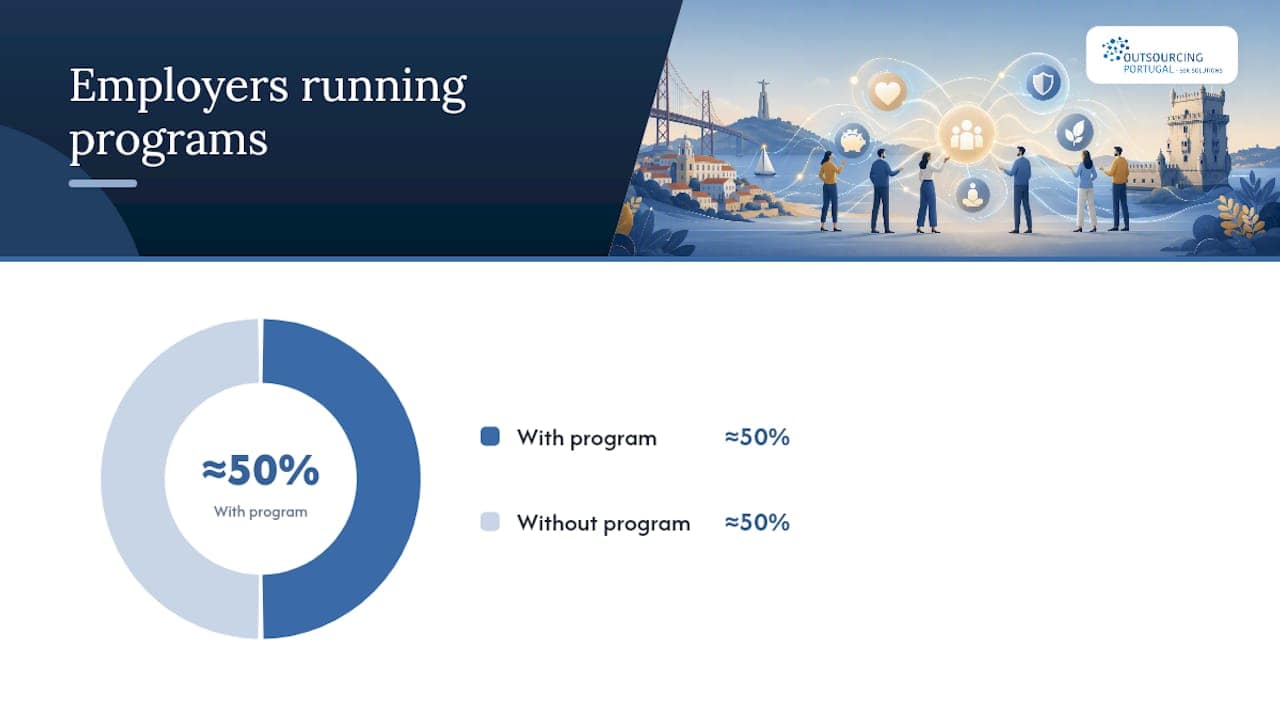
Close to half of Portuguese companies now offer some form of flexible benefits, with childcare support, education, professional training, technology stipends, health insurance, and pension plans topping the list. The mix matters because each category carries its own exemption rules, and mixing them incorrectly on a payslip is the fastest way to create an unplanned tax liability.
The meal allowance is the benefit most employees notice first. Paid in cash, it carries a lower exemption threshold than when paid onto a card, where the commonly cited exemption reference sits around €10.46 per day. A worked comparison from Pluxee’s guide shows that structuring the same allowance through a card rather than cash can measurably increase what lands in an employee’s pocket, without costing the employer more.
Here’s how the main categories typically stack up:
| Benefit | Typical structure | Fiscal note |
|---|---|---|
| Meal allowance | Card or cash | Card payments carry a higher exemption threshold than cash under current guidance |
| Vales infância (childcare) | Voucher or reimbursement | Specific tax advantages apply under CIRC when conditions are met |
| Health insurance | Employer-paid premium, sometimes family coverage | Can be exempt if it meets CIRC conditions and treats eligible employees equally |
| PPR (retirement savings) | Employer or employee contribution | Subject to its own contribution ceilings and holding-period rules |
| Transport / mobility | Card, subsidy, or public transport pass | Generally treated favorably when tied to commuting |
| Technology stipend | Card or reimbursement | Usually treated as taxable unless structured under a specific exemption |
Vales infância deserve special attention because the tax advantage under CIRC is one of the more generous exemptions available, which is why it consistently ranks among the most-used benefits in the Aon survey data. Health insurance and PPR both require closer documentation. Miss the equal-treatment condition or skip the paperwork, and the exemption disappears even if the benefit itself was legitimate.
How Do You Design a Flexible Benefits Plan Step by Step?
Building a plan that survives an audit and actually gets used takes more than picking a vendor and turning it on. Follow this sequence:
- Audit your workforce. Run a short survey or a few focus groups to find out what employees actually want. A workforce heavy on parents will value vales infância differently than a workforce of recent graduates chasing training budgets.
- Set a sustainable per-employee budget. Decide the number before you decide the categories, and set eligibility rules (tenure, contract type, full time vs. part time) up front so nobody discovers an exclusion after launch.
- Prioritize tax-efficient categories. Meal cards, vales infância, and health insurance tend to deliver the most value per euro spent because of their exemption treatment.
- Set vendor requirements. The platform must integrate with payroll, enforce fiscal limits automatically, and produce audit-ready reports. Don’t take a vendor’s word for compliance without seeing the reporting output.
- Communicate before you launch. Employees need to understand why a card payment beats cash for the same meal allowance. Unclear communication is one of the more common reasons adoption stays low even after a plan is funded.
- Pilot, then scale. Launch with one department or a small group, track adoption and satisfaction, then expand based on what actually gets used rather than what looked good on paper.
The most common mistake is offering too many categories at once, which fragments small budgets and overwhelms payroll controls. A second common mistake is letting managers approve exceptions informally, which breaks the equal-treatment condition several exemptions depend on.
Pro Tip: Start with three categories, not eight. A tightly scoped pilot with clean payroll data is easier to defend in an audit than a sprawling menu nobody fully understands.
What Vendor Types and Platforms Operate in Portugal?
The Portuguese market has matured into three broad vendor categories, and each solves a slightly different problem.
Meal-card issuers handle the highest-volume, most standardized benefit: the daily meal allowance loaded onto a card with a defined merchant network. Multi-benefit platforms go further, letting employees split a single budget across meal, childcare, health, and training from one app. Insurers and brokers offer a third route, usually for companies that want a more consultative setup alongside health coverage.
A few names illustrate how these categories differ in practice:
- Cobee by Pluxee combines a multi-category card and app with automated fiscal-limit enforcement, and its implementation guide walks through how expenses map to categories in real time.
- Edenred Flexível operates a broad acceptance network across meal, education, health, and senior-care spending, positioning itself as a national multi-benefit option.
- Howden Compensa takes a broker-led approach, pairing a technology platform with consultative service for companies that want bespoke plan design rather than a self-service menu.
- Coverflex is frequently cited in Portuguese fiscal guides as a flexible-benefits card provider covering multiple categories under one account.
Whichever route you choose, the essentials don’t change: payroll integration, automatic enforcement of fiscal ceilings, a merchant network employees actually use, and reporting detailed enough to survive a tax review. Behind the scenes, most platforms recharge balances monthly and reconcile spending against exemption limits before the payslip is finalized, which is the step that prevents a benefit from silently becoming taxable income.
What Compliance Checks Protect Your Flexible Benefits Exemptions?
The exemption on any flexible benefit depends on meeting specific conditions, not just labeling a payment “benefit” on a payslip. Miss a condition, and the Autoridade Tributária can reclassify the payment as ordinary salary, applying IRS and TSU retroactively.
Legal and tax commentary is direct on this point: a benefit that creates an economic advantage is taxable unless an explicit exemption applies, which puts the burden on the employer to document why a given payment qualifies. The most common way employers lose an exemption isn’t fraud. It’s inconsistency: paying the meal allowance in cash for some employees and by card for others, or letting one manager approve a benefit informally that HR never documented for the rest of the team.
Before you rely on any exemption, check:
- Whether the benefit applies equally to all eligible employees, since differential treatment for tax-exempt benefits risks triggering taxation across the whole group, not just the affected employee.
- Whether the payment method matches the exemption rule (card vs. cash for meal allowances carry different thresholds).
- Whether documentation exists showing the benefit’s business rationale and eligibility criteria.
- Whether your platform’s reporting can produce an audit trail on request.
With close to half of Portuguese employers already running some form of flexible benefits program, tax authorities have more precedent to draw on when reviewing plans, which raises the cost of a sloppy setup. When a benefit’s tax treatment is unclear, get counsel before rollout rather than after an audit flags it.
How Does Outsourcing Reduce Compliance Risk for Benefits Administration?
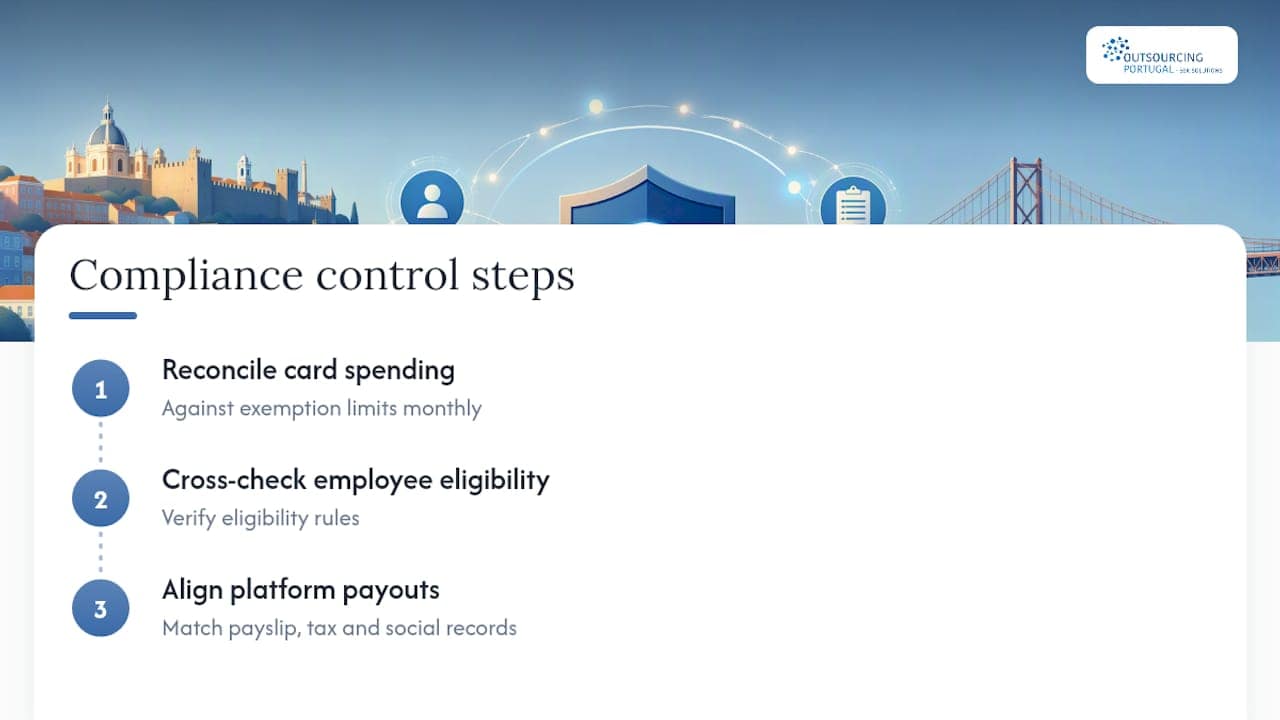
Running flexible benefits well means somebody has to reconcile card spending against exemption limits every single month, cross-check eligibility rules, and keep payroll filings consistent with whatever the benefits platform reports. A specialist payroll or Employer of Record partner already handles that reconciliation as part of standard payroll operations, catching mismatches between what a platform paid out and what a payslip should reflect before they become a tax exposure. That operational layer, tax filings, social security contributions, and documentation checks, is where most in-house HR teams without a dedicated payroll specialist tend to fall behind.
Why Small Pilots Beat Big Launches
The pattern worth watching in Portugal’s flexible benefits market isn’t which platform has the most features. It’s that companies overestimate how many benefit categories employees actually want at once. Start with the meal card, vales infância, and one training or health option. Run it as a genuine pilot, watch adoption for a full payroll cycle, then expand. Document your eligibility rules in writing before you launch anything, because that’s the paperwork that protects your exemptions later.
— Paulo
How Outsourcing-Portugal Handles Payroll and Benefits Compliance
Outsourcing-Portugal is the alternative to hiring an in-house payroll team from scratch when you need benefits administered correctly from day one. Instead of researching CIRC exemption conditions or building payroll controls yourself, you get Employer of Record services that fold benefits administration into the same compliance process handling contracts, tax filings, and social security contributions for your Portuguese team.
For companies that already have a legal entity in Portugal and just need payroll and benefits run correctly, payroll outsourcing covers the same reconciliation work without requiring a full EOR relationship. Either route gets you English-speaking support and a team that already knows how Portuguese exemption rules apply in practice, so a flexible benefits plan doesn’t become a liability six months after launch. If you’re weighing whether to build this in-house or hand it off, request a quote and compare the real cost of each path.
Sources
- Metade das empresas portuguesas oferece benefícios flexíveis aos colaboradores. Saiba quais os mais utilizados – Human Resources
- Benefícios flexíveis: o que diz a lei e como os aproveitar? – Comparaja
- Guia dos Benefícios Flexíveis nas empresas em Portugal – Pluxee
- Edenred Flexível — Edenred Portugal
FAQ
What Types of Tax-Exempt Benefits Exist in Portugal?
The main categories include the meal allowance, vales infância (childcare vouchers), health insurance, PPR contributions, and transport support, each with its own exemption conditions. A benefit stays exempt only if it meets the specific rule for that category and is applied equally to eligible employees, as Comparaja’s fiscal guide explains.
What Is a Flexible Benefits Plan?
A flexible benefits plan gives each employee a set budget to allocate across approved categories, such as meal, health, childcare, and training, rather than one fixed perk for everyone. Close to half of Portuguese companies already run some version of this model, typically through a card or app tied to a benefits platform.
Which Merchants Accept the Coverflex Card?
Coverflex operates within Portugal’s flexible-benefits card category, generally accepted at merchants covering meal, health, education, and mobility categories, similar to other national card providers. Exact merchant networks vary by provider and update regularly, so check the current list directly on the provider’s platform before relying on it for a specific purchase.
What Are the Main Benefits of a Flexible Benefits Card Like Coverflex?
Cards in this category let employees direct a single employer-funded budget toward the categories that matter to them, from meal spending to childcare, instead of receiving one fixed perk. The main advantage over a traditional benefit is flexibility paired with automatic enforcement of fiscal exemption limits, which reduces the manual payroll work HR would otherwise need to do.
Does Outsourcing-Portugal Handle Benefits Administration Directly?
Outsourcing-Portugal integrates benefits administration into its Employer of Record and payroll services, handling the reconciliation and compliance work that keeps a flexible benefits plan aligned with Portuguese tax rules. Pricing depends on the scope of services required and is available on request.