

In Portugal, a relocation allowance paid to an employee is generally taxable employment income, and social security applies on top. Only specific, documented payments fall outside that rule, such as mileage and travel allowances within the legal limits, or a temporary exemption for qualifying housing. The practical answer for an employer is to classify each element of the package before the offer is made, then run it through payroll correctly from the first month. We do this for international companies every day as a Lisbon-based Employer of Record (EOR).
This guide is for HR managers, founders and CFOs in the UK, EU and US who are planning a relocation package for a hire in Portugal. It explains what is taxed, what can be paid tax-efficiently, which 2026 limits apply and what paperwork protects you.
TL;DR
- A lump-sum relocation allowance is normally Category A employment income: the employee pays IRS (Portuguese personal income tax) on it, and social security applies.
- Social security is 34.75% of gross remuneration: 23.75% paid by the employer and 11% by the employee.
- Travel-related payments such as mileage (€0.40 per km in 2026) and daily meal allowances have legal limits. Amounts above them become taxable pay.
- Employer-provided benefits in kind are generally taxable, with a temporary exemption for qualifying permanent housing in Portugal from 1 January 2024 to 31 December 2026.
- Set out each cost in the offer, classify it before you sign, and keep the paperwork the Tax Authority expects.
Table of Contents
- What counts as a relocation allowance in Portugal
- The default rule: it is employment income
- Social security: what employer and employee pay
- Payments with legal limits: mileage, travel and meals
- Housing and other benefits in kind
- Which costs are usually the easiest to manage
- Special tax regimes for new residents
- How the employee reports it
- A five-step approach for employers
- How we handle this as your Employer of Record
- Our perspective
- FAQ
- Sources
What counts as a relocation allowance in Portugal
Portuguese law has no single “relocation allowance” category. A package is a bundle of different payments, and each one is treated on its own terms. Typical elements are:
- a lump sum paid to the employee to cover the move;
- reimbursement of flights, removals or shipping;
- temporary accommodation on arrival;
- help with a long-term rental or housing;
- visa, immigration and tax advice costs;
- travel and subsistence allowances during the transition.
The tax result depends on what the payment is for, how it is paid and whether it is documented. A fixed sum added to salary “for relocation” with no link to actual costs is the simplest to classify: it is pay. Anything linked to real expenses, with evidence, gives you more room to work with, but it also needs more paperwork.
The default rule: it is employment income
Employment income in Portugal falls under Category A of personal income tax. Under the Portuguese rules, Category A covers wages, salaries, remunerations and commissions, and employer-provided benefits in kind are generally subject to employee income tax.
In practice that means:
- The employer withholds IRS at source on taxable relocation payments, together with the monthly salary. Withholding is progressive. One published guide puts withholding rates between 13% and 48% depending on income, but the exact table changes, so use the official tables for the year of payment.
- Social security contributions apply to gross remuneration.
- The payment is reported in the employee’s annual income statement and tax return.
If you grossed up a relocation payment so that the employee receives a net amount, the cost to you is higher than the headline figure. The tax and social security on the gross-up are yours to fund.
Worked example
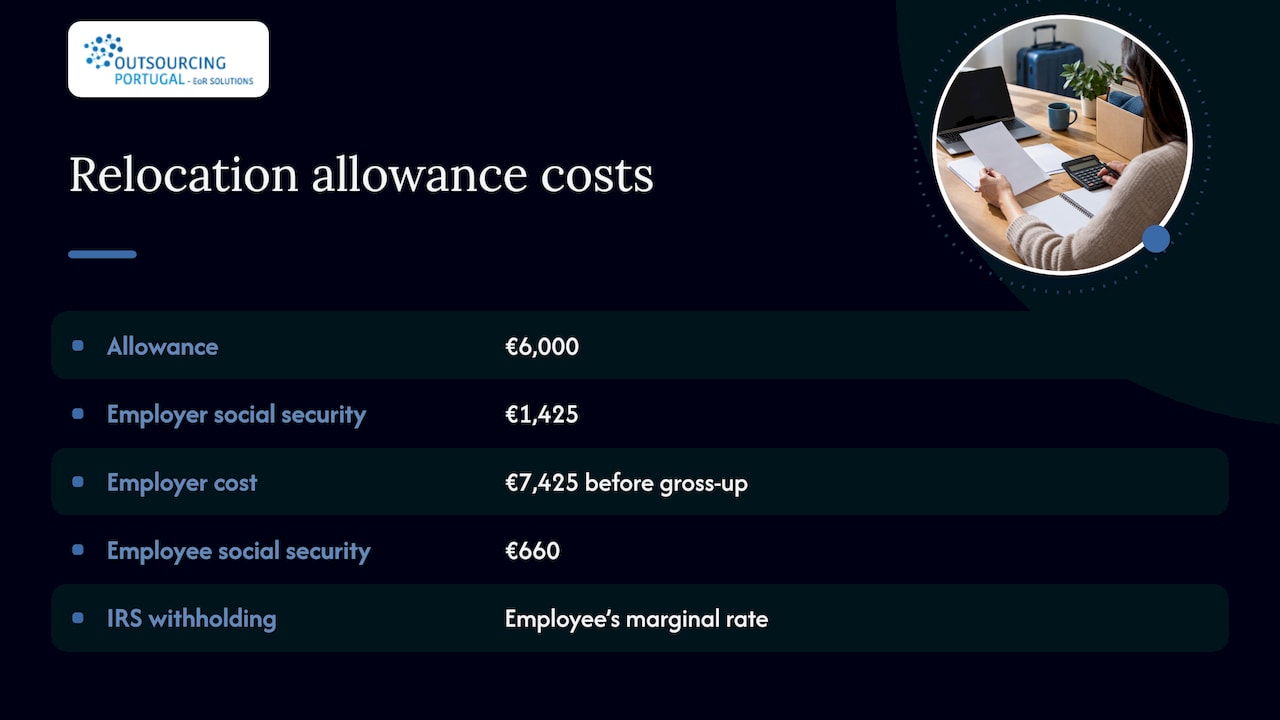
Suppose you offer a €6,000 lump-sum relocation allowance with no supporting expense claims. Treated as pay, it joins the employee’s taxable remuneration in the month it is paid. Employer social security at 23.75% adds €1,425 to your cost, so the real cost is €7,425 before any gross-up. The employee bears 11% social security (€660) plus IRS withholding at their marginal rate. The sums are illustrative, not a quote, but they show why a lump sum is the most expensive way to deliver the same value.
Social security: what employer and employee pay
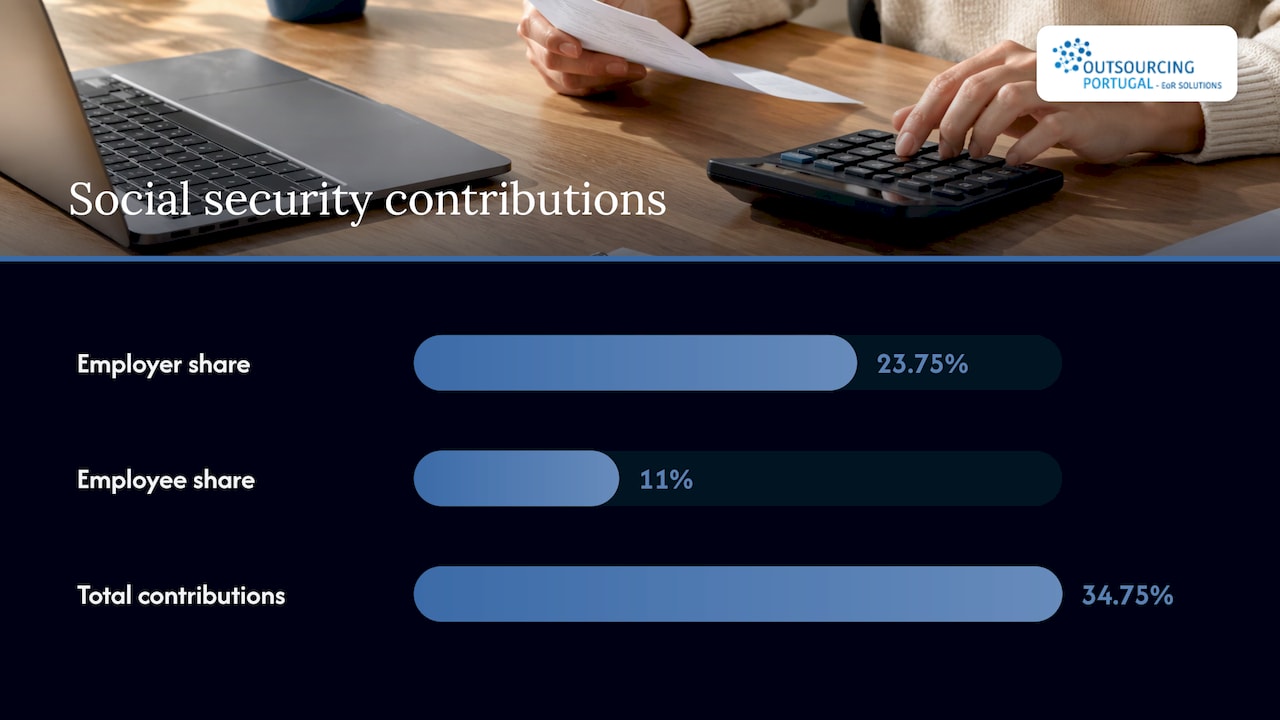
Portugal’s social security contribution is 34.75% of gross remuneration, split 23.75% employer and 11% employee. The employer is responsible for withholding the employee’s share and paying both.
Two points matter for relocation:
- Where the work is done decides the system. Contributions are generally due where work is physically performed. For work habitually performed in Portugal, a foreign employer without an applicable agreement typically has to register with Portuguese social security and register the employment relationship.
- Cross-border cases need an early check. If the employee is being posted from another EU country rather than hired locally, an A1 certificate may keep them in the home system. Our guide to the A1 certificate before posting walks through the steps.
An EU-based company hiring someone who will live and work in Portugal full time should plan for Portuguese social security, not an A1.
Payments with legal limits: mileage, travel and meals
Some payments that look like relocation costs are really travel allowances, and these have published ceilings. Below the ceiling they can be paid without being treated as salary. Above it, the excess is taxable.
| Payment | 2026 limit | Source |
|---|---|---|
| Private-car mileage for business travel | €0.40 per km | OCC 2026 useful information |
| Daily meal allowance, domestic travel (employees) | €65.89 | OCC |
| Daily meal allowance, foreign travel (employees) | €148.91 | OCC |
| Daily meal allowance, domestic (corporate officers) | €72.65 | OCC |
| Daily meal allowance, foreign (corporate officers) | €167.07 | OCC |
These limits are reviewed each year, so check the figure for the year of payment.
Ajudas de custo (travel subsistence)
Ajudas de custo are payments that compensate an employee for costs on occasional trips for the employer, away from the employee’s necessary domicile. The Tax Authority has addressed this in a 2025 binding ruling. The key word is occasional. Paying subsistence to cover the employee’s own move, or their ordinary commute to a new base, is not a business trip, and it should not be dressed up as one.
Mileage and the paperwork behind it
Private-car mileage compensation is Category A employment income when it exceeds the legal limits or the conditions for its award are not met. The employer must keep a map for each payment showing:
- the reason for the trip and the locations;
- duration and objectives;
- the vehicle and its owner;
- kilometres, rate per kilometre and total amount.
Without that map, the cost is non-deductible for corporate income tax (IRC) unless it is invoiced to clients, and non-invoiced charges are generally subject to 5% autonomous taxation, except amounts taxed as IRS income for the recipient. The same ruling is the source for each of these points.
Stays abroad
The Tax Authority’s 2026 list of tax benefits includes an exemption for compensation for travel and stay abroad above the legal limits, where the stay lasts at least 90 days. This is relevant mainly to employees sent abroad by a Portuguese employer, not to people arriving in Portugal. Check the conditions with your payroll provider before relying on it.
Housing and other benefits in kind
Benefits the employer provides directly, rather than as cash, are called benefits in kind. They are generally taxable, but there is a notable exception: a temporary exemption applies to qualifying permanent housing provided in Portugal from 1 January 2024 to 31 December 2026.
Because that window closes at the end of 2026, ask in advance what applies to a start date in 2027 or later. Do not build a multi-year housing promise on the assumption that the exemption will continue.
Short-term housing during the first weeks is a different matter. Temporary accommodation is an ordinary relocation cost, and unless a specific rule exempts it, it should be treated as a taxable benefit and costed accordingly.
Which costs are usually the easiest to manage
Use this as a working order of preference when you design a package. Each line still needs confirming against the employee’s actual situation.
| Cost | Typical treatment | What to do |
|---|---|---|
| Lump-sum allowance | Taxable pay plus social security | Use sparingly; budget the full employer cost |
| Documented business travel | Within limits, not salary | Keep the map or travel record |
| Flights and removals for the move | Needs classification | Have it classified before the offer |
| Housing support | Taxable, unless the temporary exemption applies | Check the qualifying conditions and the date |
| Visa and immigration support | Depends on who benefits and how it is paid | Agree it in writing |
The common thread is order of operations. The cost of getting this wrong is a payroll correction months later, with the employee seeing a different net figure from the one in the offer.
Special tax regimes for new residents
Some new arrivals qualify for special personal tax regimes. KPMG notes that, where criteria are met, including not having been tax resident in Portugal in the five preceding years and performing an eligible activity, employment income may benefit from a 20% rate for a 10-year period. Eligibility is individual, so it is the employee’s tax position, not the company’s, that decides. A relocation package should never be priced on the assumption that the employee qualifies.
How the employee reports it
The employee declares employment income, including taxable relocation payments, in the annual IRS return. Where your payroll has already withheld tax and reported the payments, the return normally pre-fills from the employer’s reported data, and the employee checks it. Where an employee has also been paid by a foreign entity, more care is needed. If you want to understand the annual cycle from the employer side, see our guide to employment tax returns for Portugal hires and our tax compliance guide for employers.
A five-step approach for employers
- Map the move. Is the employee moving to Portugal permanently, being posted for a period, or working remotely from Portugal for a foreign employer? Each pattern changes the tax and social security route.
- List every cost. Separate cash from in-kind items and one-off costs from recurring ones.
- Classify each payment before the offer goes out, so the employee sees realistic net figures.
- Put the package in writing. A clear relocation schedule in the offer or policy avoids later disputes about what was promised.
- Run it through payroll correctly. Withhold, report and pay contributions on the due dates, and keep the supporting records.
To see what a hire will cost in total, including the employer’s 23.75% contribution, use our employment cost calculator for Portugal. For the wider picture of moving staff, read our guide to corporate relocation to Portugal.
How we handle this as your Employer of Record
If you do not have a Portuguese entity, you cannot run payroll, register for social security or withhold tax yourself. As an Employer of Record, we become the legal employer in Portugal, so the relocation package runs through a compliant Portuguese payroll from day one.
Outsourcing Portugal is a Lisbon-based EOR and a Portugal-only specialist. We are part of HRB Solutions Group, which has been in the market for 20 years, and we have hired 500+ people. Once a candidate is selected and the offer is agreed, we can hire within 2 days.
For relocation, that means:
- Tailored salary packages with tax optimisation, built around the structure of each role and the payments that qualify.
- One competitive monthly fee for the service, so you can budget without surprises.
- Personal and human support from people who know Portuguese employment law, for you and for the employee.
- Visa, immigration and relocation support where the hire is coming from abroad.
The relevant pages are our Employer of Record service and our payroll services in Portugal. If you already have a candidate and a relocation budget, contact us and we will look at how to structure the package.
Our perspective
Most relocation problems we see in packages come from the same mistake: the headline number is agreed first, and the tax treatment is checked afterwards. By then the employee has seen a figure they expect to receive, and the employer has a cost they did not plan for.
Our approach is the reverse. We look at the role, the employee’s situation and the cost of the move, then build a package in which each element is classified before anyone signs. Tailored salary packages with tax optimisation are not about clever structures. They are about using the payments the rules allow, in the way the rules require, and documenting them.
The second point is that Portugal is a country where a specialist matters. Social security of 23.75% for the employer and 11% for the employee, withholding tables, travel limits and housing exemptions that expire all change the answer. We work only in Portugal, and a single monthly fee means you do not pay extra each time a new question arises.
Finally, relocation is personal. The employee is deciding whether to move their life. Human support at the right moment, from someone who knows the local process, makes a difference to whether they arrive confident.
Outsourcing Portugal Team
FAQ
Is a relocation allowance taxable in Portugal?
Generally yes. A cash allowance paid to an employee is treated as Category A employment income, so IRS withholding and social security apply. Only payments that meet specific legal conditions, such as travel allowances within the published limits, sit outside this.
Do employers pay social security on relocation payments?
Where the payment forms part of gross remuneration, yes. The total contribution is 34.75%, of which the employer pays 23.75% and the employee 11%. Cross-border postings may be covered by an A1 certificate instead, so confirm the position before the employee starts.
Can I pay relocation costs without a Portuguese company?
You can reimburse costs, but if the employee works in Portugal you will normally need Portuguese social security registration and payroll for the employment. Hiring through an Employer of Record lets you do this without setting up your own entity.
What are the 2026 limits for travel allowances?
For 2026 the private-car mileage reference is €0.40 per km. Daily meal allowance limits for employees are €65.89 for domestic travel and €148.91 for foreign travel. Amounts above these limits are treated as taxable pay.
Is housing support for a new employee tax-free?
Not by default. Employer-provided housing is generally a taxable benefit in kind, but a temporary exemption applies to qualifying permanent housing in Portugal from 1 January 2024 to 31 December 2026. Check the conditions and your start date.
Sources
- Ficha Doutrinária on private-car mileage compensation (Tax Authority)
- Ficha Doutrinária on ajudas de custo (Tax Authority)
- Agenda 2026, useful information (Ordem dos Contabilistas Certificados)
- Portugal individual income determination (PwC Tax Summaries)
- Relocation of foreign employees to Portugal: tax and compliance risks (Abreu Advogados)
- Tax implications on talent mobility, Portugal (IBA)
- List of tax benefits in force 2026 (Tax Authority)
- Taxation of international executives: Portugal (KPMG)
Recommended
Disclaimer: This article is for general information only and does not constitute legal, tax, or employment advice. Laws and regulations change often. Please consult a qualified professional before making decisions. For Employer of Record services in Portugal, contact Outsourcing Portugal.