

The non-habitual resident regime (RNH in Portuguese, NHR in English) no longer accepts new workers. It was repealed from 1 January 2024 and replaced by a narrower incentive called IFICI. Only people who were already registered, or who met the transitional conditions, keep the old benefits. If you are hiring someone to move to Portugal now, the question is no longer “can they get RNH?” but “do they fit IFICI, and how should we structure the package and payroll around that?”
This guide is written for HR managers, founders and CFOs who hire, or plan to hire, employees in Portugal. It explains what RNH was, who still holds it, what IFICI requires and what it means for your offer letters, payroll and compliance calendar. We are Outsourcing Portugal, a Lisbon-based Employer of Record (EOR), and we handle Portuguese employment for international companies that have no local entity.
TL;DR
- RNH is closed to new residents. It continues only for people registered by 1 January 2024 and for those who became resident by 31 December 2024 and met the transitional requirements.
- Existing holders keep the regime for up to 10 consecutive, non-extendable years, so some employees will still benefit into the early 2030s.
- New arrivals can only look at IFICI (sometimes called NHR 2.0): a 20% rate on qualifying Portuguese-source employment income for 10 years, limited to listed activities and qualifications.
- IFICI registration is due by 15 January of the year after the person becomes tax resident, and some employer confirmations fall in March.
- Employer social security is 23.75% and employee social security is 11%, whichever tax regime applies to the employee.
Table of Contents
- What RNH was and who it was for
- Is RNH still available in 2026?
- What replaced it: IFICI, sometimes called NHR 2.0
- How the application works, and what the employer must do
- A case worth knowing: RNH registered but never used
- What it means for hiring and payroll
- Perspective
- Hiring someone who is relocating? How we can help
- FAQ
- Sources
What RNH was and who it was for
RNH was a special personal income tax (IRS) regime for people who moved their tax residence to Portugal. According to the Portuguese Tax and Customs Authority (AT), taxpayers had to invoke the regime in their annual IRS return and could benefit for up to 10 consecutive years, with no extension.
To register, a person had to be 18 or over and be a Portuguese tax resident, for example by staying more than 183 days in any 12-month period or by having a home that suggests habitual residence. They also could not have been a Portuguese tax resident in any of the five previous years.
For employees, the headline benefit was a flat 20% special rate on Portuguese-source employment income from listed high-value-added activities. For those activities, the AT leaflet requires at least EQF level 4 (the European Qualifications Framework), ISCED level 35 or five years of proven professional experience. The AT’s own RNH leaflet sets out these conditions.
In practice, RNH was a broad regime. A software engineer, a finance director or an engineer on a listed profession code could often qualify, which is why it became a standard part of relocation offers.
Is RNH still available in 2026?
Not for new applicants. The AT states that the regime was repealed as of 1 January 2024, and that it continues for citizens already registered as NHR on that date. Its example: a 2021 enrollee’s regime ends in 2030.
The AT’s Circular Letter 90068/2024 adds the transitional group. RNH continues until the end of the 10th consecutive year for taxpayers registered on 1 January 2024, and also for those who became residents by 31 December 2024, applied by 31 March 2025 with 2024 effect and meet the statutory transitional requirements. Because the window is 10 years from the first year of benefit, the last transitional cases run out in the early 2030s.
The practical consequence is simple:
- Someone who became resident in 2023 or earlier and registered: may still be inside their 10-year window. Check the year their benefit started.
- Someone who became resident in 2024 and met the transitional conditions: may have RNH with effect from 2024.
- Someone who becomes resident in 2025 or later: cannot get RNH. They should be assessed for IFICI instead.
If a candidate tells you they “have RNH”, ask for the year they became resident and for proof of registration. The registration status is what determines how long the benefit lasts, and your payroll needs it right from the first month.
What replaced it: IFICI, sometimes called NHR 2.0
The replacement is the Tax Incentive for Scientific Research and Innovation (IFICI). The AT’s FAQ states that it applies to people who were not tax residents in Portugal in the previous five years and become Portuguese tax residents. It excludes anyone who benefits or has benefited from the non-habitual resident regime, or who opted for the ex-resident taxation regime.
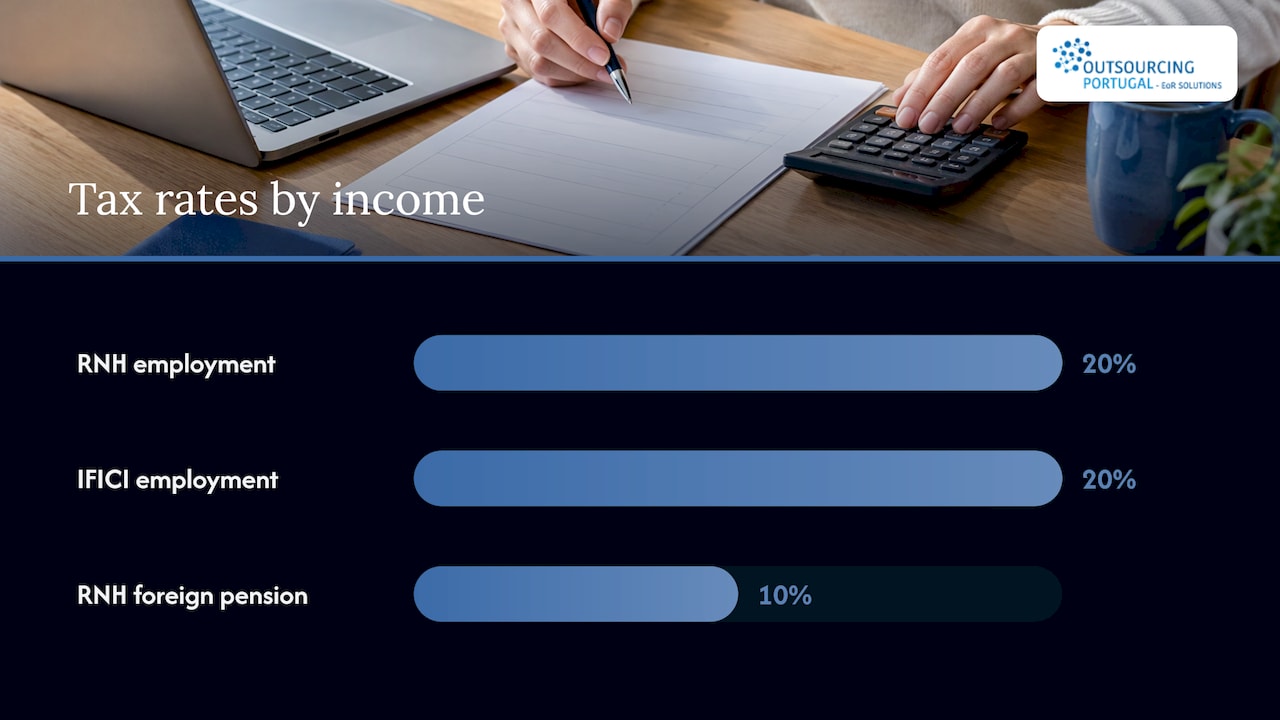
The core terms are close to RNH: a 20% special IRS rate on net income from employment and self-employment in qualifying activities, valid for 10 consecutive years. The difference is who gets in. Eligible activities include:
- higher-education teaching and scientific research;
- qualified jobs in entities carrying out productive investment;
- highly qualified professions in companies that are investment-supported or export-active;
- R&D activities;
- jobs in start-ups with the relevant certification;
- work in the Azores and Madeira.
The Cuatrecasas regulation guide describes the qualification test for highly qualified professions: at minimum EQF level 8 (a doctorate) or level 6 (a bachelor’s degree) with three years of proven professional experience. The eligible profession list includes general and executive managers, administrative and commercial directors, production and specialised-service directors, specialists in physical sciences, mathematics and engineering, industrial product and equipment designers, doctors, university professors and ICT specialists. A handful of codes and professions are excluded, so job title alone is not enough.
RNH and IFICI side by side
| RNH (closed to new entrants) | IFICI | |
|---|---|---|
| Status | Repealed from 1 January 2024; continues for registered and transitional cases | In force from 1 January 2024 |
| Who qualifies | Listed high-value-added professions | Listed qualified roles in research, innovation, investment-linked or export-active companies, start-ups, plus Azores and Madeira |
| Rate on qualifying Portuguese employment income | 20% | 20% |
| Duration | Up to 10 consecutive years, not extendable | 10 consecutive years |
| Registration | Invoked in the annual IRS return (Anexo L) after registration | Application by 15 January of the year after becoming resident |
| Foreign pensions | 10% special rate | Not covered; general IRS rules |
Rates and conditions come from the AT leaflets, the AT’s IFICI FAQ and the professional guides cited above. The foreign pension point is the main difference for mixed-income or older workers: under IFICI, foreign pensions fall under the general rules rather than a flat 10%. For most employees you hire, this is secondary, but it matters for senior hires with pension income abroad.
For the employee, the important point is that a high salary and a good job title do not guarantee IFICI. The employer’s business profile also counts for several categories, which is the part that surprises HR teams.
How the application works, and what the employer must do
IFICI is not claimed automatically. Per the Cuatrecasas guide, tax residents carrying out a qualifying activity must apply by 15 January of the following year, submitting the contract, proof of qualifications and supporting documents. The AT makes the registration status available by 31 March.
The same guide explains that verification is split. The receiving entity (the FCT, AICEP or the AT, depending on the category) checks the activity requirements, while the AT checks the remaining legal requirements. For highly qualified professions, the employer must confirm by 15 March on the Portal das Finanças that it meets the investment-support or export conditions. That is a date HR and finance should put in the calendar each year.
A practical sequence for a new hire:
- Before the offer. Map the role to the eligible profession list and check the candidate’s degree level and years of experience against the thresholds above.
- Before arrival. The employee needs a Portuguese tax number (NIF). Our employer’s guide to the NIF for foreign workers covers the steps. If the person is relocating, a local mobile connection also helps on day one, and a Portugal eSIM data plan can cover that before a local contract is set up.
- First months in Portugal. Confirm that the person becomes tax resident and keep the contract and qualification evidence together.
- By 15 January of the following year. The application is filed with the competent entity.
- By 15 March. The employer’s confirmation, where the category needs it.
- By 31 March. The AT publishes the registration status, and payroll can apply the correct treatment.
The 2024 transition had its own deadlines, set by Portaria 352/2024/1, for people who became resident in 2024. Those dates have passed. For anyone arriving now, the 15 January rule is the one that applies.
A case worth knowing: RNH registered but never used
Some employees registered for RNH and never actually used it. In a binding ruling, the AT confirmed that a taxpayer who obtained RNH status but never invoked it in the Model 3 return may request cancellation of the registration and then opt for the IRS Jovem regime in article 12-B of the IRS Code. The reason is that IRS Jovem is barred for people who benefit or have benefited from RNH or IFICI, so the order matters. This applies to young employees, and it is worth raising with them before their first return is filed.
What it means for hiring and payroll
The employee’s tax regime changes their income tax, not your social security cost. Employer social security in Portugal is 23.75% and employee social security is 11%. A simple illustration with a round, hypothetical gross salary of €60,000 a year:
- employer social security at 23.75%: €14,250, paid on top of the salary;
- employee social security at 11%: €6,600, withheld from the salary.
This is only a calculation from the two rates, not a quote. The income tax withheld each month is where RNH or IFICI changes the outcome, which is why payroll must hold the correct registration status. Our payroll guidance on employment tax returns for Portugal hires and taxation of benefits shows where employers go wrong, such as treating a benefit as non-taxable when it is not.
Three things to settle in every offer to an international hire:
- Net versus gross promises. Never promise a net figure on the assumption of a regime the candidate may not get. State gross, and describe the tax treatment as dependent on registration.
- Start date and residence. The year the person becomes resident drives the application deadline, so the start date matters.
- Who owns the paperwork. Decide up front who gathers the contract, qualifications and employer confirmation. Missed 15 January and 15 March dates are the most common avoidable failure.
If you also want to see how Portugal’s incentives for employers work, our page on tax incentives for hiring in Portugal covers that side.
Perspective
RNH made it easy to tell a candidate that Portugal was both cheaper to hire in and kinder on tax. That conversation is now more precise. The rate for the right roles can still be 20%, but eligibility depends on the role, the qualifications and sometimes on the employer itself.
We are a Portugal-only specialist, part of HRB Solutions Group, which has been in the market for 20 years, and we have hired 500+ people. What that experience points to is that the tax regime should be part of the package design, not a surprise after arrival. Our tailored salary packages with tax optimisation are built with the employee’s real position in mind, and our payroll team works from the registration status, not from assumptions.
Our support is personal and human: a named team in Lisbon that speaks to your HR manager and your new employee in English. Once a candidate is selected and the offer is agreed, we can hire within 2 days, so the contract, social security registration and payroll set-up do not hold up a start date or the clock on residence.
You pay one competitive monthly fee, and you do not need a Portuguese entity to employ people. For companies testing the market, that is the shortest route to a compliant first hire.
Outsourcing Portugal Team
Hiring someone who is relocating? How we can help
If you want to employ people in Portugal without opening a local company, our Employer of Record service makes us the legal employer in Portugal while your team directs the daily work. We run contracts, onboarding, payroll and benefits, and our payroll services apply the withholding that matches each employee’s registration status.
We can also help with visas and relocation through our softlanding service, and with local recruitment if you do not yet have a candidate. To talk through a specific hire, contact our team.
FAQ
Can a new employee moving to Portugal in 2026 still get RNH?
No. The regime was repealed from 1 January 2024 and the transitional route only covered people who became resident by 31 December 2024 and applied in time. A person who becomes resident now should be assessed for IFICI.
Is IFICI the same as RNH?
The 20% rate and the 10-year period are similar, but eligibility is much narrower. IFICI is tied to listed qualified activities, qualifications and, for several categories, the employer’s profile. Foreign pensions are also not covered.
When must the employee apply for IFICI?
By 15 January of the year after they become Portuguese tax residents. The AT makes the registration status available by 31 March. For highly qualified professions, the employer must confirm its eligibility on the Portal das Finanças by 15 March.
Does the tax regime change what I pay as an employer?
Not the social security. Employer contributions are 23.75% and employee contributions are 11%, regardless of the employee’s income tax regime. The regime affects the employee’s income tax withholding and therefore the net pay.
Who should confirm an employee’s personal tax position?
The AT’s registration status is the deciding document. For individual circumstances, such as pensions abroad or a dispute with the AT, the employee should see a Portuguese tax adviser. We design the salary package and run payroll around the confirmed status.
Sources
- AT leaflet: Residente não habitual (RNH), regime and Anexo L
- AT leaflet: Non-habitual resident (NHR) registration
- AT Circular Letter 90068/2024
- AT IFICI frequently asked questions
- Portaria 352/2024/1, article 12, transitional regime
- AT binding ruling PIV 29319
- Cuatrecasas: IFICI regulation guide
- Dower Law Firm: IFICI eligibility and the 20% rate
- Prime Legal: IFICI (NHR 2.0) and foreign pensions
Recommended
- How to hire in Portugal: 2026 guide for HR managers
- Employee Benefits for Portugal Hires: 2026 EOR Guide
- NIF for Foreign Workers in Portugal: An Employer’s Guide
- Employee Health Programs for Portugal Hires: 2026 Guide
Disclaimer: This article is for general information only and does not constitute legal, tax, or employment advice. Laws and regulations change often. Please consult a qualified professional before making decisions. For Employer of Record services in Portugal, contact Outsourcing Portugal.