

TL;DR:
- Business process outsourcing involves transferring ownership of entire functions to specialists who manage and deliver results better than in-house teams. Portugal’s multilingual talent pool and EU legal framework make it a strategic location for outsourcing beyond cost savings. Successful BPO requires clear process definitions, strong SLAs, and understanding when to use EOR for compliant hiring in Portugal.
Most people assume BPO means shipping jobs overseas to cut costs. That framing misses almost everything important. Business process outsourcing is really about handing ownership of an entire business function to a specialist who can run it better than you can in-house. For international companies and startups entering Portugal, that distinction matters enormously, because Portugal’s talent pool, language capabilities, and EU legal framework turn BPO from a cost play into a genuine competitive advantage. This article walks you through what BPO really means, how the process works, which model fits your situation, and what separates companies that thrive from those that struggle.
Table of Contents
- What is business process outsourcing?
- Types of BPO and common examples
- How the BPO process works: From scoping to SLAs
- BPO vs Employer of Record: What’s the difference for hiring in Portugal?
- A fresh perspective: What most companies miss when outsourcing in Portugal
- Need help with BPO or compliant hiring in Portugal?
- Frequently asked questions
Key Takeaways
| Point | Details |
|---|---|
| BPO means outsourcing processes | Business process outsourcing is about handing over process management, not just tasks. |
| BPO uses measurable SLAs | Performance and outcomes are governed by service level agreements to ensure quality and accountability. |
| HR and payroll are top BPO targets | Functions like human resources and payroll are some of the most commonly and effectively outsourced business processes. |
| EOR enables compliant hiring | Employer of Record is a distinct model that helps you hire legally in Portugal without a local entity. |
| Vendor management matters | Success with BPO depends on ongoing governance and vendor relationship, not one-off contracting. |
What is business process outsourcing?
Let’s clear up the most common source of confusion right away. Outsourcing a task means paying someone to do a piece of work. Business process outsourcing goes further: you transfer responsibility for an entire process, including the management, quality control, and performance accountability that go with it.
BPO is when an organization delegates one or more business processes to an external provider that owns, administers, and manages the process against measurable performance metrics.
That word “owns” is doing heavy lifting in Gartner’s definition. Your BPO provider does not just execute tasks on your instruction. They take on process ownership, which means they are accountable for outcomes, not just outputs. That changes the commercial relationship fundamentally.
Here is what BPO is not:
- Staff augmentation, where a contractor fills a seat and follows your team’s direction
- Freelance work, where you define the deliverable in detail and review every step
- Simple offshoring, where you replicate your internal team structure in another country
BPO is structured. Engagements typically start with a formal request for proposals, a vendor evaluation phase, and a transition period before steady-state operations begin. The quality bar is defined in a service-level agreement (SLA) before work starts, not after.
Portugal consistently ranks as an attractive BPO destination because of its combination of factors that are genuinely difficult to replicate elsewhere. The country produces a high volume of university graduates with engineering, finance, and languages backgrounds. English proficiency is among the highest in continental Europe, and many professionals also speak Spanish, French, and German fluently. That multilingual depth makes Portugal particularly effective for customer-facing BPO work across European markets.
Types of BPO and common examples
Now that we have the definition pinned down, let us break apart what actually gets outsourced and why different companies choose different starting points.
BPO specialists often draw a line between two broad categories:
- Horizontal BPO: Process-agnostic functions that any organization in any industry can outsource. Payroll processing, accounts payable, IT help desk, and HR administration all fall here. The expertise involved is functional rather than industry-specific.
- Vertical BPO: Industry-specialized processes. Insurance claims processing, pharmaceutical regulatory submissions, and telecom billing fall into this category. The provider needs deep sector knowledge, not just process expertise.
Most international companies entering Portugal start with horizontal BPO because the processes are well-defined, outcomes are easy to measure, and the talent available in Portugal’s major cities is well-suited to these functions.
Commonly outsourced functions include finance, HR administration/payroll, procurement/logistics, and help desk/support services, and each of these maps well to the strengths of Portugal’s workforce.
Here is how those functions look in practice, with typical performance metrics:
| BPO function | What is outsourced | Common KPIs |
|---|---|---|
| Payroll and HR admin | Payslip generation, tax filings, benefits admin | Payroll accuracy rate, on-time payment % |
| Finance and accounting | Accounts payable/receivable, reconciliation | Days payable outstanding, error rate |
| IT help desk | Tier 1 and 2 support, ticketing | First-call resolution rate, average response time |
| Procurement | Vendor management, purchase orders, logistics | Cost savings %, purchase order cycle time |
| Customer support | Multichannel contact center, complaint handling | CSAT score, average handle time |
For companies hiring in Portugal specifically, payroll outsourcing in Portugal is one of the fastest-growing service categories because Portuguese labor law carries specific obligations around social security contributions, holiday entitlements, and termination procedures that require local expertise to manage correctly.

Pro Tip: Many companies choose processes to outsource based on headcount cost alone. That is the wrong filter. The better question is: “Which processes carry compliance risk that our internal team lacks the local knowledge to manage?” In Portugal, payroll and employment administration almost always surface at the top of that list for foreign companies. For a deeper foundation on this, international payroll explained covers the local specifics in detail.
How the BPO process works: From scoping to SLAs
Understanding BPO at the conceptual level is useful. Knowing how to actually execute one changes your decision-making. Here is the lifecycle of a typical BPO engagement, from the first internal conversation to steady-state operations.
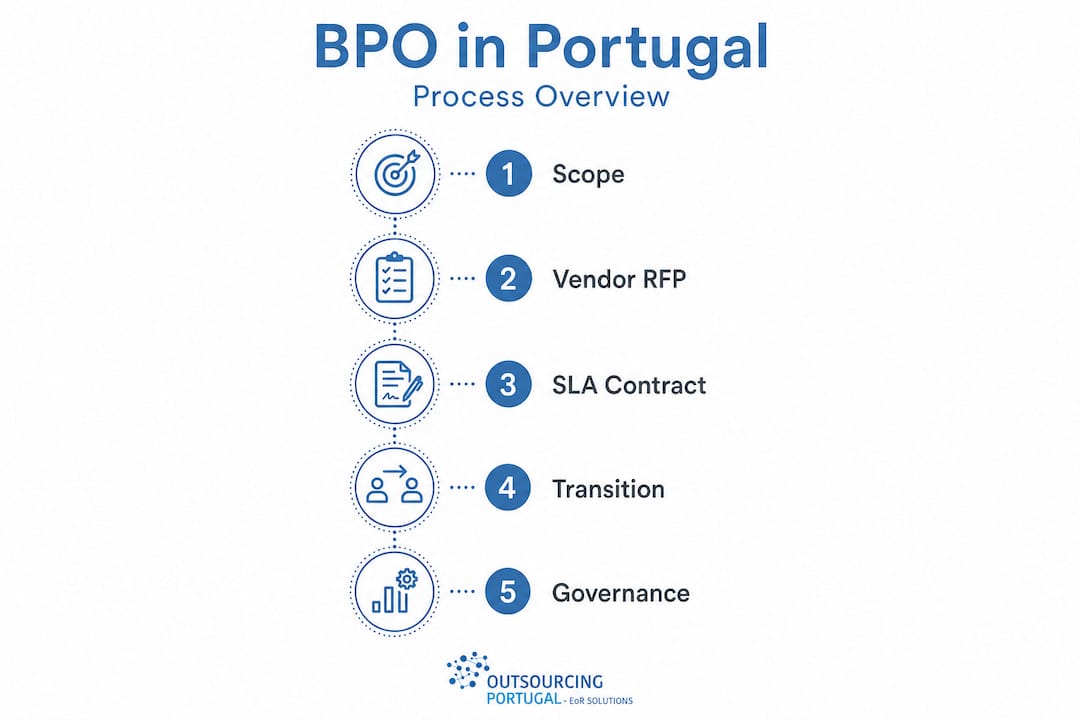
BPO engagements are structured via scope, an RFP/vendor selection process, and service-level agreements that govern how performance is measured throughout the relationship.
Step 1: Process scoping
Before you talk to a single vendor, document the current process in detail. Map every input, output, decision point, and exception. Understand your current cost and quality baseline. You cannot write a good SLA for a process you cannot describe precisely.
Step 2: Vendor selection via RFP
Issue a request for proposals to qualified vendors. Your RFP should specify required SLA targets, transition timelines, data security standards, and any local compliance requirements. In Portugal, language capability, familiarity with Portuguese labor law, and EU data protection compliance (GDPR) are non-negotiable evaluation criteria.
Step 3: Contract and SLA negotiation
This stage deserves more attention than most companies give it. The SLA is not just a performance checklist. It defines remedies when performance falls short, escalation procedures, and who owns each process decision. Weak contracts are the most common reason BPO relationships fail.
Step 4: Transition and knowledge transfer
This phase is where engagements are won or lost. Plan for a parallel-run period where both your internal team and the vendor operate the process simultaneously. Budget three to six months for complex processes, not weeks.
Step 5: Steady-state operations and ongoing governance
Once live, performance is reviewed against SLA metrics at agreed intervals. Most mature BPO relationships include monthly operational reviews and quarterly strategic reviews. This cadence prevents small problems from becoming contract-ending disputes.
Here is a sample of SLA metrics across common BPO functions, with realistic target ranges:
| Function | Metric | Typical target |
|---|---|---|
| Payroll | Payroll accuracy rate | 99.5% or higher |
| IT help desk | First-call resolution | 70 to 80% |
| Finance/AP | Invoice processing time | Under 3 business days |
| Customer support | First-response time | Under 4 hours |
| HR administration | Employee query response | Within 24 hours |
Pro Tip: Many companies review vendor performance only at contract renewal. That is far too late. Build monthly SLA reporting into the contract from day one, and include a right-to-audit clause so you can verify the data independently. Payroll compliance solutions in particular need active monthly oversight because Portuguese tax and social security rules update regularly.
BPO vs Employer of Record: What’s the difference for hiring in Portugal?
This is the question we hear most often from international companies exploring the Portuguese market. The two models serve different purposes, and choosing the wrong one creates both legal and operational problems.
What is an Employer of Record?
An Employer of Record, or EOR, is a legal entity that formally employs workers on your behalf. The EOR handles employment contracts, payroll, tax withholding, social security contributions, and compliance with Portuguese labor law. Your company directs the worker’s day-to-day activities, but the EOR is the legal employer of record.
When firms want to hire workers in Portugal without setting up a local entity, EOR arrangements let them achieve compliant employment quickly without the cost and time of incorporating a Portuguese subsidiary.
The distinction from BPO is structural:
| Dimension | BPO | EOR |
|---|---|---|
| What is transferred | Ownership of a process | Legal employment of specific workers |
| Who manages outcomes | The BPO provider | You direct the workers; EOR handles employment law |
| Best for | Non-core business processes | Hiring specific talent in Portugal compliantly |
| Local entity required | No | No |
| Worker relationship | No direct employment relationship | You manage the person; EOR is the legal employer |
| Portugal compliance | Depends on process scope | Full employment law compliance built in |
When should you choose BPO over EOR, and vice versa?
Choose BPO when:
- You want to hand off an entire function and be measured on outcomes, not people management
- The process does not require you to directly supervise individual workers
- You are outsourcing a non-core function like payroll processing or IT helpdesk
Choose EOR when:
- You want to hire specific individuals in Portugal who will work as part of your team
- You need compliant employment contracts and payroll without incorporating locally
- You are testing the Portuguese market before committing to a full subsidiary
The Employer of Record Portugal model is particularly effective for tech companies that want to hire software engineers or product managers in Lisbon or Porto while maintaining their headquarters elsewhere in Europe or North America. For a detailed walkthrough of how to set this up, the EOR guide Portugal covers the full compliance framework step by step.
Many companies end up using both models at the same time. They use EOR to employ core team members in Portugal and BPO to handle supporting functions like accounting reconciliation or IT support. That combination is increasingly common among fast-growing startups entering the EU through Portugal.
A fresh perspective: What most companies miss when outsourcing in Portugal
Here is the uncomfortable truth that does not make it into most BPO guides: the majority of outsourcing failures in Portugal are not caused by poor vendor selection. They are caused by weak process ownership on the client side.
BPO governance is operationalized through measurable performance metrics and SLAs, and the “process ownership” element is precisely what separates genuinely managed outsourcing from contracting labor on a time-and-materials basis. When international companies enter Portugal and hand off a process without first defining what success looks like in granular detail, they are not really doing BPO. They are just delegating vaguely and hoping for the best.
What we see repeatedly in practice is that companies underestimate the importance of local cultural and legal nuance in their SLA design. Portuguese labor law has strict rules around working hours, notice periods, and termination that differ meaningfully from UK, US, or German employment standards. An SLA written without local legal input often creates obligations the vendor cannot meet legally, or obligations the client cannot enforce locally.
There is also a linguistic dimension that goes beyond fluency. Portugal has strong English capability across professional roles, but the vocabulary of compliance, employment law, and corporate governance carries local specificity. A BPO vendor who speaks excellent English but lacks deep familiarity with Portuguese legal terminology can create real exposure for your business.
The advice we give consistently: treat your BPO relationship as a strategic partnership, not a cost center. Review vendor performance metrics monthly rather than annually. Include penalties and remedies in your SLA that are proportionate and enforceable. And build in a formal process review cycle every six months, even when things seem to be running smoothly. For a broader view of how these principles apply across BPO and EOR solutions in Portugal, Portugal’s combination of talent depth and EU-compliant infrastructure makes it genuinely unique for global teams looking to scale.
The most successful international companies we work with do not come to Portugal primarily to save money. They come for access to a workforce that is highly educated, multilingual, and operating inside the EU’s legal framework. Cost efficiency follows from quality, not the other way around. That mindset shift changes everything about how they structure their outsourcing relationships.
Need help with BPO or compliant hiring in Portugal?
If this article has clarified what BPO really means and how it differs from employment models like EOR, you are already ahead of most companies entering the Portuguese market. The next step is translating that clarity into a structure that works for your specific team and growth plans.
At Outsourcing Portugal, we support international companies and startups with the full range of employment and process outsourcing needs, from Portugal EOR services that let you hire compliantly without a local entity, to payroll outsourcing in Portugal that keeps you on the right side of Portuguese labor law every month. Whether you are exploring BPO for the first time or ready to build a nearshore team, explore our global employment solutions for Portugal to find the model that fits where you are right now.
Frequently asked questions
What is the main purpose of business process outsourcing?
BPO helps organizations increase efficiency and access specialist expertise by transferring ownership of non-core processes to external providers, as BPO delegates processes to providers who manage them against defined performance metrics.
Which functions are most commonly outsourced with BPO?
Finance, human resources, IT help desk, payroll, and procurement are most frequently outsourced, with outsourced functions including finance, HR/payroll and procurement ranking among the most common globally.
How does BPO compare to using an Employer of Record (EOR) in Portugal?
BPO transfers ownership of a business process, while EOR legally employs specific workers on your behalf. EOR services are distinct from BPO but are often used together by companies seeking both process efficiency and compliant hiring in Portugal.
Does BPO guarantee legal compliance when hiring in Portugal?
BPO improves operational efficiency for defined processes but does not automatically cover employment law compliance. EOR services are the compliant hiring solution for companies that want to employ workers in Portugal without a local entity.
What’s the first step to start BPO for my company?
Identify which processes are non-core and define clear outcome metrics before approaching vendors, since BPO lifecycle considerations include scoping, vendor selection, and SLA-based monitoring from the beginning of the engagement.