

TL;DR:
- Co-employment laws require a clear, written agreement to define employer responsibilities and manage liability. In Portugal, local regulations on wages, taxes, and safety apply regardless of contractual arrangements and must be actively monitored. Operational drift by client managers can transform a co-employment into joint liability, making governance and compliance tools essential.
Co-employment laws regulate how two separate organizations legally share employer responsibilities for the same worker under a formal agreement. For HR professionals and legal teams hiring in Portugal, these rules carry real weight. Get the structure wrong and you face wage claims, tax penalties, and regulatory exposure under Portuguese labor law. Get it right and you gain a compliant, flexible way to build a team without setting up a local entity. This guide covers the legal distinctions, Portuguese-specific obligations, liability risks, and practical steps your team needs to act with confidence.
What are co-employment laws and how do they work?
Co-employment law defines a contractual relationship where two entities divide employer responsibilities for the same worker. One party, typically a Professional Employer Organization (PEO) or Employer of Record (EOR), handles payroll, tax withholding, benefits administration, and statutory compliance. The other party, the client company, directs the worker’s day-to-day tasks and manages output.
The critical word here is intentional. Co-employment is a formal, negotiated structure designed to allocate risk and responsibility clearly between two parties. That distinguishes it from joint employment, which courts and agencies impose when operational reality contradicts the contract. Co-employment is chosen. Joint employment is found.
Courts and agencies assess joint employment by examining who controls supervision, hiring and firing decisions, work conditions, and compensation. Two entities exercising meaningful control over the same worker’s terms and conditions triggers joint employer liability, often unintentionally. That distinction matters enormously for multinational HR teams, because the liability exposure in a joint employment finding is broader and harder to contain.

Typical shared duties in a co-employment arrangement include payroll processing, statutory compliance, benefits enrollment, workers’ compensation coverage, and HR administration. The client company retains control over work assignments, performance goals, and project direction. The division sounds clean on paper. In practice, it requires disciplined governance to hold.
Pro Tip: Document every responsibility allocation in your Client Service Agreement before the first worker starts. Verbal understandings do not hold up during audits or legal challenges.
Key co-employment regulations for hiring in Portugal
Portuguese labor law sets the compliance floor for every worker based in Portugal, regardless of where the contract is signed or which entity is named as employer. Local employment law governs payroll, social security, and workers’ compensation obligations for multinational employers. No contractual arrangement between two foreign entities overrides that requirement.
Portugal’s labor code, the Código do Trabalho, establishes mandatory rules on working hours, paid leave, termination notice, and severance. These rules apply to co-employed workers in Portugal just as they apply to direct hires. Failing to comply with Portuguese labor regulations exposes both parties in the co-employment arrangement to penalties and legal liability. The co-employment agreement does not transfer that risk away from the client company entirely.
The table below summarizes the key Portuguese regulatory obligations that affect co-employment arrangements.
| Regulatory area | Obligation | Risk of non-compliance |
|---|---|---|
| Social security contributions | Mandatory employer and employee contributions to Segurança Social | Financial penalties and back-payment orders |
| Income tax withholding (IRS) | Monthly withholding at statutory rates based on worker’s tax category | Tax authority audits and surcharges |
| Workers’ compensation insurance | Mandatory accident-at-work insurance for all employees | Civil liability and regulatory fines |
| Paid annual leave | Minimum 22 working days per year under the labor code | Employee claims and labor inspectorate action |
| Termination and severance | Statutory notice periods and severance calculations apply | Wrongful dismissal claims and court awards |
| Workplace safety (ACT) | Compliance with the Authority for Working Conditions standards | Operational shutdowns and criminal liability |
Two obligations in this table deserve special attention. Workplace safety and nondiscrimination enforcement are non-delegable duties. Co-employment agreements do not absolve the client company from responsibility in these areas. Both parties can face legal claims if either neglects its share of these obligations.
For multinational teams, the practical implication is straightforward. You need localized regulatory expertise, not just a generic employment contract. Portuguese labor law evolves, and the most restrictive local rule always governs where the worker sits. Review your EU employment law compliance obligations before signing any co-employment agreement covering Portuguese workers.
Co-employment liability: risks and how to manage them
Co-employment liability arises when the responsibilities defined in the agreement do not match what actually happens on the ground. The most common exposure areas are wage and hour claims, discrimination complaints, payroll tax defaults, and workers’ compensation disputes. Each of these can land on the client company even when the PEO or EOR is named as the formal employer.
The primary liability risks HR and legal teams face include:
- Wage claims: Misclassification or payroll errors by either party create joint exposure to back-pay claims under Portuguese labor law.
- Discrimination complaints: Client managers who make hiring, promotion, or termination decisions expose the client company to discrimination liability regardless of the co-employment structure.
- Tax defaults: Payroll tax errors or missed filings trigger penalties from the Portuguese tax authority, and both parties may be held responsible.
- Workers’ compensation gaps: Gaps in accident insurance coverage leave the client company exposed to civil liability claims.
- Operational drift: Client managers acting as direct supervisors of co-employed workers raise joint employer legal risk and can invalidate the co-employment structure entirely.
Operational drift is the most underestimated risk. It happens gradually. A client manager starts giving daily instructions, handling performance reviews, or approving time off directly. Each action blurs the employer line. Over time, the operational reality no longer matches the contract, and courts treat the client as a joint employer.
A well-drafted Client Service Agreement allocates liability to the party best positioned to manage each risk and includes indemnification clauses where permitted. That agreement must be reviewed regularly, not filed and forgotten. Ongoing compliance monitoring and manager training are the two most effective tools for keeping the arrangement defensible.
Pro Tip: Train every manager who works with co-employed staff on what they cannot do: no direct hiring decisions, no disciplinary actions, no unilateral changes to work conditions. Route all such decisions through the official co-employer channel.
How to set up a compliant co-employment agreement in Portugal
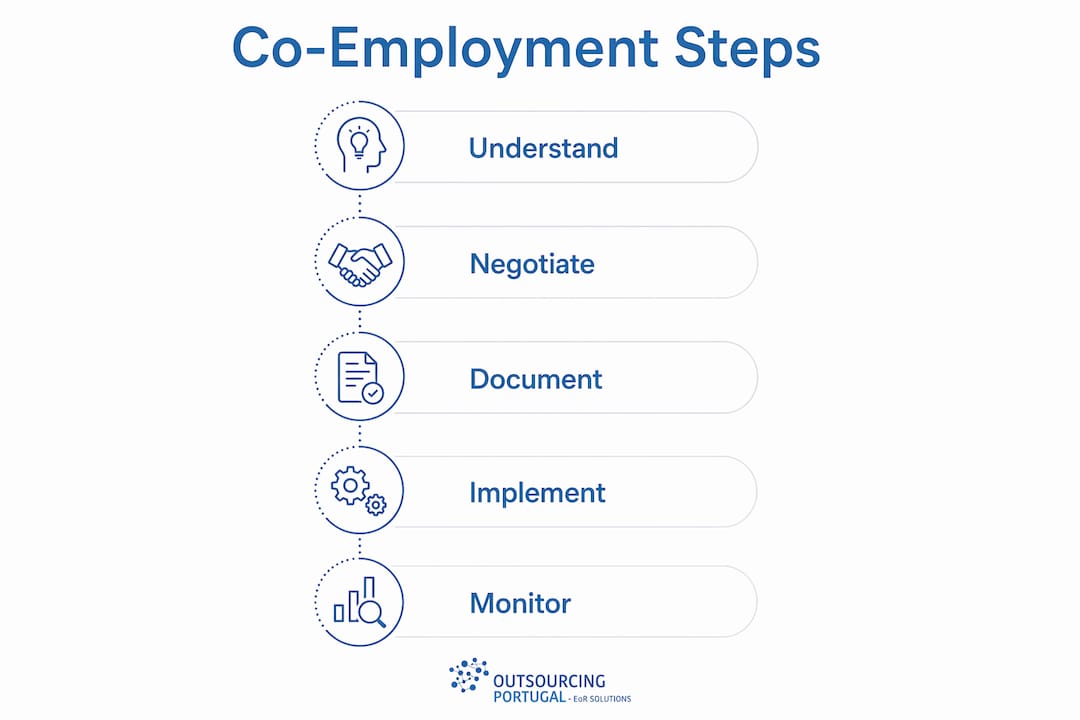
A compliant co-employment arrangement in Portugal starts with a clear, detailed Client Service Agreement. That document must define which party owns each obligation, how liability is allocated, and what indemnification applies when one party fails. Vague language in a CSA is not a neutral outcome. It creates ambiguity that courts resolve against the party with deeper pockets.
Use this checklist when establishing or auditing a co-employment arrangement covering Portuguese workers:
- Draft a detailed CSA. Specify payroll, tax withholding, social security, benefits, and compliance responsibilities by party. Include indemnification clauses and dispute resolution terms.
- Verify PEO or EOR certification. PEO certification status is a key factor in evaluating co-employment partners. Certified Professional Employer Organizations shift federal tax liability onto themselves, reducing client exposure.
- Plan for tax timing. Mid-year changes in PEO relationships can trigger a federal tax restart under IRS rules, potentially doubling payroll tax costs. Time transitions carefully.
- Establish supervision protocols. Write clear rules on how client managers interact with co-employed workers. Define which decisions require routing through the co-employer.
- Consult local legal counsel in Portugal. Portuguese labor law requires jurisdiction-specific expertise. A generic employment lawyer is not sufficient for co-employment arrangements under the Código do Trabalho.
- Set up compliance monitoring. Assign someone to track changes in Portuguese labor regulations, social security rates, and tax withholding tables. These change and your CSA must reflect current law.
- Communicate clearly with workers. Clear communication protocols reduce role confusion and operational friction. Workers should know who handles payroll questions, benefits queries, and HR issues.
- Schedule periodic program audits. Review the CSA and operational practices at least annually. Compare what the contract says against what managers actually do.
The labor compliance steps for Portuguese hires are specific and non-negotiable. Build them into your governance process from day one, not as a remediation exercise after something goes wrong.
Key Takeaways
Co-employment law requires a formal, written agreement that precisely allocates employer responsibilities, because operational ambiguity is the primary driver of joint employment liability and regulatory penalties in Portugal.
| Point | Details |
|---|---|
| Co-employment is intentional | It is a negotiated contract, not an accidental legal finding like joint employment. |
| Portuguese law sets the floor | Local labor rules govern all workers in Portugal regardless of contract jurisdiction. |
| Non-delegable duties remain shared | Workplace safety and nondiscrimination obligations bind both parties in every arrangement. |
| Operational drift is the top risk | Client managers supervising co-employed workers directly can trigger joint employer liability. |
| CSA quality determines defensibility | A detailed Client Service Agreement with indemnification clauses is the primary compliance tool. |
What I have learned from watching companies get this wrong
Most companies that run into trouble with co-employment in Portugal do not fail because they ignored the law. They fail because they assumed the contract was enough. They signed a solid CSA, handed it to legal, and then let operations run without governance. Six months later, a client manager is running weekly one-on-ones, approving leave requests, and handling performance conversations directly. The contract says one thing. The workplace says another. That gap is where liability lives.
The second mistake I see constantly is treating Portuguese labor law as a translation of a home-country framework. It is not. The Código do Trabalho has specific rules on termination that surprise even experienced HR teams. Severance calculations, notice periods, and the grounds for dismissal are all more protective of workers than most non-European frameworks. You cannot assume your standard co-employment template covers those obligations without local review.
My honest view is that the companies that manage this well share one habit: they treat the CSA as a living document, not a filing exercise. They review it when Portuguese regulations change, when their operational model shifts, and when they bring in new managers who interact with co-employed staff. That discipline is not glamorous. It is what keeps the arrangement legally defensible when an audit or a claim arrives.
The evolving regulatory environment in 2026 adds urgency to this. Portugal has been active in updating labor protections, particularly around remote work and platform employment. HR and legal teams that track these changes proactively will avoid the scramble that reactive compliance always creates.
— Paulo
How Outsourcing-portugal supports compliant hiring in Portugal
International HR teams that need to hire in Portugal without setting up a local entity have a direct path through Outsourcing-portugal’s Employer of Record and co-employment services.
Outsourcing-portugal handles payroll processing, social security filings, tax withholding, workers’ compensation insurance, and full compliance with the Código do Trabalho on behalf of client companies. That means your team directs the work while Outsourcing-portugal carries the formal employer obligations under Portuguese law. The EOR services for Portugal cover onboarding, HR support, and regulatory tracking so your legal exposure stays contained. For teams ready to build a nearshore presence, the 2026 hiring guide for Portugal is a practical starting point.
FAQ
What is co-employment in simple terms?
Co-employment is a formal arrangement where two organizations share employer responsibilities for the same worker. One party typically manages payroll and compliance while the other directs the worker’s daily tasks.
How does co-employment differ from joint employment?
Co-employment is intentional and governed by a written agreement. Joint employment is a legal finding that courts impose when two entities both exercise meaningful control over a worker’s conditions, often without intending to.
What co-employment regulations apply specifically in Portugal?
Portuguese labor law requires mandatory social security contributions, income tax withholding, workers’ compensation insurance, and compliance with the Código do Trabalho for all workers based in Portugal, regardless of the co-employment contract’s jurisdiction.
What is the biggest co-employment liability risk for international companies?
Operational drift is the leading risk. When client managers supervise, discipline, or make HR decisions for co-employed workers directly, courts can reclassify the arrangement as joint employment and expand the client’s legal liability.
Do co-employment agreements remove the client company’s compliance obligations?
No. Non-delegable duties such as workplace safety and nondiscrimination enforcement remain binding on both parties. A co-employment agreement allocates responsibility but does not eliminate the client company’s legal exposure if those duties are neglected.