
TL;DR:
- A well-written recruiter job description clearly outlines core responsibilities, expectations, and performance metrics. It should specify volume, recruitment model, and domain-specific skills to attract suitable candidates. Accurate and honest descriptions improve hiring outcomes, especially for specialized roles or international teams.
A recruiter job description defines the duties, skills, and performance expectations required to source, evaluate, and hire qualified candidates for an organization or agency. The term “talent acquisition specialist” is the recognized industry standard for this role, though “recruiter” remains the most widely used label across job boards and HR systems. Getting this document right matters more than most HR teams realize. A vague or generic description attracts the wrong candidates, sets misaligned expectations, and slows down the entire hiring function. This guide gives HR professionals and hiring managers at international companies a clear framework for writing recruiter job descriptions that work in 2026.
What core responsibilities should be in a recruiter job description?

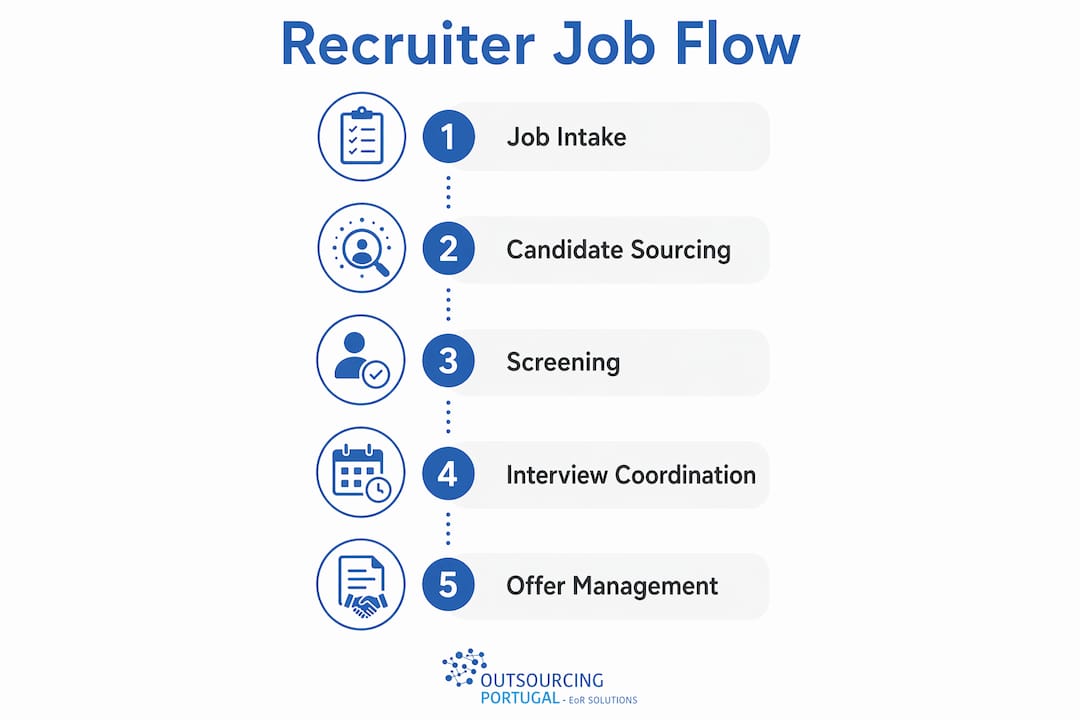
A standard recruiter job description covers eight core responsibilities: requisition intake, job posting and sourcing, screening and qualification, interview coordination, assessment and selection support, offer negotiation, pre-close management, and onboarding handoff. Each step represents a distinct phase of the hiring cycle. Leaving any of them out creates gaps that hiring managers and candidates both notice.
The eight responsibilities break down as follows:
- Requisition intake: Meet with hiring managers to understand role requirements, team context, and success criteria before posting any job.
- Job posting and sourcing: Write and distribute job postings across relevant channels, then actively source passive candidates through LinkedIn, Boolean search, and niche platforms.
- Screening and qualification: Conduct initial phone or video screens to assess fit against defined criteria before advancing candidates.
- Interview coordination: Schedule and manage interview loops, keeping candidates and interviewers informed at every stage.
- Assessment and selection support: Facilitate structured evaluation processes, including skills tests or panel debrief sessions.
- Offer negotiation: Draft and present offers, manage counteroffers, and close candidates on compensation and benefits.
- Pre-close management: Maintain contact with accepted candidates through their notice period to prevent drop-off.
- Onboarding handoff: Transfer candidate information and context to HR or the hiring team before day one.
Recruiters increasingly rely on structured, evidence-based hiring practices rather than gut instinct. Key performance indicators include time-to-fill, cost-per-hire, offer acceptance rate, and candidate satisfaction scores. Your job description should name the KPIs the role is accountable for, not just list tasks.
Volume expectations also belong in the description. In-house recruiters typically manage 10–25 open requisitions at a time, while agency recruiters handle 5–15 active roles concurrently. That difference shapes workload, tools, and pace. State the expected volume so candidates self-select accurately.
Pro Tip: List ATS proficiency as a named requirement, not a generic “tech-savvy” placeholder. Specify the system your team uses, whether Greenhouse, Workday, or another platform, so candidates know exactly what they are walking into.
How do skills and qualifications shape an effective recruiter job description?
The skills section of a recruiter job description determines who applies and who self-screens out. Weak skills lists attract generalists. Specific, tiered requirements attract the right level of experience for the role.
Core skills every recruiter job description should include:
- Communication: Written and verbal clarity for candidate outreach, hiring manager updates, and offer conversations.
- Organization: Ability to track multiple candidates across multiple roles without dropping context.
- ATS proficiency: Hands-on experience with applicant tracking systems for pipeline management and reporting.
- Sourcing techniques: Boolean search, LinkedIn Recruiter, and talent mapping for roles with limited active candidate pools.
- Inclusive hiring practices: Knowledge of structured interviewing, bias-reduction techniques, and equitable screening criteria.
Qualification expectations shift significantly by seniority level. Entry-level recruiter roles typically require a bachelor’s degree in HR, business, or a related field, plus one to two years of recruiting or HR coordination experience. Mid-level roles add three to five years of full-cycle recruiting experience and demonstrated ATS ownership. Senior roles require the ability to partner with hiring managers on hiring strategy, not just execute tasks. The word “partner” in a job description signals advisory collaboration, not simple task fulfillment. That distinction matters when setting expectations with candidates.
For roles requiring specialized sourcing, add Boolean search and talent mapping as explicit requirements. These are not generic skills. They require practice and domain knowledge to execute well.
Pro Tip: Separate “required” from “preferred” qualifications into two distinct lists. Candidates, especially women and underrepresented groups, are less likely to apply when they do not meet every listed requirement. Keeping the required list tight and honest improves application rates from qualified candidates.
Certifications like SHRM-CP or the Certified Internet Recruiter (CIR) credential enhance recruiter effectiveness in specialized contexts. List them as preferred, not required, unless the role genuinely demands them. Overstating credential requirements narrows your pool without improving hire quality.
What best practices optimize recruiter job descriptions?
The most common failure in recruiter job descriptions is vagueness. Phrases like “manage the full recruitment lifecycle” or “work with stakeholders” tell candidates almost nothing. Specificity is what separates a description that attracts strong applicants from one that generates noise.
Follow these steps to write a description that performs:
-
Define the recruitment model upfront. Clarity about whether the role is full-cycle or specialized directly shapes performance expectations and candidate suitability. State it in the first paragraph of the job description, not buried in a bullet list.
-
State volume and scope. Name the number of requisitions the recruiter will manage, the business units they support, and the hiring manager relationships they own. Candidates use this information to judge fit before applying.
-
Separate recruiting from HR. Recruiting and HR are distinct functions. Recruitment focuses on sourcing and hiring. HR manages broader employee processes. Blurring these in a job description creates operational confusion and attracts candidates with the wrong background. For international companies building remote hiring teams, this separation is especially critical.
-
Include candidate experience as a named priority. Positive candidate experience correlates with better talent acquisition outcomes. Listing it as a responsibility signals a mature recruitment function and attracts recruiters who take employer branding seriously.
-
Add salary range and key benefits. Omitting compensation data increases time-to-fill and reduces application quality. Candidates who apply without salary information are more likely to drop out at the offer stage.
-
Use metrics, not adjectives. Replace “strong communicator” with “maintains candidate response time under 48 hours.” Replace “results-driven” with “achieves offer acceptance rate above 85%.” Metrics set clear expectations and make performance reviews easier.
Pro Tip: Run your draft job description through a readability tool before posting. Descriptions written above a 12th-grade reading level consistently generate fewer applications, particularly from candidates who are not native English speakers. This matters especially for international hiring.
How do recruiter job descriptions differ for specialized roles?
Specialized recruiter job descriptions require a different approach than general talent acquisition roles. A technical recruiter hiring software engineers, a clinical recruiter filling nursing roles, or an executive recruiter sourcing C-suite candidates each needs domain knowledge that a generalist recruiter does not possess.
The table below shows how key elements shift across three common specialization types:
| Element | Technical recruiter | Clinical recruiter | Executive recruiter |
|---|---|---|---|
| Domain knowledge | Software engineering, cloud infrastructure, DevOps | Healthcare licensing, clinical certifications, regulatory compliance | Business strategy, board governance, P&L ownership |
| Sourcing platforms | GitHub, Stack Overflow, LinkedIn | Health eCareers, NurseRecruiter, professional associations | Executive networks, retained search, referral pipelines |
| Key credential | CIR or technical bootcamp background | Healthcare HR certification or clinical background | SHRM-SCP or executive search firm experience |
| Pipeline expectation | Maintain active pools for recurring engineering roles | Build passive candidate lists for hard-to-fill clinical roles | Manage long-term relationships with senior leaders |
| Performance metric | Time-to-fill for technical roles, hiring manager satisfaction | Licensure verification speed, compliance rate | Placement quality, retention at 12 months |
Specialist recruiters must demonstrate subject-matter expertise, Boolean searching, talent mapping, and active engagement within professional communities. Maintaining active talent pipelines between searches is critical for these roles. A specialist who starts sourcing from scratch every time a role opens will consistently miss target timelines.
For executive-level recruitment, the job description should reference C-suite hiring competencies explicitly, including the ability to manage confidential searches and engage passive senior leaders. Generic recruiter language does not attract candidates with this background.
Technical certification and domain knowledge are critical for specialist recruiters to credibly evaluate candidates and build trust with hiring managers. A technical recruiter who cannot read a resume for a senior backend engineer role will lose credibility with engineering leaders fast. The job description should reflect that expectation clearly.
Recruitment specialist tasks in specialized roles also include community engagement. This means attending industry conferences, participating in professional forums, and building relationships with passive candidates before a role opens. List this as a responsibility, not an afterthought.
Key Takeaways
A recruiter job description works best when it names specific responsibilities, volume expectations, and performance metrics rather than relying on generic language.
| Point | Details |
|---|---|
| Eight core responsibilities | Every recruiter job description should cover intake through onboarding handoff without gaps. |
| Volume benchmarks matter | State whether the role manages 10–25 in-house requisitions or 5–15 agency roles to set realistic expectations. |
| Define the recruitment model | Specify full-cycle, sourcing-only, or specialized to attract candidates with the right background. |
| Separate recruiting from HR | Blurring these functions in a job description attracts mismatched candidates and creates operational friction. |
| Specialization requires domain knowledge | Technical, clinical, and executive recruiters need role-specific credentials, platforms, and pipeline strategies listed explicitly. |
What I have learned writing recruiter job descriptions for global teams
After working with international companies building recruitment functions across multiple markets, one pattern stands out. The job descriptions that fail are not the ones with too little information. They are the ones that describe an idealized role rather than the actual job.
HR teams often write recruiter job descriptions that list every possible responsibility, then wonder why new hires feel overwhelmed or underperform. The fix is not a shorter list. It is an honest one. If the role requires managing 20 open requisitions while also owning employer branding content and running hiring manager training, say that. Candidates who thrive in high-volume, high-complexity environments will lean in. Candidates who prefer deep, specialized work will self-select out. Both outcomes are wins.
The second pattern I see consistently is the omission of candidate experience as a named priority. Most job descriptions treat candidate communication as implied. It is not. Recruiters who actively manage candidate experience as a deliverable produce measurably better outcomes on offer acceptance and employer brand perception. When you name it in the job description, you attract recruiters who take it seriously.
For international organizations, the stakes are higher. A recruiter operating across time zones, languages, and labor markets needs a job description that reflects that complexity. Vague descriptions attract candidates who underestimate the role. Specific descriptions attract candidates who are ready for it. The employer services dimension of international hiring adds compliance, payroll, and legal layers that a well-written recruiter job description should at least acknowledge, even if those responsibilities sit with a separate team.
— Paulo
How Outsourcing-portugal supports your international recruitment function
International companies hiring in Portugal face a layer of complexity that goes beyond writing a good job description. Payroll compliance, labor law, onboarding logistics, and legal entity requirements all sit alongside the recruiter’s core work.

Outsourcing-portugal provides employment outsourcing services that handle the compliance and payroll infrastructure your recruitment team depends on. From Employer of Record services in Portugal to full onboarding support, the platform lets your recruiters focus on sourcing and hiring while the legal and administrative framework stays covered. For HR teams building or scaling a recruitment function in Portugal, that separation of responsibilities is exactly what a well-designed recruiter job description should reflect.
FAQ
What is a recruiter job description?
A recruiter job description defines the duties, skills, qualifications, and performance expectations for a professional responsible for sourcing, screening, and hiring candidates. It covers the full recruitment cycle from requisition intake through onboarding handoff.
How many requisitions should a recruiter manage?
In-house recruiters typically manage 10–25 open requisitions at a time, while agency recruiters handle 5–15 active roles concurrently. Volume expectations should be stated explicitly in the job description to set realistic workload expectations.
What is the difference between a recruiter and an HR generalist?
Recruiting focuses solely on candidate sourcing and hiring, while HR manages broader employee-related processes including performance management, benefits, and compliance. Blurring these roles in a job description creates operational confusion and attracts candidates with mismatched backgrounds.
What skills are required for a specialized recruiter role?
Specialized recruiters need domain knowledge in their target field, Boolean search proficiency, talent mapping skills, and active engagement in relevant professional communities. Certifications like SHRM-CP or CIR strengthen credibility with hiring managers in technical and clinical contexts.
Should a recruiter job description include salary information?
Yes. Including a salary range reduces time-to-fill and improves application quality by filtering out candidates whose expectations do not align with the role. Omitting compensation data increases drop-off rates at the offer stage.