

A contrato de representante comercial in Portugal is governed by Decreto-Lei n.º 178/86, which classifies it as an agency relationship whenever the representative acts with autonomy, stability, and receives remuneration for promoting the principal’s contracts. The single biggest operational priority for any business drafting one: structure the relationship so the representative stays genuinely independent, with powers documented in writing, or risk requalification as employment, unexpected tax exposure, and a costly termination indemnity.
TL;DR:
- Ensuring the agent’s independence requires documented powers and clear boundaries to avoid reclassification as an employee or unintended tax liabilities.
- Written authorization detailing contract signing, payment limits, and representation scope minimizes third-party disputes and legal exposure.
- Courts assess actual working relationships beyond contract labels, with indicators like fixed hours, supervision, and salaried pay risking employment classification.
- The statutory indemnity of clientela depends on proven relationship-building during the contract and the ongoing benefit to the principal after termination.
- For non-employee market entry, Employer of Record services provide a compliant alternative, eliminating risks tied to agency requalification and permanent establishment.
Table of Contents
- Where the law is: statutory definition and form requirements
- Core rights and duties of the agent and the principal
- Representation powers and protecting third parties from disputes
- When “representative” becomes “employee” in the eyes of a court
- Termination rules and the indemnity of clientela
- Post-contract non-compete clauses: what the law actually allows
- Tax and permanent establishment risk for foreign principals
- A drafting checklist for the representative contract itself
- How Outsourcing-portugal supports compliant market entry
- Author’s recommendations for counsel and decision-makers
- Outsourcing-portugal: an alternative when you want direct control
- Sources
Where the law is: statutory definition and form requirements
Everything about the commercial representative contract in Portugal traces back to one statute: Decreto-Lei n.º 178/86. It defines agency as an arrangement where one party undertakes to promote, on behalf of another, the conclusion of contracts within a defined territory or client circle. Four elements have to be present for the law to treat the relationship as agency rather than something else: autonomy in how the work gets done, stability over time rather than a single transaction, a promotional role (finding and closing deals for the principal, not performing the principal’s core business), and remuneration tied to that activity.
The statute does not always demand a written contract for the basic agency relationship to exist. It does, however, require writing for specific elements that carry legal weight: powers of representation must be documented in writing if the agent is going to bind the principal to third parties, and post-contract non-compete clauses are void unless reduced to writing. This distinction trips up a lot of companies that assume an informal handshake arrangement is fine because “it’s just sales.” It might be fine commercially. Legally, the moment you need to enforce a non-compete or prove an agent’s authority to a court or a counterparty, the absence of a signed document becomes the whole problem.
The full consolidated text, including subsequent amendments, sits on the Diário da República portal, and it’s worth reading directly rather than relying on secondhand summaries, since the obligations, timing rules, and indemnity formulas all live in specific articles you’ll want to cite when negotiating or litigating.
Core rights and duties of the agent and the principal
DL 178/86 assigns a fairly balanced set of obligations to both sides of the relationship, and a contract that only spells out what the principal wants from the agent, without mirroring the principal’s own duties, tends to look one-sided in a dispute.
The agent’s statutory duties include:
- Acting in good faith and pursuing the interests entrusted by the principal.
- Promoting contracts within the agreed territory or client base according to the principal’s reasonable instructions, provided those instructions don’t undermine genuine autonomy.
- Maintaining confidentiality over business information obtained through the relationship.
- Keeping adequate records of activity and rendering accounts to the principal on request.
The principal’s duties run in parallel. The principal must supply the agent with the documentation, samples, price lists, and technical information needed to do the job properly, must inform the agent promptly about whether proposed business has been accepted or rejected, and must pay commissions on a fixed statutory schedule: by the last day of the month following the quarter in which the commission accrued.
When drafting, don’t just restate these obligations in generic language. Define exactly what “acceptance” means for your business (a signed order, a shipped invoice, a countersigned quote), specify the commission base (gross sale value, net after returns, net after freight), and attach the statutory payment deadline as a hard date rather than a vague “promptly.” Vague obligations create disputes; precise ones prevent them.
Representation powers and protecting third parties from disputes
Not every commercial representative can sign contracts on the principal’s behalf, and this distinction matters enormously for anyone dealing with the agent commercially. An agent with written powers of representation can validly bind the principal to a third party within the scope of those powers. An agent without them can only promote and negotiate. Any contract the agent purports to sign is not automatically binding on the principal, though the principal can ratify it after the fact.

Credit collection follows its own rule. The law presumes an agent has authority to receive payments on the principal’s behalf when that authority has been granted or is reasonably implied by the course of dealing, but disputes over whether that authority existed are common precisely because verbal arrangements leave no trail. The safest approach is to record collection authority explicitly, spelling out payment methods the agent may accept and any monetary limits.
Practical steps that reduce third-party disputes:
- Issue the agent a written authorization document referencing specific powers, which the agent can show to counterparties.
- State the scope of representation clearly in every contract template the agent uses with clients.
- Avoid letting an agent without written powers use letterhead, email signatures, or business cards that imply signing authority they don’t have.
Getting this wrong doesn’t just create internal friction. It can expose the principal to contracts it never intended to be bound by, negotiated by someone acting outside their actual authority.
When “representative” becomes “employee” in the eyes of a court
Portuguese courts don’t care what you call the contract. This is the single most important thing counsel drafting these agreements needs to internalize: substance beats form, every time. Doctrinal analysis from the Universidade Católica Portuguesa confirms that courts look past the label on the document and assess the actual working relationship to decide whether someone is genuinely an independent commercial agent or, in fact, an employee dressed up in a services contract.
Autonomy is the decisive factor. A principal can give commercial instructions (target markets, pricing guidelines, product training) without destroying that autonomy. What tips the balance toward employment is functional direction that substitutes for what an employer would normally organize.
Watch for these red flags:
- Fixed working hours the representative must observe, rather than results-based freedom.
- Subordinated day-to-day direction: reporting structures, mandatory check-ins, or supervisory approval for routine decisions.
- A fixed monthly salary that dwarfs the commission component, suggesting pay isn’t actually tied to results.
- Deep integration into company systems: a company email domain, mandatory use of internal software, inclusion in staff meetings and internal org charts.
Pro Tip: If you’re unsure whether an arrangement leans too far toward subordination, ask who bears the commercial risk. A true agent absorbs the risk of a bad sales quarter through lower commissions. An employee gets paid regardless. That single question resolves more borderline cases than any clause in the contract.
Requalification isn’t a paperwork inconvenience. Once a court or the Portuguese social security authority determines the relationship was, in substance, employment, the consequences cascade: the representative can claim unpaid holiday pay, severance, and other employment entitlements retroactively; Social Security arrears become due for the entire misclassified period, often with penalties; and the tax authority may reassess withholding obligations the principal never applied because it treated the person as self-employed.
Termination rules and the indemnity of clientela
Open-ended agency contracts in Portugal require advance notice before termination, and the required notice period generally scales with how long the relationship has run. Terminating without respecting that notice period exposes the principal (or the agent, if the agent terminates) to a damages claim for the harm caused by the abrupt ending, calculated on what the other party would reasonably have earned during the missed notice window.
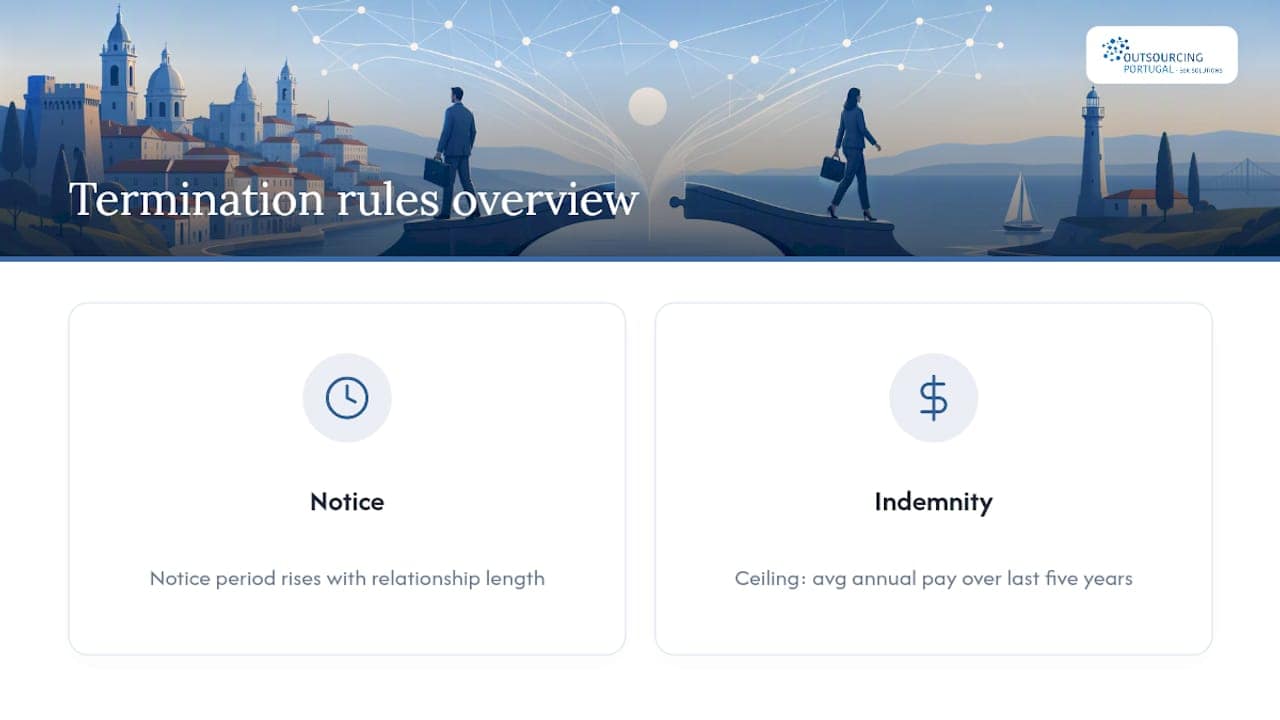
Separately from notice, and often more significant financially, is the indemnity of clientela. This indemnity becomes due when the agent has built up or meaningfully expanded a client base that the principal continues to benefit from after the contract ends. It isn’t automatic. The agent has to show the goodwill was actually created or grown during the relationship, and that the principal retains a real ongoing advantage from it.
The statutory ceiling for this indemnity is the agent’s average annual remuneration over the last five years of the relationship, or over the full contract duration if it ran shorter than five years.
Here’s a worked example. Suppose an agent earned commissions averaging around €50,000 annually over the last several years. That figure represents the statutory ceiling a court would apply if it found the indemnity of clientela justified. It’s a ceiling, not an automatic entitlement. Courts still weigh how much of that client relationship survives the agent’s departure and whether the principal genuinely keeps benefiting from it. Businesses negotiating an exit should run this calculation early rather than being surprised by it during termination talks.
Post-contract non-compete clauses: what the law actually allows
Non-compete clauses that survive termination of a commercial representative contract are permitted under Portuguese law, but the statute boxes them in tightly. To be enforceable, a post-contract restriction must satisfy three conditions simultaneously, drawn directly from DL 178/86:
- It must be agreed in writing, not implied or verbal.
- It cannot exceed two years from termination of the contract.
- It must be limited to the geographic area, or the specific circle of clients, that was actually entrusted to the agent during the relationship.
A clause that tries to block the agent from working in an entire industry nationwide, when the agent only ever covered three districts and a defined client list, will not hold up. Courts read these restrictions narrowly because they restrain someone’s ability to earn a living.
The more defensible approach is to tie the restriction to the actual client list the agent managed or a precisely mapped territory, rather than broad industry language, and to consider offering the agent some form of compensation for the restriction period. It isn’t a strict legal requirement, but it materially strengthens the clause’s standing if challenged and signals good faith in negotiation.
Tax and permanent establishment risk for foreign principals
Foreign companies appointing a Portuguese commercial representative face a tax question that’s easy to overlook: does the agent’s activity create a permanent establishment (PE) in Portugal, triggering Portuguese corporate tax on profits attributable to that activity? Under EU and international tax frameworks, a dependent agent who habitually concludes contracts on behalf of a non-resident principal, without genuine commercial independence, can indeed create a PE, even without the principal ever opening an office in Portugal.
The dividing line largely mirrors the employment requalification test. An independent agent who assumes real commercial risk, represents multiple principals, and trades on their own account is unlikely to create a PE. An agent who works exclusively for one principal, follows detailed instructions indistinguishable from employee direction, and effectively functions as a de facto local sales office is a much stronger PE candidate.

This is where labor requalification risk and tax risk reinforce each other rather than sitting in separate boxes. The same facts that get an agent reclassified as an employee (subordination, exclusivity, lack of independent risk) are the facts a tax authority would point to when arguing PE. Structuring safeguards that preserve autonomy do double duty: they protect against both outcomes simultaneously. Given how much is at stake, cross-border principals should get a tax opinion on PE exposure before signing, not after the first year of activity raises questions. Reviewing your cross-border employment approach early tends to save far more than it costs.
A drafting checklist for the representative contract itself
Pulling the statute, the case law, and the practical risks together, here’s a sequence worth working through when drafting or reviewing a Portuguese commercial representative contract:
- State governing law and jurisdiction explicitly, referencing DL 178/86, even though Portuguese law would likely apply by default to activity performed in Portugal.
- Define the scope precisely: territory, client circle, and product or service lines covered.
- Document representation powers in writing, specifying whether the agent can sign contracts, collect payments, or only negotiate and promote.
- Set out the commission formula in numeric, unambiguous terms, along with the statutory payment timing.
- Include confidentiality and data protection clauses, addressing how client information gets handled under Portuguese and EU data rules.
- Draft termination provisions with clear notice periods and reference the conditions for indemnity of clientela.
- Cap any non-compete clause at two years, tied to the actual client list or territory.
- Add autonomy safeguards: language confirming the agent sets their own working hours, bears expenses, and retains freedom to represent other principals unless exclusivity is separately negotiated and priced.
- Grant audit and accounting rights so the principal can verify commission calculations without micromanaging daily activity.
- Require the agent to invoice independently and maintain their own tax and social security registration as evidence of genuine self-employment.
Pro Tip: Keep the agent’s marketing materials, email signature, and business cards visually distinct from your own employees’ branding. It sounds trivial, but in a requalification dispute, small administrative details like this often carry more weight than the contract’s wording.
How Outsourcing-portugal supports compliant market entry
Appointing an independent agent isn’t the only route into the Portuguese market, and for many companies it isn’t the simplest one either. Outsourcing-portugal offers Employer of Record services that let you hire someone to do sales, business development, or client management work directly, under a compliant local employment structure, without the requalification guesswork that comes with an agency arrangement.
That matters because the line between “independent agent” and “de facto employee” is exactly where companies get burned on Social Security arrears and PE exposure. An EOR arrangement sidesteps the ambiguity entirely: the worker is properly employed from day one, payroll and tax withholding are handled correctly, and there’s no need to litigate autonomy after the fact. For businesses weighing whether to appoint a representative or simply hire, comparing the two against Portugal’s legal compliance requirements is worth doing before either contract gets signed.
Author’s recommendations for counsel and decision-makers
Three things to do before you sign anything. First, confirm factual independence exists, not just contractual language claiming it. Second, put representation powers and commission timing in writing, matching the statutory payment schedule exactly. Third, if the principal is based outside Portugal, get a tax opinion on permanent establishment risk before the agent starts working, not after a tax audit raises the question.
Consult local counsel whenever the relationship involves exclusivity, significant commission volumes, or any ambiguity about who directs daily work. If the business goal is simpler, direct control over a salesperson’s time, an Employer of Record structure usually resolves the ambiguity faster and more cheaply than litigating an agency dispute later.
— Paulo
Outsourcing-portugal: an alternative when you want direct control
If the analysis above leaves you thinking an agency contract carries more legal risk than your business wants to carry, there’s a more straightforward path. Outsourcing-portugal’s Employer of Record service lets you hire a salesperson or business developer in Portugal directly, on payroll, with full compliance handled on your behalf, no local entity required.

The tradeoff is worth being honest about. An independent agency contract can be cheaper on paper, since you’re only paying commission on results. But that lower headline cost comes bundled with the requalification and PE risks covered throughout this guide, plus the administrative burden of monitoring autonomy indicators over time. An EOR arrangement costs more predictably but removes that risk almost entirely, since the worker is compliantly employed from the start. If your priority is speed and certainty over the lowest possible cost, explore Outsourcing-portugal’s Employer of Record services and get a quote for hiring your first Portugal-based team member.
Sources
The foundational text is Decreto-Lei n.º 178/86, which defines the agency relationship, along with its consolidated version reflecting subsequent amendments to obligations, payment timing, and indemnity rules. For doctrinal depth on requalification risk, the Universidade Católica Portuguesa repository analysis offers substance-over-form reasoning courts apply in practice. Cross-border tax questions benefit from EUR-Lex and general administrative guidance from Portugal’s government portal.
This article is general information, not a substitute for advice from a qualified lawyer. Consult a qualified legal professional about your own circumstances before acting on anything here.
- Regulamenta o contrato de agência ou representação comercial
- Academic/doctrinal analysis of agency and distribution contracts (UCP repository)
- EUR‑Lex