
Hiring internationally involves balancing cost and compliance, and Portugal offers significant cost savings but with legal nuances to navigate. International companies expanding into Portugal in 2026 face the challenge of controlling employment expenses while meeting strict labor regulations. This guide covers key steps to hire effectively in Portugal, from understanding total employment costs and legal requirements to choosing between entity formation and Employer of Record solutions. You’ll learn how to budget accurately, ensure compliance, and retain talent without overspending.
Table of Contents
- Understanding Total Employment Costs In Portugal
- Navigating Legal Requirements When Hiring In Portugal
- Choosing The Best Hiring Approach: Entity Setup Vs Employer Of Record
- Onboarding And Retaining Talent While Maximizing Cost Efficiency
- How Outsourcing Portugal Supports Your Hiring Success
- What Is The Total Cost Of Hiring An Employee In Portugal?
- What Legal Documents Are Required To Hire In Portugal?
- Should I Use An Employer Of Record Or Set Up A Local Entity?
- How Can I Ensure Compliance When Hiring Remote Employees In Portugal?
Key takeaways
| Point | Details |
|---|---|
| Understanding total employment costs | Employer social security contributions, mandatory 13th and 14th month pays, and vacation days add approximately 26.63% to gross salary. |
| Legal compliance essentials | Written employment contracts, day-one social security registration, and workplace accident insurance are legally required to avoid fines. |
| Entity setup vs Employer of Record | EOR offers speed and low upfront cost but less control, while entity setup provides more control with higher initial investment. |
| Onboarding and retention strategies | Structured onboarding, mandatory benefits, and career growth opportunities increase retention while controlling costs. |
| Expert support reduces risk | Partnering with employment specialists ensures compliance and optimizes hiring expenses in Portugal’s complex labor market. |
Understanding total employment costs in Portugal
Budgeting for Portugal hires requires understanding the full cost picture beyond base salary. Employer social security contributions are 23.75% on gross salary, with total payroll taxes reaching 26.63%. These mandatory contributions fund healthcare, pensions, and unemployment insurance.
Portuguese labor law mandates additional payments that significantly impact your total cost of workforce. Employees receive 13th and 14th month pays, effectively adding two extra salary payments annually. Workers are entitled to 22 working days of paid vacation plus 13 public holidays. These mandatory benefits increase your annual employment cost by roughly 16% beyond the monthly gross salary.
Salary ranges vary by role and seniority. Mid-level tech professionals in Lisbon earn between €30,000 and €45,000 annually, while senior developers command €50,000 to €70,000. When you factor in social security, mandatory pays, and benefits, a €40,000 annual salary translates to approximately €50,650 in total employer cost.
Using an employment cost calculator helps you estimate total hiring expenses accurately. These tools account for:
- Base gross salary
- Employer social security at 23.75%
- Wage guarantee fund at 1%
- Workplace accident insurance at approximately 1.88%
- 13th and 14th month payments
- Paid vacation and public holiday costs
Workplace insurance and the wage guarantee fund add smaller but necessary costs. Workplace accident insurance typically runs 1.88% of gross salary, covering injuries and occupational diseases. The wage guarantee fund protects employees if your company faces insolvency, costing about 1% of payroll.
Pro Tip: Always budget for the full loaded cost, not just base salary. Hidden costs like recruitment fees, onboarding time, and equipment can add another 10% to 15% in the first year.
Navigating legal requirements when hiring in Portugal
Legal compliance starts with proper employment contracts. Written contracts are mandatory for fixed-term positions and non-EU employees, though best practice dictates written agreements for all hires. Contracts must specify salary, working hours, job duties, vacation entitlement, and notice periods. Probation periods cannot exceed 90 days for most roles or 180 days for senior management and highly specialized positions.
Social security and tax registrations must occur on the employee’s first working day. You’ll register with the Portuguese Social Security system and obtain a tax identification number for payroll withholding. Missing these deadlines triggers penalties and potential audits. Your registration obligations include:
- Social security enrollment for employer and employee
- Tax authority notification of new hire
- Workplace accident insurance activation
- Submission of employment contract to labor authorities if requested
Contractor misclassification represents a serious legal risk. Avoid verbal contracts or misclassifying contractors as employees to prevent fines and audits. Portuguese authorities scrutinize working relationships where contractors function as de facto employees. Red flags include exclusive work for one client, fixed working hours, use of company equipment, and lack of entrepreneurial risk. Misclassification can result in retroactive social security payments, fines up to €44,000, and back taxes.
Fixed-term contracts require valid justification under Portuguese law. You cannot use them for permanent operational needs. Valid reasons include temporary workload increases, seasonal work, replacing absent employees, or project-based assignments. Fixed-term contracts can run up to two years with a maximum of three renewals. Exceeding these limits automatically converts the contract to permanent employment.
Workplace protections extend beyond contracts and insurance. You must provide a safe working environment, respect maximum working hours of 40 per week, and honor minimum rest periods of 11 consecutive hours daily. Overtime requires employee consent and cannot exceed 200 hours annually per worker. Termination procedures follow strict rules, with notice periods ranging from 15 to 75 days based on tenure.
“Getting accurate employment contracts in Portugal right from the start protects both employer and employee, preventing costly disputes and ensuring smooth operations.”
Pro Tip: Partner with local legal experts or an EOR provider to navigate Portugal’s complex labor code. Small compliance errors can snowball into major financial and legal problems.
Choosing the best hiring approach: Entity setup vs Employer of Record
Your hiring strategy in Portugal hinges on choosing between forming a local entity or using an Employer of Record. Each approach offers distinct advantages depending on your scale, timeline, and control requirements.
EOR solutions provide speed and low upfront cost but less direct control. An EOR becomes the legal employer, handling payroll, taxes, benefits, and compliance while you manage day-to-day work. This model lets you hire within days rather than months, with no need to establish a Portuguese legal presence. EOR providers charge per-employee monthly fees, typically 8% to 15% of gross salary, making costs predictable and scalable.
Entity setup delivers maximum control and long-term cost savings but requires significant upfront investment. Forming a Portuguese subsidiary involves legal fees, registration costs, and ongoing accounting expenses. Setup takes three to six months and costs €5,000 to €15,000 initially. However, once established, your per-employee costs drop to actual salary plus taxes, eliminating EOR fees. This approach makes financial sense when hiring 10 or more employees or planning multi-year operations.
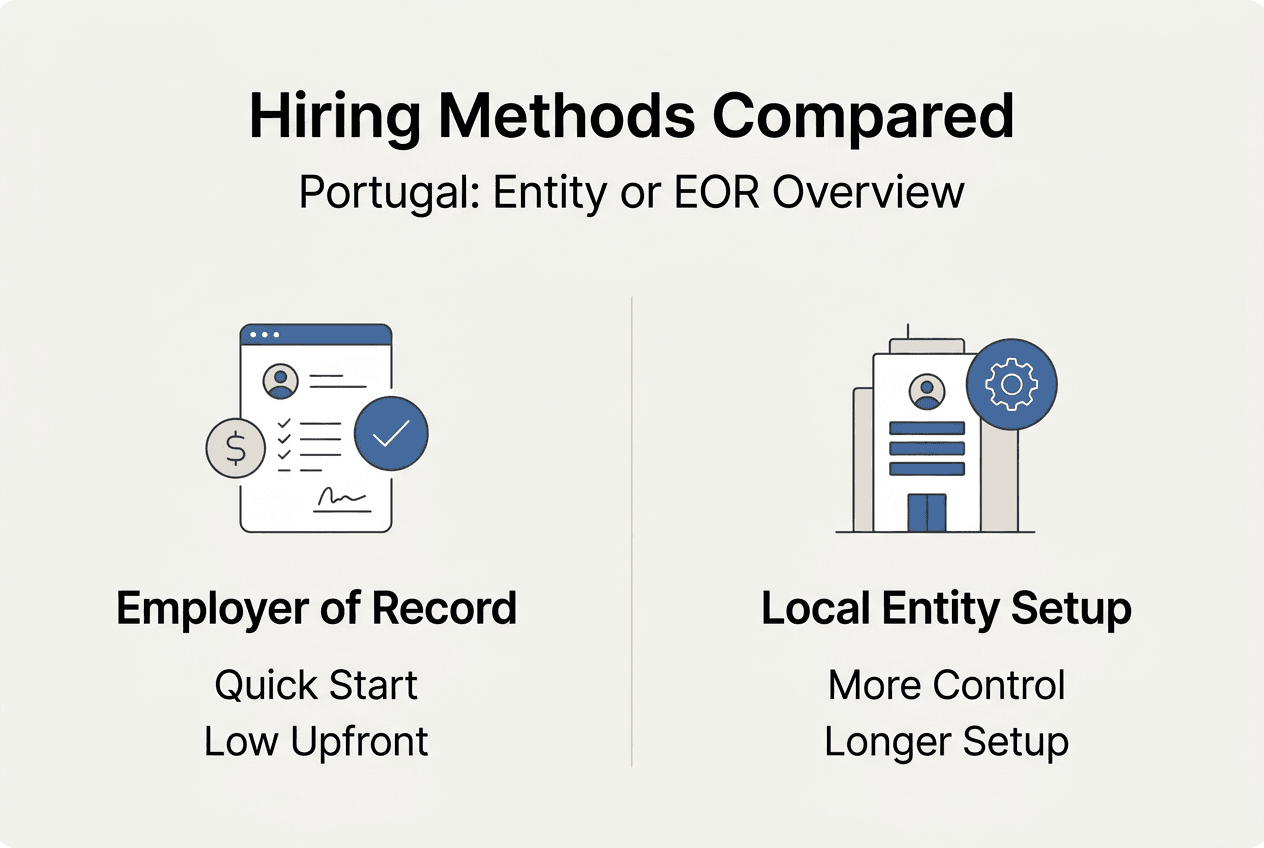
| Factor | Employer of Record | Local Entity Setup |
|---|---|---|
| Time to hire | 1 to 2 weeks | 3 to 6 months |
| Upfront cost | Low (minimal setup fees) | High (€5,000 to €15,000+) |
| Ongoing cost per employee | 8% to 15% of gross salary monthly | Accounting and admin overhead only |
| Control over operations | Limited (EOR is legal employer) | Full (you are legal employer) |
| Best for | Testing market, small teams, quick scaling | Long-term presence, large teams, maximum control |
EOR suits companies testing the Portuguese market, hiring one to five employees, or needing immediate staffing. You avoid entity maintenance, local accounting, and administrative burden. The tradeoff is less control over HR policies, benefits customization, and employee relationships. EOR providers handle compliance, but you depend on their expertise and responsiveness.
Entity formation makes sense for established operations, hiring 10 or more staff, or requiring tight integration with corporate systems. You control every aspect of employment, from benefits design to performance management. Long-term, the cost per employee drops significantly compared to EOR fees. However, you assume full compliance responsibility and administrative overhead.
Hybrid approaches combine both models. Some companies use Employer of Record Portugal services initially, then transition to a local entity once headcount justifies the investment. Others maintain an entity for core staff while using EOR for contractors or specialized roles.
Key considerations when choosing include:
- Planned headcount over 12 to 24 months
- Budget for upfront vs ongoing costs
- Need for control over HR policies and benefits
- Internal capacity to manage Portuguese payroll and compliance
- Timeline for becoming operational
- Strategic commitment to the Portuguese market
Pro Tip: If you plan to hire more than eight employees within 18 months, entity setup typically becomes more cost effective than EOR. Run the numbers using your specific salary ranges and growth projections. For guidance on scaling tech teams in Portugal, compare both models against your expansion timeline.
Onboarding and retaining talent while maximizing cost efficiency
Effective onboarding sets the foundation for employee success and retention. Structure your onboarding to integrate new hires within the first 30 days. Start with pre-arrival preparation: send welcome packets, equipment, and access credentials before day one. On the first day, conduct orientation covering company culture, team introductions, and administrative setup. Week one should focus on role-specific training and early wins.
Your onboarding checklist should include:
- Employment contract signing and document collection
- Social security and tax registration completion
- Equipment provision (laptop, phone, software licenses)
- System access and security training
- Introduction to team members and key stakeholders
- Review of job responsibilities and performance expectations
- Assignment of initial projects or tasks
Mandatory benefits form the baseline of your compensation package. Beyond the legally required 22 vacation days, 13th and 14th month pays, and social security coverage, consider cost-effective additions. Meal allowances are tax-advantaged up to €6 per working day. Transportation subsidies enjoy favorable tax treatment. Health insurance supplements the public system and costs €30 to €80 per employee monthly, significantly boosting perceived value.

Employee engagement beyond salary drives retention in Portugal’s competitive talent market. Portuguese professionals value stability and benefits over high bonuses, especially in tech hubs Lisbon and Porto. Career development opportunities, clear advancement paths, and work-life balance matter more than aggressive compensation. Implement regular one-on-ones, skills training budgets, and flexible working arrangements to increase satisfaction without major cost increases.
Probation periods let you assess fit while respecting legal limits. Use the full 90-day probation for most roles or 180 days for senior positions to evaluate performance, cultural alignment, and skill match. Provide clear feedback and measurable objectives during probation. If the fit isn’t right, termination during probation requires minimal notice and no severance, reducing hiring risk.
Retention strategies balance cost control with employee motivation:
- Offer clear career progression with defined promotion criteria
- Provide annual salary reviews tied to performance and market rates
- Create recognition programs celebrating achievements without major expense
- Enable remote or hybrid work to improve work-life balance
- Invest in professional development through courses, conferences, or certifications
- Foster strong team culture through regular team events and communication
Portuguese employment law favors employee stability, making retention more cost effective than replacement. Turnover costs include recruitment fees (15% to 25% of annual salary), onboarding time, productivity loss, and knowledge transfer. Investing in retention through modest benefits and career development typically costs far less than replacing talent.
Pro Tip: Track retention metrics by hire source, department, and manager. Identify patterns in early turnover to refine your hiring and onboarding processes. High turnover in the first six months signals onboarding or role clarity issues, while departures after two years often relate to career growth limitations. For insights on attracting cost-effective tech talent in Portugal’s nearshore market, focus on stability and professional development over purely financial incentives.
How Outsourcing Portugal supports your hiring success
Navigating Portugal’s employment landscape becomes simpler with expert support. After mastering the fundamentals of cost-effective hiring, many international companies turn to specialized partners to implement their strategy efficiently.

Outsourcing Portugal offers comprehensive employment services tailored to international firms expanding into Portugal. Their solutions span payroll management, Employer of Record services, entity formation support, and ongoing HR administration. Whether you’re hiring your first Portuguese employee or scaling to a full team, their expertise ensures compliance while controlling costs and accelerating time to productivity. Their EOR Portugal services handle the legal employer responsibilities, letting you focus on managing your team’s work rather than navigating Portuguese labor regulations. By partnering with specialists who understand both international business needs and local requirements, you reduce the risk of costly compliance errors while optimizing your hiring investment.
What is the total cost of hiring an employee in Portugal?
The total cost of hiring an employee in Portugal includes gross salary plus approximately 26.63% in payroll taxes and mandatory benefits. Employer social security contributions account for 23.75% of gross salary, while the wage guarantee fund and workplace accident insurance add roughly 2.88% combined. You must also budget for mandatory 13th and 14th month payments, which effectively add two months of salary annually, plus 22 working days of paid vacation and 13 public holidays. For a €40,000 annual salary, expect total employer costs around €50,650 when including all mandatory contributions and benefits.
What legal documents are required to hire in Portugal?
Written employment contracts are mandatory for fixed-term positions and non-EU employees, though best practice recommends written agreements for all hires. Contracts must specify salary, working hours, job description, vacation entitlement, probation period, and termination notice requirements. You must register the employee with Portuguese Social Security and the tax authority on their first working day of employment. Verbal contracts should be avoided to prevent legal penalties and compliance issues. Additional required documentation includes proof of workplace accident insurance and, if applicable, work permits for non-EU nationals.
Should I use an Employer of Record or set up a local entity?
EOR is faster and simpler with less control, while entity setup offers more control but higher upfront effort and costs. EOR suits companies testing the Portuguese market, hiring one to five employees, or needing to become operational within weeks. You’ll pay 8% to 15% of gross salary monthly in EOR fees but avoid entity formation costs and administrative burden. Entity setup makes financial sense when hiring 10 or more employees or planning long-term operations, as per-employee costs drop significantly once the initial €5,000 to €15,000 setup investment is complete. Choose EOR for speed and cost certainty, or entity formation for maximum control and long-term savings.
How can I ensure compliance when hiring remote employees in Portugal?
Remote hires require written agreements covering equipment provision, data privacy, expense reimbursement, and working hour expectations to meet legal standards. Your remote work policy must specify who provides and maintains equipment, how you’ll handle internet and utility costs, and data security protocols. Portuguese labor law requires the same protections for remote workers as office-based employees, including maximum working hours, rest periods, and right to disconnect. Maintain clear documentation of remote work arrangements, conduct regular check-ins to ensure compliance with working time regulations, and provide remote workers with the same benefits and career opportunities as on-site staff to avoid discrimination claims.