
TL;DR:
- Cross-border employment in Portugal involves complex legal, tax, and compliance obligations beyond remote work.
- Using an Employer of Record streamlines hiring, payroll, and legal compliance for rapid market entry.
- Ongoing adherence to Portuguese labor laws, contracts, and audits is essential to avoid penalties and legal risks.
Signing a contract with a Portuguese employee from your headquarters in London, New York, or Berlin might feel straightforward. It is not. Cross-border employment involves a web of legal obligations, payroll registration requirements, statutory benefits rules, and tax exposure that no single template contract can address. For HR managers and business executives at multinationals, Portugal is an increasingly attractive destination because of its educated, multilingual workforce, competitive salary bands, and EU membership. But attracting talent there and employing them compliantly are two very different things. This guide breaks down every layer so you can act with confidence.
Table of Contents
- Defining cross-border employment: What it means for global companies
- Legal and compliance challenges of cross-border employment in Portugal
- Comparing cross-border employment options: Direct vs. EoR vs. outsourcing
- Best practices for compliant cross-border employment in Portugal
- A practical perspective: Why most global HR teams underestimate cross-border risks
- Connect with experts for compliant hiring in Portugal
- Frequently asked questions
Key Takeaways
| Point | Details |
|---|---|
| Legal compliance is critical | Failing to follow Portuguese employment law can result in significant penalties and business risks. |
| EoR simplifies cross-border hiring | Partnering with an Employer of Record can streamline processes for hiring remote teams in Portugal. |
| Structure contracts and payroll carefully | Robust contracts and payroll systems reduce risk and support ongoing compliance. |
| Understand your hiring options | Choosing between direct, EoR, or outsourcing affects control, cost, and compliance. |
Defining cross-border employment: What it means for global companies
Cross-border employment refers to any employment arrangement where the employer and employee operate from different countries, requiring the employer to meet legal, tax, and payroll obligations in the employee’s country of residence or work. In the Portuguese context, this applies when your company, registered in another jurisdiction, hires a person who lives and works in Portugal, regardless of whether that person is a Portuguese national or a foreign professional who has relocated there.
This is fundamentally different from traditional remote work, where an employer and employee share the same legal jurisdiction. It is also different from standard international relocation, where a company sends one of its own staff abroad temporarily. Compliance in cross-border hiring is distinct because you are the foreign party with obligations in a country where you may have no registered entity, no local bank account, and no established HR infrastructure.
Here are the most common scenarios where cross-border employment applies for companies targeting Portugal:
- A UK tech company hiring software engineers in Lisbon without a Portuguese subsidiary
- A US SaaS firm building a customer support team in Porto for European time zone coverage
- A German manufacturing group sending an expatriate manager to oversee a Portuguese project for 18 months or more
- A Singapore-headquartered business testing the Iberian market by onboarding two or three Portuguese sales professionals before committing to a full entity setup
“Cross-border employment is distinct from traditional remote work due to legal and compliance nuances.” Each scenario triggers unique obligations under Portuguese law, EU directives, and bilateral tax treaties, which is why the employment structure you choose matters enormously before you ever post a job listing.
What makes Portugal especially relevant right now is its 2024 ranking as one of Europe’s top nearshore destinations, supported by a workforce that is highly proficient in English, Spanish, and French. The country’s regulatory environment within the EU also means that compliance frameworks are sophisticated and non-negotiable.
Legal and compliance challenges of cross-border employment in Portugal
Understanding what cross-border employment means is the starting point. Navigating the legal landscape around it is where most companies run into serious problems. Portugal operates under a detailed Labor Code (Código do Trabalho) and is fully subject to EU employment directives, including rules on working time, anti-discrimination, posted workers, and data protection under GDPR.
The top compliance mistakes international employers make when hiring in Portugal include:
- Assuming a foreign employment contract is sufficient. Portuguese law applies by default when an employee habitually works in Portugal, regardless of what the contract says about governing law.
- Running Portuguese payroll through a foreign payroll system. This creates social security gaps, exposes the company to penalties, and fails to meet mandatory Portuguese payroll filing requirements.
- Misclassifying employees as independent contractors. Portugal has strict rules around bogus self-employment, and reclassification by the labor authority can result in back payments of social security contributions and fines.
- Ignoring mandatory benefits. Portuguese employees are entitled to 22 days of paid annual leave, holiday subsidies, a Christmas bonus (13th and 14th month salary), and specific rules around termination notice and severance.
- Overlooking tax registration obligations. A foreign company with an employee in Portugal may be creating a permanent establishment (PE) for corporate tax purposes, which carries significant financial exposure.
Here is a practical workflow to get compliant before your first Portuguese hire starts:
- Conduct a PE risk assessment with a local tax advisor to determine whether your hiring model triggers corporate tax exposure.
- Register as an employer with the Portuguese Social Security Institute (Instituto da Segurança Social) if you plan to employ directly.
- Draft employment contracts governed by Portuguese law, including mandatory statutory clauses around notice, probationary periods, and collective agreements.
- Set up a payroll compliance in Portugal structure that includes monthly pay slips, social security contributions (employer rate: 23.75%, employee rate: 11%), and income tax withholding (IRS retenção na fonte).
- Register for outsourcing employment compliance reporting if applicable under EU posted worker directives.
“Establishing compliant payroll structures and contracts is essential, especially when employees work from different jurisdictions.” This is especially true in Portugal, where the labor inspectorate (Autoridade para as Condições do Trabalho, or ACT) has increased audit activity in recent years, particularly targeting companies with remote workers who have no visible local employer.
Pro Tip: Before issuing any offer letter, verify whether the role falls under a collective bargaining agreement (convenção coletiva de trabalho). Many sectors in Portugal, from IT to hospitality to logistics, are covered by sector-specific agreements that set minimum salary floors, overtime rules, and additional benefits beyond the statutory baseline.
Comparing cross-border employment options: Direct vs. EoR vs. outsourcing
Once you understand the legal environment, you face a structural decision: how will you actually employ your Portuguese team members? There are three primary models, and each carries different implications for risk, cost, flexibility, and compliance.
Direct employment means your company sets up a Portuguese legal entity (either a branch or a subsidiary like a Sociedade por Quotas, or Lda.) and employs workers directly under that entity. This gives you maximum control but requires significant upfront investment: entity registration, local bank accounts, accounting systems, HR infrastructure, and typically three to six months of setup time.

Employer of Record (EoR) is a model where a third-party organization becomes the legal employer of your Portuguese staff on your behalf. Your company directs the work, but the EoR handles contracts, payroll, social security, tax withholding, and compliance. This is particularly effective when you want to hire quickly, test the market, or avoid the cost of entity setup. EoR and outsourcing solutions can significantly streamline compliance and reduce administrative burdens for multinationals with teams in Portugal.
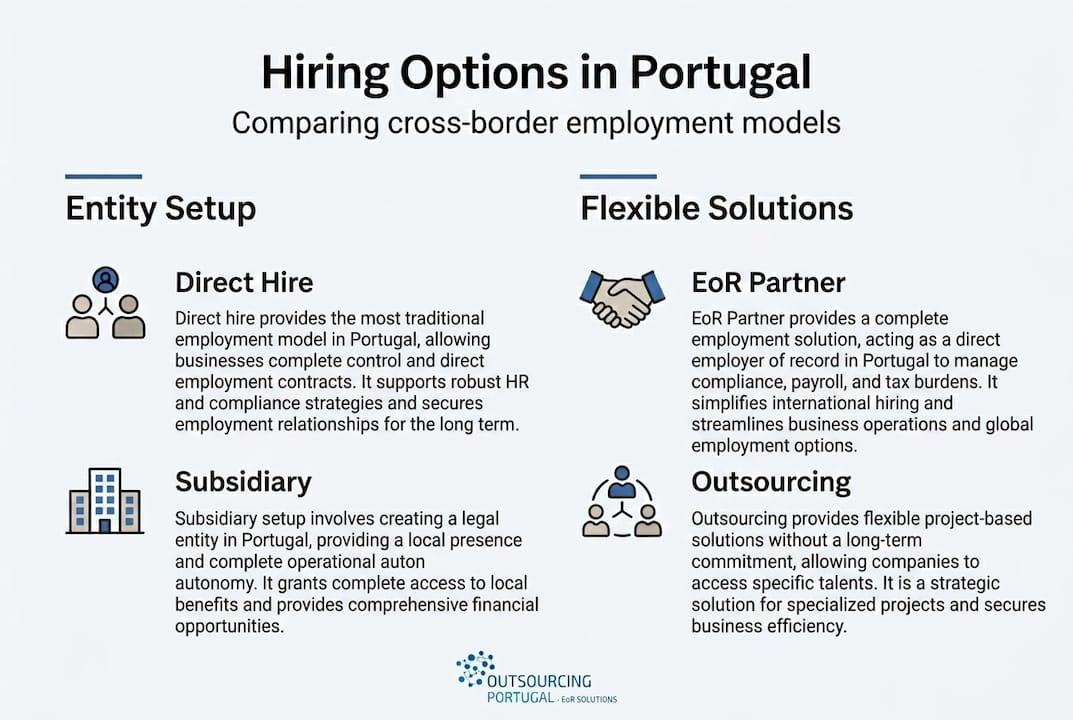
Outsourcing typically refers to contracting a local service provider to deliver specific functions or project outcomes, rather than employing individuals directly. This works well for project-based work but offers less control over individual workers.
| Criteria | Direct employment | Employer of Record | Outsourcing |
|---|---|---|---|
| Legal responsibility | Full, via local entity | Shared with EoR provider | With the service provider |
| Setup time | 3 to 6 months | Days to weeks | Varies by contract |
| Ongoing cost | High (entity overhead) | Moderate (service fee) | Variable |
| Compliance support | Self-managed | Fully supported | Limited |
| Flexibility to scale | Low (rigid entity structure) | High | Moderate |
| Worker control | Maximum | High | Low to moderate |
| PE risk | Low (entity exists) | Managed by EoR | Variable |
For most multinationals entering Portugal for the first time, or scaling a remote team without an existing presence, the EoR model offers the most practical balance between speed, compliance, and cost. Managing expat payroll for HR teams through an EoR is particularly effective for companies relocating international staff to Portugal, where dual tax obligations and social security coordination add additional complexity.
Pro Tip: EoR is not just for startups or small teams. Large enterprises frequently use EoR in Portugal as a bridge structure while their entity registration is pending, or as a permanent solution for small headcounts where entity overhead is not justified by team size.
Best practices for compliant cross-border employment in Portugal
Choosing the right structure is only half the work. Executing it correctly, and maintaining compliance month after month, requires a disciplined operational approach. Here is what the most effective global HR teams do when building cross-border employment programs in Portugal.
Onboarding and contracts:
- Issue Portuguese-law employment contracts before the start date, not after
- Include trial period clauses (up to 180 days for roles requiring high qualification)
- Specify the applicable collective bargaining agreement where relevant
- Document the employee’s role, reporting line, and work location clearly
- Ensure GDPR-compliant data processing agreements are in place before any personal data is collected
Payroll and statutory benefits:
- Use a structured payroll system to calculate monthly gross pay, IRS withholding, and social security deductions accurately
- Process the 13th month (Christmas bonus) in December and the 14th month (holiday subsidy) before the employee takes summer leave
- Ensure meal allowances are handled correctly: the tax-exempt threshold is reviewed annually and must be applied properly to avoid unnecessary income tax exposure for employees
- Maintain accurate payroll records for at least five years, as required by Portuguese law
Ongoing compliance and audit readiness:
- Schedule quarterly internal reviews of employment contracts, payroll records, and benefit entitlements
- Monitor changes to the Portuguese National Minimum Wage (Salário Mínimo Nacional), which has increased significantly in recent years and is reviewed annually
- Keep digital records of time tracking, leave management, and performance documentation in case of ACT inspection
- Use international payroll for remote teams platforms that generate audit-ready reports and flag compliance gaps automatically
| Compliance area | Key action | Review frequency |
|---|---|---|
| Employment contracts | Review against current labor code | Annually or upon role change |
| Payroll accuracy | Reconcile gross pay, IRS, and SS | Monthly |
| Statutory benefits | Audit 13th/14th month, leave | Twice per year |
| Minimum wage compliance | Update salary floors | January each year |
| Collective bargaining | Check sector agreement updates | Bi-annually |
| PE risk monitoring | Review with tax advisor | Annually |
Common pitfalls to avoid:
- Relying on verbal assurances from local service providers instead of documented compliance frameworks
- Treating statutory minimum notice periods as negotiable. They are not
- Assuming your company’s global HR policies override Portuguese law when they conflict
- Failing to register employees with Social Security before their first working day, which is both a legal obligation and a condition for their access to healthcare and other benefits
A practical perspective: Why most global HR teams underestimate cross-border risks
After working with dozens of multinationals expanding into Portugal, a clear pattern emerges: the teams that struggle most are not the ones that lack budget or ambition. They are the ones that underestimate regulatory nuance because everything looked straightforward at the outset.
Here is the uncomfortable reality. Portugal is genuinely business-friendly. The government has made real efforts to attract foreign investment. The NHR (Non-Habitual Resident) tax regime, the Digital Nomad visa, and EU single-market access all signal a country that wants international employers here. But “business-friendly” does not mean “low-compliance.” Those are different things. The Portuguese labor system is employee-protective by design, shaped by decades of EU influence, and the ACT labor inspectorate takes that seriously.
The most common myth we encounter is that a good HR platform solves the problem. Software helps, but it does not create legal compliance. A payroll tool that runs calculations correctly on wrong inputs still produces wrong outputs. If your employment contract misclassifies the worker’s role, or fails to apply the correct collective agreement, no amount of automation corrects that underlying error. Technology is a multiplier of good decisions, not a substitute for them.
The teams that get this right share one habit: they consult local legal expertise before making structural decisions, not after a problem surfaces. Following practical compliance advice from people who work inside the Portuguese system every day is not a luxury. It is the single highest-return investment you can make in a cross-border hiring program. The cost of a compliance audit, back-payment demand, or reputational issue with a Portuguese regulator will always exceed what proactive expert guidance costs.
Connect with experts for compliant hiring in Portugal
Building a compliant cross-border employment program in Portugal does not have to mean months of regulatory research and entity setup headaches.
Outsourcing Portugal offers specialized Portugal EoR services that allow your company to hire Portuguese talent within days, fully compliant with local labor law, payroll requirements, and statutory benefit obligations. Whether you are scaling a remote development team, onboarding your first Lisbon-based sales hire, or managing expatriate assignments, the right global employment solutions partner can handle contracts, payroll, social security registration, and ongoing HR support on your behalf. Explore international hiring compliance guidance tailored to Portugal’s specific legal environment, and speak directly with local experts who understand exactly what your cross-border team needs to operate without risk.
Frequently asked questions
What is the difference between cross-border employment and local employment?
Cross-border employment involves hiring staff who work from or reside in a different country than the employer, requiring additional legal and tax compliance versus local employment. As noted in compliance in international hiring, this distinction carries real legal weight and cannot be ignored.
Are Employer of Record (EoR) services suitable for rapidly scaling remote teams in Portugal?
Yes, EoR services allow multinationals to onboard employees compliantly and efficiently while minimizing administrative burden. EoR solutions streamline compliance and reduce overhead significantly compared to setting up a local entity.
What compliance risks do international employers face when hiring in Portugal?
Risks include payroll misclassification, tax misreporting, and breach of local labor laws, which can result in significant penalties. Compliant payroll structures and contracts are essential defenses against these risks.
Can companies pay remote staff in Portugal through a foreign payroll?
International companies typically need a compliant Portuguese payroll setup to avoid legal issues and ensure correct benefits. Structured payroll management systems are essential for meeting local filing and withholding obligations accurately.
How can HR managers stay updated on compliance for cross-border employment?
Work with local experts, regularly review Portuguese labor laws, and use trusted HR service providers. Ensuring legal compliance when outsourcing employment in Portugal is an ongoing process, not a one-time setup task.