

TL;DR:
- Portugal streamlines company registration, offering companies established in under one hour through Empresa na Hora.
- The common legal structure for foreign startups is the low-capital Lda, favored for its simplicity and speed.
- Post-incorporation compliance, including tax filings and UBO declarations, is crucial to avoid fines and operational issues.
Most international founders expect EU incorporation to be a bureaucratic nightmare. Stacks of paperwork, months of waiting, layers of notarized documents, and a maze of local regulations. Portugal quietly breaks that assumption. The country has invested seriously in streamlining company setup, and the results are genuinely surprising. Empresa na Hora allows you to register a company in under one hour using pre-approved names and templates, at a cost of just EUR 360. This guide covers every stage, from choosing your legal structure to staying compliant after launch.
Table of Contents
- Understanding business incorporation in Portugal
- Why incorporate in Portugal? Benefits and common misconceptions
- Step-by-step process: How to incorporate in Portugal
- Costs and compliance: What to expect after incorporation
- What most guides miss: The realities of incorporation in Portugal
- How we help with business incorporation in Portugal
- Frequently asked questions
Key Takeaways
| Point | Details |
|---|---|
| Rapid incorporation options | Portugal enables company setup in under an hour for simple entities using streamlined government services. |
| Clear entity choices | Founders can select between Lda. and S.A. structures based on ownership and capital needs. |
| Transparent costs and timelines | Expect total setup costs ranging from EUR 1,300–5,500, with timelines from 1 hour to 4 weeks. |
| Ongoing compliance duties | Certified accounting, VAT, UBO, and social security filings are mandatory for all incorporated firms. |
| Expert support prevents fines | Using local professionals and compliance partners significantly reduces risk of penalties and missteps. |
Understanding business incorporation in Portugal
Before you can make smart decisions about market entry, you need to understand what “incorporation” actually means in Portugal’s legal framework. It is not simply registering a name or obtaining a license. Incorporation is the legal process of creating a separate legal entity, one that can own property, sign contracts, open bank accounts, and employ people independently of its founders.
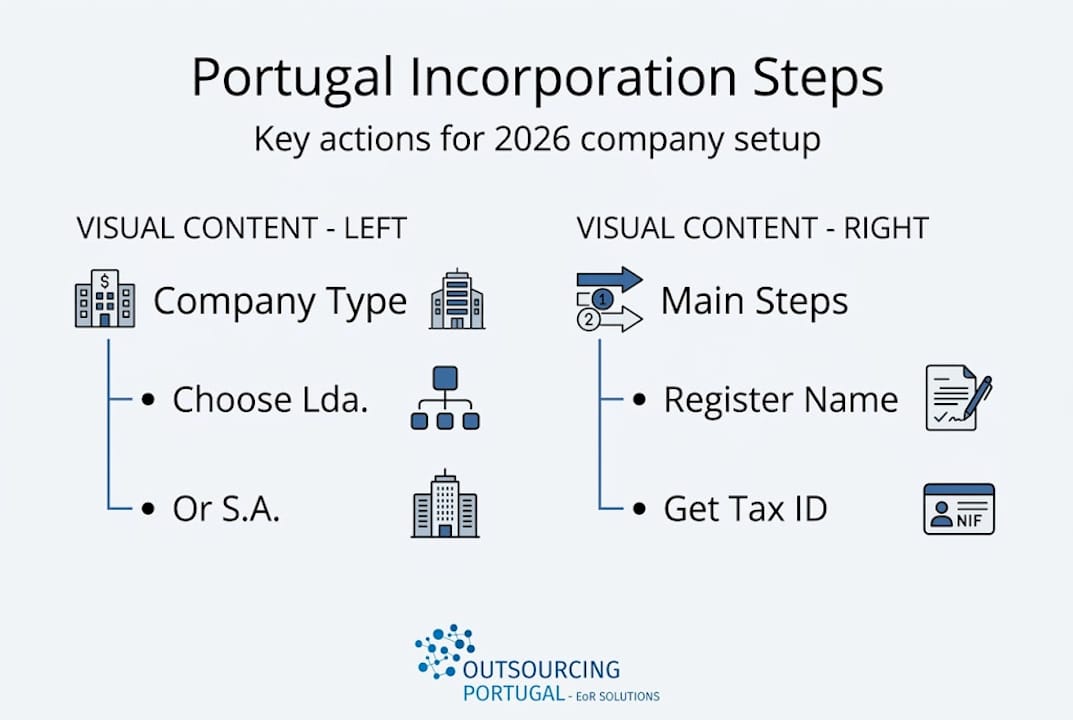
Business incorporation in Portugal primarily means registering either a Sociedade por Quotas (commonly known as an Lda.) or a Sociedade Anónima (known as an S.A.) with the Commercial Registry, officially called the Conservatória do Registo Comercial. The Unipessoal Lda. is a single-shareholder version of the standard Lda. and is particularly popular with solo founders and small international teams launching their first Portuguese operation.
Lda. vs. S.A.: which structure fits your plan?
Choosing between these two forms is one of the most consequential early decisions. Here is how they compare:
| Feature | Lda. (Sociedade por Quotas) | S.A. (Sociedade Anónima) |
|---|---|---|
| Minimum capital | EUR 1 | EUR 50,000 |
| Shareholders | 1 or more | 5 or more (typically) |
| Share transferability | Restricted | Freely transferable |
| Governance complexity | Low | High |
| Best for | Startups, SMEs, foreign subsidiaries | Larger companies, future public offering |
| Liability | Limited to share capital | Limited to shares |
Most international startups and subsidiaries choose the Lda. structure, and for good reason. The minimum capital requirement is effectively just EUR 1, there is less administrative overhead, and governance can be kept lean. The S.A. structure makes more sense if you are planning to bring in multiple investors, issue transferable shares, or eventually list the company publicly.
A few key terms you will encounter throughout the process:
- UBO (Ultimate Beneficial Owner): The real human beings who ultimately own or control the company. Every incorporated entity must declare its UBOs to Portuguese authorities within 30 days of registration.
- Commercial Registry (Conservatória do Registo Comercial): The government body where all companies must be officially registered. Think of it as the source of truth for Portuguese corporate identity.
- NIPC (Número de Identificação de Pessoa Coletiva): Your company’s tax identification number, essential for everything from opening a bank account to invoicing clients.
“Getting the legal structure right at the start saves enormous headaches later. An Lda. works for 90% of foreign subsidiaries entering Portugal, but if you plan rapid investor rounds, talk to Portuguese legal experts before committing.”
If you need help navigating the early stages of entry, including legal structure decisions and initial setup logistics, softlanding services in Portugal can handle the groundwork so your leadership team stays focused on the business.
Why incorporate in Portugal? Benefits and common misconceptions
Portugal consistently ranks among the most attractive EU destinations for international business. But the reasons go deeper than the weather and cost of living. For companies looking to expand your business into the EU, Portugal offers a combination of practical advantages that are hard to match elsewhere.

EU market access with minimal bureaucracy. Once incorporated in Portugal, your company operates within the EU’s single market, giving you access to 450 million consumers and the ability to transact in euros without customs barriers. This is particularly valuable for non-EU companies establishing their European headquarters.
Capital requirements that make sense for startups. Unlike Germany (EUR 25,000 minimum for a GmbH) or Spain (EUR 3,000 minimum), Portugal’s Lda. requires just EUR 1 in minimum capital. This dramatically lowers the financial barrier to entry, especially for early-stage companies testing the market.
A growing startup ecosystem. Lisbon consistently ranks among Europe’s top startup cities. Programs like Startup Portugal and Web Summit’s permanent home in Lisbon signal a maturing tech and innovation culture that attracts both talent and investors.
Speed. This is where Portugal truly separates itself. Using the Empresa na Hora system, simple Lda. formations using pre-approved name templates can be completed in as little as 24 hours. More complex setups typically wrap up within one to four weeks, far faster than many European counterparts.
| Country | Min. capital (LLC equivalent) | Avg. time to incorporate |
|---|---|---|
| Portugal (Lda.) | EUR 1 | 1 hour to 4 weeks |
| Germany (GmbH) | EUR 25,000 | 2-4 weeks |
| Spain (SL) | EUR 3,000 | 2-6 weeks |
| Netherlands (BV) | EUR 0.01 | 1-3 weeks |
It is worth noting that Q1 2026 saw a roughly 6% drop in new company formations compared to the same period last year. That dip reflects broader macroeconomic caution, not any structural problem with Portugal’s incorporation framework. For international companies, the system remains fast, reliable, and founder friendly.
Common misconception: “Setup is slow and complicated.” The reality is the opposite. Pre-approved company templates, online registration portals, and the Empresa na Hora program have fundamentally changed the landscape. For most standard setups, the paperwork barrier is minimal.
Pro Tip: If your structure is simple (one or two shareholders, no complex governance rules), use a pre-approved company name template through Empresa na Hora and you can walk out of the designated registry office with a fully incorporated company the same day.
Step-by-step process: How to incorporate in Portugal
Knowing that Portugal is fast is useful. Knowing exactly how to move through the process is what actually gets your company off the ground. Here is the full sequence, from first decision to ready-to-trade entity.
Step 1: Choose your entity type and ownership structure. Decide between Lda. and S.A. based on your capital situation, ownership plan, and long-term goals. Most international startups and subsidiaries will choose the Lda. Decide upfront how many shareholders you will have and what percentage each will hold, because this drives the articles of association.
Step 2: Reserve or select your business name. You can either choose from a list of pre-approved generic names (fastest route) or submit a custom name for approval through the National Registry of Collective Persons (RNPC). Pre-approved names allow same-day incorporation. Custom names add a few days for approval.
Step 3: Register at the Commercial Registry. This is the core step. If you are using Empresa na Hora, you visit a designated office, present your identification documents, choose your pre-approved name, and pay the registration fee. The Empresa na Hora system completes standard Lda. registrations in under one hour, at a cost of EUR 360 for a standard name or EUR 380 if you bring a pre-approved custom name. For more complex setups, registration is handled through the standard Commercial Registry process.
Step 4: Notary formalization (if needed). For complex ownership structures, custom articles of association, or S.A. formations, you will need a notarized public deed. Notary fees typically range from EUR 200 to EUR 1,500 depending on complexity. Simple Lda. setups via Empresa na Hora skip this step entirely.
Step 5: Obtain your tax and social security numbers. After registration, your company receives its NIPC automatically. You will also need to register with the Portuguese Tax Authority (Autoridade Tributária e Aduaneira) and with Social Security (Segurança Social) before you can legally employ anyone or issue compliant invoices.
Step 6: Open a corporate bank account. Most Portuguese banks require your registration certificate, articles of association, UBO declarations, and founder identification. Timeline varies by bank, but typically runs one to three weeks. International banks with Portuguese operations often streamline this for foreign founders.
Overall timeline and cost summary:
- Empresa na Hora (simple Lda.): 1 hour, EUR 360
- Standard registry process: 1 to 4 weeks, EUR 360 to EUR 1,600 DIY
- Full service with legal support: EUR 3,500 to EUR 5,500, 1 to 4 weeks
For a detailed breakdown of what hiring through your new entity will actually cost, the Portugal employment cost calculator gives you real numbers before you commit.
Pro Tip: Empresa na Hora is excellent for speed, but it uses standard articles of association. If your company has more than two shareholders, special voting arrangements, or unusual profit distribution rules, build in extra time to draft custom documents with legal support before registration day.
Costs and compliance: What to expect after incorporation
Getting incorporated is step one. Staying compliant is the ongoing responsibility that separates companies that thrive from those that face fines and frozen accounts. International founders consistently underestimate this dimension.
One-off setup costs to plan for:
- Commercial Registry fee: EUR 360 to EUR 380 (Empresa na Hora)
- Notary fees (if applicable): EUR 200 to EUR 1,500
- Legal or agency support: EUR 1,000 to EUR 3,500
- Corporate bank account setup: typically free to EUR 200
Ongoing compliance costs you must budget for:
- Certified accountant (Técnico Oficial de Contas): EUR 150 to EUR 500 per month, mandatory by law
- Social security contributions: 23.75% employer contribution on gross salaries
- Corporate income tax (IRC): 21% standard rate, with SME reductions available for qualifying small businesses
- VAT (IVA): Registration required if annual turnover exceeds EUR 15,000; standard rate is 23%
UBO declaration. Within 30 days of incorporation, all companies must declare their Ultimate Beneficial Owners to the Central Registry of Beneficial Ownership (RCBE). Missing this deadline triggers automatic fines. This is one of the most commonly missed post-registration requirements among foreign founders.
“Many companies underestimate ongoing compliance requirements—particularly social security filings and UBO declarations—leading to fines or frozen accounts that disrupt operations entirely.”
Your certified accountant handles most of this. But choosing the right accountant matters enormously. They are not just filing paperwork; they are your early warning system for regulatory changes, your interface with Portuguese tax authorities, and your protection against accidental non-compliance.
For companies that want to stay lean and outsource payroll complexity entirely, working with a Portugal payroll outsourcing provider ensures payroll, social security, and tax filings are handled by specialists who know the system inside out.
Pro Tip: Budget at least EUR 300 per month for ongoing compliance from day one. Companies that treat accounting as an afterthought often face surprise bills, penalties, and audit stress within the first 12 months.
What most guides miss: The realities of incorporation in Portugal
Here is the uncomfortable truth that most incorporation guides gloss over: fast setup and smooth operation are two completely different things. Portugal genuinely delivers on speed. The Empresa na Hora system works. The fees are low. The EU access is real.
But we have seen too many international companies treat incorporation as the finish line. They get their certificate, open their bank account, and then discover six months later that their social security filings are wrong, their UBO declaration was never submitted, or their certified accountant is reacting rather than advising.
The companies that succeed in Portugal over the long term are the ones who invest in proactive compliance partners from day one. Not reactive accountants who file what you send them, but advisors who flag issues before they become fines. The lessons learned from expanding in Portugal consistently point to the same pattern: underspending on expert support in year one creates much larger costs in year two.
Incorporation is the launchpad. What happens after launch determines whether your Portuguese entity becomes a genuine competitive asset or a compliance headache.
How we help with business incorporation in Portugal
Setting up a company in Portugal is achievable, but doing it right requires more than a registry form.
At Outsourcing Portugal, we work with international companies and startups to handle every stage of the journey, from initial legal structure decisions to payroll management, HR compliance, and ongoing accountant coordination. If you are not ready to incorporate immediately, our Employer of Record services let you hire Portuguese talent and build your team now, without needing a local entity. When you are ready to formalize, our EoR and hiring solutions scale with you. Reach out to contact our Portugal experts for a tailored consultation on your specific situation.
Frequently asked questions
How long does it take to incorporate a company in Portugal?
Simple companies can be incorporated in under 1 hour through Empresa na Hora, while more complex structures typically take 1 to 4 weeks depending on ownership structure and document requirements.
What does it cost to incorporate a business in Portugal?
Registration fees start from EUR 360 with Empresa na Hora; full-service incorporation including legal support can range from EUR 1,300 to EUR 5,500 depending on complexity.
Is a certified accountant mandatory for new companies?
Yes, Portuguese law requires all companies to have a mandatory certified accountant for tax filings, social security reporting, and ongoing statutory compliance.
What taxes and compliance filings are required after incorporation?
Most companies must register for VAT if turnover exceeds EUR 15,000, file a UBO declaration within 30 days, and pay a standard corporate tax rate of 21%.
What risks do foreign founders often underestimate?
Many founders underestimate post-incorporation compliance requirements, particularly social security and UBO reporting, which can lead to fines or frozen accounts that disrupt day-to-day operations.