

In Portugal, employers may only terminate contracts for the specific grounds set out in the Labour Code: disciplinary dismissal, extinction of the job position, collective dismissal, unsuitability, expiry, or mutual agreement. Procedure decides legality as much as the underlying facts. Workers should keep every written notice they receive. Employers should document each step in real time or bring in specialist counsel before acting.
TL;DR:
- Employers must strictly follow the specific dismissal category required by law, such as expiry, mutual agreement, or misconduct, to avoid unlawful termination claims.
- Disciplinary dismissals require a detailed nota de culpa, a timely employee response, and a reasoned final decision based solely on the alleged facts; procedural errors risk a court ruling for reinstatement or higher damages.
- Redundancy and collective dismissals necessitate formal communications with concrete grounds, proper negotiation with worker representatives, detailed documentation, and filing with authorities before termination can proceed legally.
- Notice periods are strictly scaled according to seniority, with 15 days for less than one year and up to 75 days for over ten years; labor credits and final payments must be settled immediately at termination.
- Workers can contest dismissals by filing a court challenge within weeks, provided they collect all relevant documentation and act promptly; dismissing protected workers without additional procedural steps is a high legal risk.
Table of Contents
- What Are the Types of Dismissal Procedures in Portugal?
- How Does the Disciplinary Dismissal Procedure Work?
- What Steps Apply to Redundancy and Collective Dismissals?
- How Much Notice and Severance Does a Worker Get?
- How Can a Worker Contest a Dismissal in Portugal?
- Which Protections and Procedural Traps Should You Watch For?
- Documentation Checklist and Timeline for Dismissal Procedures
- When Should You Bring in Outside Counsel or an EOR Partner?
- How Outsourcing-Portugal Keeps Terminations Compliant
- Where to Verify Dismissal Rules and Download Official Forms
- Sources
- FAQ
What Are the Types of Dismissal Procedures in Portugal?
Portugal’s Labour Code closes the door on informal firing. There is no “at will” employment here, and any despedimento (dismissal) outside the recognized categories is automatically unlawful, regardless of how justified the employer feels. Dismissal without just cause or for political or ideological reasons is expressly prohibited, which sets the tone for everything that follows.
Six modalities cover the field:
- Caducidade (expiry): the contract ends on its own when a fixed term concludes or a specific condition is met. No dismissal decision is required, but formal notice is still expected.
- Revogação (mutual agreement): employer and employee sign off on ending the relationship voluntarily, often with a negotiated payment. If the signature is not notarized, the worker has seven days to revoke the agreement, which surprises a lot of employers who assume the deal is final on signing.
- Despedimento por justa causa (disciplinary dismissal): triggered by serious employee misconduct. No severance is owed if the dismissal is upheld, but the procedural bar is high.
- Extinção do posto de trabalho (extinction of the job position): the role itself disappears due to restructuring or market conditions, not the employee’s conduct. Severance and notice apply.
- Inadaptação (unsuitability): the employee cannot adapt to reasonable changes in the job, typically after new technology or reorganized duties. Severance and notice apply here too.
- Despedimento coletivo (collective dismissal): multiple positions are eliminated at once, following the same logic as extinction of post but with added negotiation obligations.
The government’s own guidance on cessation of employment contracts walks through each category and directs employers to the Autoridade para as Condições do Trabalho (ACT) for procedural questions. Getting the category wrong at the outset is one of the most common ways employers end up defending an “illicit dismissal” claim later, even when the underlying business reason was entirely legitimate.
How Does the Disciplinary Dismissal Procedure Work?
Justa causa dismissals follow the strictest script in Portuguese labor law, and courts read that script literally. CMS Law’s expert guide to Portuguese dismissals confirms that skipping or rushing any stage can turn a legitimate firing into an expensive court loss.
Here is the sequence employers must follow:
- Preliminary inquiry (optional but common). Some employers run an internal fact-finding review before issuing formal charges, especially when the misconduct is unclear or disputed.
- Communication of intention to dismiss plus nota de culpa. The employer sends a written statement of guilt describing the alleged facts in enough detail for the employee to mount a defense. Vague language here is the single biggest procedural weakness employers create for themselves.
- Suspension (if applicable). The employer may suspend the employee with pay while the process runs, though this is not mandatory in every case.
- Right to consult the file. The employee can review all evidence gathered against them before responding.
- Written response window. The employee has 10 business days to submit a defense, request witnesses, and challenge the facts.
- Evidence gathering and witness statements. The employer must actually consider what the employee submits, not just go through the motions.
- Final decision with written reasoning. The employer issues a reasoned written decision, which must rely only on the facts already stated in the nota de culpa.
Missing a deadline, or basing the final decision on facts never mentioned in the nota de culpa, is a defect courts treat seriously. A vague nota de culpa or a denied opportunity to present witnesses is enough to convert a disciplinary dismissal into an illicit one, exposing the employer to reinstatement or a significantly higher indemnity.
Courts also apply a proportionality test. Even clear misconduct must make continued employment objectively impossible, weighed against the employee’s record and the severity of the act. A single late arrival will not clear that bar. Repeated insubordination after prior warnings usually will.
Pro Tip: Keep a dated paper trail from day one, not just once you decide to dismiss. Courts scrutinize whether the employer’s story stayed consistent from the first internal memo to the final decision letter, and any drift between those documents undermines the whole case.
What Steps Apply to Redundancy and Collective Dismissals?
Extinction of post applies when a single role disappears. Collective dismissal kicks in once a set threshold of positions is eliminated within a short window, and it carries a heavier procedural load because worker representatives get a formal seat at the table.
The employer’s opening communication has to include specific content, not a general announcement:
- The grounds for the dismissal, described concretely rather than in boilerplate language.
- A full personnel table showing roles, categories, and how the change affects staffing.
- The objective selection criteria used to choose which employees are affected.
- The exact number and category of positions being eliminated.
- The method used to calculate compensation for each affected worker.
Once that communication goes out, an information and negotiation phase opens with worker representatives or, where none exist, directly with affected employees. DGERT’s own guidance on collective dismissals requires minutes of these negotiation meetings, and both the initial communication and the final outcome must be filed with DGERT (Direção-Geral do Emprego e das Relações de Trabalho) before the process closes. Skipping the negotiation phase, or notifying DGERT after the fact instead of during the process, renders the dismissal unlawful outright.
Selection criteria deserve extra caution. When several employees hold similar roles, courts treat ad hoc or inconsistent selection as strong evidence of a disguised dismissal, even when the business reason for cutting the role is entirely genuine. Employers restructuring several similar positions should document why each specific person, and not a colleague in the same role, was selected.
How Much Notice and Severance Does a Worker Get?
Notice periods in Portugal scale with seniority, and getting this wrong is a common, avoidable mistake. According to MLGTS’s employment practice guide, the statutory notice grid runs as follows:
- Under 1 year of service: 15 days’ notice
- 1 to 5 years of service: 30 days’ notice
- 5 to 10 years of service: 60 days’ notice
- 10 or more years of service: 75 days’ notice
Severance for extinction of post, unsuitability, and collective dismissal is generally based on base pay and length of service, applying to contracts signed from October 1, 2013 onward. Contracts predating that reform follow transitory rules that can produce a higher figure, so checking hire date against the applicable regime matters before quoting a number to either side.
Fixed-term and probationary contracts follow their own shorter rules, and it is worth confirming these separately rather than assuming the standard grid applies. ACT’s online compensation simulators let both workers and employers estimate the exact payout before any letter goes out, which avoids a lot of avoidable disputes over arithmetic.
Beyond notice and severance, a departing employee is owed a set of labor credits regardless of which modality applies:
- Any outstanding salary through the last day worked.
- Proportional holiday pay and holiday allowance for the current year.
- Christmas allowance (subsídio de Natal) accrued proportionally.
- Any overtime or expense reimbursements still pending.
These credits are due at termination, not on the next regular payroll cycle, and employers who delay payment invite an additional claim on top of the original dismissal dispute.
How Can a Worker Contest a Dismissal in Portugal?
Workers who believe their dismissal was unlawful have a narrow but workable path, and timing determines whether that path stays open.
- File an impugnação (judicial challenge) with the competent labor court. Deadlines are strict, so acting within weeks of receiving the final decision is far safer than waiting months.
- Preserve every document before filing: the nota de culpa, the final decision letter, any correspondence about compensation, and contact details for potential witnesses.
- Avoid treating any payment as final. If an employer pays compensation and the worker accepts it without promptly rejecting or contesting the amount, courts may treat that as acceptance of the dismissal. Workers who intend to fight should say so in writing when the payment arrives.
- Contact ACT or a union representative early. Both can advise on whether the procedural steps were followed correctly and flag obvious defects.
- Pursue the judicial hearing, where a court decides whether the dismissal was lawful and, if not, whether the remedy is reinstatement or indemnity.
If a court finds the dismissal illicit, the worker generally chooses between reinstatement in the same role and an increased indemnity in lieu of reinstatement. Back pay for the period between dismissal and the court’s decision is often part of the award, which is exactly why employers who drag out a weak case tend to pay far more than if they had negotiated early.
Which Protections and Procedural Traps Should You Watch For?
Certain workers carry extra legal shielding, and dismissing them without extra steps is one of the fastest ways to lose a case regardless of the underlying facts.
- Pregnant employees, recent mothers, and workers on parental leave cannot be dismissed without a prior opinion from CITE (Commission for Equality in Labour and Employment). Proceeding without that opinion is a defect on its own, separate from whatever grounds the employer cites.
- Union representatives and works council members enjoy similar reinforced protection, requiring extra procedural steps before any termination can proceed.
- Vague or generic nota de culpa language remains the most frequent disciplinary dismissal defect, as CMS Law’s guide to Portuguese dismissals notes.
- Missing or inconsistent selection criteria in extinction of post or collective dismissal cases signals a disguised dismissal to reviewing courts.
- Late payment of labor credits or severance creates a second, independent complaint on top of any dispute about the dismissal itself.
Pro Tip: If you are an employer handling a reorganization that touches a protected worker, get a CITE opinion before drafting the termination letter, not after. Retrofitting the paperwork once the process has started rarely satisfies a reviewing court.
Documentation Checklist and Timeline for Dismissal Procedures
Both sides benefit from a simple record-keeping habit built around the actual statutory clock.
Employers should keep: dated internal reports on the underlying facts, copies of every written notice sent to the employee, minutes from any negotiation or consultation meetings, DGERT submission receipts where applicable, the full compensation calculation with supporting figures, and a copy of the Social Security cessation report referencing Mod. RV1009-DGSS.
Workers should keep: every written communication received, bank receipts showing what was actually paid, a personal copy of the nota de culpa, contact details for any witnesses who saw relevant events, and the final work certificate (certificado de trabalho) confirming dates of employment.
| Stage | Typical timing |
|---|---|
| Nota de culpa issued | Start of disciplinary process |
| Employee’s written response | 10 business days from notice |
| Final decision issued | After evidence review, with written reasoning |
| Notice period before termination | 15 to 75 days, based on seniority |
| Social Security cessation report | By the 10th of the following month |
| Judicial challenge (impugnação) | Within weeks of the final decision |
When Should You Bring in Outside Counsel or an EOR Partner?
Some situations are not worth handling alone. A reorganization touching several similar roles, a protected worker who needs a CITE opinion, cross-border staff whose contracts sit under more than one legal framework, or any dismissal where litigation already looks likely all justify bringing in specialist help before, not after, the first letter goes out.
What a specialist actually does is procedural: auditing the planned steps against the Código do Trabalho, drafting the nota de culpa or collective communication so it survives scrutiny, liaising with DGERT on filings, and running the final payroll settlement so labor credits land correctly and on time. That combination of legal precision and payroll execution is where most in-house teams, especially those managing Portuguese staff from abroad, run into trouble.
— Paulo
How Outsourcing-Portugal Keeps Terminations Compliant
Outsourcing-Portugal exists for exactly the moment this article describes: an international employer who needs a Portuguese termination handled correctly, without hiring local employment lawyers from scratch or guessing at DGERT filing rules. As your Employer of Record, we run compliance audits before a termination letter goes out, prepare documentation templates that match what courts actually expect, handle DGERT liaison on collective and extinction-of-post cases, and settle final payroll so labor credits are paid correctly and on schedule.

That combination cuts the two biggest risk points employers face: a procedural defect that turns a lawful dismissal into an expensive court loss, and a payroll delay that opens a second complaint on top of the first. If you are planning a reorganization, a single dismissal, or you simply want a second set of eyes before you send a nota de culpa, request a procedural audit through our Employer of Record and payroll services page and get a clear read on your exposure before you act.
Where to Verify Dismissal Rules and Download Official Forms
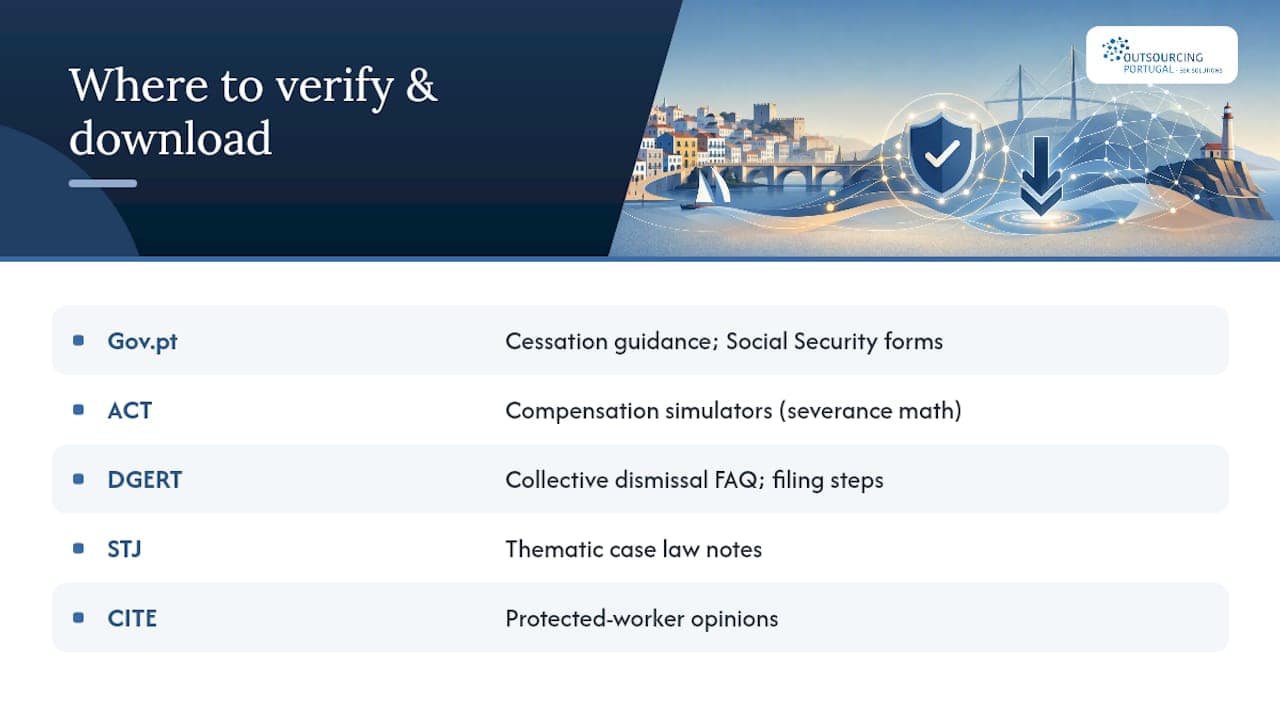
For the government’s own summary of termination modalities and Social Security reporting forms, start with gov.pt’s cessation of employment guidance. ACT’s compensation simulators confirm severance math. DGERT’s collective dismissal FAQ covers filing steps, and the STJ’s thematic case law notes show how courts actually rule on disputed cases. For CITE opinions on protected workers, contact CITE directly before proceeding.
This article is general information, not a substitute for advice from a qualified lawyer. Consult a qualified legal professional about your own circumstances before acting on anything here.
Sources
- Eurofound — Individual employment relations: Portugal
- CMS Expert Guide — Dismissals and termination of employment in Portugal
- DGERT — Despedimentos colectivos FAQ
- STJ thematic notes — Dismissal collective and extinction of job position (2015–2024)
FAQ
What Are the Requirements to Dismiss a Permanent Employee in Portugal?
Employers need a lawful ground from the closed list in the Código do Trabalho, such as justa causa or extinction of post, plus strict adherence to the matching procedure, including written notice and, for disciplinary cases, a properly drafted nota de culpa.
What Rights Do I Have if I Am Dismissed in Portugal?
You are entitled to written reasoning for the decision, any applicable notice period or severance, all outstanding labor credits, and the right to challenge the dismissal in court if you believe the grounds or procedure were defective.
What Is the Notice Period for Dismissal in Portugal?
Statutory notice runs from 15 days for under one year of service up to 75 days for 10 or more years of service, based on the seniority grid set out in Portuguese employment practice guides.
How Many Days’ Notice Must I Give My Employer if I Resign?
Resignation notice periods differ from employer-initiated dismissal notice and typically follow separate rules set in the employee’s contract or collective agreement, so check your specific contract terms rather than assuming the dismissal grid applies.
Can My Employer Change the Reason for My Dismissal After the Fact?
No. Courts do not allow employers to introduce new grounds once the nota de culpa or dismissal communication has been issued, which is why contemporaneous documentation matters so much for employers defending a claim.