

TL;DR:
- A Portugal work visa, called the D1 residence visa, allows non-EU and non-EEA nationals to live and work in Portugal with an employment contract. The application process involves applying at the Portuguese consulate and completing residence registration with AIMA, with strict document requirements and timelines. Successful applicants must gather certified documents like criminal records, health insurance, proof of accommodation, and obtain a Portuguese tax number before applying.
A Portugal work visa is defined as the D1 residence visa, the primary legal authorization for non-EU and non-EEA nationals to live and work in Portugal under a valid employment contract. Knowing how to get a work visa in Portugal means understanding a two-stage process: first, applying at the Portuguese consulate in your home country, then completing residence permit registration with AIMA (Agência para a Integração, Migrações e Asilo) after you arrive. The process has firm document requirements, specific timelines, and real consequences for missing steps. This guide covers every stage, from eligibility through long-term residence, with current 2026 rules and practical advice for individuals and families making the move.
What are the eligibility criteria and document requirements for the Portugal work visa?
The D1 visa requires a signed employment contract with a Portuguese employer registered with local labor authorities. That contract must comply with Portuguese labor law, including a minimum wage of approximately €870 per month as of 2026. Meeting this threshold is not optional. Consulates reject applications where the salary falls below the legal floor.
Your document checklist covers several categories:
- Valid passport: Must remain valid for at least three months beyond your intended stay.
- Employment contract: Signed, meeting Portuguese labor standards, and issued by a registered employer.
- Criminal record certificate: Must be issued within three months prior to submission and from every country where you lived for more than one year since age 16. Each certificate needs an apostille and a certified Portuguese translation.
- Health insurance: Coverage must be valid for at least 120 days with a minimum coverage amount of €30,000 to cover your initial period after arrival.
- Proof of accommodation: A rental agreement, hotel booking, or letter from a host confirming your address in Portugal.
- Proof of financial means: Bank statements showing you can support yourself during the transition period.
- Portuguese Tax Identification Number (NIF): The NIF is indispensable for opening a bank account and signing contracts. Many applicants obtain it through a Portuguese representative before they ever board a plane.
- Completed visa application form and passport photos: Submitted directly to the Portuguese consulate or an authorized visa center.
Pro Tip: Get your NIF before you submit your consulate application. Without it, you cannot open a Portuguese bank account or finalize your employment contract, and some consulates will flag the gap.
Document certification is strict. All foreign documents must carry an apostille stamp and a certified translation into Portuguese. A criminal record certificate that is even one day past the three-month window at the time of submission will trigger rejection. Build that deadline into your preparation calendar.

What is the step-by-step process to apply for and receive a Portugal work visa?
The Portugal work permit process follows a clear sequence. Skipping or reordering steps creates delays that can push your start date back by months.
-
Secure your employment contract. Your Portuguese employer must be registered with Portuguese labor and social security authorities. The contract must meet minimum wage and labor law standards before you submit anything to a consulate.
-
Obtain your NIF. Apply through a Portuguese consulate in your country or appoint a local representative in Portugal to handle it on your behalf. This number unlocks your ability to open a bank account and finalize financial arrangements.
-
Gather and certify all documents. Collect criminal records from every relevant country, get apostilles, arrange certified translations, and secure health insurance with the required €30,000 minimum coverage for at least 120 days.
-
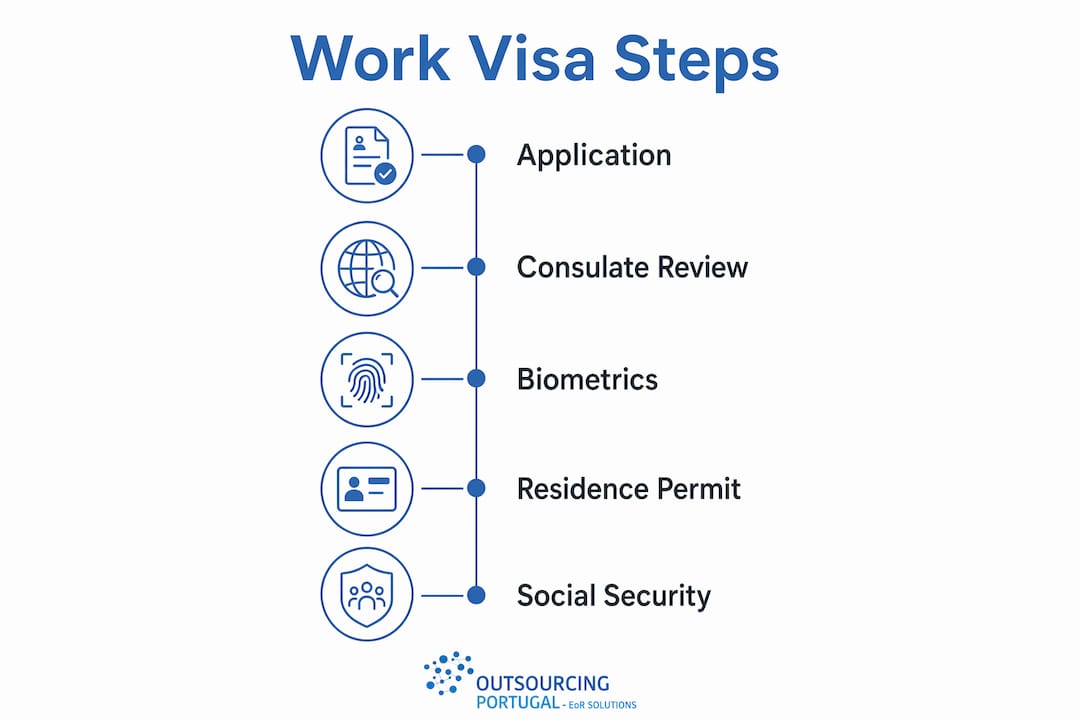
Submit your D1 visa application at the Portuguese consulate. Book your appointment, submit the full document package, pay the application fee of approximately €173, and provide biometric data at the consulate.
-
Wait for consulate processing. The processing time is typically up to 60 working days. That is roughly three calendar months, so plan your job start date accordingly.
-
Receive your D1 entry visa. This visa is valid for four months, giving you a window to travel to Portugal and complete the next stage. Four months sounds generous, but AIMA appointment slots fill quickly, so book as soon as your visa arrives.
-
Travel to Portugal and attend your AIMA biometric appointment. AIMA handles all residence permit processing after the consulate issues your entry visa. Your appointment is typically pre-scheduled, but confirm the date immediately upon arrival.
-
Submit your residence permit application to AIMA. Bring your D1 visa, employment contract, proof of address, and any additional documents AIMA requests. The work permit must be issued within 90 working days after your residence permit application is filed.
-
Register with social security and local authorities. After your AIMA appointment, register with the Portuguese Social Security Institute (Segurança Social) and update your address with the local parish council (Junta de Freguesia).
-
Receive your residence card. AIMA issues the physical Título de Residência card. Processing can take several months, but your legal status in Portugal is protected once the biometric appointment is complete.
Statistic callout: The consulate processing window of up to 60 working days and the AIMA residence permit window of up to 90 working days mean the full process from application to physical card can span six months or more. Factor this into your relocation timeline before you give notice at your current job.
What are common challenges and practical tips when applying for a Portugal work visa?
Most application failures trace back to document problems, not eligibility issues. The most overlooked requirements are criminal records from multiple countries and missing apostilles. If you lived in three countries since age 16, you need three separate criminal record certificates, each apostilled and translated.
Common pitfalls to avoid:
- Expired criminal records: Certificates older than three months at the time of submission are automatically rejected. If your consulate appointment is delayed, you may need to request fresh certificates.
- Missing apostilles: A notarized document without an apostille is not accepted. Verify the Hague Convention status of the issuing country before you assume a notarization is sufficient.
- No NIF before application: Some consulates will not process your application without proof that you have started the NIF process. Do not leave this step until after you arrive.
- Outdated visa advice online: The job seeker visa regime changed significantly in late 2025. Old-style job seeker visas are no longer accepted. You need a firm employment contract before applying, not a letter of intent or a job offer still under negotiation.
- AIMA appointment delays: Slots at AIMA fill up fast. Book your appointment the moment your D1 visa is approved, not after you land in Portugal.
“Many delays in Portugal work visa applications are caused by overlooked requirements: criminal records from all countries of residence, missing apostilles, and documents that expire between preparation and submission. Building a document tracker with expiry dates for each certificate prevents the most common rejection triggers.”
Pro Tip: Appoint a Portuguese legal representative or immigration specialist before you start. They can obtain your NIF remotely, verify document requirements with the specific consulate handling your application, and flag issues before they become rejections.
For families relocating together, each adult family member needs their own criminal record certificates and health insurance documentation. Children require birth certificates with apostilles. Plan for the full family document load from day one, not as an afterthought.
How do the Portugal work visa and residence permit interplay, and what happens after arrival?
The D1 visa and the residence permit are two separate legal instruments. Understanding the difference prevents compliance gaps that can affect your employment and your family’s legal status.
| Stage | Document | Issuing Authority | Validity |
|---|---|---|---|
| Entry | D1 residence visa | Portuguese consulate | 4 months |
| Residence permit application | Proof of AIMA filing | AIMA | Until card issued |
| Residence card | Título de Residência | AIMA | 2 years (renewable) |
| Permanent residence | Permanent residence permit | AIMA | After 5 years |
The D1 visa gets you into Portugal legally. It does not authorize long-term residence on its own. Once you attend your AIMA biometric appointment and file your residence permit application, your legal status in Portugal is protected even while you wait for the physical card. That distinction matters because AIMA card issuance can take several months, and you need to keep working and accessing services during that gap.
After your residence card arrives, register with the Portuguese Social Security Institute. This registration gives you access to the national health service (SNS) and starts your contribution record, which matters for future benefits and citizenship applications. Your employer handles payroll contributions, but you must confirm the registration is active.
The residence permit is renewable as long as your employment continues. After five years of legal residence, you can apply for permanent residence. Citizenship eligibility follows after that, subject to language and integration requirements. For families planning a long-term move, that five-year clock starts from your first AIMA registration date, not from when you receive your physical card.
For a deeper look at how workforce mobility in Portugal works within the broader compliance framework, the rules around employment contracts and permit renewals are tightly linked.
Key Takeaways
Getting a Portugal work visa requires a valid employment contract, certified documents, and a two-stage process through the Portuguese consulate and AIMA that can take six months or more from start to residence card.
| Point | Details |
|---|---|
| D1 visa is the entry route | Non-EU nationals need a D1 residence visa backed by a registered employer and compliant employment contract. |
| Document timing is critical | Criminal records must be issued within three months of submission; apostilles and certified translations are mandatory. |
| Two-stage process with AIMA | The consulate issues the entry visa; AIMA issues the residence card after biometrics and permit application. |
| NIF must come first | Obtain your Portuguese Tax Identification Number before submitting your consulate application to avoid stalls. |
| Five-year path to permanence | Legal residence for five years opens the door to permanent residence and eventual citizenship eligibility. |
What I’ve learned after watching families navigate Portugal’s immigration system
The single biggest mistake I see is treating the Portugal work visa process as a checklist rather than a timeline. People gather documents in the right order but forget that criminal records expire, apostille services take weeks, and AIMA appointment slots disappear fast. By the time they realize a certificate is three days past the three-month window, they have already paid consulate fees and booked flights.
My honest advice: start the document collection process at least four months before your target travel date. That buffer absorbs the inevitable delays from foreign government offices, translation services, and apostille authorities. Families with children need even more lead time because school enrollment and family reunification paperwork add another layer.
The 2025 changes to the job seeker visa regime caught a lot of people off guard. Advice that was accurate in 2024 is now wrong. If you are reading a guide that mentions applying without a firm employment contract, stop and find a more current source. The current rules require a signed contract before you walk into a consulate.
Local support is not a luxury for families. A Portuguese immigration lawyer or a relocation specialist who knows the current AIMA appointment system will save you weeks of confusion. The employment contract types in Portugal matter too. Make sure your contract structure meets the D1 visa requirements before you sign, not after.
Portugal rewards people who prepare. The country has a genuinely welcoming immigration framework for skilled workers, and the residence-to-citizenship pathway is one of the clearest in the EU. Get the paperwork right the first time, and the rest of the process follows.
— Paulo
How Outsourcing-portugal supports your relocation and employment setup
Relocating for work means managing visa paperwork, employment contracts, payroll registration, and social security compliance at the same time. That is a heavy load for individuals and families who are also packing up a life in another country.
Outsourcing-portugal provides Employer of Record services in Portugal that handle the employer-side requirements your D1 visa depends on: registered employment contracts, payroll management, social security registration, and full compliance with Portuguese labor law. For foreign workers whose employers are not yet established in Portugal, an EOR arrangement means your visa-qualifying employment contract is in place from day one. Outsourcing-portugal also supports HR compliance and settlement assistance, so you are not navigating AIMA and Segurança Social alone. Contact Outsourcing-portugal to find out how their employment outsourcing services can simplify your move.
FAQ
What is the D1 visa and who needs it?
The D1 residence visa is the standard work authorization for non-EU and non-EEA nationals moving to Portugal under an employment contract. EU and EEA citizens do not need a visa to work in Portugal.
How long does the Portugal work visa process take?
Consulate processing takes up to 60 working days, and AIMA must issue the residence permit within 90 working days after application. The full process from document preparation to residence card can take six months or more.
Can I work in Portugal while waiting for my residence card?
Yes. Once you complete your AIMA biometric appointment and file your residence permit application, your legal status is protected and you can continue working while the physical card is processed.
What happens if my criminal record certificate expires before my consulate appointment?
You must request a new certificate. Certificates older than three months at the time of submission are rejected, regardless of when they were originally issued.
Can my family join me on a Portugal work visa?
Yes, through family reunification. Each adult family member needs their own documentation, including criminal records and health insurance. Children require apostilled birth certificates. Apply for family reunification through AIMA after your own residence permit is filed.