

TL;DR:
- An HR management company handles core human resources functions like payroll, compliance, and employee relations for businesses. They offer different service models, with cost-effective options such as fractional HR and outsourced solutions for international companies in Portugal. AI tools assist in automating compliance tasks and keeping up with local labor law updates efficiently.
An HR management company is a professional service provider that handles core human resources functions on behalf of a business, covering everything from payroll and compliance to talent management and employee relations. For international companies hiring in Portugal, partnering with the right human resources solutions provider is the difference between smooth operations and costly legal exposure. Dedicated HR partners scale support to match business needs without locking companies into fixed overhead. This guide covers service models, pricing structures, technology integration, and compliance considerations specific to Portugal’s employment environment.
What does an HR management company actually do?

An HR management company takes over the people functions that consume internal time and carry legal risk. The industry term for the broadest version of this service is “full-service HR outsourcing,” though providers operate across a spectrum from pure consulting to complete employee management services.
Core service categories include:
- Payroll processing and tax compliance: Calculating wages, filing contributions, and managing statutory deductions under Portuguese labor law
- Employee relations and disciplinary support: Handling grievances, performance improvement plans, and termination procedures
- Recruitment and onboarding: Sourcing candidates, running background checks, and managing new hire documentation
- Benefits administration: Structuring and managing health, pension, and leave entitlements
- HR strategy consulting: Aligning people policies with business goals, workforce planning, and leadership development
- Compliance monitoring: Tracking changes to employment law and updating internal policies accordingly
The distinction between service models matters. HR consulting services deliver advice and project-based support without taking on operational responsibility. Fractional HR providers embed part-time HR expertise into a business on a retainer basis. Full outsourcing transfers day-to-day HR operations entirely to an external team. International companies entering Portugal typically start with fractional HR or an Employer of Record arrangement, then scale toward full outsourcing as headcount grows.
Pro Tip: Before signing with any outsourced HR provider, ask specifically whether they have in-country expertise in Portuguese labor law. Generic HR firms often lack the local knowledge needed for compliant employment contracts under the Portuguese Labor Code.
How do pricing models for HR management companies compare?
Pricing is where most business leaders make their first mistake. They compare the monthly cost of an outsourced provider against a single line item, without accounting for the full cost of an internal hire.
Full-time HR manager salaries typically run from $75,000 to $100,000 per year before benefits, payroll taxes, and overhead. That figure does not include recruitment costs, onboarding time, or the risk of a bad hire. Outsourced human resources solutions eliminate most of that exposure.
Fractional HR engagements start as low as $675 per month, giving growing companies access to senior HR expertise at a fraction of the cost of a full-time hire. That entry point makes fractional HR the most accessible model for small and mid-sized international teams.
| Model | Typical Cost | Best For | Key Benefit |
|---|---|---|---|
| Full-time HR hire | $75,000–$100,000+/year | Large, stable headcount | Full internal control |
| Fractional HR retainer | From $675/month | Growing teams, variable needs | Senior expertise, low overhead |
| Full outsourcing retainer | Varies by scope | Complex, multi-country operations | End-to-end operational coverage |
| PEO (per-employee fee) | Per-employee monthly rate | Companies wanting co-employment | Bundled benefits access |
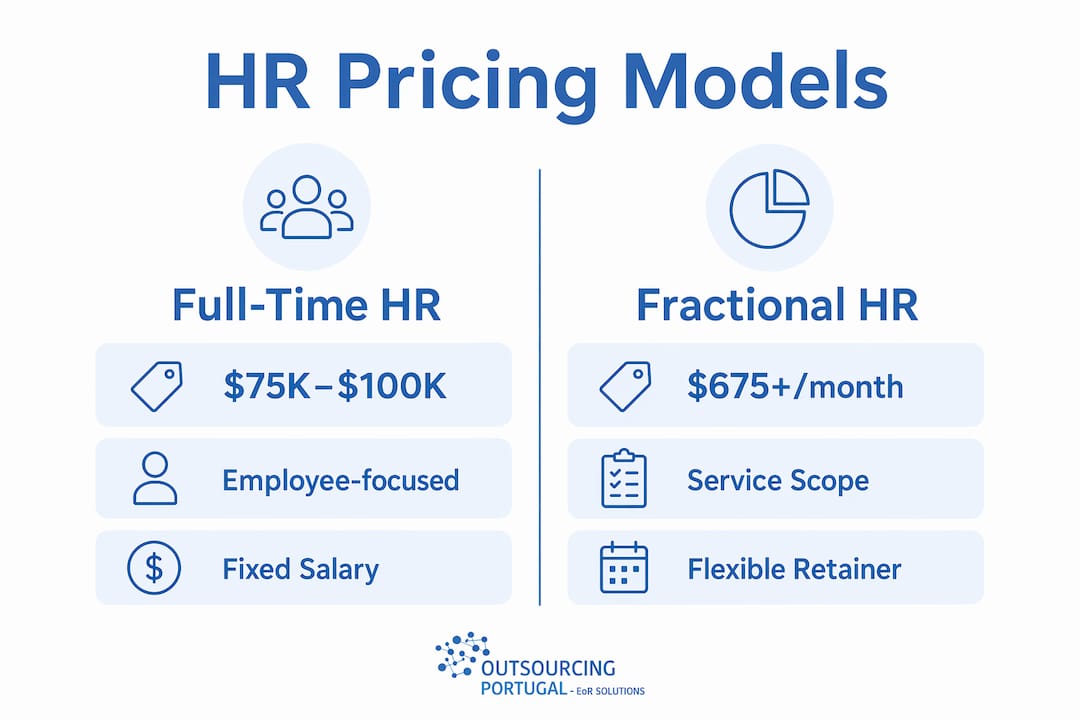
Retainer-based fractional HR charges by service scope rather than headcount, which cuts overhead for companies scaling quickly. PEOs charge per employee, which becomes expensive as teams grow. For international companies building Portugal-based teams, the retainer model typically delivers better value at the growth stage.
Pro Tip: Request a scope-of-work breakdown before agreeing to any retainer. Vague retainers lead to scope creep. A clear service schedule protects both sides and makes it easier to evaluate ROI after six months.
What role does AI play in modern HR management services?
AI has moved from a marketing talking point to a functional tool inside HR compliance and performance management workflows. The change is measurable.
AI-integrated compliance tools save 3–5 hours per performance review cycle by automating documentation, flagging policy gaps, and generating audit-ready assessments. For a team running quarterly reviews across 50 employees, that adds up to hundreds of hours recovered annually.
The most effective AI compliance tools follow a three-step workflow:
- Intake: Collecting case details, employee records, and relevant policy documentation
- Evaluation: Analyzing inputs against embedded labor law standards and internal policy frameworks
- Audit-ready assessment: Generating a defensible written output that HR professionals can review, adjust, and approve
AI compliance tools like ARIES embed authoritative labor law databases directly into the evaluation process. They support HR judgment rather than replacing it. The output is a structured recommendation, not an automated decision.
For multinational HR teams managing Portugal-based staff, AI tools solve a specific problem: keeping up with Portuguese labor law updates without requiring constant manual research. Portugal’s Labor Code is detailed, and changes to minimum wage, working time rules, or termination procedures require fast policy updates. AI-assisted monitoring flags those changes before they create compliance gaps.
The workforce compliance workflow for HR teams in 2026 increasingly depends on these tools to maintain audit readiness across multiple jurisdictions simultaneously.
How does compliance shape HR management for international companies in Portugal?
Compliance is the single greatest risk for international companies hiring in Portugal without local HR expertise. Portugal operates under a detailed Labor Code that governs contracts, working hours, termination, and employee protections. Getting any of these wrong creates financial and reputational exposure.
Key compliance areas for international firms include:
- Employment contracts: Portuguese law requires written contracts specifying role, salary, working hours, and probation terms
- Working time rules: Standard working hours are capped, with strict overtime and rest period requirements
- Termination procedures: Dismissal without cause requires specific notice periods and severance calculations
- Social security contributions: Both employer and employee contributions are mandatory and precisely defined
- Data protection: GDPR applies fully to employee data held by companies operating in Portugal
Switching to managed HR services or a PEO can cut payroll administration costs by up to 50% through better integration and consolidated compliance management. That figure reflects the real cost of fragmented, manual compliance processes.
The HR best practices guide for Portugal covers the specific compliance requirements that international firms encounter most often. Proactive policy updates, not reactive fixes, define the difference between companies that scale smoothly and those that face labor disputes.
A well-structured HR management firm keeps compliance documentation audit-ready at all times. That means updated employee handbooks, signed policy acknowledgments, and a clear record of any disciplinary or performance management actions. For companies operating across multiple EU jurisdictions, this level of documentation discipline is non-negotiable.
What should you look for when choosing an HR management company?
Choosing the wrong HR partner costs more than staying in-house. The selection criteria below apply specifically to international companies evaluating providers for Portugal-based operations.
- Local labor law expertise: Confirm the provider has direct, in-country knowledge of Portuguese employment law, not just generic EU compliance experience.
- Service scope alignment: Match the provider’s service catalog to your actual needs. A company with 15 employees in Lisbon does not need the same model as a 200-person nearshore team.
- Technology integration: Ask whether the provider uses AI-assisted compliance tools and how they handle policy updates when Portuguese labor law changes.
- Engagement model flexibility: The best HR management firms offer fractional, full outsourcing, and Employer of Record options so you can scale the relationship as headcount grows.
- Cultural and communication fit: International HR partnerships fail most often on communication, not competence. Confirm the provider works in your time zone and communicates in your operating language.
- Transparent pricing: Retainer-based models should come with a clear scope of work. Avoid providers who bundle services without itemizing what is included.
- References from comparable clients: Ask for references from international companies of similar size operating in Portugal. Generic testimonials do not tell you what you need to know.
HR as a competitive advantage starts with diagnostics, not assumptions. The right provider begins by understanding your business goals before recommending a service model. That diagnostic step separates genuine HR strategy consulting from commodity HR administration.
The top reasons to outsource HR in Portugal consistently come back to three factors: compliance certainty, cost control, and speed to hire. A provider who cannot demonstrate strength in all three is not the right fit for an international operation.
Key Takeaways
An HR management company delivers the most value when it functions as a strategic partner aligned with your business goals, not just an administrative vendor handling paperwork.
| Point | Details |
|---|---|
| Outsourcing cuts costs significantly | Fractional HR starts at $675/month versus $75,000–$100,000+ per year for a full-time hire. |
| Compliance is the primary risk in Portugal | Portuguese labor law requires precise contracts, termination procedures, and social security filings. |
| AI tools save measurable time | AI-integrated compliance workflows save 3–5 hours per performance review cycle. |
| Retainer models outperform per-employee fees | Scope-based retainers reduce overhead for growing teams better than PEO per-employee pricing. |
| Local expertise is non-negotiable | Generic HR providers without in-country Portugal knowledge create compliance exposure, not protection. |
What I’ve learned about HR partnerships that most guides won’t tell you
The advice you read most often about choosing an HR management company focuses on checklists and pricing comparisons. That is useful, but it misses the thing that actually determines whether the partnership works.
The providers who deliver real value start every engagement with a diagnostic conversation about where the business is going, not just where it is now. I have seen international companies sign with technically capable HR firms and still end up with misaligned policies because nobody asked the right questions at the start. The multinational HR strategies that hold up over time are built on that diagnostic foundation.
The other thing most guides skip is the cost of a bad exit. Switching HR providers mid-growth is expensive and disruptive. Employee records need transferring, payroll systems need migrating, and compliance documentation needs auditing. Choosing carefully at the start is far cheaper than fixing a poor fit later.
My honest recommendation: treat the first three months of any HR outsourcing relationship as a paid trial. Set clear deliverables, review them at 90 days, and make the decision to deepen or exit based on evidence, not optimism. The best HR management firms welcome that structure because they know they can deliver.
— Paulo
Outsourcing-portugal’s approach to HR management in Portugal
Outsourcing-portugal works with international companies that need HR management expertise in Portugal without the overhead of a local entity. The service model covers payroll, compliance, onboarding, and Employer of Record arrangements, all structured around the specific requirements of Portuguese labor law.
The engagement model is flexible. Companies can start with a focused compliance and payroll retainer, then expand to full HR outsourcing as their Portugal-based team grows. For companies evaluating their options, the best employment outsourcing agencies for 2026 guide covers the top providers operating in Portugal, with a breakdown of service scope and fit by company size. Outsourcing-portugal’s combination of local legal expertise and scalable service models makes it a practical starting point for any international team entering the Portuguese market.
FAQ
What is an HR management company?
An HR management company is a professional service provider that handles human resources functions for businesses, including payroll, compliance, employee relations, and talent management. Providers range from fractional HR consultants to full-service outsourced HR teams.
How much does outsourced HR management cost?
Fractional HR retainers start as low as $675 per month, compared to $75,000–$100,000 or more per year for a full-time HR manager. The right model depends on team size, service scope, and whether you need in-country compliance expertise.
Why do international companies need specialized HR support in Portugal?
Portugal’s Labor Code sets strict requirements for employment contracts, working hours, termination procedures, and social security contributions. International companies without local HR expertise face significant compliance risk when hiring Portuguese employees.
What is the difference between fractional HR and a PEO?
Fractional HR firms charge a monthly retainer based on service scope, while PEOs charge a per-employee fee and typically act as a co-employer. Fractional HR offers more flexibility and lower costs for growing teams, while PEOs provide bundled benefits access.
How does AI improve HR compliance management?
AI compliance tools automate documentation, flag policy gaps, and generate audit-ready assessments, saving 3–5 hours per performance review cycle. They embed labor law standards directly into the evaluation process, supporting HR decisions without replacing human judgment.