
TL;DR:
- Portugal’s labor laws extend beyond EU standards, enforcing strict compliance on outsourcing practices.
- Recent restrictions prohibit outsourcing within 12 months of collective dismissals, with serious penalties for violations.
- Proper local knowledge and adherence to collective agreements, posted worker regulations, and documentation are essential for legal outsourcing.
International companies entering Portugal through outsourcing often assume that general EU employment standards are enough to keep them compliant. They are not. Portugal has its own Labor Code with rules that go well beyond EU minimums, and violations can trigger serious financial penalties, forced reinstatement of workers, and reputational damage. Two recent legislative updates, specifically around the 12-month outsourcing restriction and collective agreement obligations, have caught many experienced HR managers off guard. This guide walks you through every major compliance layer so you can build your outsourcing strategy in Portugal on solid legal ground.
Table of Contents
- Understanding Portugal’s legal framework for outsourcing
- Critical compliance rules for outsourcing employment
- Employee protections and collective agreements when outsourcing
- Special compliance considerations for posted and cross-border workers
- Why most compliance mistakes in outsourcing are avoidable
- Get local support for compliant outsourcing in Portugal
- Frequently asked questions
Key Takeaways
| Point | Details |
|---|---|
| Twelve-month rule | You cannot outsource services within a year after certain layoffs or face serious penalties. |
| Collective agreement protection | Outsourced employees are covered by the most favorable collective agreement when they perform core roles over 60 days. |
| Mandatory notifications | Posted and cross-border workers require ACT notification and must follow Portuguese labor rules. |
| Localization matters | Adapting procedures to Portuguese laws prevents common compliance mistakes in outsourcing. |
Understanding Portugal’s legal framework for outsourcing
Portugal’s primary employment legislation is the Código do Trabalho, commonly called the Labor Code. For international companies outsourcing employment functions, this code sets the rules on contracts, termination, working time, and the specific conditions under which outsourcing is permitted. It is not a flexible framework. Judges and labor inspectors apply it literally, and ignorance of its provisions is not a valid defense.
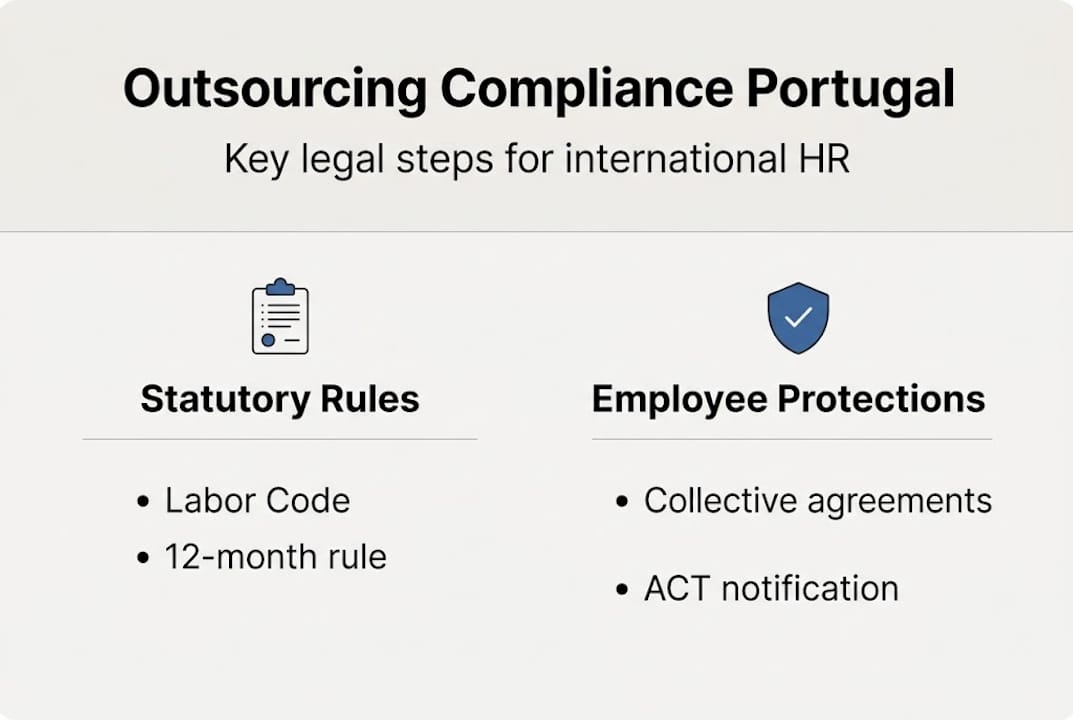
The most significant recent change affects companies that have recently reduced headcount. Under Art. 338-A Labor Code, it is prohibited to outsource services within 12 months of dismissing employees for job extinction or collective dismissal. Violating this rule is classified as a serious offense and carries substantial fines. This is not a technicality. It is a hard stop that applies regardless of how the outsourcing contract is structured.
Beyond this restriction, the Labor Code also governs:
- Notice periods: Minimum notice requirements vary by seniority and must be honored in any outsourcing transition.
- Collective bargaining agreements (CBAs): Sector-specific CBAs often set wages, benefits, and working conditions above statutory minimums.
- Posted worker rules: Workers temporarily assigned to Portugal from abroad must meet Portuguese minimum conditions.
- Fixed-term contracts: Strict limits apply on duration and renewal, even within outsourced arrangements.
For companies using an Employer of Record model, understanding these layers is essential. Our EOR compliance guide covers how the EOR absorbs these obligations on your behalf, but you still need to understand what those obligations are.
Portugal also maintains a set of mandatory protections that cannot be waived by contract, including minimum wage, paid leave, and anti-discrimination provisions. These apply to all workers in Portugal, regardless of where the employer is incorporated.
Key stat: Portugal’s minimum wage increased to €1,020 per month in 2026, and any outsourcing arrangement must reflect this floor across all covered roles.
The practical takeaway here is that Portugal’s legal framework is layered. You need to track statutory law, applicable CBAs, and any mandatory protections simultaneously. Missing one layer is enough to create liability.
Critical compliance rules for outsourcing employment
With the legal framework covered, it is crucial to recognize the specific dos and don’ts, especially the rules that trip up even seasoned HR managers. Here is a step-by-step overview of the core compliance rules you need to follow.
- Check the 12-month window before outsourcing. If your company or the service provider has conducted collective dismissals or job extinction terminations in the past year, outsourcing is prohibited for those functions. Document the dismissal history of any provider you engage.
- Define core vs. peripheral activity clearly. Portuguese courts look at whether outsourced tasks are central to the beneficiary company’s business. Outsourcing core functions carries higher legal scrutiny and triggers the collective agreement obligations described below.
- Verify the provider’s employment contracts. As the beneficiary company, you can be held jointly liable if the provider’s workers are not properly contracted or paid.
- Align with applicable CBAs. Identify which sector-level collective agreement applies to your outsourced workers and confirm that wages and benefits meet or exceed those terms.
- Maintain proper documentation. Keep records of service agreements, worker assignments, and payment histories. Labor inspectors can request these at any time.
Pro Tip: Before signing any outsourcing contract in Portugal, ask the provider to confirm in writing that no collective or job extinction dismissals occurred in the past 12 months for the roles being outsourced. This one step eliminates a major liability risk.
“Violations of the 12-month outsourcing restriction are classified as serious offenses under Portuguese law, meaning fines are not discretionary. They are mandatory upon finding a violation.”
For HR managers building their first Portuguese team, our 2026 hiring guide provides a practical overview of the full hiring lifecycle. You should also review the payroll compliance checklist to ensure your payroll setup reflects all statutory and CBA-driven obligations from day one.
A common mistake international HR teams make is applying their home country’s compliance logic to Portugal. What counts as a “serious offense” in Portugal may be treated as a minor administrative issue elsewhere. The reverse is also true. Mapping your existing processes to Portuguese law requires deliberate localization, not just translation.
Employee protections and collective agreements when outsourcing
Beyond basic compliance, Portugal’s laws also address employee rights in outsourced roles, especially regarding collective agreements. This is where many international companies get a genuine surprise.
Under Art. 498-A, when outsourced workers perform services that match the core business of the beneficiary company for more than 60 days, the beneficiary’s collective agreement applies to those workers if it is more favorable than the provider’s agreement. This is not optional. It is a statutory obligation that runs regardless of what the outsourcing contract says.

| Scenario | Duration | Collective agreement that applies |
|---|---|---|
| Peripheral task outsourcing | Any duration | Provider’s CBA |
| Core business task outsourcing | Under 60 days | Provider’s CBA |
| Core business task outsourcing | Over 60 days | Beneficiary’s CBA (if more favorable) |
| No CBA at either company | Any duration | Statutory minimums only |
This rule has real financial consequences. If your company’s CBA provides higher wages, more vacation days, or better health benefits than the provider’s CBA, you are obligated to ensure those terms apply to the outsourced workers after 60 days. Failing to do so exposes you to back-pay claims and regulatory fines.
For employees, this is a meaningful protection. It prevents the use of outsourcing as a mechanism to strip workers of rights they would otherwise hold. For you as the hiring company, it means you need to know your own CBA well, not just the provider’s.
Key obligations to track when collective agreements apply:
- Wage parity: Confirm hourly or monthly rates meet the beneficiary’s CBA minimums after the 60-day threshold.
- Leave entitlements: Vacation and sick leave rules under the beneficiary’s CBA must be honored.
- Bonus structures: Some CBAs include mandatory 13th or 14th month payments that must be reflected in outsourced worker compensation.
Our employee benefits list breaks down what Portuguese employees are legally entitled to, including CBA-driven benefits that go beyond the statutory floor.
Special compliance considerations for posted and cross-border workers
Cross-border outsourcing adds another layer of complexity. Here is what you need to know about posted workers and related compliance obligations.
A posted worker is an employee based in another country who is temporarily sent to work in Portugal. This is common in multinational outsourcing arrangements. Portuguese law, aligned with EU Directive 96/71/EC, sets mandatory minimum conditions that posted workers must receive, regardless of where they are employed.
Here is the compliance sequence for posted workers:
- Notify ACT (Autoridade para as Condições do Trabalho) before the worker begins their assignment in Portugal. This is a legal requirement, not a courtesy.
- Guarantee Portuguese minimum conditions, including minimum wage, maximum working hours, paid leave, and health and safety standards.
- Understand that choice-of-law clauses do not override mandatory protections. Even if your contract specifies that another country’s law governs the employment relationship, mandatory Portuguese protections apply in full.
| Obligation | Applies to posted workers? | Notes |
|---|---|---|
| ACT notification | Yes | Required before assignment starts |
| Portuguese minimum wage | Yes | €1,020/month in 2026 |
| Portuguese working time limits | Yes | Max 40 hours/week standard |
| Portuguese paid leave | Yes | Minimum 22 working days/year |
| Home country CBA | Conditional | Only if more favorable than Portuguese rules |
Pro Tip: If you are posting workers to Portugal for longer than 12 months, the full Portuguese Labor Code applies, not just the minimum conditions. Plan your assignment durations carefully.
For companies managing cross-border teams, our workforce mobility guide covers the full spectrum of posted worker obligations and how to structure compliant international assignments.
The ACT notification process is often overlooked by international HR teams who treat it as bureaucratic formality. It is not. Missing this notification is an independent violation that carries its own penalties, separate from any substantive employment law breach.
Why most compliance mistakes in outsourcing are avoidable
After working through Portugal’s compliance landscape with dozens of international companies, one pattern stands out clearly: most violations are not caused by bad intent. They are caused by applying home country HR processes to a Portuguese context without localization.
A German company might assume that its rigorous EU compliance framework covers Portugal automatically. A U.S. company might treat Portuguese labor law as broadly similar to at-will employment norms. Both assumptions lead to the same result: missed obligations, fines, and damaged employee relationships.
The fix is not complicated, but it does require deliberate effort. A localized compliance checklist, reviewed by someone who actually knows Portuguese labor law, closes the majority of legal gaps before they become problems. Our detailed compliance guide is built specifically for this purpose.
The companies that get this right are not necessarily the largest or most legally sophisticated. They are the ones that treat Portugal as its own legal environment and find partners who operate within it every day. That local knowledge is worth more than any general EU compliance framework.
Get local support for compliant outsourcing in Portugal
Navigating Portugal’s Labor Code, collective agreement obligations, posted worker notifications, and the 12-month outsourcing restriction is manageable when you have the right support in place.
At outsourcing-portugal.co.uk, we help international companies build compliant employment structures in Portugal without the guesswork. Whether you need a full EoR solution to handle all employer obligations on your behalf, or targeted guidance on a specific compliance question, our team is ready to help. If you are ready to move forward or just want to understand your options, contact our experts for a direct conversation about your situation.
Frequently asked questions
What is the 12-month rule for outsourcing after layoffs in Portugal?
Under Art. 338-A of the Portuguese Labor Code, outsourcing is prohibited within 12 months of collective or job extinction dismissals, and violations are classified as serious offenses subject to mandatory fines.
Do Portuguese collective agreements apply to outsourced employees?
Yes. When outsourced staff perform core business tasks for more than 60 days, the beneficiary company’s collective agreement applies if it offers more favorable terms than the provider’s agreement.
What must companies do when posting foreign workers to Portugal?
Companies must notify ACT before the assignment begins, guarantee Portuguese minimum conditions, and recognize that choice-of-law clauses cannot override Portugal’s mandatory employment protections.
How can international HR managers avoid common outsourcing compliance mistakes in Portugal?
Using a localized compliance checklist and partnering with experts who specialize in Portuguese labor law eliminates the vast majority of legal risks before they escalate into penalties or disputes.