
TL;DR:
- Payroll fraud involves insiders manipulating payroll systems to steal company funds, often going undetected for an average of 18 months with median losses of $50,000. Small businesses face a higher risk due to fewer internal controls, making segregation of duties and multiple approvals essential for prevention. Detecting and responding quickly with audits and legal action minimizes damage and safeguards payroll integrity.
Payroll fraud is the deliberate manipulation of payroll systems by authorized personnel to steal or divert company funds for personal gain. Unlike external cyberattacks, this threat lives inside your organization, carried out by people with legitimate access to your systems. Median losses reach $50,000 per incident before detection, with the average scheme running 18 months unnoticed. Small businesses face 1.5 times the fraud risk of larger firms, largely because they lack the layered controls that bigger organizations take for granted. Recognizing the types, signs, and countermeasures is the first line of defense.
What are the common types of payroll fraud?
Payroll fraud schemes fall into several distinct categories, each exploiting a specific weakness in your payroll workflow. Knowing how each one operates makes them far easier to spot.
- Ghost employees. A payroll administrator adds a fictitious worker or keeps a terminated employee active in the system. Paychecks flow to an account the fraudster controls. This scheme is the most common and often runs the longest before detection.
- Timesheet manipulation. Employees or supervisors inflate hours worked, claim overtime that never happened, or approve each other’s falsified timesheets. In hourly workforces, even small daily additions compound into significant losses over months.
- Unauthorized pay rate changes. Someone with edit access quietly raises their own salary or a co-conspirator’s pay rate. Without a secondary approval step, these changes can persist through dozens of pay cycles.
- Direct deposit diversion. A fraudster changes the bank account number on file for an employee, redirecting wages to their own account. This is especially effective when verification steps are absent or bypassed.
- Benefits and garnishment fraud. Perpetrators manipulate benefit deductions, expense reimbursements, or court-ordered garnishments to redirect funds. This category is often overlooked because it sits at the edge of payroll and HR.
Pro Tip: Require a manager outside the payroll department to approve any changes to bank account details, pay rates, or employee status. A single extra approval step eliminates the most common entry points for fraud.
Each scheme shares one trait: it requires access. The person committing the fraud almost always has a legitimate reason to be in the system, which is exactly why internal controls matter more than perimeter security.
What are the signs of payroll fraud businesses should monitor?
Early detection depends on knowing what normal looks like, so that anything abnormal stands out immediately. 75% of payroll fraud perpetrators displayed behavioral red flags before they were caught. That statistic means the warning signs were visible. They were simply not acted on.
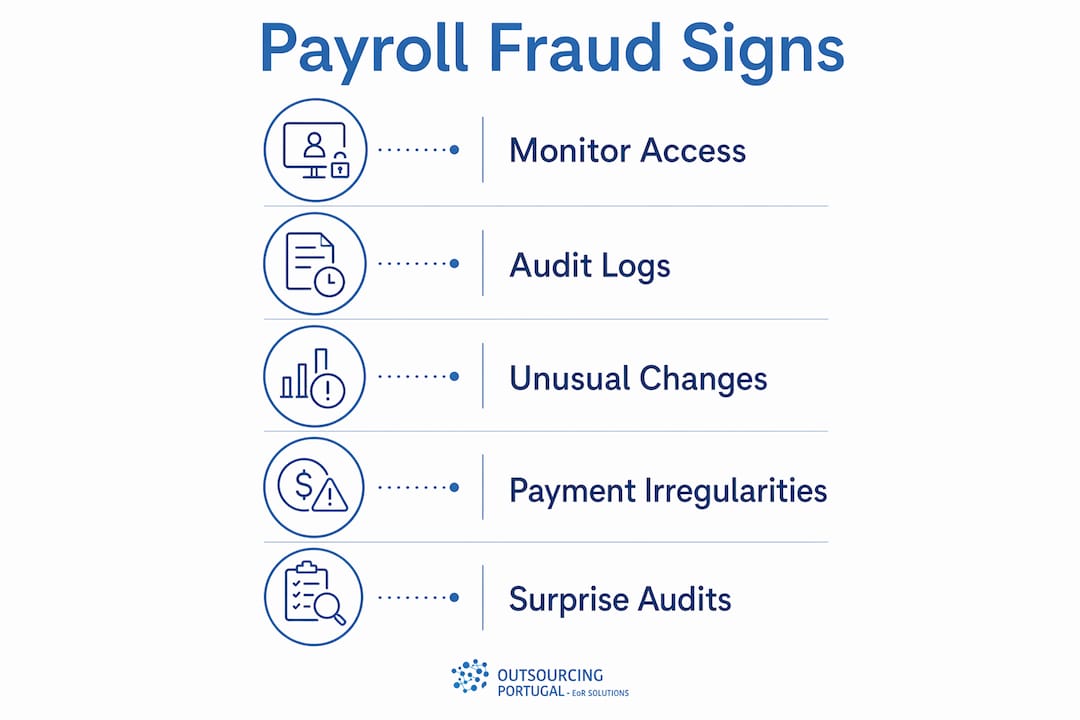
Behavioral signals include employees who resist taking vacation, refuse to cross-train colleagues, or react defensively when asked routine questions about payroll records. These behaviors often indicate someone protecting access to a scheme they have built over time.
On the data side, watch for these specific red flags:
- Payroll expenses growing faster than headcount or revenue
- Frequent edits to pay records, especially outside business hours
- Direct deposit changes submitted without supporting documentation
- Discrepancies between payroll reports and bank reconciliations
- Employees with no supervisor listed, or supervisors approving their own timesheets
- Duplicate Social Security numbers, addresses, or bank account numbers across employee records
Audit logs that record pay rate changes, login timestamps, and edit histories are your most reliable detective tool. Review them on a scheduled basis, and flag any after-hours activity for immediate follow-up. Exception reports, which automatically surface unusual transactions, reduce the manual effort required to catch anomalies.
How can businesses prevent payroll fraud through internal controls?
Prevention requires structure, not just trust. The most effective controls separate the people who can create payroll data from those who approve and reconcile it.
- Segregate duties. One person should never enter employee data, process payroll, and reconcile accounts. These three functions must sit with three different people or teams. When one person controls all three, ghost employee schemes become nearly undetectable.
- Implement role-based access controls. Grant each user only the access their role requires. A timesheet approver does not need the ability to change pay rates. An HR administrator does not need access to bank account fields.
- Require secondary approval for sensitive changes. Direct deposit changes, pay rate edits, and new employee additions should all require a second approver who is independent of the person making the change. Verification via the employee’s address of record adds a further barrier to diversion fraud.
- Conduct unannounced payroll audits. Surprise audits reduce median fraud losses by 63%. Schedule them irregularly so no one can anticipate and conceal activity before a review.
- Reconcile headcount independently. Assign someone outside payroll processing to compare the active employee list against HR records and physical headcount. This low-tech check reliably surfaces ghost employees.
- Maintain a complete documentation trail. Every pay change, approval, and system login should generate a timestamped record. This trail supports both internal investigations and any legal action that follows.
Pro Tip: Treat payroll system access the way you treat access to your bank accounts. Limit it, log it, and review it regularly. Most small businesses grant far more access than any individual role requires.
Outsourcing payroll to a third-party provider adds a layer of separation, but it does not eliminate your liability. SOC 2 Type II audits verify a vendor’s platform security, but employers remain responsible for their own internal approval workflows and access credentials. Outsourcing changes who processes payroll. It does not change who owns the risk of internal fraud.

What advanced detection technologies can improve fraud identification?
Traditional rule-based fraud detection works by flagging transactions that exceed preset thresholds. It catches obvious violations but misses schemes built on collusion, where two or more people with legitimate access work together to bypass controls.
Graph analytics addresses this gap directly. Rather than evaluating each transaction in isolation, graph analytics maps the relationships between employees, approvers, accounts, and transactions. It identifies patterns like approval rings, where a small group of employees consistently approve each other’s changes, or shared attributes across supposedly unrelated employee records. Graph analytics improves fraud detection precision and recall by 50% compared to rule-based systems. That improvement comes from the ability to perform multi-hop relational analysis, tracing connections across several degrees of separation that a standard query would never surface.
Risk scoring models take this further by combining structural data (who approves whom), financial data (transaction amounts and frequencies), and behavioral data (login times, edit patterns) into a single score per employee or transaction. Machine learning refines these scores over time, reducing false positives and improving the signal-to-noise ratio for investigators.
| Detection method | What it catches | Primary limitation |
|---|---|---|
| Rule-based threshold checks | Single-actor violations, obvious anomalies | Misses collusion and gradual escalation |
| Audit log review | After-hours edits, unauthorized access | Requires manual review; reactive |
| Graph analytics | Approval rings, collusion, shared identifiers | Requires data integration and governance investment |
| Risk scoring models | Multi-factor behavioral patterns | Needs historical baseline data to calibrate |
Implementing graph analytics requires clean, integrated data across HR, payroll, and finance systems. Data governance, meaning clear ownership of data quality and access, is a prerequisite. Without it, the models surface noise rather than fraud.
What to do when payroll fraud is detected
Speed and containment define the first 48 hours after discovery. Acting quickly limits further losses and preserves the evidence needed for legal action.
- Suspend access immediately. Revoke the suspected perpetrator’s system credentials before any investigation conversation takes place. This prevents evidence destruction and stops ongoing transactions.
- Preserve all audit trails. Do not alter, delete, or “clean up” any records. Forensic investigators and prosecutors need the original data, including logs of who accessed what and when.
- Engage legal counsel early. Employment law, criminal law, and tax compliance intersect in payroll fraud cases. A DOJ enforcement case involving $38 million in losses over seven years resulted in sentences exceeding 17 years and full restitution orders. The legal consequences are severe, and your response needs to be legally sound from the start.
- Correct payroll and tax filings. Fraudulent payroll entries affect tax withholdings, Social Security contributions, and reported wages. Work with a tax professional to file amended returns and notify relevant authorities as required.
- Communicate carefully. Internal communications about the investigation should be limited to those with a direct need to know. External communications, including any public disclosures, should go through legal counsel.
- Conduct a post-incident review. Once the immediate situation is resolved, audit the controls that failed. Every fraud scheme reveals a gap. Closing that gap is the most productive outcome of a painful experience.
Key Takeaways
Payroll fraud is an insider threat that costs businesses a median of $50,000 per incident and runs undetected for an average of 18 months, making early detection controls the highest-return investment a business can make.
| Point | Details |
|---|---|
| Insider threat is primary | Most payroll fraud is committed by employees with legitimate system access, not external attackers. |
| Segregation of duties is non-negotiable | No single person should enter, approve, and reconcile payroll without independent oversight. |
| Surprise audits cut losses sharply | Unannounced audits reduce median fraud losses by 63%, making them one of the most cost-effective controls. |
| Behavioral red flags precede detection | 75% of perpetrators showed warning signs before discovery; monitoring behavior is as important as monitoring data. |
| Graph analytics catches collusion | Traditional rule-based systems miss multi-actor schemes; graph analytics improves detection precision by 50%. |
What I’ve learned about payroll fraud in small and medium businesses
The most dangerous assumption a business owner makes is that payroll fraud only happens in large, faceless corporations. In reality, small businesses are the most exposed. They have fewer people, which means fewer opportunities to separate duties. They also have higher trust between colleagues, which makes it harder to enforce controls without feeling like you are accusing someone.
The single highest-impact change I have seen small businesses make is treating payroll access the way they treat access to the company bank account. Not everyone needs it. Not everyone should have it. When you limit access and log every action, the deterrent effect alone reduces risk significantly.
Surprise headcount reconciliations are underused and undervalued. Comparing your active payroll list against physical headcount takes an afternoon. It catches ghost employees, terminated workers still receiving pay, and duplicate entries that automated systems often miss. Most businesses that run this check for the first time find at least one discrepancy.
The behavioral warning signs are real and they are visible. An employee who never takes vacation, who handles payroll alone, and who reacts poorly to routine questions about records is telling you something. You do not need a forensic accountant to notice that pattern. You need a culture where oversight is normal, not threatening.
The payroll compliance checklist approach works because it forces you to document what controls exist and who owns them. When you write it down, the gaps become obvious. That documentation also becomes your defense if fraud occurs and you need to demonstrate due diligence.
— Paulo
Payroll security and Outsourcing-portugal’s compliance-first approach
Payroll fraud risk does not disappear when you hire across borders. For international businesses building teams in Portugal, the compliance layer becomes more complex, and the cost of a control gap increases.
Outsourcing-portugal provides Employer of Record services in Portugal that build segregation of duties into the payroll structure by design. The EOR model separates the employer of record function from your internal management, creating an independent approval and processing layer that reduces single-point-of-failure risk. Dedicated compliance oversight, documented approval workflows, and regular payroll audits are standard components of the service. For businesses that want to hire in Portugal without setting up a local entity, this structure also addresses the internal control gaps that make payroll fraud possible in the first place. Contact Outsourcing-portugal to assess where your current payroll controls fall short.
FAQ
What is payroll fraud?
Payroll fraud is the intentional manipulation of a payroll system by an authorized person to steal or divert company funds. It is an insider threat, not an external attack.
How long does payroll fraud go undetected?
The median detection time for payroll fraud is 18 months, with median losses of $50,000 per incident. Small businesses face 1.5 times the risk of larger firms.
What are the most effective ways to prevent payroll fraud?
Segregation of duties, role-based access controls, secondary approval for sensitive changes, and unannounced audits are the most effective preventive controls. Surprise audits alone reduce median losses by 63%.
What should I do immediately after discovering payroll fraud?
Revoke the suspect’s system access, preserve all audit logs without alteration, engage legal counsel, and correct any affected payroll and tax filings with the relevant authorities.
Can outsourcing payroll eliminate fraud risk?
Outsourcing payroll to a third-party provider reduces risk by adding separation between processing and approval, but employers remain responsible for their own internal access controls and approval workflows.