
TL;DR:
- International payroll in Portugal involves compliance with local laws, taxes, social security, and pay schedules.
- Using an Employer of Record simplifies hiring and manages payroll obligations legally without a local entity.
- Ongoing regulatory updates require regular reviews to ensure continuous compliance and avoid penalties.
Paying employees in another country feels straightforward until you realize it isn’t. Many HR managers assume international payroll is just a matter of wiring salaries abroad and calling it done. The reality involves local tax filings, mandatory social security contributions, labor law compliance, currency handling, and reporting deadlines that vary by country. Get any one of these wrong in Portugal, and you’re looking at fines, delayed operations, or worse. This guide cuts through the noise, explains exactly what international payroll covers, and gives you a practical framework for hiring in Portugal without a local entity and without the compliance headaches.
Table of Contents
- Defining international payroll and why it matters
- Key challenges in managing payroll across borders
- EOR, shadow payroll, and staying compliant in Portugal
- Best practices: Efficient, compliant international payroll for Portugal
- A hard truth: Why international payroll is never ‘set and forget’
- Next steps: Secure, simple hiring in Portugal
- Frequently asked questions
Key Takeaways
| Point | Details |
|---|---|
| International payroll essentials | Compliant payroll means more than just salary payments—it covers tax, social security, and reporting in each country. |
| EOR and shadow payroll | Employer of Record solutions enable legal hiring in Portugal, and shadow payroll addresses expat tax needs. |
| Common pitfalls | Ignoring local rules, social security, or agreement details can lead to costly errors. |
| Continuous compliance | International payroll needs regular updates and audits, not a set-it-and-forget-it approach. |
Defining international payroll and why it matters
Let’s start with a clear definition. International payroll basics describe it as the process of managing payroll for employees working in countries outside the company’s home country, involving compliance with local tax laws, social security contributions, currency conversions, and pay frequency requirements varying by jurisdiction. That’s a lot packed into one sentence, and every word matters.
For HR teams at international companies, this means you can’t apply your home country’s payroll logic to Portuguese employees. Portugal operates under its own Labor Code, tax authority (Autoridade Tributária e Aduaneira), and social security system (Segurança Social). Each has specific rules about how and when employees must be paid, what deductions apply, and what reports must be filed.
“Getting international payroll wrong isn’t just a paperwork problem. It can trigger audits, invalidate employment contracts, and block your ability to operate in a market entirely.”
When you hire in Portugal without a registered local entity, the compliance risk multiplies. You have no legal employer on the ground, which means no one is formally responsible for tax withholding or social security filings unless you structure it correctly. This is where payroll compliance solutions become critical rather than optional.
Here’s what international payroll actually covers in practice:
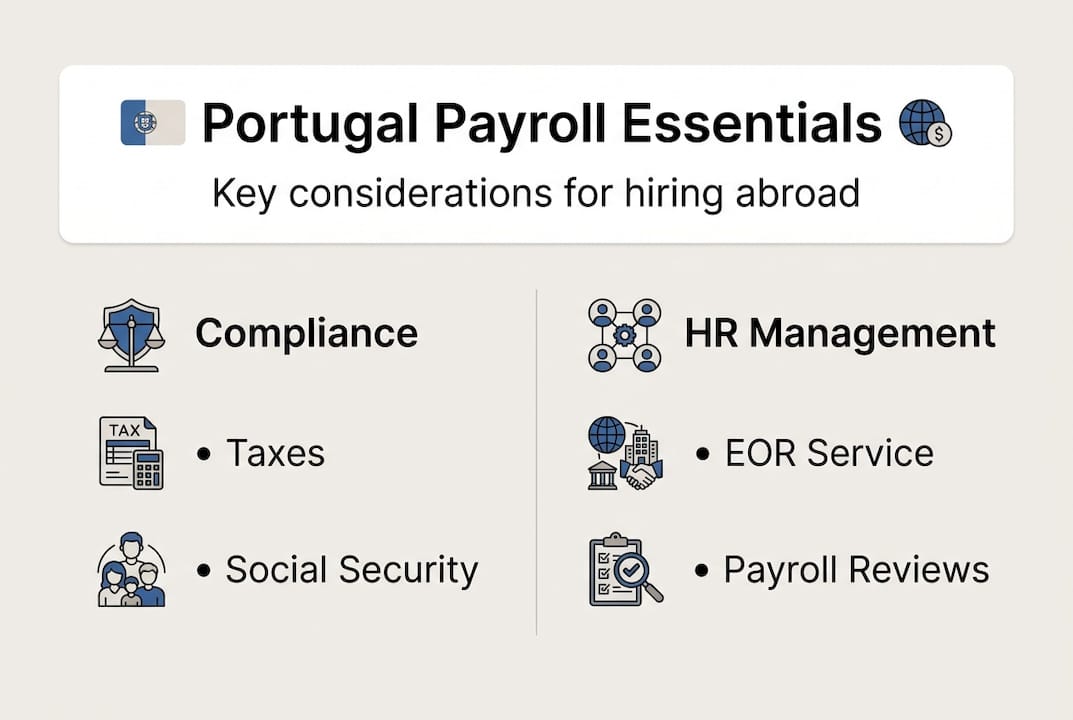
- Compliance: Adhering to Portuguese labor law, employment contracts, and statutory entitlements like paid leave and notice periods
- Tax withholding: Calculating and remitting IRS (income tax) deductions at the correct rates for each employee
- Social security: Contributing to Segurança Social at the employer rate of 23.75% and employee rate of 11%
- Multicurrency management: Handling EUR payments accurately, including exchange rate risks for non-eurozone parent companies
- Work permits and residency: Ensuring non-EU employees have the right documentation before payroll begins
- Pay frequency: Portugal requires monthly salary payments, which differs from bi-weekly cycles common in the US or UK
Missing any of these components doesn’t just create administrative headaches. It creates legal liability. Reputational damage in a market you’re trying to grow into is costly and slow to repair.
Key challenges in managing payroll across borders
Even experienced HR professionals are surprised by how much variation exists across European countries. Cross-border payroll challenges confirm that local tax laws, social security, and pay frequency requirements vary greatly by jurisdiction, and Portugal is no exception.
Here’s a quick comparison to show how Portugal stacks up against two other popular European hiring destinations:
| Feature | Portugal | Germany | Netherlands |
|---|---|---|---|
| Employer social security | 23.75% | ~19.3% | ~22% |
| Employee social security | 11% | ~19.3% | ~27.65% |
| Pay schedule | Monthly | Monthly | Monthly |
| Holiday bonus | Mandatory (1 month) | Not mandatory | Not mandatory |
| Christmas bonus | Mandatory (1 month) | Not mandatory | Not mandatory |
| Income tax system | Progressive (14.5% to 48%) | Progressive (14% to 45%) | Progressive (9.32% to 49.5%) |
The mandatory holiday and Christmas bonuses in Portugal catch many companies off guard. These aren’t optional perks. They’re legal requirements, and failing to budget for them creates both financial and legal exposure.
The three most common compliance errors we see are:
- Misclassification: Treating employees as independent contractors to avoid payroll obligations. Portugal’s tax authority actively audits this, and penalties are severe.
- Double taxation: Not checking whether a tax treaty exists between Portugal and the employee’s home country, leading to taxes being paid twice.
- Missed social security filings: Late or incorrect Segurança Social contributions trigger fines and can affect an employee’s benefits eligibility.
To stay compliant, follow these critical steps:
- Register with the Portuguese tax authority or use an outsourced payroll services provider who handles this on your behalf
- Confirm the correct employment classification for every worker before the first paycheck
- Set up a payroll calendar aligned with Portugal’s monthly payment cycle and bonus schedule
- File monthly Declaração Mensal de Remunerações (DMR) reports with the tax authority
Pro Tip: Always check totalization agreements before onboarding expat employees. Portugal has agreements with the US, UK, and several other countries that prevent double social security contributions. Ignoring this step is one of the most expensive mistakes international companies make.
EOR, shadow payroll, and staying compliant in Portugal
If your company doesn’t have a legal entity in Portugal, you need a mechanism to employ people there legally. Two key tools come into play: the Employer of Record (EOR) and shadow payroll.
An EOR is a third-party organization that legally employs workers on your behalf in Portugal. The EOR handles all employer obligations, including contracts, payroll, tax withholding, social security, and labor law compliance. You direct the work; the EOR handles the legal and administrative side. This is the fastest and most reliable path to hiring in Portugal without setting up a local entity.
Here’s how the three main approaches compare:
| Approach | Legal employer | Payroll responsibility | Setup time | Compliance risk |
|---|---|---|---|---|
| EOR | EOR provider | EOR provider | Days to weeks | Low |
| Direct payroll (own entity) | Your company | Your company | Months | High without local expertise |
| Shadow payroll | Home country employer | Shared | Varies | Moderate |
Shadow payroll is a different concept. It’s used when an employee remains on their home country’s payroll (often for benefits or equity reasons) but works in Portugal. Shadow payroll guidance confirms it’s particularly needed for US expats going through tax equalization, and you must always verify totalization agreement coverage to avoid double social security contributions.
Practical ways an EOR ensures legal hiring in Portugal:
- Issues Portuguese-law compliant employment contracts
- Manages monthly payroll processing and DMR filings
- Handles mandatory bonus payments in June and December
- Enrolls employees in Segurança Social from day one
- Manages termination procedures in line with the Labor Code
For companies exploring this route, reviewing Portugal EOR and payroll options gives you a clear picture of what’s covered. If you have specific questions about how EOR works in practice, the EOR Portugal FAQ is a useful resource. Understanding compliance in international hiring also helps you evaluate providers more critically.

Pro Tip: When evaluating EOR providers, ask specifically whether they cover shadow payroll scenarios and how they handle totalization agreement verification for non-EU employees. Not all providers offer this, and the gap can cost you.
Best practices: Efficient, compliant international payroll for Portugal
Building a solid international payroll process for Portugal isn’t just about picking the right vendor. It requires upfront planning, clear internal ownership, and ongoing attention. Payroll compliance standards confirm that pay frequency, tax, and benefit standards must align with Portugal’s specific requirements from the start, not retroactively.
Before you process a single paycheck, work through these setup steps:
- Conduct a needs analysis: How many employees are you hiring? What roles? Are any of them expats? This shapes whether EOR, shadow payroll, or a hybrid approach is right.
- Research Portugal-specific requirements: Review the Portuguese Labor Code, IRS tax brackets for 2026, and Segurança Social rates. Use the Portugal payroll checklist as your starting reference.
- Engage local legal or HR counsel: Even if you use an EOR, having local advice on contract terms and termination clauses protects you.
- Configure your payroll system: Ensure it supports EUR payments, Portuguese tax tables, and monthly reporting cycles.
- Run a parallel payroll test: Before going live, process a test month to catch errors in tax calculations or social security contributions.
For ongoing compliance, build these habits into your operations:
- Review payroll reports monthly before submission to catch classification or calculation errors early
- Audit employee contracts annually to confirm they reflect current labor law requirements
- Track regulatory updates from the Autoridade Tributária, as tax brackets and social security rates can change
- Maintain clear records of all payroll filings for a minimum of 10 years, as required by Portuguese law
For a structured approach, the Portugal payroll solutions page outlines how a managed service can handle much of this systematically. The goal is a payroll process that runs cleanly every month, with no surprises at year-end.
A hard truth: Why international payroll is never ‘set and forget’
Here’s something most vendors won’t tell you: even the best EOR or payroll provider doesn’t eliminate your compliance responsibility entirely. Portugal’s labor regulations, tax codes, and social security rules evolve. What was fully compliant in 2024 may need adjustment in 2026. Assuming that signing a contract with a provider means you can walk away is how companies end up with unexpected penalties.
We’ve seen HR teams get comfortable after a smooth first year, only to be caught off guard by a change in minimum wage rates, a new reporting requirement, or a reclassification ruling. The outsourced payroll insights from teams managing Portugal payroll consistently show that regular internal reviews catch issues before they become expensive.
Compliance is a moving target, and your job is to keep moving with it. The companies that handle international payroll well treat it as an ongoing operational function, not a one-time implementation project.
Pro Tip: Schedule quarterly compliance reviews with your EOR or payroll provider, even when everything seems fine. These check-ins surface regulatory changes, flag employee status shifts, and keep your process aligned with current Portuguese law.
Next steps: Secure, simple hiring in Portugal
Managing international payroll in Portugal doesn’t have to be overwhelming. With the right structure and trusted partners, you can hire compliantly, pay accurately, and scale your team without setting up a local entity.
At Outsourcing Portugal, we specialize in exactly this. Whether you need a top-rated Portugal EOR to legally employ your team from day one, or you want to speak directly with specialists about your specific payroll setup, we’re here to help. Reach out to our team through expert Portugal payroll help and get a clear picture of what compliant, efficient hiring in Portugal looks like for your company. No guesswork, no surprises.
Frequently asked questions
What does international payroll include for Portugal employees?
It covers salaries, income tax withholding, social security contributions, mandatory bonuses, and full alignment with Portuguese labor law, as outlined in international payroll basics.
Do I need an entity in Portugal to legally pay employees?
No. An Employer of Record service acts as the legal employer in Portugal, handling all payroll and compliance obligations so you don’t need a registered local entity.
What is shadow payroll, and do I need it for US expats?
Shadow payroll tracks and reports compensation for employees who remain on their home country’s payroll while working in Portugal, preventing double taxation. Per shadow payroll guidance, it’s essential for US expats going through tax equalization.
What are the most common mistakes in international payroll?
Misclassifying employees as contractors, missing DMR filing deadlines, and failing to check social security treaties are the top errors, all of which cross-border payroll challenges consistently flag as high-risk areas.