
TL;DR:
- Portugal offers a growing tech scene but faces an 85% senior engineering talent shortage.
- Using an EOR enables quick market entry, but scaling may require establishing a local entity.
- Proper planning and compliance management are crucial to avoid risks like misclassification and operational issues.
Portugal looks straightforward on paper: a stable EU economy, strong English proficiency, and a growing tech scene. But the reality of entering this market is more nuanced than most companies expect. Senior engineering and AI roles face an 85% talent shortage, and setting up a local entity can take three to six months before you hire a single person. The smarter path for most international businesses is to test the market first, validate your assumptions, and scale only when the numbers justify it. This guide walks you through exactly how to do that.
Table of Contents
- Why international companies are eyeing Portugal
- Testing the Portuguese market: EOR vs. local entity
- Common pitfalls: Risks when testing the Portuguese market
- Making the most of testing: When and how to scale your presence
- What most companies miss about testing the Portuguese market
- How Outsourcing Portugal can help test and grow your team
- Frequently asked questions
Key Takeaways
| Point | Details |
|---|---|
| Skilled, cost-effective talent | Portugal offers affordable access to multilingual tech and IT professionals but faces senior engineering shortages. |
| EOR speeds market entry | Hiring with an Employer of Record lets companies test the market within weeks, saving on setup costs and risk. |
| Mistakes can be costly | Misclassification and compliance mistakes with EORs can bring penalties—heed local HR nuances and plan transitions carefully. |
| Scale up wisely | Monitor team size and market potential to know when to switch from EOR to a local entity for long-term growth. |
Why international companies are eyeing Portugal
Portugal has quietly become one of Europe’s most attractive hiring destinations. The workforce is highly educated, with strong English and Spanish fluency across sectors. Labor costs remain competitive compared to Western Europe, and the country’s EU membership means contracts, data protection, and employment law align with familiar frameworks. For international businesses looking at Portugal’s tech industry strengths, the country punches above its weight.
Here’s what’s drawing companies in right now:
- Tech and IT: Lisbon and Porto have developed genuine software engineering and product development ecosystems, with strong university pipelines feeding junior and mid-level roles.
- Renewable energy: Portugal is a European leader in clean energy, creating demand for specialized engineering talent that international firms want to tap.
- Customer operations and BPO: Multilingual teams, cultural compatibility with European and Latin American markets, and lower wage floors make Portugal ideal for support and operations roles.
- Finance and legal services: A growing number of shared service centers are choosing Lisbon over higher-cost alternatives like Amsterdam or Dublin.
The appeal is real. But there’s a catch.
Talent shortage alert: Senior engineering and AI roles in Portugal face an 85% shortage rate. Demand is outpacing supply at the senior level, which means companies that assume Portugal is an easy talent market are in for a surprise.
This shortage doesn’t cancel out Portugal’s advantages. It does mean your hiring strategy needs to be precise. Companies that succeed here plan ahead, move fast, and use flexible hiring structures to secure talent before competitors do. If you’re considering expanding to Portugal, understanding where tech talent shortages hit hardest helps you set realistic timelines and expectations from day one.
Testing the Portuguese market: EOR vs. local entity
With Portugal’s appeal in mind, how can companies efficiently test the market without taking on excessive risk? Here’s a head-to-head look.
The two main routes are: set up a legal entity in Portugal, or use an Employer of Record (EOR). An EOR is a third-party company that legally employs your workers in Portugal on your behalf, handling payroll, tax, and compliance while you direct the day-to-day work.
| Factor | EOR | Local entity |
|---|---|---|
| Time to first hire | 1 to 2 weeks | 3 to 6 months |
| Upfront cost | Minimal | €5,000 to €15,000 |
| Ongoing cost | 8 to 15% of gross salary | Fixed overhead plus admin |
| Compliance responsibility | Handled by EOR | Fully on you |
| HR control | Shared | Full |
| Best for | Testing, small teams | 10+ employees, long-term |
The cost-effective hiring guide for Portugal 2026 confirms that EOR enables hiring in 1 to 2 weeks versus the three to six months required to establish a local entity, with entity setup costs running €5,000 to €15,000 upfront. For a company testing the market with two or three hires, that upfront cost and time delay is hard to justify.
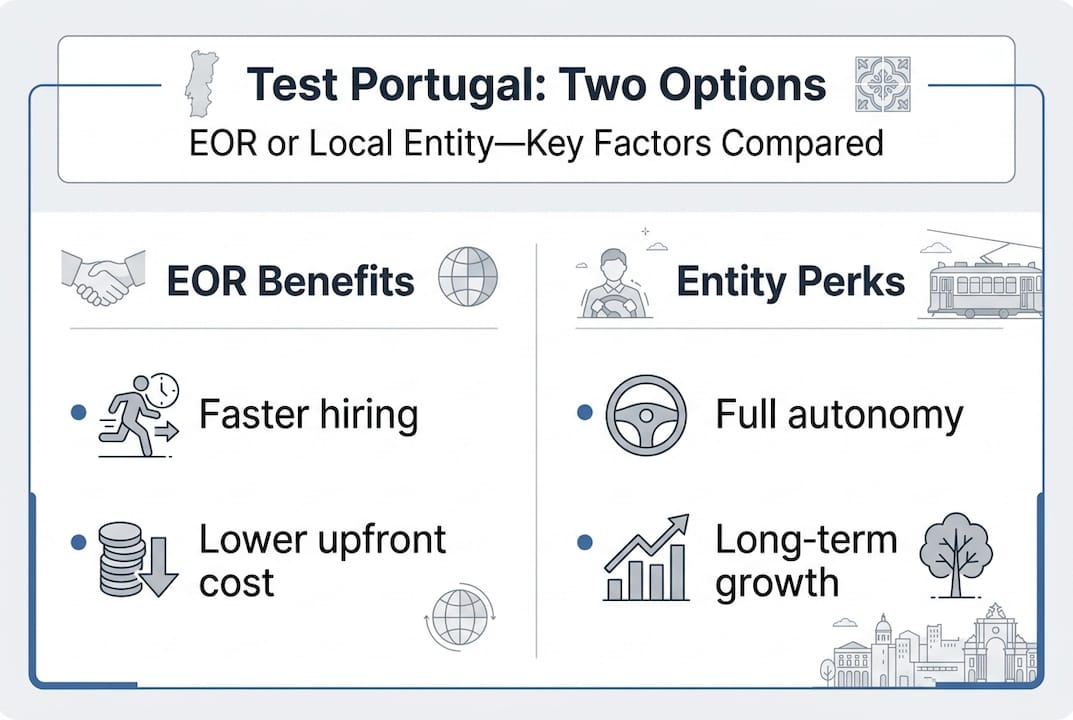
EOR ongoing costs run 8 to 15% of gross salary, roughly €450 to €700 per employee per month, with a break-even point around 6 to 10 employees. Below that threshold, EOR is almost always the more cost-effective choice.
Here’s a simple decision framework:
- Fewer than 8 employees: EOR is your best option. Lower cost, faster start, minimal compliance burden.
- 8 to 15 employees: Run a break-even analysis using an employment cost calculator to compare real numbers.
- More than 15 employees: A local entity likely makes financial sense, especially if you plan a multi-year presence.
- Uncertain timeline: Stick with EOR until you have 12 months of performance data.
Pro Tip: Before committing to either model, use a cost calculator to model your actual monthly spend under each scenario. The difference between EOR and entity costs can be significant once you factor in accountants, legal filings, and local HR management. Good EOR compliance guidance will also clarify which employment obligations apply to your specific sector and team structure.
Common pitfalls: Risks when testing the Portuguese market
No hiring approach is risk-free, so it’s essential to recognize where companies go wrong. Here are the top pitfalls to anticipate.

The biggest mistake international companies make is treating EOR as a set-it-and-forget-it solution. It isn’t. There are real risks that require active management, and ignoring them creates legal and operational exposure.
Misclassification is the most serious. If your EOR arrangement looks more like a direct employment relationship without proper structure, Portuguese labor authorities may reclassify your workers as direct employees. That triggers back-payment obligations, fines, and potential legal disputes. The line between contractor, EOR employee, and direct hire must be clearly maintained.
Limited HR control is a structural reality with EOR. Your EOR provider is the legal employer. That means some HR decisions, including termination processes and certain benefits administration, go through them. Companies that expect full HR autonomy from day one are often frustrated by this reality. It’s not a dealbreaker, but it requires clear expectations upfront.
“Edge cases like hybrid EOR-to-entity transitions carry significant complexity, and misclassification risks remain high if the arrangement isn’t structured correctly from the start.”
Here’s what to watch for:
- Poorly drafted contracts: Vague scope of work or unclear reporting lines increase misclassification risk.
- Skipping cultural onboarding: Portuguese workers value stability and clear communication. Ignoring this leads to early attrition.
- Assuming EOR handles everything: Tax registrations, data processing agreements, and sector-specific licenses may still require your direct involvement.
- Delaying the entity transition: Waiting too long to switch to a local entity when your team has grown creates unnecessary EOR costs and operational friction.
Working with a provider that offers proactive compliance guidance is the most reliable way to stay ahead of these issues. The goal is to catch problems before they become fines.
Making the most of testing: When and how to scale your presence
After addressing the pitfalls, it’s time to talk strategy. How do you actually leverage market testing for long-term growth?
Successful market testing isn’t passive. It requires a clear set of metrics, defined decision points, and a realistic timeline. Companies that treat EOR as a permanent solution rather than a testing phase often miss the window to scale efficiently.
| Metric | EOR phase target | Entity trigger |
|---|---|---|
| Team size | Under 8 employees | 8 to 10+ employees |
| Monthly EOR cost | Below €5,600/mo | Exceeds entity overhead |
| Hiring frequency | Occasional | Regular, ongoing |
| Compliance complexity | Manageable | Requires dedicated HR |
| Market confidence | Testing | Validated, multi-year plan |
Portugal is a stable EU hub with predictable regulatory conditions, which means the transition from EOR to entity is well-documented and manageable when timed correctly. The cost-effective hiring guide recommends EOR for teams under 8 employees, with entity setup becoming cost-justified as teams grow beyond that threshold.
Follow this scaling checklist:
- Set a 90-day review: After your first EOR hire, assess team performance, hiring velocity, and cost trajectory.
- Define your entity trigger: Decide in advance at what team size or monthly cost you will initiate entity setup.
- Start legal prep early: Entity registration in Portugal takes time. Begin the process three months before you need it.
- Transfer employment contracts carefully: Moving employees from EOR to direct employment requires proper notice periods and updated contracts.
- Use EOR Portugal solutions to bridge the gap: Keep EOR active during the transition to avoid compliance gaps.
Knowing when to scale up is as important as knowing when to start. The companies that get this right treat market testing as a structured phase, not an indefinite holding pattern.
What most companies miss about testing the Portuguese market
Here’s the uncomfortable truth: most international companies enter Portugal with more optimism than preparation. They read the headline stats, see the cost advantages, and assume the rest will fall into place. It rarely does.
The talent shortage at the senior level is real and persistent. Companies that build their Portugal strategy around hiring five senior engineers in three months are setting themselves up for disappointment. The smarter approach is to layer your hiring: start with mid-level roles where supply is stronger, build your team’s local reputation, and grow into senior hires over 12 to 18 months.
The EOR-to-entity transition is also underestimated. We’ve seen companies delay this decision until they have 20 employees on EOR, paying a significant premium every month because the entity setup felt complicated. It isn’t, when planned properly.
Finally, cultural integration matters more than most companies expect. Portugal has its own professional norms, communication styles, and expectations around job security. Understanding sector depth in Portugal and the workforce culture behind it is what separates companies that retain talent from those that churn through it. Cautious optimism, grounded in real data, consistently outperforms confident assumptions.
How Outsourcing Portugal can help test and grow your team
Testing a new market is a lot easier when you have the right infrastructure behind you.
At Outsourcing Portugal, we specialize in helping international companies hire in Portugal quickly, compliantly, and cost-effectively, without needing to set up a local entity first. From your first EOR hire to a full entity transition, we manage payroll, compliance, onboarding, and HR support so you can focus on building your team. Our global employment solutions are designed specifically for businesses at the market-testing stage, giving you the speed and flexibility to validate your Portugal strategy before making long-term commitments. Reach out to discuss a hiring plan tailored to your goals.
Frequently asked questions
What are the top advantages of testing the Portuguese market using EOR?
EOR allows you to hire in 1 to 2 weeks instead of waiting three to six months for entity setup, with no upfront registration costs and full local compliance managed on your behalf.
When should a business switch from EOR to a local entity in Portugal?
Switch to a local entity when your team exceeds 8 to 10 employees or when you have a confirmed multi-year presence, since EOR costs for larger teams quickly outpace the fixed overhead of running your own entity.
What risks do international employers face with EORs in Portugal?
The most common risks include worker misclassification, reduced HR autonomy, and compliance gaps during transition. Misclassification exposure is especially high if contracts and reporting structures aren’t clearly defined from the start.
What sectors have the biggest talent shortages in Portugal?
Senior engineering and AI roles face the steepest shortages, with an 85% senior talent gap reported across the IT sector, making proactive hiring strategies essential for companies targeting these roles.