

TL;DR:
- LLC payroll depends on how the IRS classifies the business, affecting tax obligations and compliance.
- Owners take draws instead of wages unless the LLC elects S-Corp status, which requires paying a reasonable salary.
LLC payroll is defined as the system an LLC uses to pay workers, withhold taxes, and meet federal and state filing obligations based on its tax classification. Most LLC owners do not realize that their payroll obligations depend almost entirely on how the IRS classifies their business. A single-member LLC taxed as a sole proprietorship operates under completely different payroll rules than an LLC that has elected S-Corporation status. Getting this distinction wrong costs money, triggers penalties, and can unwind the liability protection the LLC structure provides.
What is payroll for an LLC, and who needs it?
Default-taxed LLC owners do not use payroll for themselves. They take owner’s draws, which are distributions of profit, not wages. The IRS does not require a default LLC to run formal payroll for its members. Payroll becomes mandatory the moment the LLC hires employees or elects corporate tax treatment.
The distinction matters because it determines your tax obligations, your filing calendar, and your exposure to IRS penalties. A default LLC with no employees has almost no payroll administration. That same LLC with two employees must withhold federal income tax, Social Security, and Medicare from every paycheck, deposit those funds on a strict IRS schedule, and file Form 941 every quarter.
Owner’s draws are not free money. The IRS treats them as self-employment income, which means the owner pays self-employment tax at 15.3% on net earnings. That rate covers both the employer and employee portions of Social Security and Medicare. Quarterly estimated tax payments to the IRS are required to avoid underpayment penalties.
State-level obligations apply to employees regardless of the LLC’s federal tax classification. Most states require registration for unemployment insurance, and many require workers’ compensation coverage. Mixing personal and business finances in this context creates audit risk and weakens the liability shield the LLC structure provides.
Pro Tip: Open a dedicated business checking account and fund it with owner’s draws only after calculating your quarterly estimated tax liability. This prevents the common mistake of spending tax money before it is due.
Key payroll obligations for a default LLC with employees:
- Withhold federal income tax, Social Security, and Medicare from employee wages
- Deposit withheld taxes on the IRS-required schedule (monthly or semi-weekly)
- File Form 941 quarterly and Form 940 annually for federal unemployment
- Register with your state for unemployment insurance and income tax withholding
- Issue W-2 forms to all employees by january 31 each year
How does S-Corp election change LLC payroll requirements?
An LLC that elects S-Corporation taxation must put its owner-operators on payroll. The IRS requires these owners to pay themselves a reasonable salary subject to full payroll taxes. Profits above that salary can be taken as distributions, which are not subject to self-employment tax. That difference is the source of the tax savings S-Corp election is known for.
The financial case is real but conditional. Owners earning around $130,000 in net profit can see annual savings of $6,000–$9,000 through S-Corp election. Those savings come from reducing the amount of income subject to the 15.3% self-employment tax rate. Below roughly $80,000 in net income, the compliance costs often exceed the savings, making the election counterproductive.
Underpaying your reasonable salary is the single fastest way to trigger an IRS audit as an S-Corp owner. The IRS compares your salary to industry benchmarks for your role. If your salary is suspiciously low relative to your distributions, the agency reclassifies those distributions as wages and assesses back taxes, interest, and penalties.
S-Corp payroll compliance follows a strict calendar:
- Set a reasonable salary based on market rates for your role and document the rationale
- Run payroll on a regular schedule (weekly, biweekly, or monthly) and withhold all applicable taxes
- Deposit payroll taxes to the IRS on the required schedule, either monthly or semi-weekly
- File Form 941 each quarter to report wages, tips, and withheld taxes
- File Form 940 annually for federal unemployment tax
- Issue W-2 forms to yourself and all employees by january 31
A single missed payroll tax deposit can trigger immediate penalties, often wiping out a significant portion of the tax savings the S-Corp election was designed to create. The administrative burden is real and should be factored into any decision to elect S-Corp status.
Pro Tip: Before electing S-Corp status, model your expected tax savings against the full cost of payroll processing, quarterly filings, and additional bookkeeping. The break-even point is higher than most owners expect.
How to set up payroll for an LLC
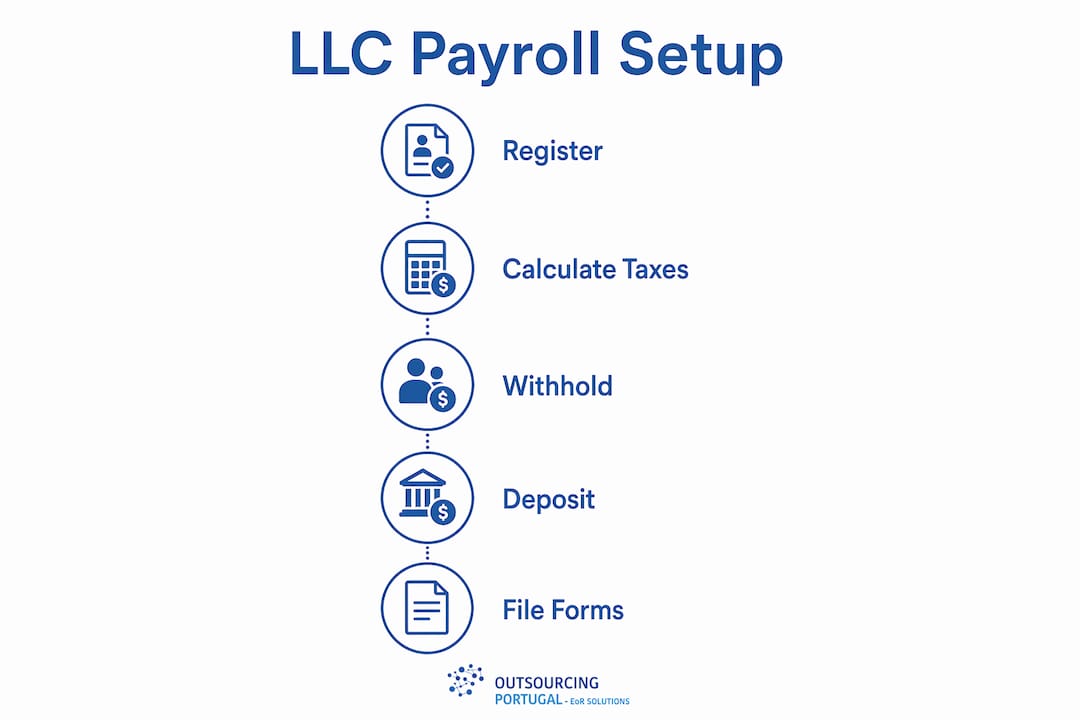
Setting up payroll correctly from the start prevents the most common and costly compliance errors. The process follows a clear sequence regardless of the LLC’s size.
- Obtain an Employer Identification Number (EIN) from the IRS. This is free and takes minutes online. You cannot run payroll or open a business bank account without it.
- Register for federal payroll tax accounts. The IRS automatically activates your payroll tax account once you file your first Form 941.
- Register with your state for unemployment insurance, income tax withholding, and any required workers’ compensation accounts.
- Classify all workers correctly as employees or independent contractors. Misclassification is one of the most audited areas in small business payroll.
- Set your payroll schedule and communicate it to employees. Most states require a minimum pay frequency, typically biweekly or semimonthly.
- Calculate and withhold taxes for each pay period using IRS Publication 15 (Circular E) as your guide.
- Deposit withheld taxes on the IRS schedule. New employers typically start as monthly depositors.
- File quarterly and annual reports including Form 941, Form 940, and state equivalents.
The table below summarizes the core forms and their deadlines:
| Form | Purpose | Deadline |
|---|---|---|
| Form 941 | Quarterly payroll tax report | Last day of the month after each quarter |
| Form 940 | Annual federal unemployment tax | january 31 |
| W-2 | Employee wage and tax statement | january 31 |
| 1099-NEC | Contractor payment report | january 31 |
| State UI report | Unemployment insurance filing | Varies by state, typically quarterly |
Maintaining separate payroll systems protects liability and strengthens compliance. Many business owners underestimate the complexity involved until they face their first penalty notice.

Should you outsource LLC payroll or handle it in-house?
Payroll errors cause penalties starting almost immediately upon a missed tax deposit. That reality makes payroll one of the highest-risk administrative functions for small businesses. The question is not whether to take it seriously. The question is whether to manage it internally or hand it to a specialist.
Automated payroll software handles tax calculations, deposit scheduling, and year-end form generation with minimal manual input. Most platforms integrate with accounting software and flag compliance issues before they become penalties. For LLCs with fewer than ten employees, a quality software platform covers most needs at a predictable monthly cost.
Outsourced payroll services for international businesses go further. They assign dedicated specialists who monitor regulatory changes, handle state registrations, and take on liability for filing errors. This matters most for LLCs operating across multiple states or jurisdictions, where compliance rules change frequently and the cost of a mistake is high.
Benefits of outsourcing LLC payroll:
- Eliminates the risk of missed deposit deadlines and associated penalties
- Handles multi-state registration and compliance automatically
- Generates W-2s, 1099s, and quarterly filings without owner involvement
- Provides audit support if the IRS or a state agency raises questions
- Frees owner time for revenue-generating activities
Pro Tip: When evaluating payroll providers, ask specifically whether they assume liability for filing errors. Some platforms calculate taxes but leave the filing responsibility with you. That distinction matters enormously if something goes wrong.
You can also explore payroll technology options designed for businesses that need flexible, compliant payroll administration without building an internal HR function.
What state-specific payroll rules apply to LLCs?
State payroll obligations vary widely and cannot be inferred from federal rules. LLC members may opt out of workers’ compensation in many states, but the application process and eligibility criteria differ significantly by jurisdiction. Some states require a formal exclusion filing. Others grant automatic exclusion to members below a certain ownership threshold.
State disability and paid family leave contributions range from 0.19% to 1.3% of wages depending on the state. California, New York, New Jersey, and Washington have mandatory programs that require both employer registration and employee payroll deductions. Ignoring these obligations is not an option. State labor agencies audit small businesses regularly and assess back contributions with interest.
Key state-level payroll obligations to verify for your LLC:
- Unemployment insurance: Required in every state. Rates vary based on your industry and claims history.
- Income tax withholding: Required in most states with an income tax. A few states, including Texas and Florida, have no state income tax.
- Workers’ compensation: Required for employees in nearly all states. LLC members may qualify for exclusion.
- Disability insurance: Mandatory in California, New York, New Jersey, Rhode Island, and Hawaii.
- Paid family leave: Required in California, New York, New Jersey, Washington, Massachusetts, and Connecticut, among others.
Check your state’s department of labor and department of revenue websites before running your first payroll. Registering late triggers back assessments that often exceed the original tax owed.
Key Takeaways
LLC payroll obligations are determined by tax classification, not by the number of owners or the size of the business.
| Point | Details |
|---|---|
| Default LLC payroll | Owners take draws, not wages; payroll is only required for employees. |
| S-Corp salary requirement | Owner-operators must pay themselves a reasonable salary subject to full payroll taxes. |
| S-Corp tax savings threshold | The election typically pays off above $80,000 in net income after accounting for compliance costs. |
| State compliance varies | Workers’ comp, disability, and paid family leave rules differ by state and require separate registration. |
| Outsourcing reduces risk | Dedicated payroll providers assume liability for filing errors and handle multi-state compliance automatically. |
The real cost of getting LLC payroll wrong
Most LLC owners I work with underestimate payroll complexity until they receive their first penalty notice. The IRS does not send warnings before assessing failure-to-deposit penalties. The notice arrives after the fact, and the clock on interest starts immediately.
The S-Corp election conversation is where I see the most expensive mistakes. Owners elect S-Corp status because they read that it saves on self-employment taxes, which it does. But they skip the modeling step. They do not calculate whether their actual savings exceed the cost of payroll processing, quarterly filings, and the additional bookkeeping an S-Corp requires. At $60,000 in net income, the math often does not work. At $130,000, it usually does. The income level matters.
My strongest advice is to treat payroll as a compliance function, not an accounting task. Payroll accuracy is a legal requirement. The businesses that handle it best are the ones that set up dedicated systems early, separate payroll accounts from operating accounts, and review their payroll strategy annually as income grows. A payroll structure that made sense at $75,000 in net profit may need adjustment at $150,000.
— Paulo
Outsourcing-portugal: payroll and employment compliance support
Managing LLC payroll across jurisdictions adds layers of complexity that most internal teams are not built to handle. Outsourcing-portugal provides employment outsourcing services that cover payroll administration, tax compliance, and HR support for businesses operating across borders.

Whether you are hiring your first employee or managing a distributed team, Outsourcing-portugal’s employment outsourcing services handle the compliance infrastructure so you can focus on the business. From payroll tax deposits to worker classification reviews, the team manages the details that carry the highest penalty risk. Explore payroll and HR solutions built for businesses that need accuracy and compliance without building an internal payroll department from scratch.
FAQ
Does an LLC have to run payroll for its owners?
A default LLC does not run payroll for its owners. Owners take draws from profits and pay self-employment tax directly. Payroll for owners is only required if the LLC elects S-Corporation or C-Corporation tax status.
What is a reasonable salary for an S-Corp LLC owner?
The IRS defines a reasonable salary as compensation comparable to what the owner would earn performing the same work for another employer. There is no fixed dollar amount. The IRS uses industry wage data and the owner’s actual duties to evaluate whether the salary is appropriate.
What forms does an LLC need to file for payroll taxes?
An LLC with employees files Form 941 quarterly, Form 940 annually, and W-2s for each employee by january 31. Independent contractors receive Form 1099-NEC instead of a W-2.
At what income level does S-Corp election make sense for an LLC?
The S-Corp election typically becomes worthwhile at around $80,000 in net income, depending on payroll service fees and bookkeeping costs. Below that threshold, compliance costs often exceed the tax savings.
Can LLC members opt out of workers’ compensation?
LLC members can opt out of workers’ compensation in many states, but the process and eligibility rules vary by jurisdiction. Some states require a formal exclusion application. Check your state’s workers’ compensation board for the specific procedure.