
TL;DR:
- Building remote teams requires a clear operating model, a disciplined tool stack, and structured onboarding processes to ensure efficiency and scalability.
- Prioritizing written communication, defining norms, and enforcing protocols prevent burnout and foster effective collaboration across time zones.
A remote team is a group of employees working across different locations, time zones, and often countries, coordinated through digital tools rather than a shared office. This remote team setup guide gives managers and HR professionals at international companies a step-by-step framework for building distributed teams that actually perform. The core components are your operating model, your tool stack, your hiring criteria, your onboarding program, and your culture rituals. Get all five right before you hire your first person, and you avoid the expensive rebuilding that derails most distributed teams.
What operating model should your remote team use?
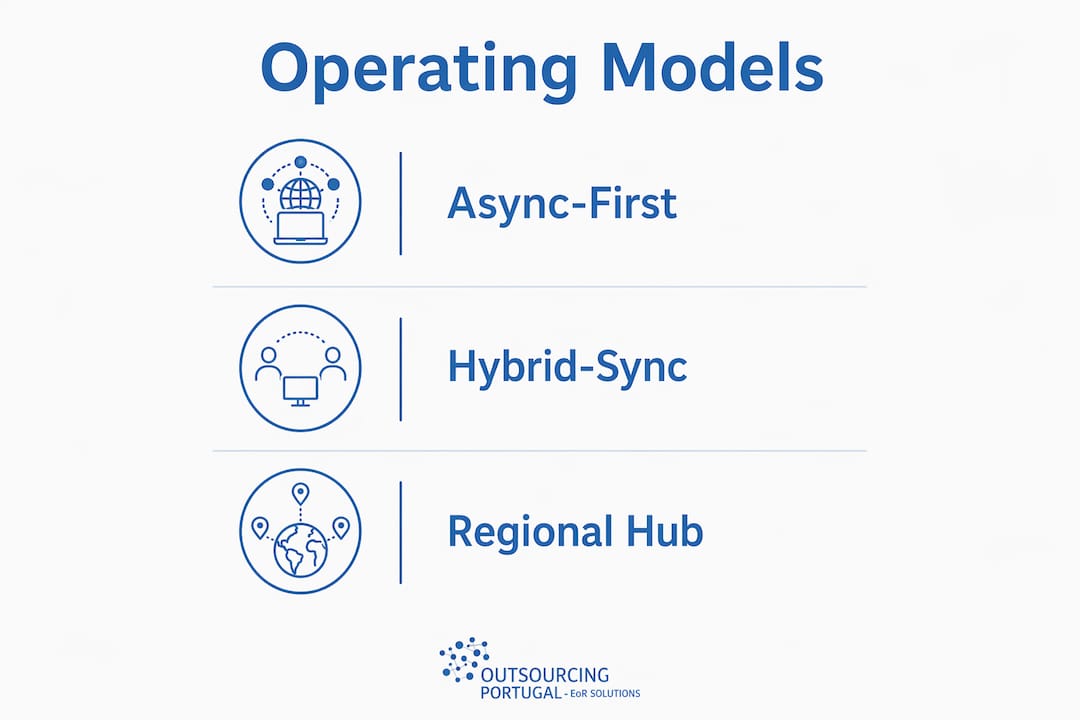
The operating model is the single most important decision in any virtual team management guide. It determines how your team communicates, makes decisions, and ships work across time zones. Three models dominate in 2026.

| Model | Best for | Key requirement |
|---|---|---|
| Async-first | Teams spanning 3+ time zones | Written communication discipline |
| Hybrid-sync | Teams within 2–3 time zone overlap | Defined meeting windows |
| Regional hub | Teams clustered by geography | Overlap hours and shared standups |
Teams adopting async-first models report up to 95% asynchronous communication. That figure means the vast majority of decisions, updates, and feedback happen in writing, not in meetings. If your team spans North America and Europe, async-first is not optional. It is the only model that scales without burning people out.
The hybrid-sync model works when your team shares at least four hours of overlap daily. You schedule two or three live meetings per week and handle everything else asynchronously. Regional hub teams, common in nearshore setups like Portugal-based engineering teams, operate more like traditional offices during local hours but still need async protocols for cross-region coordination.
Before you post a single job listing, write down your communication norms. Define which channels carry which types of messages, how quickly people must respond, and how decisions get made when no one replies. Async decision-making protocols that treat silence as consent within a fixed deadline prevent the multi-week delays that kill momentum across global time zones.
Pro Tip: Set your operating model in a one-page document before your first hire. New team members who read it on day one calibrate their behavior immediately, which saves you weeks of correction later.
What are the best tools for remote teams?
The standard remote tool stack in 2026 is Slack for chat, Linear or Jira for project tickets, Notion for documentation, Loom for async video, and Google Meet for synchronous meetings. Using one tool per job function reduces notification overload by roughly one week per month. That is not a minor efficiency gain. It means your team gets back 12 weeks of focused work per year just by eliminating tool sprawl.
Here is how each tool maps to its function:
- Slack: Real-time chat, channel-based announcements, and direct messages
- Linear or Jira: Sprint planning, bug tracking, and task assignment
- Notion: Team wiki, process documentation, and meeting notes
- Loom: Async video walkthroughs, code reviews, and design feedback
- Google Meet: Weekly all-hands, 1:1s, and client calls
The tool stack alone is not enough. You need a communication handbook that governs how these tools are used. A communication handbook with explicit response times, such as responding to Slack mentions within four hours, prevents the “always-on” culture that leads to burnout. The handbook should also define meeting load limits, async standup formats, and escalation paths for urgent issues.
Security is non-negotiable for international teams. Require single sign-on (SSO) across all tools, enforce multi-factor authentication (MFA), and use a password manager like 1Password or Bitwarden for shared credentials. A security breach in a distributed team is harder to contain than in an office, so the controls need to be set up before anyone logs in.
Pro Tip: Build your communication handbook in Notion and link it from your Slack workspace description. Every new hire sees it on their first day without you having to send it manually.
How do you hire effectively for remote roles?
Remote hiring has one criterion that outranks all others: written communication. Remote hiring must prioritize written communication skills because candidates who are brilliant in person but cannot write clearly create coordination bottlenecks that slow every project they touch. Your hiring process needs to surface this skill early.
Build a role scorecard before you open any position. The scorecard defines the role’s mission in one sentence, lists three to five expected deliverables for the first 90 days, and specifies decision rights. Decision rights tell the candidate which choices they own independently and which require sign-off. This clarity attracts self-directed candidates and filters out people who need constant supervision.
Follow this sequence when building your remote team:
- Hire a senior anchor first. Hiring a strong senior anchor individual first prevents the costly rebuilding that comes from premature mass hiring. This person sets documentation standards, defines process rituals, and models the communication behavior you want the whole team to adopt.
- Write a short exercise into the process. Ask candidates to write a one-page strategy document, a technical proposal, or a project postmortem. The quality of their writing tells you more than any interview.
- Evaluate async responsiveness. Send candidates a written question by email and observe how quickly and clearly they respond. This is a direct simulation of how they will behave on the job.
- Check for time zone compatibility. Confirm the candidate’s working hours overlap with your core team window before extending an offer.
Pro Tip: Use a passive talent sourcing playbook to reach candidates who are not actively job hunting. The best remote workers are often already employed and need a specific reason to move.
What does structured remote onboarding look like?
Structured remote onboarding is a 2–4 week program that begins before the employee’s first day and ends with a completed deliverable. Structured onboarding programs with pre-shipped equipment, scheduled 1:1s, and immediate small deliverables reduce interruptions by 30–50% in the first month. That reduction matters because interruptions in a remote context are expensive. Every question a new hire asks pulls a senior team member out of deep work.
The equipment question is straightforward. Organizations commonly provide a $1,000 home-office stipend per new hire, covering an ergonomic chair, adjustable monitor stand, and keyboard. Ship the equipment before day one or transfer the stipend at least one week before the start date. A new hire who spends their first morning troubleshooting a broken setup loses trust in your organization immediately.
Your onboarding workflow should include:
- A welcome direct message in Slack sent before 9 AM on day one
- A pre-built checklist in Notion covering tool access, handbook review, and first-week meetings
- A buddy assignment pairing the new hire with a peer for informal questions
- A scheduled 1:1 with their manager on day one, day three, and day seven
- A first small project or deployment completed by the end of week one
The first deliverable is the most important element. Completing something real in week one builds confidence and signals to the new hire that they are trusted to contribute immediately. For international onboarding specifically, the international onboarding guide from Outsourcing-portugal covers the legal and HR dimensions that domestic onboarding programs typically miss.
How do you build remote team culture that actually works?
Remote culture is built through operating behaviors, not social events. Remote culture is best built through async-only weeks and weekly all-hands rather than virtual happy hours. Async-only weeks, where the team runs for five days without a single scheduled meeting, test whether your processes are genuinely self-sufficient. Most teams discover gaps they did not know existed.
The behaviors that build culture in distributed teams are:
- Weekly all-hands: A 30-minute video call where leadership shares company updates and team members ask questions publicly
- Async standups: Daily written updates posted in Slack by each team member covering what they did, what they plan to do, and any blockers
- KPI reviews: Monthly output reviews focused on results, not activity or hours logged
- Documentation sprints: Quarterly sessions where the team updates the Notion wiki with new processes and decisions
A centralized documentation culture reduces questions and interruptions while creating institutional memory that survives team turnover. Teams that write things down consistently outperform those that rely on oral knowledge transfer.
Burnout prevention requires explicit rules, not good intentions. Set a policy that no one is expected to respond outside their stated working hours. Publish those hours in each person’s Slack profile. Remove the ambiguity that makes remote workers feel they must always be available.
Performance management in remote teams must measure outputs, not activity. Track what people deliver, not when they log in.
For teams operating across cultures, the multicultural team management guide from Outsourcing-portugal provides specific techniques for managing communication style differences that affect async collaboration.
Key takeaways
Effective remote team setup requires defining your operating model, building a dedicated tool stack, hiring for written communication, and running structured onboarding before you scale headcount.
| Point | Details |
|---|---|
| Operating model first | Choose async-first, hybrid-sync, or regional hub before hiring anyone. |
| One tool per function | Use Slack, Notion, Linear, and Loom to cut notification overload by roughly one week per month. |
| Hire a senior anchor first | A strong first hire sets documentation standards and prevents costly team rebuilding later. |
| Ship equipment before day one | A $1,000 stipend and pre-shipped gear reduce first-month interruptions by 30–50%. |
| Build culture through behavior | Async-only weeks and weekly all-hands outperform virtual social events for team cohesion. |
What most remote team guides get wrong
I have watched international companies make the same mistake repeatedly: they hire fast and build infrastructure later. The logic seems reasonable. You have budget, you have roles to fill, and you want momentum. The result is always the same. Six months in, the team is held together by a tangle of Slack threads, undocumented decisions, and senior people spending half their time answering questions that should be in a wiki.
The fix is not complicated, but it requires discipline before the pressure to hire kicks in. Write your communication handbook first. Define your tool stack and enforce it. Hire your senior anchor and give them four to six weeks to build the documentation foundation before you bring in anyone else. This sequence feels slow. It is actually the fastest path to a team that scales without breaking.
The ergonomic investment is another area where companies underinvest. A $1,000 stipend per hire sounds like a cost. It is actually a productivity purchase. A developer with a proper monitor setup and an ergonomic chair produces more and takes fewer sick days than one hunched over a laptop on a kitchen table.
One more thing: async decision-making protocols are not bureaucracy. They are the mechanism that lets your team move without waiting for a meeting. Treat silence as consent after a fixed deadline. Post the decision in Notion. Move on. Teams that master this ship faster than teams that require consensus on everything.
How Outsourcing-portugal simplifies your remote team setup in Portugal
Building a distributed team across borders means managing employment law, payroll, and compliance in every country where you hire. That administrative load slows down the operational work described in this guide.
Outsourcing-portugal handles the legal and HR infrastructure so you can focus on building the team itself. Through Employer of Record services in Portugal, Outsourcing-portugal employs your team members compliantly under Portuguese law, manages payroll, and handles all statutory obligations. You get the talent and the operating model. Outsourcing-portugal handles the entity, the contracts, and the compliance. For companies exploring global employment solutions for Portugal, this approach removes the biggest barrier to building a nearshore team quickly and legally.
FAQ
What is the first step in setting up a remote team?
Define your operating model before hiring anyone. Choose between async-first, hybrid-sync, or regional hub based on your team’s time zones and collaboration needs, then write a communication handbook that governs tool use and response times.
How long should remote onboarding take?
Structured remote onboarding programs last 2–4 weeks and include pre-shipped equipment, scheduled 1:1s, and a first deliverable completed by the end of week one. This structure reduces first-month interruptions by 30–50%.
What tools do remote teams need in 2026?
The standard stack is Slack for chat, Linear or Jira for project management, Notion for documentation, Loom for async video, and Google Meet for live meetings. Using one tool per function reduces notification overload significantly.
Why does written communication matter so much in remote hiring?
Remote teams operate primarily through written async channels, so candidates who cannot write clearly create coordination bottlenecks. A short written exercise during the hiring process is the most reliable way to evaluate this skill.
What is an Employer of Record and why does it matter for remote teams?
An Employer of Record (EOR) is a third-party company that legally employs workers on your behalf in a foreign country, handling payroll, taxes, and compliance. For international companies hiring in Portugal, an EOR removes the need to set up a local legal entity before building your team.