

TL;DR:
- EU legal compliance requires companies to follow all binding EU laws across their operations, including Portugal. Non-compliance can lead to severe fines, operational bans, and reputational damage. Establishing a compliance management system and appointing clear ownership helps manage obligations efficiently.
EU legal compliance is defined as the obligation to meet all binding European Union laws, including directly applicable Regulations and nationally transposed Directives, across every aspect of your business operations. For international companies hiring and operating in Portugal, this means navigating a layered framework that covers data protection under GDPR, AI governance under the EU AI Act, sustainability reporting under CSRD, and employment law aligned with Portuguese labor statutes. Non-compliance carries fines up to 4% of global turnover under GDPR alone, plus operational restrictions and reputational damage that can end market access entirely. The stakes in 2026 are higher than ever, and understanding what EU regulatory compliance requires is the first step toward protecting your operations.
What is EU legal compliance and how does it apply in Portugal?
EU legal compliance means your company acts in a legally correct, transparent manner across anti-corruption, data protection, sustainability, employment, and competition law. The framework divides into two instrument types, each with different operational implications.
Regulations apply directly and immediately across all EU member states, including Portugal, without any national legislative step. Directives require each member state to pass national legislation within a set transposition period, typically 2–3 years. Portugal then enforces those transposed rules through its own legal code, which means your compliance team must track both the EU source text and the Portuguese implementation.
| Instrument | How it applies | Operational impact |
|---|---|---|
| EU Regulation | Directly binding, no transposition needed | Immediate compliance required on effective date |
| EU Directive | Requires Portuguese national law | Monitor transposition timeline and local text |
| National law | Portuguese-specific implementation | May add stricter requirements than the Directive |
The major compliance domains affecting Portugal-based operations include GDPR for personal data, the EU AI Act for algorithmic hiring tools, CSRD for sustainability disclosures, DORA for digital operational resilience, and the EU Employment Directives covering working conditions and pay transparency.
Pro Tip: Map every tool and process your Portugal team uses against these five domains before your next compliance review. A single AI-powered recruitment platform can trigger obligations under both GDPR and the AI Act simultaneously.
Which EU compliance areas matter most for hiring in Portugal?
Employment law is the most immediate compliance area for any company hiring in Portugal. EU Directives on transparent and predictable working conditions, adequate minimum wages, and work-life balance have all been transposed into Portuguese labor law. Your employment contracts, working-hour policies, and termination procedures must reflect both the EU Directive requirements and the Portuguese Labor Code.

GDPR governs every piece of employee data you collect, store, or transfer. This includes recruitment data, payroll records, performance files, and any monitoring of remote workers. Processing employee data requires a lawful basis, typically a contractual necessity or legitimate interest, and employees retain rights to access, correction, and erasure.
The EU AI Act introduces a new layer of obligation for companies using algorithmic tools in hiring. Systems that score candidates, screen resumes automatically, or assess emotional states during interviews are classified as high-risk under the Act. High-risk systems require documented risk assessments, human oversight mechanisms, and audit logs available on demand.
Key compliance obligations for hiring and operations in Portugal:
- Provide written employment contracts that meet EU transparency requirements before or on the first day of work
- Appoint a Data Protection Officer if your processing of employee data is large-scale or systematic
- Conduct a conformity assessment for any AI tool used in recruitment or workforce management
- Implement CSRD sustainability reporting if your company meets the size thresholds (250+ employees or €40 million turnover)
- Maintain documented training records for all staff with compliance responsibilities
- Establish a whistleblower channel meeting EU Whistleblower Directive standards
Pro Tip: Review your HR software vendor’s EU AI Act compliance documentation now. If your vendor cannot produce a conformity assessment for high-risk AI features, you share liability for its use.
What are the penalties for non-compliance with EU regulations in Portugal?
Financial penalties under EU law are calculated to hurt at scale. GDPR fines reach up to 4% of global annual turnover, with no cap on the absolute euro amount for large multinationals. The EU AI Act sets a separate penalty structure: prohibited AI practices trigger fines of up to €35 million or 7% of worldwide turnover, whichever is higher. Other AI Act violations carry fines up to €15 million or 3%, and providing incorrect information to regulators costs up to €7.5 million or 1%.
Beyond fines, non-compliance triggers operational consequences that can be more damaging than the financial penalty itself. These include:
| Consequence | Trigger | Business impact |
|---|---|---|
| License revocation | Repeated or severe violations | Loss of right to operate in Portugal |
| EU tender exclusion | Compliance failures on record | Blocked from public procurement contracts |
| Market ban | Prohibited product or AI practice | Forced withdrawal of services from EU market |
| Reputational damage | Public enforcement decisions | Customer and partner attrition |
Enforcement in Portugal is carried out by the CNPD (the national data protection authority) for GDPR matters, and by sector regulators for financial, AI, and product compliance. The European Commission coordinates cross-border enforcement for the largest cases.
Audit readiness is not optional. Compliance files and exception registers must be maintained continuously so that your team can respond to a regulator’s request within hours, not weeks. Under the AI Act, documentation must be provided immediately upon authority request, with no grace period for assembly.
How can international companies operationalize EU compliance in Portugal?
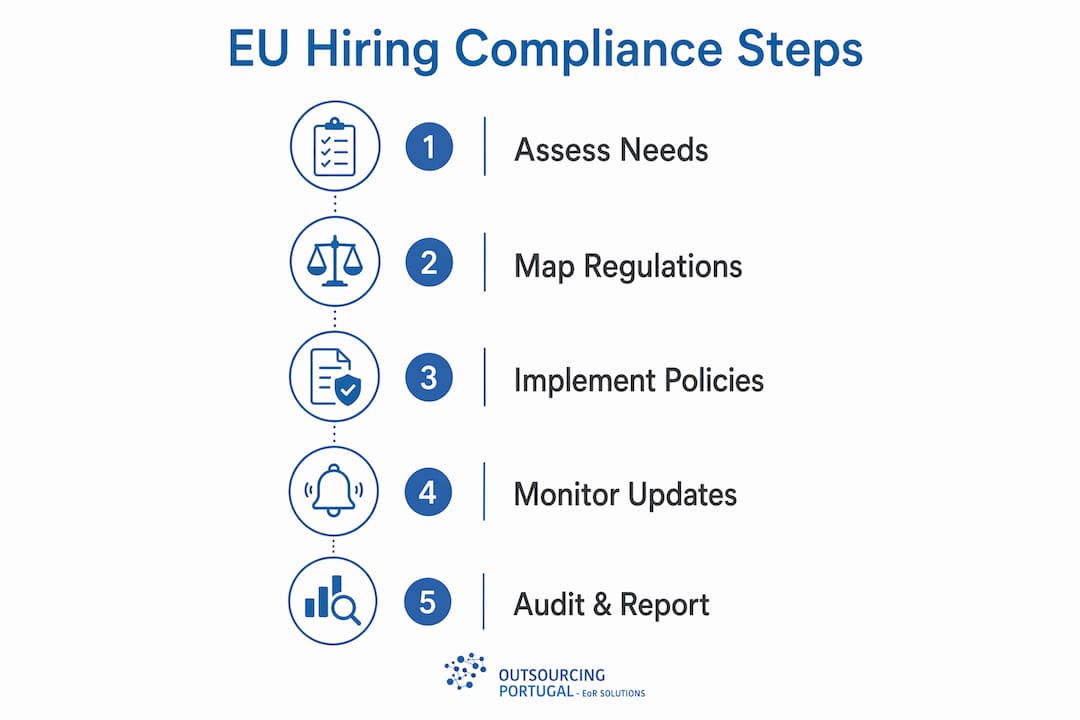
A Compliance Management System (CMS) is the structural foundation for meeting European compliance requirements at scale. A CMS is not a single software product. It is a documented set of policies, controls, reporting channels, training programs, and escalation procedures that covers all compliance domains from anti-corruption to ESG. Building one requires five concrete steps.
-
Conduct a compliance gap assessment. Map your current Portugal operations against GDPR, the AI Act, CSRD, DORA, and applicable employment directives. Identify every process, tool, and data flow that touches a regulated domain.
-
Assign ownership. Each compliance domain needs a named owner with authority to enforce controls. For GDPR, this is typically your Data Protection Officer. For AI Act compliance, assign a technical lead who can produce conformity documentation.
-
Implement automated digital traceability. Manual reporting no longer meets the audit and disclosure standards required under CSRD and the EU Battery Regulation. Automated governance tools that generate real-time audit trails are now the baseline expectation for 2026 compliance programs.
-
Build your compliance file. Maintain a central repository containing contracts, risk assessments, training records, incident logs, and exception registers. This file must be structured so that any document can be retrieved and presented to a regulator within one business day.
-
Extend compliance to your supply chain. Regulatory accountability now extends to third-party vendors and open-source software dependencies. Under DORA, your ICT vendors must meet operational resilience standards, and you bear accountability for their failures. Audit your vendor contracts and require compliance attestations annually.
Continuous monitoring is the final, non-negotiable element. Compliance is an ongoing operational state, not a one-time certification. Schedule quarterly reviews of regulatory updates from the European Commission, the CNPD, and Portugal’s Authority for Working Conditions (ACT) to catch transposition changes before they create gaps.
Pro Tip: Set up automated alerts for Official Journal of the European Union publications in your compliance domains. New Regulations take effect the moment they are published, and waiting for your legal team to flag them manually creates a window of unintentional non-compliance.
Key Takeaways
EU legal compliance in Portugal requires immediate adherence to EU Regulations and active monitoring of Directive transpositions, covering employment law, GDPR, the AI Act, and CSRD.
| Point | Details |
|---|---|
| Two-tier legal framework | EU Regulations apply immediately; Directives require Portuguese national transposition within 2–3 years. |
| Five core compliance domains | GDPR, AI Act, CSRD, DORA, and employment directives each carry distinct obligations for Portugal operations. |
| Penalty severity | AI Act fines reach €35 million or 7% of turnover; GDPR fines reach 4% of global annual revenue. |
| Documentation is non-negotiable | Compliance files and exception registers must support immediate regulator response, with no assembly delays. |
| Supply chain accountability | International companies bear legal responsibility for the compliance of their ICT vendors and software dependencies. |
Why compliance culture beats compliance checklists
Most compliance failures I see in international companies operating in Portugal are not failures of knowledge. They are failures of ownership. A company knows GDPR applies. It knows the AI Act is live. What it lacks is a named person who wakes up every morning treating compliance as their primary operational responsibility, not a quarterly review item.
The shift to automated digital traceability in 2026 is genuinely significant. Companies that built their CSRD and GDPR programs on spreadsheets and manual audits are now structurally behind. Automated governance tools are not a luxury for large enterprises. They are the minimum viable infrastructure for any company with more than 50 employees operating across EU jurisdictions.
The AI Act is the regulation I see most underestimated. Business leaders assume it applies to AI companies, not to companies that use AI tools. That assumption is wrong. If your Portugal HR team uses an AI-powered applicant tracking system, you are an operator under the Act, and operator obligations are substantial. The time to audit your hiring technology stack is before a regulator asks you to.
My strongest recommendation is to treat your legal compliance in Portugal program as a living system with quarterly update cycles, not an annual audit. The regulatory calendar in 2026 is moving faster than most compliance teams are staffed to handle. Build the infrastructure now, assign the ownership clearly, and document everything as if a regulator will read it tomorrow.
— Paulo
How Outsourcing-portugal helps you stay compliant while hiring in Portugal
Managing EU regulatory compliance while building a team in Portugal is a significant operational challenge for any international company without a local entity.
Outsourcing-portugal provides Employer of Record services that place the legal employment relationship, payroll obligations, and Portuguese labor law compliance under a locally established entity. This means your company can hire in Portugal without setting up a subsidiary, while a dedicated compliance team handles GDPR-aligned employment contracts, ACT reporting, and EU Directive adherence on your behalf. Outsourcing-portugal also supports onboarding, HR documentation, and audit-ready record-keeping so your compliance file is always current. For international teams ready to hire in Portugal with full legal coverage, explore employment solutions built for EU compliance from day one.
FAQ
What is EU legal compliance in simple terms?
EU legal compliance means your business meets all binding European Union laws, including Regulations that apply directly and Directives implemented through national law, across every operational domain from data protection to employment.
Does GDPR apply to employee data in Portugal?
GDPR applies to all personal data processing in Portugal, including employee recruitment records, payroll data, and workforce monitoring. Companies must have a lawful basis for each processing activity and must honor employee data rights.
What fines does the EU AI Act impose?
The EU AI Act sets fines up to €35 million or 7% of worldwide turnover for prohibited AI practices, and up to €15 million or 3% for other violations, whichever amount is higher.
How do EU Regulations differ from EU Directives?
EU Regulations apply directly and immediately in all member states without national legislation. Directives require each country, including Portugal, to pass implementing laws within a defined transposition period, typically 2–3 years.
What is the fastest way to ensure EU compliance when hiring in Portugal?
Using an Employer of Record in Portugal transfers employment law obligations to a locally compliant entity, covering contracts, payroll, GDPR-aligned HR records, and labor authority reporting from the first hire.