

Budget an amount typically between one-third and nearly one-half above gross annual pay to employ a tech worker in Portugal once you add the mandatory 14-month payments, the employer social security contribution, meal allowance, and work-accident insurance. For example, a €3,000 monthly gross salary results in a total annual employer cost significantly above €40,000. Youth and long-term unemployment hiring incentives can reduce the employer social security contribution if correctly applied for before hiring.
TL;DR:
- Employer total costs in Portugal typically range from 130% to 145% of gross salary once the 14-month pay structure, social security, insurance, and allowances are included.
- Fixed costs like meal allowance and accident insurance weigh more heavily at entry levels, causing multipliers to be higher for junior roles than for senior positions.
- Properly applying hiring incentives such as TSU reductions for youth or long-term unemployed hires requires early planning and accurate documentation before contract signings.
- Using an Employer of Record is usually more cost-effective for fewer than 8 to 15 hires, while establishing a local entity becomes cheaper with larger teams.
- Budget calculations must account for pro-rated allowances, legal contributions, and potential incentives to avoid significant underestimation of actual employment costs.
Table of Contents
- What Do Salários Tech Portugal Benchmarks Actually Look Like?
- How to Calculate Total Employer Cost, Step by Step
- Which Hiring Incentives Cut Your TSU Bill?
- EOR or Local Entity: Which Actually Costs Less?
- A Compact Checklist to Budget and Reduce Cost Legally
- What Do Developers, Engineers, and Managers Actually Earn?
- Do Salaries Vary by Region Within Portugal?
- Where Is the Portuguese Tech Salary Market Headed?
- How Does Portugal Compare to Other European Tech Hubs?
- How Much Do Experience and Education Move the Number?
- What Benefits Do Portuguese Tech Companies Offer Beyond Salary?
- A Perspective on Hiring Tech Talent in Portugal
- How Outsourcing Portugal Turns These Numbers Into a Hire
- Sources
- FAQ
What Do Salários Tech Portugal Benchmarks Actually Look Like?
The multiplier changes depending on where a role sits on the pay scale, and the reason is almost entirely fixed costs. Meal allowance and accident insurance premiums don’t scale with salary the way TSU does, so they eat a bigger percentage of total cost at the entry level than they do for a senior architect earning triple the base pay.
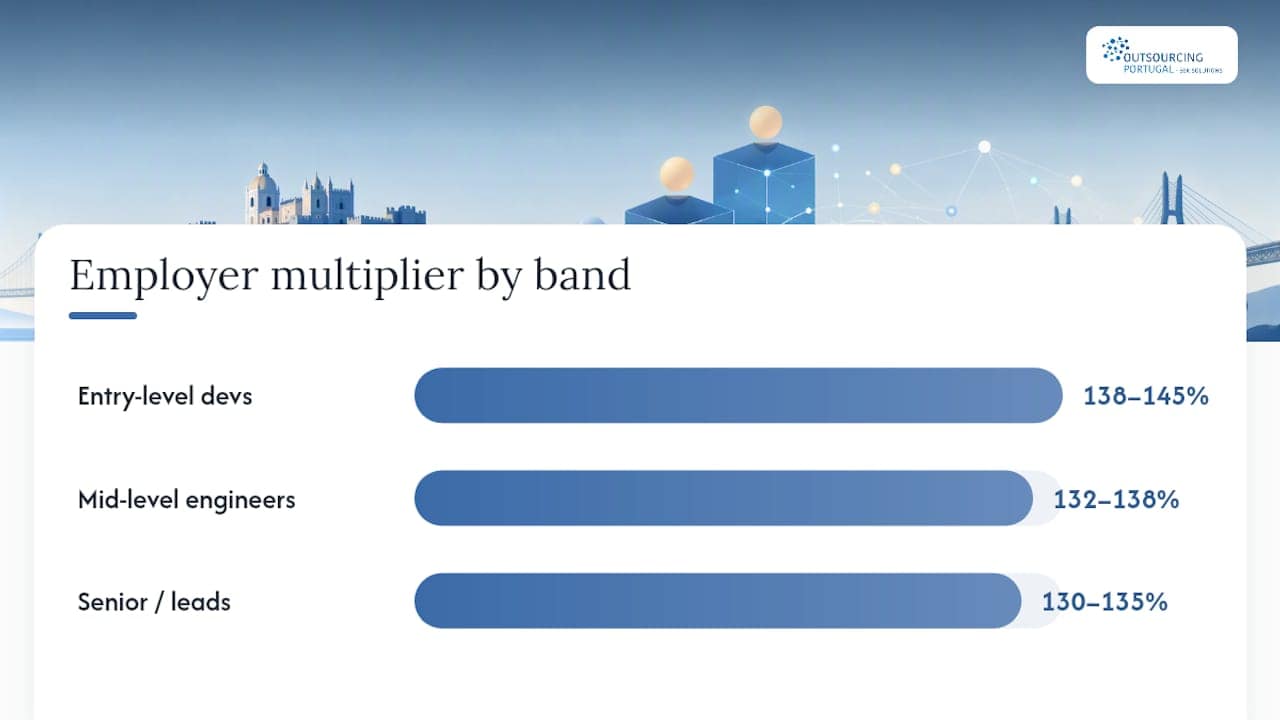
Here’s how the multiplier typically breaks down by band:
- Entry-level developers (junior, 0 to 2 years): multiplier often runs 138% to 145%, because fixed costs like meal allowance represent a larger share of a smaller gross salary.
- Mid-level engineers (3 to 6 years): multiplier settles closer to 132% to 138% as the same fixed costs shrink as a percentage of pay.
- Senior and lead roles (7+ years, engineering managers): multiplier often sits at the lower end, 130% to 135%, since TSU dominates the cost structure at this point.
Employer cost benchmark: according to Simula, total employer cost in Portugal typically lands between 130% and 145% of gross pay once the 14-month structure, TSU, meal allowance, and insurance are all included.
Take a mid-level developer earning €3,000 gross per month. Multiply by 14 to get €42,000 in annual gross pay. Applying a multiplier around the typical range for this salary band yields a total annual employer cost notably above gross pay, before factoring in any hiring incentive that might reduce employer social security contributions. That gap between gross salary and real cost is the number most international hiring teams underestimate on their first Portuguese hire, and it’s precisely the kind of detail a tool that models Portugal’s tech talent market is built to clarify before you sign an offer letter.
Fed Finance’s own worked example puts the multiplier near 1.37 for a €1,500 monthly gross salary profile, reinforcing that lower salary bands carry a heavier proportional load from fixed statutory extras.
How to Calculate Total Employer Cost, Step by Step
Building this number correctly means separating what grows with salary from what doesn’t. Here’s the sequence that produces an accurate figure every time.
- Start with monthly gross salary and multiply by 14. Portugal pays 12 monthly salaries plus a holiday subsidy and a Christmas subsidy, both legally mandated. Skipping this step is the single most common budgeting error international companies make.
- Apply employer TSU at 23.75% to the full 14-month gross figure. This is the employer’s social security contribution, separate from the 11% the employee pays out of their own paycheck.
- Add work-accident insurance, typically budgeted around 1% of gross pay, though the exact premium depends on the insurer and role risk classification.
- Add meal allowance. For 2026, the tax-exempt threshold for meal allowance is higher when paid via meal card compared to cash; it should be multiplied by actual working days in the year rather than by a flat monthly figure.
- Apply any eligible TSU reduction or exemption for incentivized hires before finalizing the annual figure.
- Pro-rate for part-time contracts or mid-year starts, adjusting both the 14-month base and the meal allowance for actual days worked.
It’s a common spreadsheet error and it inflates your budget by a real amount for no reason.
Bonuses complicate this slightly. A discretionary annual bonus still incurs TSU and typically counts toward taxable income for the employee, so treat it as an additional line rather than folding it into the base 14-month calculation. A dedicated employment cost calculator built for Portugal handles these edge cases faster than a manual spreadsheet, particularly for irregular payment schedules.
Which Hiring Incentives Cut Your TSU Bill?
Portugal offers real TSU reductions for specific hiring profiles, but none of them apply automatically. You have to identify eligibility before the contract starts and file the paperwork through Segurança Social Direta.
- First-job youth hires can qualify for a reduced TSU rate for up to five years, depending on age and prior employment history.
- Long-term unemployed hires (typically 12+ months out of work) can trigger a three-year TSU reduction.
- Very long-term unemployed hires may qualify for a full three-year TSU exemption in certain cases, subject to Segurança Social’s specific criteria.
- IEFP grant programs, including Emprego +Talento and +Emprego, offer fixed grants on top of any TSU relief, with amounts indexed to the Indexante dos Apoios Sociais (IAS) and tied to contract type and minimum retention periods.
None of these are retroactive. If you sign a contract first and try to claim the reduction afterward, you’ve likely missed the window. Build the eligibility check into your offer-stage checklist, not your onboarding checklist, and keep documentation on file. Segurança Social audits these claims, and losing eligibility retroactively means repaying the difference plus penalties.
EOR or Local Entity: Which Actually Costs Less?
Speed and headcount decide this question more than anything else. An Employer of Record lets you hire in days rather than months, charging a per-employee monthly management fee on top of the statutory pass-through costs already discussed above.
Setting up a Portuguese entity means a different cost profile entirely:
- Legal incorporation, registered office, and local accounting fees, all before your first hire even starts.
- Ongoing fixed overhead: bookkeeping, compliance filings, and a local payroll function, regardless of headcount.
- A break-even point against EOR fees that market analysis generally places around 8 to 15 employees, depending on your fee structure and overhead assumptions.
Below that threshold, an EOR almost always wins on total cost and certainly wins on speed. Above it, the fixed costs of an entity start to dilute across enough salaries that ownership becomes cheaper long-term.
Pro Tip: Ask any EOR provider for a line-by-line breakdown separating their management fee from statutory pass-through costs like TSU and insurance. Compare those pass-through lines against official rates. If the numbers don’t match, you’re paying a hidden markup dressed up as compliance cost.
A Compact Checklist to Budget and Reduce Cost Legally
- Confirm TSU incentive eligibility before making an offer, not after signing.
- Structure meal allowance through a meal card, not cash, to hit the higher €10.455 daily exemption.
- Pro-rate meal allowance to actual working days rather than a flat monthly assumption.
- Budget on a 14-month basis from day one, with a 1% baseline for accident insurance.
- Consider benefit packaging (health insurance, transport allowance) as a legally exempt way to add candidate value without inflating taxable salary.
- File Segurança Social declarations on time. Late filings can forfeit incentive eligibility even when the hire itself qualified.
Pro Tip: Set a recurring calendar reminder to re-check statutory rates every January. TSU percentages, minimum wage, and meal allowance thresholds all get revised, and last year’s spreadsheet formula can quietly become wrong.
What Do Developers, Engineers, and Managers Actually Earn?
Gross salary ranges vary widely by role and seniority, and that variance is exactly what drives the multiplier differences discussed earlier. Junior developers in Portugal typically start in a lower gross monthly band, while mid-level backend and full-stack engineers command noticeably more. Senior engineers, DevOps specialists, and engineering managers sit at the top of the individual-contributor and first-line-management scale, with data and machine learning specialists often commanding a premium given the smaller talent pool.
Engineering managers and heads of engineering typically earn a further step above senior individual contributors, reflecting both scope and the smaller number of people qualified for the role. The gap between junior and senior compensation in Portuguese tech has widened over recent hiring cycles, largely because demand for senior remote-capable engineers has outpaced the local supply, while junior salaries have grown more slowly.
For international HR teams, the practical takeaway is that role definition matters more than title. A “senior developer” job posting in Lisbon can mean genuinely different compensation depending on whether the company is a local startup, a multinational with a nearshore delivery center, or a foreign-owned remote-first team. Benchmark against the specific skill set and seniority level you need, not just the job title, and build your employer-cost model around the gross figure you’d realistically need to offer to win that candidate in the current market.

Do Salaries Vary by Region Within Portugal?
Lisbon commands the highest gross salaries for tech roles in Portugal, followed by Porto, with a noticeable gap once you move outside these two metro areas. Companies hiring in smaller cities or inland regions can often find comparable technical talent at somewhat lower gross salary expectations, though the difference has been narrowing as remote work normalizes pay expectations nationally.
This matters directly for your employer cost model because TSU, meal allowance rules, and insurance premiums don’t change by region. What changes is the gross base you’re calculating from. A Porto-based senior engineer earning a lower gross salary than a Lisbon-based equivalent will generate a correspondingly lower total employer cost, even though the percentage multiplier stays roughly the same.
Remote-first hiring has complicated this regional logic. Companies building nearshore teams increasingly recruit across the country rather than anchoring to Lisbon specifically, which means HR teams benchmarking “Portugal tech salaries” need to specify whether they mean a Lisbon-anchored figure or a national blended average. The two numbers can differ meaningfully, and using the wrong one in a budget model either overpays for talent outside the capital or underbids candidates you’re trying to recruit in it.
Where Is the Portuguese Tech Salary Market Headed?
Salary growth in Portuguese tech has tracked closely with the country’s growing reputation as a nearshore delivery hub for Western European and North American companies. Demand for senior engineering, cybersecurity, and data specialists has consistently outpaced local graduate output in those specific niches, putting sustained upward pressure on compensation for experienced hires.
Inflation and minimum wage adjustments also filter through the system every year. The national minimum wage for continental Portugal rose to €920 gross monthly for 2026 under Decreto-Lei n.º 139/2025, which pushes up the cost floor for junior hires and, indirectly, exerts upward pressure on salary bands just above minimum wage as employers maintain pay differentials.
Companies planning multi-year hiring in Portugal should expect gradual, not explosive, salary growth for most roles, with sharper increases concentrated in scarce specializations like cloud infrastructure, AI/ML engineering, and cybersecurity. Budget models built on a single year’s benchmark risk going stale within 18 to 24 months in these high-demand niches, less so for more commoditized front-end or QA roles where supply keeps pace with demand.
How Does Portugal Compare to Other European Tech Hubs?
Portugal remains one of the more cost-competitive tech hiring markets in Western Europe, sitting below Germany, the Netherlands, Ireland, and France on gross tech salaries for comparable roles, while still offering an EU-based, English-proficient, and technically capable workforce. That gap is exactly why nearshore delivery models built around Portugal have grown steadily among companies headquartered in higher-cost markets.
The comparison isn’t just about gross pay, though. Employer cost structures differ meaningfully across these countries too.
For HR teams comparing total cost of ownership rather than just headline salary, Portugal’s combination of below-average gross pay and a mid-range statutory burden usually produces a lower blended employer cost than Northern European alternatives, even after accounting for the 14-month structure. That’s the calculation that matters when deciding where to place a nearshore team, not the gross salary figure alone.
How Much Do Experience and Education Move the Number?
Experience level is the single strongest driver of salary variation in Portuguese tech, more so than the specific university or degree a candidate holds. A computer science degree from a Portuguese university carries real weight for entry-level hiring, but by the time a candidate reaches five or six years of experience, demonstrated project history and specific technical skills matter far more to compensation than academic credentials.
Self-taught developers and bootcamp graduates have become increasingly common in the Portuguese market, particularly in web development and QA, and salary data increasingly reflects skill and portfolio strength over formal education at the mid-career level. Advanced degrees still command a premium in specialized fields, particularly data science, machine learning research, and certain cybersecurity roles where a master’s degree or PhD signals depth that’s harder to demonstrate through a portfolio alone.
For employer cost modeling, the practical implication is straightforward: budget by experience band and specialization first, and treat education as a secondary adjustment rather than a primary variable, except in those narrow research-heavy specializations where formal credentials still carry outsized weight in hiring decisions.
What Benefits Do Portuguese Tech Companies Offer Beyond Salary?
Meal allowance is the most universal benefit in the Portuguese labor market, tech included, precisely because of the tax exemption structure discussed earlier. Nearly every formal tech employment contract in Portugal includes it, typically delivered via meal card rather than cash to maximize the exemption threshold.
Health insurance is the next most common addition, offered by the large majority of established tech employers and increasingly expected by candidates as a baseline rather than a differentiator. Beyond that, benefit packages in Portuguese tech companies commonly include some combination of remote or hybrid work flexibility, transport allowances, professional development budgets, and equipment stipends for home office setups.
Equity or stock options appear more often at startups and scale-ups than at larger established companies, though they remain less standardized in Portugal than in markets like the United States. For international companies building an offer package, matching local benefit norms, particularly meal allowance and health insurance, often matters more to candidate acceptance rates than matching absolute gross salary figures, since these benefits are embedded in what Portuguese tech talent expects as standard practice.
A Perspective on Hiring Tech Talent in Portugal
Portugal’s real advantage isn’t the lowest salary in Europe. It’s the combination of educated, multilingual talent, a stable regulatory environment, and a cost structure that’s genuinely competitive once you calculate it correctly. Most hiring mistakes happen at the spreadsheet stage, not the recruiting stage. Get the employer-cost math right and Portugal delivers exactly what it promises.
— Paulo
How Outsourcing Portugal Turns These Numbers Into a Hire
Running these calculations by hand across multiple candidates, salary bands, and incentive scenarios eats real time, and one missed TSU exemption or miscounted meal allowance day can throw an entire budget off. Outsourcing Portugal builds the line-by-line employer cost estimate for you, factoring in the current TSU rate, meal allowance rules, applicable hiring incentives, and your specific role and salary band, so you get one accurate number instead of a spreadsheet full of assumptions.

Beyond the cost estimate, the service covers what happens after you decide to hire: Employer of Record contracts, payroll processing, onboarding, ongoing compliance with Segurança Social filings, and nearshore team setup for companies scaling beyond a single hire. You skip the entity setup, the local accounting overhead, and the guesswork on which incentives your hire actually qualifies for. If you’re ready to see what a specific role and salary band actually costs to employ in Portugal, request a tailored cost estimate and get numbers built around your exact hiring plan rather than a generic benchmark.
Sources
Check Segurança Social Direta for TSU rules, the IEFP hiring supports page for grant programs, and simula.pt’s cost simulator for a quick benchmark. Diário da República publishes the legal text behind each rate. Re-verify every January, since figures change annually.
- Simula
- Segurança Social – direitos e obrigações dos empregadores em Portugal
- Fed Finance — real cost of a worker in Portugal 2026
- Eco article on new minimum wage 2026
FAQ
Can I Reduce My TSU Bill Legally?
Yes. Portugal offers TSU reductions or exemptions for first-job youth hires and long-term unemployed candidates, but you must apply through Segurança Social Direta before or at the point of hire.
Is an EOR Cheaper Than Setting Up a Portuguese Entity?
For most companies hiring fewer than roughly 8 to 15 employees, an Employer of Record like Outsourcing Portugal typically costs less than establishing and maintaining a local entity, largely due to avoided fixed overhead.
How Much Does Meal Allowance Add to Employer Cost?
For 2026, the tax-exempt meal allowance threshold is higher via meal card than cash, representing a fixed cost that HR teams should budget based on actual working days rather than a flat monthly figure.