
TL;DR:
- Relocating to Portugal requires navigating multiple government agencies, legal processes, and tax obligations, not just booking a flight and finding housing.
- Newcomers must carefully select the appropriate visa, obtain a NIF within 48 hours, and prepare for lengthy processing times at AIMA.
Relocating to Portugal as an international professional isn’t as simple as booking a flight and finding an apartment. You’re walking into a process that spans consular appointments, multiple government agencies, new tax obligations, and a housing market with quirks that catch most newcomers off guard. This settlement assistance guide for Portugal breaks down exactly what you need to prepare before you arrive, what to do in your first weeks on the ground, and how to stay legally compliant long after you’ve unpacked. Whether you’re moving independently or with employer support, this is the roadmap you actually need.
Table of Contents
- Key takeaways
- Your settlement assistance guide for Portugal: start here
- Executing your settlement after you arrive
- Residency compliance and tax obligations
- Local resources and expat support networks
- My honest take on settling in Portugal
- How Outsourcing-portugal simplifies your settlement
- FAQ
Key takeaways
| Point | Details |
|---|---|
| Match your visa to your income | Choose between D7, D8, or D2 based on your income source and employment status before applying. |
| Get your NIF on day one | The NIF is required for nearly every legal transaction in Portugal, so obtain it immediately after arrival. |
| Build time buffers | AIMA processing times can exceed a year, so apply early and never plan around ideal timelines. |
| Know the tax regime changes | The NHR program closed in 2024; IFICI now applies to qualified professionals, changing your tax picture significantly. |
| Use specialist support | Housing, legal paperwork, and payroll compliance are areas where professional help prevents costly mistakes. |
Your settlement assistance guide for Portugal: start here
The foundation of a successful relocation is matching the right visa to your situation before you even submit an application. Portugal offers several long-stay visa categories for international professionals, and picking the wrong one wastes months.
Here’s a breakdown of the most relevant visa types:
- D7 (Passive Income Visa): Designed for individuals with stable passive income, including pensions, rental income, or investment returns. You must demonstrate consistent income above a set threshold.
- D8 (Digital Nomad Visa): Built for remote workers and freelancers. The D8 visa requires income of at least four times Portugal’s national minimum wage, which sits at €920/month in 2026, putting the bar at roughly €3,680/month.
- D2 (Entrepreneur Visa): For those launching or running a business with Portuguese market ties.
- Golden Visa alternatives: The traditional property route was largely discontinued, but investment-based routes in venture capital or cultural heritage remain active.
For US citizens specifically, visa-free entry covers stays up to 90 days in the Schengen Area. Professional relocation requires a long-stay residence visa applied for at a Portuguese consulate in your home country.
Documents you’ll need for nearly every visa category:
- Valid passport with at least six months of remaining validity
- Criminal background check apostilled from your country of origin
- Proof of accommodation in Portugal (rental agreement or property deed)
- Proof of health insurance valid in Portugal
- Bank statements or financial records demonstrating income above the threshold
- Completed visa application form with biometric photos
Pro Tip: If you’re a remote worker employed by a foreign company, the D8 is often the clearest path. Review the e-visa Portugal guidance from Outsourcing-portugal before your consulate appointment to avoid documentation gaps.
| Visa Type | Target Profile | Income Requirement |
|---|---|---|
| D7 | Passive income earners, retirees | Approx. €760+/month (minimum wage based) |
| D8 | Remote workers, digital nomads | 4x minimum wage (€3,680+/month in 2026) |
| D2 | Entrepreneurs, self-employed | Business viability proof required |
| Golden Visa alternatives | Investors | Qualifying investment thresholds |
Executing your settlement after you arrive
Once your consulate issues a residence visa, the clock starts. That visa is valid for 120 days and allows two entries into Portugal. During that window, you must complete the next phase: applying for your residence permit through AIMA (Agência para a Integração, Migrações e Asilo), the agency that replaced SEF in late 2023.
Here’s the practical sequence most professionals follow:
- Obtain your NIF (Número de Identificação Fiscal). This is your Portuguese tax identification number. The NIF is required for lease agreements, bank accounts, utility contracts, and almost every legal and financial transaction. Head to a local tax office (Finanças) or use a fiscal representative if you haven’t arrived yet. Get this done within your first 48 hours.
- Open a Portuguese bank account. With your NIF and passport in hand, most major banks will open an account for non-residents or new residents. This is critical for receiving salary payments, paying rent, and meeting financial proof requirements for your permit renewal.
- Schedule your AIMA appointment. Book as early as possible. Processing delays at AIMA are real and well-documented, with some residence card applications taking over a year to complete. Your visa’s entry stamp gives you legal grounds to stay while you wait, but you need that appointment on record.
- Submit biometrics and documents. At your AIMA appointment, you’ll provide fingerprints, your photo, and a full document package including passport, NIF, proof of income, health insurance, and accommodation proof.
- Receive your residence card. First-time cards are typically issued for two years. Renewals follow after that, with the path toward permanent residency opening at the five-year mark.
- Finalize housing. Rental contracts in Portugal require your NIF and typically ask for one to three months of deposit upfront. Understand your rights under Portuguese tenancy law before you sign.
Pro Tip: Keep certified copies of every document you submit to AIMA. If records are lost or questions arise during processing, having your own complete file saves significant time. The workforce settlement guide from Outsourcing-portugal walks through each document step in detail.
Residency compliance and tax obligations

Settling in Portugal isn’t a one-time event. Your legal status depends on ongoing compliance with presence requirements, tax filings, and permit renewals. Getting this wrong can jeopardize everything you’ve built.
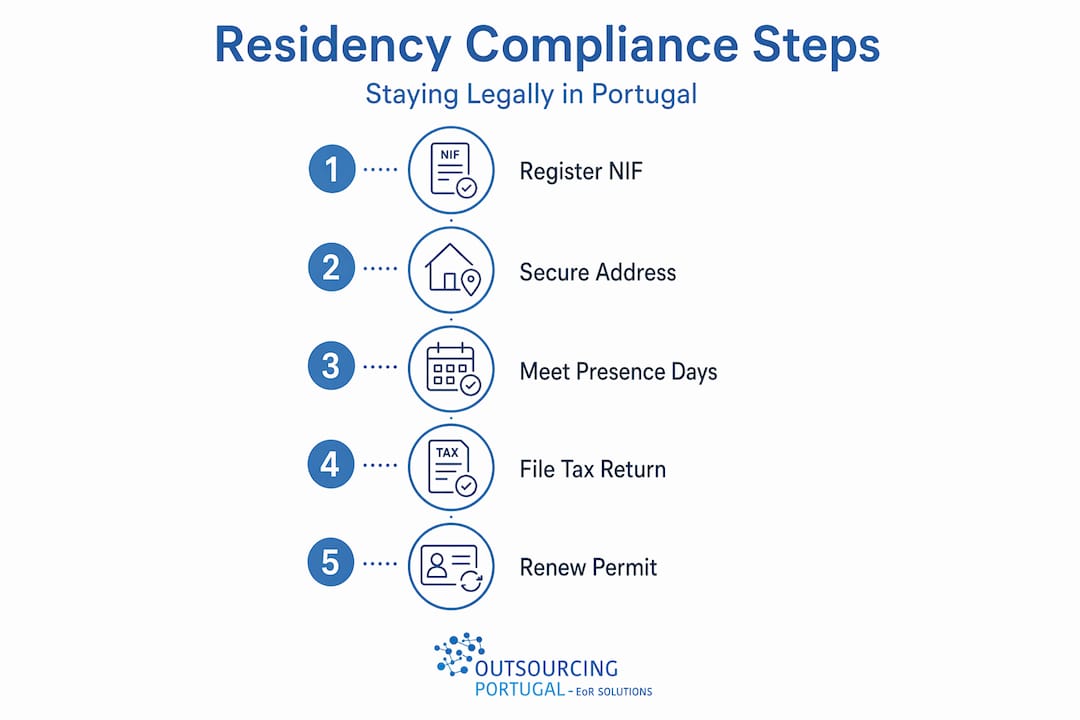
On physical presence, the rule is clear: temporary residents must stay at least 18 months cumulatively within every two-year period to maintain their residence permit. Traveling frequently for work is fine, but you need to track your time carefully.
Tax residency triggers automatically when you spend over 183 days in Portugal within a calendar year or establish Portugal as your habitual residence. Once you’re a tax resident, Portugal taxes your worldwide income. Annual tax filings are generally due between April 1 and June 30 for the prior year’s income.
The tax regime landscape has shifted significantly. Key changes every professional should know:
- The Non-Habitual Resident (NHR) regime closed to new applicants in 2024. Most retirees now face Portugal’s standard progressive income tax rates.
- The IFICI regime (Incentivo Fiscal à Investigação Científica e Inovação) replaced NHR’s core appeal for professionals. It targets highly qualified workers in scientific research, technology, and innovation roles.
- US citizens benefit from a US-Portugal tax treaty that provides mechanisms to avoid double taxation, but you still need to file in both countries. Consult a cross-border tax specialist.
Settling legally in Portugal requires treating residency as a shifting policy framework, not a fixed checklist. Proactive compliance and continuous policy monitoring are what separate professionals who succeed long-term from those who get caught off guard by regulatory changes.
Portugal’s immigration enforcement trends are also tightening. The shift from SEF to AIMA signaled a move toward a more structured, policy-driven framework. The tolerance for informal or delayed compliance is shrinking. Review your permit status and documentation at least annually, well before any renewal deadline.
Local resources and expat support networks
The good news is that you’re not figuring this out alone. Portugal has a well-established ecosystem of support specifically for newcomers, and knowing where to look saves you real time and money.
Government and legal resources:
- AIMA operates walk-in and appointment-based services across major cities. Lisbon and Porto have the highest capacity but also the longest wait times.
- The Câmara Municipal (City Hall) in most cities offers newcomer welcome services, including help with registration and basic legal questions.
- Portugal’s CNAI (National Immigrant Support Centers) provides free legal guidance and interpreter services for residents navigating bureaucratic processes.
Housing: This is where most professionals hit friction. No MLS system exists in Portugal, and many realtors operate without formal credentials, making it genuinely difficult to find reliable rental listings. Platforms like Idealista and Uniplaces serve as starting points, but specialized relocation agencies provide access to off-market properties and vet landlords on your behalf.
Expat communities and integration:
- Online groups on Facebook and Internations for specific cities (Lisbon, Porto, Algarve) are active and surprisingly useful for real-time housing leads and service recommendations.
- Language schools offering Portuguese courses are widely available. Even basic conversational Portuguese accelerates your integration and earns real goodwill from locals.
| Resource Type | Options Available | Best For |
|---|---|---|
| Legal aid | CNAI, private immigration lawyers | Permit applications, compliance |
| Housing search | Idealista, relocation agencies | Rentals, property purchase |
| Tax compliance | Cross-border accountants, IFICI consultants | Tax filings, regime selection |
| Community support | Internations, Facebook expat groups | Networking, local tips |
| Healthcare access | SNS (public health), private insurers | Routine and emergency care |
Pro Tip: Registering with your country’s embassy in Lisbon isn’t just a formality. It gives you access to emergency consular services and keeps you informed about policy changes that could affect your residency status.
My honest take on settling in Portugal
I’ve seen professionals arrive in Portugal with a beautifully organized folder of documents and still run into serious delays because they planned their timelines around best-case scenarios. The gap between “I submitted my application” and “I have my residence card” can genuinely stretch to 12 or 18 months at AIMA. In my experience, the professionals who settle smoothly are the ones who factored that reality into their plans from day one, not the ones who were surprised by it.
The housing market frustrates almost everyone. What I’ve found is that the expats who fare best treat it like a negotiation with an opaque system rather than a transparent marketplace. They hire local help. They move quickly when something good appears. They don’t hold out for perfect.
On taxes, I’d push back on the instinct to wait and see how the IFICI regime plays out for your specific profile. Portugal’s tax framework has changed twice in three years. If you’re a qualified tech professional or researcher, get a specialist to model your situation against the new rules now, not after you’ve filed your first return incorrectly.
The bigger point is this: Portugal rewards people who treat residency as an ongoing responsibility, not a box that gets checked at arrival. The legal environment is manageable, but only if you stay current with it.
— Paulo
How Outsourcing-portugal simplifies your settlement

For international professionals relocating with employer backing, or for companies bringing talent into Portugal, the compliance burden is real. Payroll, legal employment registration, permit support, and tax compliance all need to work together from the moment someone touches down.
Outsourcing-portugal provides Employer of Record and payroll services that handle the legal employment framework so your team can focus on work, not paperwork. From NIF acquisition support to contract compliance under Portuguese labor law, the platform covers the full settlement lifecycle. Explore the full employment and hiring services to see how compliant, fast workforce deployment works in practice, whether you’re relocating one senior hire or building an entire nearshore team.
FAQ
What is the income requirement for the D8 Digital Nomad Visa?
The D8 visa requires proof of income at four times Portugal’s national minimum wage. In 2026, that means approximately €3,680 per month in verifiable remote income.
How long does it take to get a residence permit in Portugal?
After submitting your application through AIMA, processing times currently exceed a year in many cases due to administrative backlogs inherited from the SEF-to-AIMA transition in late 2023.
What is the NIF and why does every expat need one?
The NIF is Portugal’s tax identification number and is required for signing rental contracts, opening bank accounts, setting up utilities, and completing most legal transactions. It’s one of the first steps you take after arriving.
Did the NHR tax regime end for new applicants?
Yes. The NHR regime closed to new applicants in 2024. Professionals arriving now should evaluate the IFICI regime, which targets qualified workers in research, technology, and innovation sectors with specific tax incentives.
How many days per year must you spend in Portugal to keep your residency?
Temporary residents must accumulate at least 18 months of physical presence within every two-year period to meet Portugal’s minimum presence requirements for permit renewal.