
TL;DR:
- Contract management outsourcing involves delegating contract lifecycle tasks to external providers who combine expertise, processes, and technology for greater consistency. It offers benefits such as increased capacity, standardized workflows, and cost flexibility, especially for high-volume, multinational companies. Successful outsourcing depends on prior process governance, system integration, and clear performance metrics, with hybrid solutions often providing optimal results.
Most business leaders assume contract management outsourcing is simply a way to hand off paperwork to cheaper labor. It is not. What is contract management outsourcing, really? It is the strategic delegation of contract lifecycle tasks to an external provider that combines specialized people, documented processes, and purpose-built technology to manage contracts more consistently than most internal teams can. For multinationals managing hundreds or thousands of contracts across jurisdictions, this distinction matters enormously. This guide covers the definition, real benefits, honest tradeoffs, and a practical framework for making outsourcing work.
Table of Contents
- Key Takeaways
- What is contract management outsourcing
- Key benefits of outsourcing contract management
- Challenges and tradeoffs to take seriously
- How to choose and implement outsourcing effectively
- Outsourcing versus automation versus in-house models
- My honest take on what makes outsourcing actually work
- Ready to build a smarter outsourcing operation in Portugal?
- FAQ
Key Takeaways
| Point | Details |
|---|---|
| More than labor arbitrage | Contract management outsourcing delivers standardized workflows and governance, not just cheaper headcount. |
| Full lifecycle scope | Providers handle drafting, negotiation, execution, obligation tracking, and renewals, not just one contract stage. |
| Integration is the real risk | Workflow misalignment between providers and internal systems causes more failures than contract complexity does. |
| Governance before handoff | Predefined templates, approval routing, and escalation rules must exist before any outsourcing engagement begins. |
| Automation is a real alternative | Software-driven in-house models can replicate many outsourcing benefits while preserving control and cost predictability. |
What is contract management outsourcing
Contract management outsourcing means delegating contract lifecycle tasks to an external provider who takes operational responsibility for some or all of those functions. The provider does not just execute instructions. It brings a structured delivery model that typically combines specialist legal and commercial expertise, standardized processes, and contract management technology.
The scope of what gets outsourced varies widely. At the narrow end, a company might outsource only contract review and redlining. At the full end, providers handle the entire contract lifecycle, from initial drafting through negotiation, execution, storage, obligation tracking, amendments, and renewals. Understanding this spectrum matters because the operational implications of narrow versus full-scope outsourcing are completely different.
Typical services covered under contract management outsourcing include:
- Contract drafting and template management — creating first drafts using approved templates and clause libraries
- Review and redlining — identifying risk, suggesting edits, and negotiating terms with counterparties
- Execution support — coordinating approvals and managing signature workflows
- Repository and storage management — organizing executed contracts in searchable, accessible systems
- Obligation tracking — monitoring key dates, deliverables, and compliance requirements post-signature
- Renewal and amendment management — flagging expiring contracts and managing changes through their lifecycle
What separates contract management outsourcing from simply hiring a contractor is the managed service model. Providers like those operating KPMG’s legal managed services model combine people, process, and technology to deliver consistency and speed in high-volume contracting environments. You are not buying hours. You are buying a delivery system.
Key benefits of outsourcing contract management
The practical case for outsourcing contract management is strongest when internal teams are stretched, inconsistent, or operating without clear service levels. Here is where the benefits are most concrete.
Freed internal capacity. Legal and commercial teams in multinational companies spend disproportionate time on routine contract tasks that require competence but not senior judgment. Outsourcing accelerates contract review and execution when internal processes lack the staffing or automation to keep pace. Your senior lawyers get back to work that genuinely requires their expertise.
Access to specialist workflows. External providers bring pre-built playbooks, clause libraries, and escalation frameworks that most in-house teams build slowly over years. Those standardized tools reduce inconsistency in how contracts get drafted and reviewed across different business units or geographies.

Cost model flexibility. Outsourcing converts fixed headcount costs into variable service costs. For companies with uneven contract volumes across the year, this flexibility can reduce total cost compared to maintaining a fully staffed in-house function year-round. See how proven outsourcing strategies translate this flexibility into measurable savings in practice.
Compliance and quality gains through standardization. When a provider enforces standard templates, review checklists, and approval workflows, the quality floor rises. Ad-hoc contract practices that slip through in busy periods get caught by systematic provider controls.
Pro Tip: Before signing with any provider, ask specifically which contract types they have handled in your industry and jurisdiction. A provider with deep experience in SaaS vendor agreements is not automatically equipped for construction subcontracts or regulated financial services contracts.
The benefits of contract outsourcing are real, but they depend entirely on the quality of the engagement setup. Benefits do not arrive automatically. They get built.
Challenges and tradeoffs to take seriously
The risks of contract management outsourcing are not theoretical. They are operational, and most of them stem from underestimating what it takes to integrate an external provider into your contracting workflows.
-
Loss of institutional context. External providers do not know your business the way your team does. They do not automatically understand which counterparties require special handling, which internal stakeholders are slow to approve, or which contract clauses are non-negotiable for operational reasons rather than legal ones. That knowledge transfer takes time and ongoing investment.
-
Integration gaps between systems. Providers’ workflows often fail to integrate smoothly with clients’ existing systems. If your contracts live in a CRM, an ERP, and a legacy document management system, getting a provider to work across those environments without creating parallel data silos is genuinely hard. Slow turnaround times often trace back to this problem, not to provider incompetence.
-
SLA ambiguity. Vague service level agreements create permanent friction. Without clearly defined turnaround standards, quality metrics, and escalation procedures, you lose visibility into whether outsourcing is actually performing better than in-house management did.
-
Long-term cost unpredictability. Variable pricing models work well at average volumes. But if contract activity spikes significantly, costs can exceed what staffed internal teams would have cost. This requires careful modeling before commitment.
-
Governance gaps at scale. Multinational outsourcing depends heavily on governance and standardized playbooks. Without jurisdiction-specific rule sets and clear escalation paths, providers default to generic approaches that create compliance risk.
The companies that struggle most with contract outsourcing are not the ones who chose the wrong provider. They are the ones who outsourced a broken internal process and expected the provider to fix it. External providers optimize what you give them. They do not redesign your contracting strategy.
Addressing legal compliance risks before handing off contract responsibilities to any provider is not optional. It is the work that determines whether outsourcing succeeds.
How to choose and implement outsourcing effectively
Getting contract management outsourcing right requires preparation that most companies skip. The work happens before you sign the provider agreement, not after.
Assess your current contract operations honestly
Start by mapping your actual contract portfolio: volume by type, average cycle time, error rates, and bottleneck locations. Operational constraints like weak SLAs, inconsistent approvals, and poor reporting are prime targets for outsourcing. If you cannot describe your current process clearly, you cannot scope a provider engagement accurately.
Define governance before the handoff
This is the step most often skipped and most often regretted. Before any provider touches a contract, you need documented templates and approved clause libraries, defined approval routing by contract type and value, clear escalation triggers for non-standard terms, and named internal contacts for each contract category.
Providers work best when they execute a governance structure you have already designed. They are not governance consultants by default.
Align data and systems deliberately
Data migration and system alignment are critical preparatory steps before outsourcing or CLM platform integration. Cleanse your contract repository before transition. Identify which systems the provider needs to access, in what format, and with what permissions. The contract management software solutions you use internally need to speak the same language as the provider’s tools, or you build a data gap from day one.
Set performance metrics with teeth
Define what good looks like in measurable terms: turnaround time by contract type, error rates per review cycle, SLA adherence percentage. Build quarterly review cadences into the contract. Outsourcing without measurement reverts to faith-based management.
Pro Tip: Structure your provider contract with a 90-day ramp period where performance is measured but not penalized. Providers who resist this clause are telling you something important about their confidence in their own onboarding process.
| Evaluation criterion | What to assess |
|---|---|
| Contract portfolio fit | Does the provider have documented experience with your contract types? |
| Technology compatibility | Can their platform integrate with your CRM, ERP, or CLM tools? |
| Governance experience | Do they have ready-made playbooks for multinational or regulated environments? |
| Pricing model clarity | Is pricing predictable across volume ranges, or does it spike at higher volumes? |
| Escalation protocols | How are non-standard situations flagged and resolved, and at what speed? |
Outsourcing versus automation versus in-house models
Understanding what is contract outsourcing is incomplete without comparing it to the alternatives. Business leaders increasingly face a three-way choice.
Contract automation software solutions offer many of the same benefits as outsourcing while keeping contracts entirely in-house, improving alignment with existing workflows, and giving you greater control and cost predictability. Platforms that automate drafting, routing, e-signature, and obligation tracking can handle significant volume without adding headcount or external dependencies.
The tradeoff is implementation cost and change management. Automation requires internal adoption, configuration investment, and ongoing administration. For companies with strong IT resources and stable contract processes, this is often worth it.
Here is how the three models compare across key dimensions:
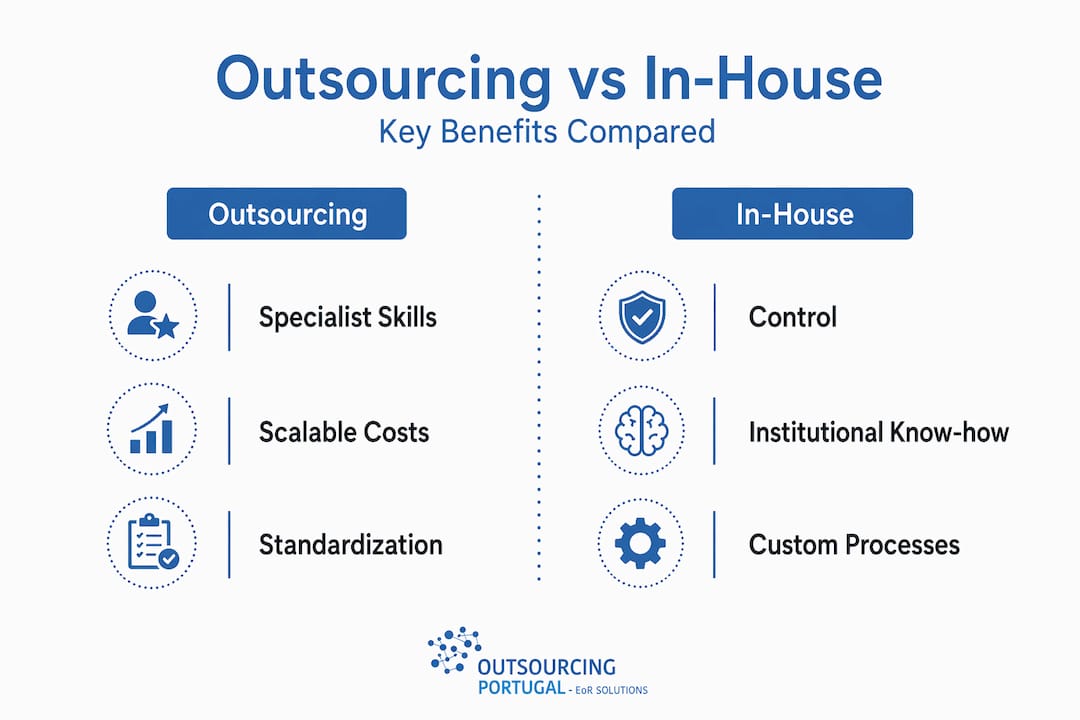
| Dimension | Outsourcing | Automation software | In-house management |
|---|---|---|---|
| Control | Lower | High | Highest |
| Cost model | Variable | Fixed + implementation | Fixed headcount |
| Scalability | High | High | Limited |
| Compliance support | Provider-dependent | Tool-dependent | Team-dependent |
| Integration complexity | High | Medium | Low |
| Time to value | Medium | Slower | Immediate |
Situations where outsourcing clearly wins:
- High contract volume with unpredictable peaks that would strain internal teams
- Rapid geographic expansion requiring immediate contracting capacity
- Post-merger integration where two contract processes need temporary unified management
- Organizations that lack the internal maturity to implement and maintain CLM software
In-house automation tends to win when you have stable processes, strong internal legal operations, and a long-term commitment to building institutional contracting capability. Hybrid models, where internal teams use automation tools and external providers handle overflow or specialized contract types, are increasingly common and often the most practical answer for large multinationals.
My honest take on what makes outsourcing actually work
I have watched enough outsourcing engagements go sideways to form a strong opinion: the companies that benefit most from contract management outsourcing are not the ones with the best providers. They are the ones with the clearest internal processes before they outsource.
What I have seen consistently is that outsourcing rewards preparation. Companies that invest in governance and outsourcing alignment before engaging a provider get dramatically better results than those who treat outsourcing as a way to escape a process they never got under control.
The other thing I believe strongly: post-signature obligation management is where outsourcing adds the most underappreciated value. Most conversations about outsourcing focus on drafting and review. But the post-signature lifecycle is where missed obligations, lapsed renewals, and unmonitored compliance requirements quietly create liability. A good provider tracking those obligations systematically is worth more than a faster first draft.
My advice to any business leader evaluating this: treat your provider selection as a process design exercise, not a vendor sourcing exercise. The question is not “who can do this work?” It is “how do we build a contracting system that produces consistent outcomes at scale?” The answer might be outsourcing, automation, or a hybrid. What it will never be is a quick fix.
— Paulo
Ready to build a smarter outsourcing operation in Portugal?
If this article has clarified what contract management outsourcing involves, the natural next question is where to build that capacity. Portugal has emerged as one of Europe’s most practical nearshore outsourcing destinations for multinationals. Outsourcing-portugal provides employment outsourcing services covering hiring, payroll, HR support, and full legal compliance through Employer of Record structures. That means you can build contract operations, legal support, or administrative teams in Portugal without setting up a local entity.

The combination of a highly educated, multilingual workforce, EU regulatory stability, and competitive labor costs makes Portugal a strong choice for companies scaling contract management and operational functions. Whether you need EOR and payroll support or a complete nearshore team structure, Outsourcing-portugal has the local expertise to make it work. Talk to our team to discuss what a Portugal-based outsourcing model looks like for your business.
FAQ
What is contract management outsourcing?
Contract management outsourcing means hiring an external provider to handle contract lifecycle tasks such as drafting, review, negotiation, execution, and ongoing obligation tracking. Providers typically combine specialist people, standardized processes, and contract management technology to deliver these services at scale.
What are the main benefits of outsourcing contract management?
The primary benefits include reduced internal bottlenecks, access to specialist expertise and pre-built playbooks, flexible cost structures, and improved compliance through standardized workflows. The gains are strongest when internal contract processes already have documented governance that a provider can execute against.
What are the biggest risks in contract management outsourcing?
The most common risks are integration gaps between provider and internal systems, loss of institutional knowledge, vague SLAs, and long-term cost unpredictability at higher contract volumes. Most failures trace back to outsourcing a poorly defined internal process rather than provider quality.
How does contract management outsourcing compare to automation software?
Automation software keeps contracts in-house with greater control and cost predictability, but requires implementation investment and internal change management. Outsourcing provides immediate capacity and specialist expertise but introduces integration complexity. Many multinationals use hybrid models combining both.
When should a multinational consider contract lifecycle management outsourcing?
Strong indicators include high and variable contract volumes, rapid geographic expansion, post-merger integration needs, or insufficient internal maturity to implement and maintain CLM software. Companies with stable, well-documented processes often benefit more from automation than from full outsourcing.