
TL;DR:
- Entity setup creates a legal business identity, determining liability, taxes, and compliance needs.
- Getting each step right from choosing a structure to regulatory filings saves costs and prevents legal issues.
Entity setup is the formal process of creating a legally recognized business entity that defines its legal status, tax responsibilities, and compliance obligations. For business professionals and entrepreneurs entering new markets, understanding what is entity setup means understanding how your company will be taxed, who bears liability, and what regulators expect from day one. The entity setup process covers everything from choosing a business structure to filing formation documents with state authorities and obtaining an Employer Identification Number (EIN) from the IRS. Get it right, and you build a foundation that protects assets and supports growth. Get it wrong, and you face delays, fines, or personal liability exposure.
What is the entity setup process and its key steps?
Entity setup is a sequential legal process, not a single filing. Each step builds on the last, and skipping one creates compliance gaps that are expensive to fix later.
1. Choose your business structure
The structure you select determines your tax treatment, liability exposure, and governance requirements. Business structure determines tax obligations and personal liability. Sole proprietorships offer no separation between personal and business assets, while LLCs and corporations create a distinct legal identity that shields owners from business debts.

2. Clear your entity name
Name clearance goes beyond a quick state database search. Name clearance requires checking jurisdiction-specific regulations to avoid long-term operational risks. Trademark conflicts with existing registered marks can invalidate your chosen entity name, so a federal trademark search through the USPTO is non-negotiable.
3. File formation documents
Filing formation documents with the Secretary of State or equivalent authority is the legal act that brings your entity into existence. For corporations, this means Articles of Incorporation. For LLCs, it means Articles of Organization. Both require accurate information about the entity’s purpose, structure, and registered agent.
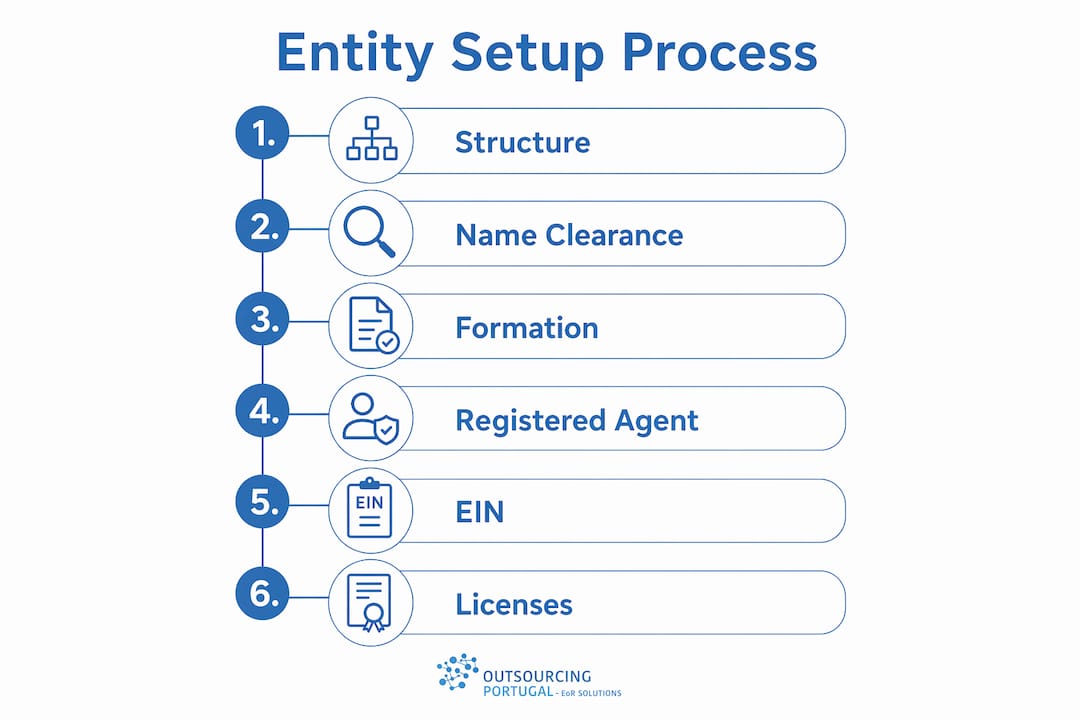
4. Appoint a registered agent
A registered agent is a person or company with a physical address in the formation state who receives legal notices on your behalf. Failing to maintain a registered agent with a physical address can result in losing good standing or missing critical legal notices. This is not optional. No registered agent means no valid filing.
5. Obtain an EIN from the IRS
An EIN acts as a social security number for the business and is applied for directly through the IRS. You need it to open a business bank account, handle payroll, and file federal taxes. The application is free and can be completed online in minutes.
6. Secure licenses and permits
Registration may require additional local licenses and permits beyond state incorporation. These vary by industry and location. A restaurant needs health permits. A financial services firm needs regulatory licenses. Identify every requirement before you begin operations.
Pro Tip: File for your EIN immediately after your formation documents are approved. Banks will not open a business account without it, and payroll cannot start until the account exists.
How do different business structures affect liability, taxation, and compliance?
Choosing a structure is the most consequential decision in the entity formation process. Each structure carries a distinct legal personality, tax treatment, and compliance burden.
| Structure | Legal Separation | Tax Treatment | Compliance Burden |
|---|---|---|---|
| Sole Proprietorship | None | Personal income tax | Minimal |
| Partnership | Partial | Pass-through to partners | Moderate |
| LLC | Full | Pass-through (default) or corporate election | Moderate |
| C Corporation | Full | Corporate tax + dividend tax | High |
| S Corporation | Full | Pass-through (with restrictions) | High |
The LLC is the most popular structure for small and mid-size businesses because it combines full legal separation with pass-through taxation. That means profits flow directly to owners’ personal returns, avoiding the double taxation that C corporations face. Entities can be taxed as C corps, S corps, or nonprofits depending on state statutes and elections made at formation.
Corporations carry the heaviest compliance load. Corporations as separate legal entities protect owners from personal liability and require defined governance through bylaws or resolutions. Bylaws govern officer responsibilities, board decisions, and shareholder rights. Skipping this governance step creates disputes later.
Three factors drive the structure decision for most business professionals:
- Liability exposure. If your business carries significant risk, full legal separation through an LLC or corporation is the only responsible choice.
- Tax efficiency. Pass-through structures avoid double taxation but limit flexibility in how profits are distributed.
- Funding plans. Venture capital investors require C corporation structures. If you plan to raise institutional capital, form a C corp from the start.
What are the common legal and compliance pitfalls in entity setup?
Most entity setup failures are not caused by complex legal problems. They come from predictable, avoidable mistakes made during or immediately after formation.
Common pitfalls include missing signatures, incomplete filings, and failure to submit affidavits or publish notices in certain jurisdictions. New York, for example, requires LLCs to publish formation notices in two local newspapers for six consecutive weeks. Missing this step can result in the LLC losing its authority to operate in the state.
The four pitfalls that cause the most damage:
- Commingling finances. Mixing personal and business finances can invalidate the liability protection created by entity formation. Courts call this “piercing the corporate veil.” Once pierced, owners become personally liable for business debts, eliminating the main benefit of forming an entity.
- Inadequate name clearance. Trademark conflicts with existing registered marks can invalidate entity names. A state database search only confirms availability at the state level. Federal trademark registration is a separate system, and conflicts there can force a costly rebrand.
- Neglecting the registered agent. A lapsed or missing registered agent means legal notices go undelivered. Lawsuits can proceed without your knowledge, and the entity can lose good standing with the state.
- Ignoring post-formation filings. Beneficial ownership reporting under the Corporate Transparency Act now requires most U.S. entities to file ownership information with FinCEN. Missing this filing carries civil and criminal penalties.
Pro Tip: Open a dedicated business bank account the same week your EIN arrives. This single action creates the paper trail that proves financial separation and protects your liability shield.
The role of legal requirements in business operations extends well beyond the formation date. Annual reports, franchise tax filings, and license renewals are ongoing obligations that keep the entity in good standing.
How does entity setup vary when expanding into international markets?
Cross-border entity formation is where complexity multiplies. Every jurisdiction has its own registration procedures, compliance mandates, and timelines. What works in Delaware does not translate to Singapore, Portugal, or Germany.
Entity setup varies internationally. Different jurisdictions impose unique registration, compliance, and licensing requirements, and local registered office presence is almost always mandatory. In Singapore, for example, a company must appoint a locally resident director. In Portugal, a Sociedade por Quotas (the equivalent of an LLC) requires a minimum share capital and registration with the Conservatória do Registo Comercial.
Key considerations for international entity formation:
- Local registered office. Most jurisdictions require a physical address in the country, not just a mailing address. This is separate from your registered agent requirement.
- Tax registration. VAT registration, corporate tax registration, and social security enrollment are typically separate filings from the entity registration itself.
- Local legal counsel. Formation documents drafted for one jurisdiction are rarely valid in another. Local counsel is not optional. It is the difference between a compliant entity and a filing that gets rejected.
- Timeline expectations. U.S. LLC formation can take 24 hours in some states. International formations routinely take 4–12 weeks, depending on the jurisdiction and document requirements.
For companies that need to hire talent in a new market quickly, Employer of Record (EOR) services provide a direct alternative. An EOR lets you hire employees in a foreign country without forming a local entity. The EOR acts as the legal employer, handling payroll, tax withholding, and labor law compliance on your behalf. This is particularly valuable when testing a new market before committing to the full cost and time of entity formation.
The workforce compliance workflow for international hires is significantly more complex than domestic hiring. Understanding that complexity before you commit to a structure saves months of remediation work.
Key Takeaways
Entity setup is a multi-step legal process that determines liability protection, tax treatment, and compliance obligations, and getting each step right from the start is far less expensive than fixing mistakes after the fact.
| Point | Details |
|---|---|
| Structure drives everything | Choose your business structure before filing anything. It determines tax treatment, liability, and governance. |
| Name clearance is two-step | Check both state databases and the USPTO trademark registry before committing to an entity name. |
| Registered agent is non-negotiable | A lapsed or missing registered agent can cost you good standing and leave lawsuits uncontested. |
| Commingling finances kills protection | Keep personal and business finances completely separate to preserve the liability shield your entity creates. |
| International formation needs local counsel | Cross-border entity setup involves jurisdiction-specific rules that generic formation services cannot handle reliably. |
What I’ve learned after watching too many entity setups go sideways
Most business professionals treat entity setup as a box to check. File the documents, get the EIN, open the bank account, done. That mindset is exactly why so many entities end up with compliance problems within their first two years.
The part that rarely gets discussed is the governance layer. Formation documents create the entity, but bylaws, operating agreements, and shareholder resolutions define how it actually functions. I have seen LLCs with no operating agreement fall apart the moment a co-founder dispute arose, because there was no documented framework for resolving it. The courts then apply default state rules, which almost never match what the founders actually intended.
The second thing professionals consistently underestimate is the ongoing compliance calendar. Entity formation is a starting line, not a finish line. Annual reports, franchise taxes, license renewals, and now beneficial ownership filings under the Corporate Transparency Act create a recurring compliance burden that requires active management. Missing one filing can cascade into penalties, loss of good standing, and in some states, administrative dissolution.
My honest recommendation: spend as much time on your post-formation compliance calendar as you do on the formation itself. Build a filing tracker on day one. Assign ownership for each recurring obligation. If you are expanding internationally, get local legal counsel before you file anything. The cost of a local attorney is a fraction of the cost of a rejected filing or a compliance breach.
Entity formation is more than paperwork. It establishes governance and long-term legal rights that require precise professional oversight to maintain. Treat it that way from the start.
— Paulo
How Outsourcing-portugal supports your entity setup and market entry
Expanding into Portugal or building a nearshore team in the EU involves exactly the kind of jurisdiction-specific complexity described throughout this article. Outsourcing-portugal provides full-service support for international companies navigating that process, from entity formation guidance and registered agent provision to payroll management and ongoing compliance monitoring.

For companies that want to hire Portuguese talent before committing to a full entity, Outsourcing-portugal’s EOR and employment services let you onboard workers compliantly from day one. Portugal offers a highly educated, multilingual workforce, competitive labor costs, and EU-standard legal protections. Whether you are forming a local entity or testing the market through an EOR structure, Outsourcing-portugal has the local expertise to keep you compliant at every stage.
FAQ
What is entity setup in simple terms?
Entity setup is the legal process of creating a business structure, such as an LLC or corporation, that gives your company a distinct legal identity separate from its owners. It involves filing formation documents, appointing a registered agent, and obtaining an EIN from the IRS.
How long does the entity setup process take?
Domestic U.S. entity formation can take as little as 24 hours in states like Delaware or Wyoming. International formations typically take 4–12 weeks depending on the jurisdiction and document requirements.
What is the difference between an LLC and a corporation in entity setup?
Both provide full legal separation between owners and the business, but they differ in tax treatment and governance. LLCs default to pass-through taxation and have flexible management structures. Corporations face corporate-level taxation but are required for companies seeking venture capital investment.
Can I set up an entity in a foreign country without being physically present?
Most jurisdictions allow remote formation through a local registered agent or legal representative, but requirements vary. Some countries require at least one locally resident director or officer, making local counsel essential.
What is an Employer of Record and how does it relate to entity setup?
An Employer of Record is a third-party company that acts as the legal employer for your workers in a foreign jurisdiction, handling payroll, taxes, and labor law compliance. It is the primary alternative to full entity setup for companies that need to hire internationally without the time or cost of forming a local legal entity.