

TL;DR:
- Portugal offers cost savings, regulatory stability, and high-quality multilingual talent for outsourcing.
- Rising macroeconomic pressures make Portugal a more attractive nearshore alternative to Asian destinations.
- Success in Portugal relies on strategic planning, local expertise, and integrating teams into global operations.
Multinational corporations (MNCs) are quietly rewriting their outsourcing playbooks, and Asia is no longer the automatic first call. A combination of rising tariffs, geopolitical uncertainty, and the growing demand for specialized talent has forced global HR leaders to look harder at alternatives. Portugal has emerged as one of the most compelling answers to that search. This guide breaks down the real motivations behind MNC outsourcing decisions, shows you how Portugal stacks up against traditional destinations on hard data, and gives you a tactical roadmap for making it work.
Table of Contents
- Why multinational corporations choose to outsource: evolving motivations
- Portugal vs. traditional outsourcing destinations: what the data shows
- Key success factors: what makes Portugal attractive for MNC outsourcing
- Strategic tips for MNCs: how to optimize your outsourcing approach in Portugal
- Perspective: why the standard outsourcing playbook is outdated in 2026
- Take your outsourcing strategy further with expert support
- Frequently asked questions
Key Takeaways
| Point | Details |
|---|---|
| Strategic outsourcing drivers | Modern multinational corporations outsource for talent, resilience, and innovation, not just cost. |
| Portugal’s competitive data | Portugal offers lower total costs than Asia when accounting for all expenses and risks. |
| High-value workforce | Skilled multilingual teams and EU stability make Portugal a prime outsourcing hub. |
| Best practices matter | Effective governance and local hiring partners are key to outsourcing success in Portugal. |
Why multinational corporations choose to outsource: evolving motivations
To set the stage, let’s clarify why outsourcing remains a centerpiece for MNCs and why these reasons are changing fast.
The classic case for outsourcing has always been straightforward: reduce labor costs, scale operations quickly, and extend your global footprint without building expensive infrastructure from scratch. Those drivers haven’t disappeared. But they’ve been joined by a more sophisticated set of motivations that are reshaping where and how MNCs outsource.
Classic outsourcing drivers still in play:
- Labor cost arbitrage, typically 30 to 50% savings versus home-market hiring
- Rapid scalability without long-term fixed headcount commitments
- Access to global markets and local customer knowledge
- 24/7 operational coverage across time zones
Modern motivations that are now equally important:
- Access to specialized talent pools in data science, AI, and multilingual services
- Resilience against geopolitical disruption and supply chain shocks
- EU regulatory compliance and GDPR alignment for data-sensitive operations
- Sustainability credentials and lower carbon footprint for ESG reporting
- Reduced total cost of ownership (TCO), which accounts for hidden costs beyond wages
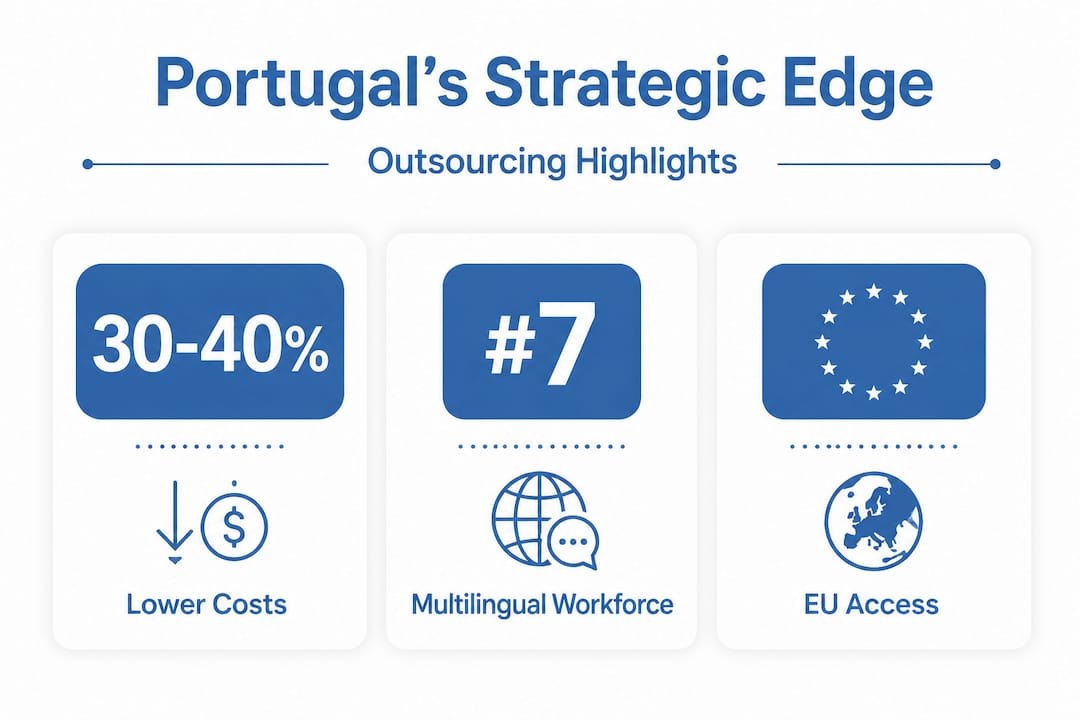
Portugal addresses nearly every item on both lists. The country entered Deloitte’s top 10 GBS locations for global business services, driven by its skilled multilingual workforce, 30 to 40% cost savings versus Western Europe, and EU stability. That’s not a coincidence. It’s the result of deliberate investment in education, infrastructure, and business-friendly policy.
“Portugal’s rise in global business services rankings reflects a structural shift: MNCs now prioritize resilience, talent quality, and regulatory alignment alongside cost savings.” — Business Services Report 2025
The shift from pure cost focus to outcome-based thinking is also visible in how companies structure outsourcing contracts. Traditional outsourcing models measured success by input metrics like cost per hour or headcount. Modern MNCs measure outcomes: speed to market, error rates, customer satisfaction scores, and innovation contribution. Portugal’s workforce, educated to European standards and deeply integrated into the global tech ecosystem, performs well on these newer metrics.
Managing payroll outsourcing in Portugal is one area where this shift is especially visible. Companies that once viewed payroll as a pure cost center now see it as a compliance and risk management function, one where Portugal’s EU legal framework provides real protection.
Pro Tip: Don’t underestimate the value of time zone alignment for project turnaround. Portugal sits in Western European Time, meaning your teams in Lisbon work overlapping hours with colleagues in London, Frankfurt, New York, and São Paulo. That reduces the 24-hour feedback loops that slow down projects in Asia-based outsourcing arrangements.
Portugal vs. traditional outsourcing destinations: what the data shows
Once you know the “why,” the next logical question is “where?” Let’s see how Portugal competes on the hard numbers.
The instinct to default to Asia for outsourcing made sense in the 1990s and 2000s when wage differentials were enormous. In 2026, that calculus has shifted significantly. When you factor in the full TCO, including shipping, import tariffs, carbon taxes, quality return rates, and management overhead, the gap between Portugal and Asia has narrowed dramatically. In some sectors, it has reversed entirely.
Consider this direct comparison for a representative set of outsourcing and manufacturing scenarios:
| Factor | Portugal | Asia | Western Europe |
|---|---|---|---|
| Average labor cost (services) | Competitive, 30-40% below W. Europe | Low base, rising rapidly | High |
| TCO per unit (textiles, 2026) | €13.75 | €14.77 | €18+ |
| Time zone overlap (CET/GMT) | Excellent | Poor to moderate | Excellent |
| EU regulatory compliance | Full | Requires adaptation | Full |
| Carbon tax exposure | Low | High (import levies) | Low |
| Quality return/defect rates | Low | Moderate to high | Low |
| Geopolitical risk | Low | Moderate to high | Low |
| English proficiency | High | Variable | High |
The TCO advantage of Portugal over Asia is now documented at the unit level. For textiles, for example, Portugal comes in at €13.75 per unit versus €14.77 for Asia once you include shipping, tariffs, carbon tax, and quality returns. That’s a real reversal of the traditional cost narrative.

The Securiton case study makes this concrete. The Swiss security technology company built a dedicated team in Porto and achieved savings of 2.5 to 3 times compared to equivalent Swiss operating costs. That’s not a marginal efficiency gain. That’s a structural cost transformation that funds reinvestment in product development and sales.
Macro forces are accelerating this shift. Rising US and EU tariffs on Asian imports, tightening carbon border adjustment mechanisms, and increasing geopolitical friction between Western economies and key Asian manufacturing hubs have all added hidden costs to Asia-based outsourcing. Portugal, as an EU member state, is insulated from most of these pressures. For cost-effective nearshoring in Portugal, these macro tailwinds are turning a good option into an obvious one for many MNCs.
Key success factors: what makes Portugal attractive for MNC outsourcing
Beyond the numbers, let’s unpack what’s really driving successful outsourcing in Portugal for both large and growing global companies.
Numbers tell part of the story. But the MNCs that have built their most successful outsourcing operations in Portugal will tell you the real differentiators are less quantifiable. Cultural compatibility, communication quality, and the depth of the local talent ecosystem matter enormously when you’re building teams that need to integrate with global operations.
Key factors driving MNC success in Portugal:
- Multilingual workforce: Portuguese professionals typically speak three or more languages, with English proficiency ranking among the highest in the EU. This makes Portugal a natural fit for sourcing multilingual talent for European and global operations.
- EU regulatory stability: GDPR compliance, labor law predictability, and a transparent legal system reduce the governance burden for MNCs operating across multiple jurisdictions.
- Tech and innovation ecosystem: Lisbon and Porto have become genuine tech hubs, with growing startup ecosystems, world-class universities, and strong pipelines of engineering and data science graduates.
- Cultural affinity: Portuguese professionals are known for their adaptability, collaborative working style, and comfort with international business norms. This reduces the friction that often plagues offshore teams.
- Infrastructure quality: Reliable broadband, modern office parks, and excellent international connectivity support seamless remote and hybrid operations.
The scale of MNC commitment to Portugal speaks for itself. Amgen operates with 400+ employees across 40 nationalities in data, analytics, finance, and R&D functions. Airbus runs an 800-person global business services center. Ferring Pharmaceuticals has 300 employees handling IT, finance, and HR. Volkswagen Digital Solutions employs 700 professionals. These are not pilot programs. They are strategic, long-term commitments from some of the world’s most demanding corporate operators.
| Company | Headcount | Functions |
|---|---|---|
| Amgen | 400+ (40 nationalities) | Data, analytics, finance, R&D |
| Airbus | 800 | Global business services |
| Ferring Pharmaceuticals | 300 | IT, finance, HR |
| VW Digital Solutions | 700 | Digital and tech services |
| Securiton | Dedicated team | Engineering, technical support |
Portugal’s advantages extend into specialized areas like call center and multilingual customer support, where the combination of language skills, cultural warmth, and competitive costs creates a genuinely differentiated proposition for MNCs serving European and global customer bases.
That said, challenges exist and responsible planning requires acknowledging them. Talent retention is a real issue, particularly for highly specialized technical roles where competition from other MNCs and local startups is fierce. Some niche skill sets remain in short supply. MNCs that invest in training, career development, and competitive compensation packages consistently outperform those that treat Portugal as a pure cost play. For teams working in Portugal for the first time, understanding local labor market dynamics is essential to building a sustainable operation.
Pro Tip: Multinational teams consistently report that cultural affinity with Portuguese colleagues reduces miscommunication and speeds up onboarding. Investing in cross-cultural orientation for your global managers pays back quickly in reduced friction and faster team integration.
Strategic tips for MNCs: how to optimize your outsourcing approach in Portugal
With the why and the where covered, it’s time to get tactical. Here’s how successful MNCs make the most of Portuguese outsourcing.
Entering or expanding in Portugal requires more than signing a contract with a local provider. The MNCs that get the most from their Portuguese operations follow a disciplined approach from day one.
-
Partner with local hiring and compliance experts early. Portugal’s labor law is detailed and employee-protective. Getting your employment contracts, benefits structure, and termination procedures right from the start prevents costly disputes. A local Employer of Record (EOR) or HR outsourcing partner can handle this while you focus on building your team.
-
Define clear KPIs before you hire. Outcome-based metrics like project delivery speed, customer satisfaction scores, and error rates should be established before your first hire, not after. This creates accountability and makes performance conversations constructive rather than reactive.
-
Invest in language and cultural training. Even though Portuguese professionals are highly multilingual, investing in company-specific communication standards and cultural onboarding improves collaboration with your global teams significantly.
-
Set up governance and escalation paths. Define who owns decisions locally versus globally, how issues get escalated, and what reporting cadence keeps leadership informed. Clear governance prevents the ambiguity that undermines many outsourcing relationships.
-
Leverage government incentives. Portugal offers a range of tax incentives and grants for companies that create skilled employment, particularly in technology and R&D. Work with a local advisor to identify which programs apply to your hiring plans.
-
Build for retention from day one. Offer competitive salaries benchmarked to the local market, clear career progression, and meaningful work. Portugal’s skilled multilingual workforce has options, and the best talent will move if they don’t see a future with your organization.
-
Integrate your Portuguese team into global workflows. Treat your Portugal-based team as a core part of your global operation, not a remote outpost. Include them in company communications, leadership meetings, and innovation initiatives.
For MNCs looking to expand revenue generation capabilities, sales outsourcing in Portugal offers a particularly strong return. Portugal’s multilingual sales professionals can cover multiple European markets from a single location, reducing the cost and complexity of building separate sales teams in each country.
Pro Tip: Tap into Portugal’s government incentives for technical hiring and R&D investment. Programs like SIFIDE (the R&D tax credit system) and various regional development grants can meaningfully reduce the cost of building specialized teams, particularly in technology and life sciences.
Perspective: why the standard outsourcing playbook is outdated in 2026
Let’s zoom out to the bigger strategic lesson revealed by Portugal’s rise as an outsourcing hub.
Most outsourcing decisions are still made with a spreadsheet that has one column: cost. Labor cost per hour, cost per seat, cost per transaction. That framing made sense when outsourcing was a simple arbitrage play. It’s now a liability.
The MNCs winning in global markets are treating outsourcing as a strategic capability, not a cost line. They’re asking different questions. Not “how cheap can we get this done?” but “how do we build a team that can respond to market shifts in 48 hours?” Not “what’s the lowest hourly rate?” but “what’s the total cost of a quality failure?”
Portugal’s rise as a nearshoring destination illustrates this shift perfectly. Companies that chose Portugal for cost reasons alone have been pleasantly surprised by the innovation contribution, the communication quality, and the strategic value their Portuguese teams deliver. Companies that chose Portugal for strategic reasons have built some of their most effective global operations there.
The traditional cost-focused outsourcing model is being replaced by an outcome-based approach where resilience, talent quality, and integration capability are weighted alongside price. Portugal wins on all of these dimensions in a way that pure cost-play destinations simply cannot match.
The uncomfortable truth for many HR leaders is that their outsourcing KPIs are measuring the wrong things. If you’re tracking cost per hire and cost per transaction but not measuring innovation contribution, team stability, and compliance risk reduction, you’re flying blind. Portugal’s model forces a more honest accounting, and that’s a good thing for the long-term health of your global operations.
Take your outsourcing strategy further with expert support
If you’re ready to put these insights into practice, here’s how you can get expert help every step of the way.
Building a high-performing outsourcing operation in Portugal requires local expertise, legal precision, and a partner who understands both the Portuguese market and the demands of multinational operations. Whether you’re hiring your first employee or scaling a team of hundreds, getting the foundations right matters enormously.
Our Employer of Record services in Portugal let you hire Portuguese talent immediately, with full legal compliance, without setting up a local entity. We handle employment contracts, payroll, tax filings, and HR administration so your team can focus on building the business. For companies evaluating the broader landscape, our global employment solutions provide a clear framework for structuring your Portugal operations efficiently. And if you’re ready to build a nearshore team, our nearshore Portugal solutions connect you with the talent, infrastructure, and compliance support you need to move fast and stay compliant.
Frequently asked questions
What kinds of roles do multinational corporations typically outsource to Portugal?
MNCs most commonly outsource IT, data analytics, finance, HR, R&D, and multilingual customer service functions to Portugal, as demonstrated by operations from Amgen, Airbus, and Ferring among others. These roles benefit directly from Portugal’s combination of technical education, language skills, and EU regulatory alignment.
How does Portugal compare to Asia for overall outsourcing costs in 2026?
Portugal’s total cost of ownership is now lower than Asia in many sectors, with documented unit costs of €13.75 in Portugal versus €14.77 in Asia once you include shipping, tariffs, carbon taxes, and quality returns. The gap continues to widen as Asian labor costs rise and Western tariffs increase.
Is the Portuguese workforce multilingual and globally competitive?
Yes. Portugal’s highly skilled multilingual workforce consistently attracts leading MNCs to establish global business services centers, with professionals typically fluent in three or more languages and trained to European university standards.
What challenges do MNCs face when outsourcing to Portugal?
The primary challenges include talent retention in competitive technical fields and limited scale for some highly specialized roles. Portugal faces talent retention and skill gap pressures similar to other high-performing global locations, which means MNCs need to invest actively in career development and competitive compensation to keep their best people.
Does outsourcing to Portugal provide sustainability or ESG advantages?
Absolutely. Portugal’s proximity to Western European markets reduces logistics emissions, its EU membership ensures compliance with the world’s most rigorous environmental regulations, and the country’s commitment to renewable energy makes it one of Europe’s greener operating environments for multinational businesses.