

Budget roughly between one and two times a base gross salary once mandatory Portuguese employer costs are added in. The main drivers are the Segurança Social employer contribution, the 13th and 14th-month subsidies, the FCT and FGCT compensation funds, work-accident insurance, and a meal allowance. Most companies underestimate this multiplier because they price only the headline social security rate. Run those numbers through a calculator or an Employer of Record before you quote a candidate a start date.
TL;DR:
- Employers should budget around 1.7 times the gross salary to cover all costs, including Segurança Social, subsidies, insurance, and funds, not just the headline social security rate.
- FCT and FGCT funds add roughly 1.075 percent of salary for eligible contracts, which many companies overlook in their initial budgets.
- Visa and immigration costs for non-EU employees typically require budgeting around €1,900 minimum salary thresholds and several hundred euros in government fees, with timelines taking weeks or months.
- Using an Employer of Record can streamline compliance, contract setup, and payroll registration, especially for first hires, by consolidating legal, tax, and insurance requirements under one provider.
Table of Contents
- What Does Custo De Vida Portugal Empresas Actually Include?
- What Legal and Labor Steps Must Employers Complete?
- What Visa Costs Apply When Hiring Non-EU Employees?
- How Much Does a €36,000 Salary Really Cost an Employer?
- How Should You Budget and When Does an EOR Make Sense?
- What International Employers Consistently Get Wrong
- Get an Accurate Employer Cost Estimate Before You Hire
- Where These Figures Come From
- Sources
- FAQ
What Does Custo De Vida Portugal Empresas Actually Include?
“Custo de vida Portugal empresas” gets searched a lot, but it’s a slightly loose phrase. What international employers actually need is the employer cost of employment (sometimes called the “loaded cost” or “total cost of employment”) in Portugal, not the personal cost of living for an individual worker. That distinction matters because the two numbers move independently. A Lisbon software engineer’s personal cost of living affects the salary you need to offer to be competitive; it has nothing to do with what you, as the employer, owe on top of that salary in taxes, funds, and benefits.
This section breaks down every mandatory line item that sits between the gross salary you agree to and the actual invoice your finance team pays each month.
Segurança Social (employer social security) is the biggest line. The standard employer rate is 23.75% of gross salary, and critically, it applies to the employee’s full gross remuneration, including the 13th and 14th-month subsidies. A common budgeting mistake is modeling this on 12 months of pay instead of 14, which quietly understates your annual provision by roughly a sixth.
FCT and FGCT compensation funds add a smaller but real cost. These two funds, designed to cover severance-related liabilities, combine to roughly 1.075% of remuneration for eligible contracts. It is a separate line from Segurança Social and easy to miss in a first-pass budget.
Work-accident insurance is mandatory from day one of employment. Rates vary by activity, and office-based roles typically sit at the lower end of a 0.5% to 2% band, while higher-risk industries pay more. Confirm your specific band with an insurer before you finalize any hiring budget, because a generic estimate here is one of the more common places companies get caught out.
13th and 14th-month subsidies (subsidio de Natal and subsidio de ferias) are statutory, not discretionary. They function as an extra month of salary each, typically paid around Christmas and before the summer vacation period, and both are subject to the employer Segurança Social rate above.
Meal allowance is near-universal in Portuguese employment practice, even though it is not always technically mandatory by law. Employers typically pay it as a meal card rather than cash, since card-based allowances carry a higher tax-exempt ceiling than cash payments. Anything paid above the exempt threshold becomes taxable income for the employee and adds to your payroll cost base.
What Legal and Labor Steps Must Employers Complete?
Hiring in Portugal is not just a signature on a contract. Compliance runs across employment law, payroll, Social Security, insurance, and sometimes immigration. Treating a signed contract as the finish line is one of the most common compliance mistakes foreign employers make](https://www.lvpadvogados.com/hiring-in-portugal-labour-and-immigration-compliance-is-more-than-a-contract).
- Draft a contract with the required legal terms and communicate the new hire to Social Security before or on the employee’s start date.
- Confirm work-accident insurance is active before the first day worked, since gaps here carry real liability exposure.
- Check applicable Collective Bargaining Agreements (CBAs). CBAs frequently set minimum salaries or working conditions above the statutory floor, and skipping this check is how companies end up underpaying legally without realizing it.
- Set up IRS payroll withholding and establish recordkeeping practices that satisfy Portuguese tax authority requirements.
Pro Tip: Before you post a salary range externally, check whether a CBA applies to that role’s sector. It can quietly raise your minimum offer by hundreds of euros a month and change your whole budget.
Getting this sequence wrong rarely shows up immediately. It surfaces months later as a Social Security audit query or a back-pay claim, which costs far more to fix than to prevent. A payroll outsourcing partner can absorb most of this administrative risk directly.
What Visa Costs Apply When Hiring Non-EU Employees?
Non-EU hires add a layer of immigration cost and timeline risk that EU hires don’t carry. The distinction that matters most for budgeting is between a temporary stay authorization, valid up to 12 months, and a full residence permit, which carries longer-term obligations and renewal cycles.
- Salary thresholds: immigration guidance commonly references minimum declared salaries for certain permit categories, with figures around €1,900 cited for highly skilled roles.
- Government fees: analysis and issuance fees for residence permits are commonly in the low hundreds of euros, though exact amounts depend on the permit type and category.
- Timelines: processing can stretch over weeks to months, so immigration steps need to start well ahead of a planned start date, not alongside it.
- Payroll alignment: the salary figure used for immigration purposes must match what actually appears on payroll. A mismatch between declared remuneration and payroll practice is a documented risk area that can jeopardize a permit renewal.
Immigration and payroll registration need to move in parallel, not sequentially. If your visa paperwork quotes one salary and your payroll system runs another, you’ve created a compliance gap before the employee has even started.
How Much Does a €36,000 Salary Really Cost an Employer?
Here’s the math behind the multiplier, using a €36,000 gross annual base salary as the model.
Add the base salary, subsidies, Segurança Social, FCT/FGCT, and insurance together and you land close to €52,500 to €52,800 before accounting for meal allowance, which puts the loaded multiplier right around 1.7 times the base salary. That figure lines up with what payroll providers report as typical when subsidios, funds, insurance, and meal cards are all counted.
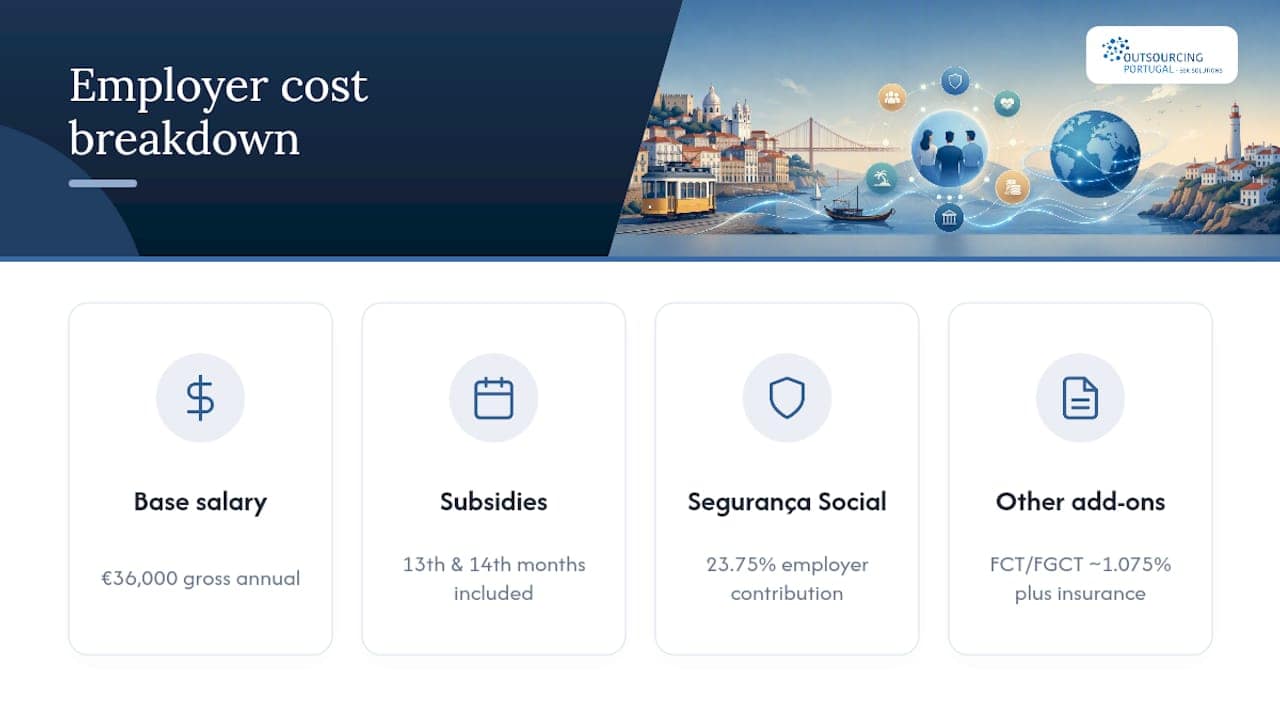
The most common modeling mistake is stopping at Segurança Social and ignoring FCT/FGCT and insurance entirely, which can understate the true employer cost by several percentage points. The Employment Cost Calculator Portugal 2026 lets you run your own salary and industry inputs against this same structure.
How Should You Budget and When Does an EOR Make Sense?
A workable budget checklist covers five lines: Segurança Social on 14 months, FCT/FGCT, your confirmed work-accident insurance band, meal allowance policy, and any CBA-driven salary floor for the role’s sector.
Watch for vendor quotes that skip detail on any of these. Quotes that omit 13th/14th-month treatment, leave the insurance band unspecified, or gloss over FCT/FGCT are a frequent source of under-budgeting, and they tend to surface as surprise invoices three or four months into the employment relationship, not on day one.
- Ask any payroll or EOR vendor for a full line-item breakdown, not a single blended percentage.
- Confirm which CBA, if any, applies to the role before signing off on a salary offer.
- Get the work-accident insurance band in writing before the hire starts.
Pro Tip: If a vendor’s quote is a single “all-in” number with no breakdown, ask them to itemize it. A quote that can’t be broken into Segurança Social, FCT/FGCT, insurance, and subsidios is a quote you can’t audit.
An Employer of Record earns its cost when speed and compliance risk outweigh the appeal of running payroll in-house, particularly for a first hire in Portugal or a small team where building internal payroll expertise isn’t worth the overhead. Compare that route against building offshore payroll infrastructure directly before committing either way.
What International Employers Consistently Get Wrong
The single biggest mistake we see from clients arriving in Portugal for the first time isn’t a math error. It’s sequencing. Companies quote a candidate a number, get a verbal yes, and only then start checking whether a CBA applies to that role or whether the insurance band they assumed actually matches the job’s risk classification. By the time the gap surfaces, the offer has already been made.
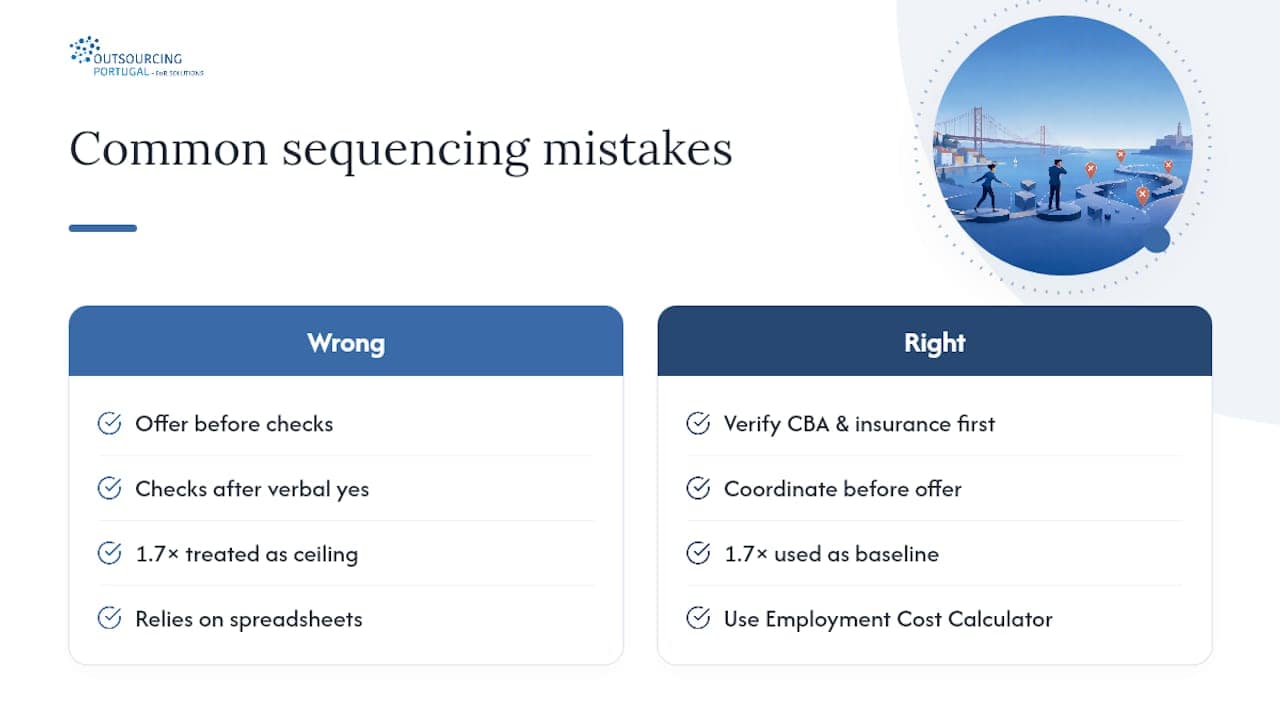
The other pattern worth naming: companies that treat the 1.7 times multiplier as a ceiling rather than a baseline. It’s a reasonable planning number for a standard office role, but industries with higher work-accident insurance bands, or roles covered by a CBA with richer benefits, push past it. Our own clients use the Employment Cost Calculator specifically because a static multiplier from a blog post can’t account for their sector or their specific hire.
What actually reduces risk isn’t more spreadsheets. It’s moving payroll registration, insurance activation, and CBA verification into a single coordinated process before an offer goes out, which is precisely where outsourced payroll and EOR support earn their fee.
— Paulo
Get an Accurate Employer Cost Estimate Before You Hire
This budgeting exercise can be simplified into a single number without the guesswork of stitching together Segurança Social rates, insurance bands, and CBA checks on your own. A full Employer of Record and payroll partner in Portugal can handle contract drafting, Social Security registration, work-accident insurance, IRS withholding, and visa coordination for non-EU hires under one service.

If you’re modeling a specific salary or role right now, run it through the Employment Cost Calculator Portugal 2026 to get a figure tailored to your industry and insurance band, rather than a generic multiplier. From there, request a tailored quote through our Employer of Record Portugal service and we’ll walk you through exactly how the numbers apply to your hire, before you make an offer, not after.
Where These Figures Come From
The Segurança Social rate and its treatment of subsidios come from PwC Portugal’s payroll guide. FCT/FGCT figures, insurance bands, and the loaded multiplier are sourced from WhichPayroll’s Portugal guide. Compliance sequencing comes from LVPA Advogados, and immigration salary thresholds and fees from ICLG’s corporate immigration guide.
This article is general information, not a substitute for advice from a qualified financial advisor. Consult a qualified financial professional about your own circumstances before acting on anything here.
Sources
- PwC Portugal — Tax/Payroll guide 2026 (social security)
- WhichPayroll — Portugal payroll & EOR guide 2026
- LVPA Advogados — Hiring in Portugal: Labour & immigration compliance guide
- ICLG — Corporate immigration laws and regulations (Portugal) 2026
FAQ
What Is the Typical Employer Cost Multiplier in Portugal?
Most companies should budget roughly around 1.7 times base gross salary, with 1.7 times cited as a common working figure once Segurança Social, subsidios, FCT/FGCT, insurance, and meal allowance are all included.
Does Segurança Social Apply to the 13th and 14th-Month Subsidies?
Yes. The 23.75% employer rate applies to gross remuneration including both subsidies, which is why modeling on 14 months rather than 12 avoids under-budgeting.
How Much Do FCT and FGCT Add to Employer Costs?
FCT and FGCT combined typically add roughly 1.075% of remuneration for eligible contracts, on top of the Segurança Social contribution.
What Salary Threshold Applies for Non-EU Work Visas?
Immigration guidance commonly references figures around €1,900 for certain highly skilled categories, though the applicable threshold depends on the specific permit route.
Should a Company Use an EOR or Set Up a Local Entity?
An Employer of Record is usually the faster, lower-risk route for a first hire or small team, since it avoids entity setup while keeping payroll, Social Security registration, and compliance handled under one contract with a partner like Outsourcing-portugal.